
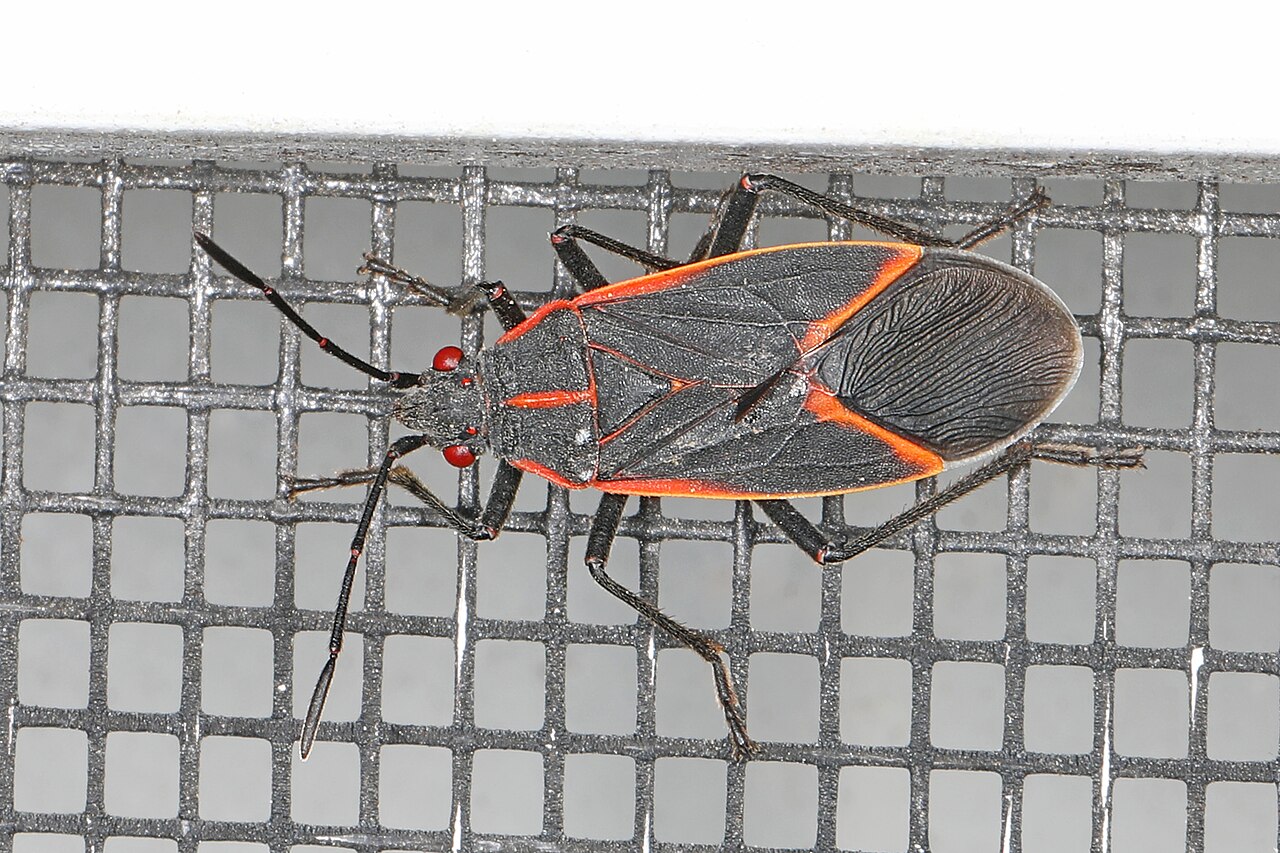
Boxelder Bug (Boisea trivittata) is a North American true bug best known for feeding on boxelder seeds and sheltering inside buildings during cold weather. This guide separates well-supported biology from common assumptions and covers identification, range, habitat, diet, behavior, reproduction and conservation.
Identification
Adults are elongate, mostly black true bugs with three narrow orange-red lines on the pronotum, red edging along the wings and abdomen, and overlapping forewings that form an X. Newly hatched nymphs are tiny and bright red; older nymphs develop black wing pads. Males and females share the same pattern; females are generally broader through the abdomen, but close comparison or examination is needed for reliable sexing.
Identification should combine body shape, markings, size, voice or movement, and location. One feature by itself can overlap with a related animal, a juvenile, or an individual in unusual light.
Photographs are most useful when they preserve scale and show several diagnostic features. Handling or repositioning a wild boxelder bug for identification can cause stress and is unnecessary.
Size and physical adaptations
Boxelder Bug typically measures adults about 11–14 mm long and weighs Not reliably established for wild individuals. Nymphs begin near 1.5 mm and grow through five molts before reaching the adult size range.
Its useful adaptations include piercing-sucking mouthparts extract fluids from seeds and plant tissues, dark wings absorb warmth on sunlit surfaces, adults survive winter in dry protected crevices, aggregation behavior helps individuals locate favorable overwintering sites. These traits work together in the animal’s normal setting rather than serving as isolated curiosities.
Published measurements may use different methods, life stages or sample locations. Comparing figures responsibly means checking what was measured rather than selecting the largest number available.
Range and distribution
It occupies much of North America from southern Canada through most of the United States into eastern Mexico, although the similar western boxelder bug is more typical near the Pacific coast. The native range includes Canada, United States, Mexico.
A country-level map indicates broad distribution, not continuous occupation. Climate, elevation, water, vegetation, prey, breeding sites, barriers and survey effort all affect where records occur.
Records near the edge of the range deserve careful documentation because they may reflect natural movement, improved survey coverage, accidental transport or a genuine distribution change.
Habitat
Woodlands, yards, parks and urban areas where boxelder or other maples produce seeds, plus nearby sunny rocks, tree trunks and buildings used for warming and winter shelter.
Nymphs feed close to seed-bearing trees through summer; adults fly to warm south- and west-facing surfaces in autumn and enter dry cracks for winter. Protecting a population therefore requires the feeding, shelter and breeding features that make a site usable, along with connections that allow movement.
Microhabitat matters. Shade, soil, current, moisture, shelter or host plants can determine whether a small area is usable even when the surrounding landscape appears suitable.
Diet and feeding
Boxelder Bug is a seed-feeding herbivore. Important foods include boxelder seeds, other maple seeds, young leaves and twigs, fallen seeds, occasional fruits. Nymphs and adults insert their beaks into seeds and soft plant tissue to drink fluids. Female boxelder trees are especially important because they produce the abundant samaras on which large populations develop.
Diet changes with age, season, location and food supply. A dramatic prey record does not establish what most individuals eat most of the time; repeated field observations provide a stronger picture.
Feeding opportunities also create risk. An animal focused on prey may be less alert to predators, traffic or people, while contaminated prey can transfer pollutants through the food web.
Behavior and communication
Active mainly in warm daylight; adults become dormant in cold overwintering sites. The bugs feed and develop around host trees, gather in conspicuous sun-basking clusters in spring and autumn, and enter wall voids or similar crevices for winter without nesting or feeding there.
Chemical aggregation cues, host odors, touch and visual contrast help the bugs gather and locate food or shelter. Behavior should be interpreted in context: alarm, courtship, feeding and temperature regulation can produce very different actions from the same animal.
Daily schedules are flexible responses, not rigid rules. Weather, breeding condition, disturbance, tides or food can move activity into a different part of the day.
Reproduction and development
After overwintered adults emerge and feed in spring, they mate and females place reddish eggs in bark crevices, on leaves and near host seeds. Eggs are laid in small clusters; a female can produce many eggs across the season. Wingless red nymphs pass through five instars, darkening as black wing pads develop, before molting into winged adults.
Young animals face different risks and may use different microhabitats or food than adults. Breeding success depends on adult condition, suitable sites and the survival of offspring through vulnerable early stages.
Counts of eggs or young describe reproductive output, not the number expected to reach adulthood. Mortality is normally greatest during eggs, larval or juvenile stages.
Predators and ecological role
A native seed consumer associated especially with boxelder maple. It feeds birds, spiders and predatory insects, while large aggregations create a nuisance for people without normally damaging structures. Documented or likely predators include Spiders, Assassin Bugs, Birds, Praying Mantises.
This animal is both a consumer and a food source. Its influence comes through many repeated interactions, so ecological claims should be based on measured populations rather than assumptions drawn from appearance.
Predator and prey relationships differ among places. A species can be ecologically influential without being abundant everywhere, and its role can change across its range.
Relationship with people
Boxelder bugs are nuisance invaders rather than structural pests. They do not eat wood, fabric or stored food and do not establish breeding colonies indoors, but crushed insects can stain pale surfaces and release an odor.
Vacuum indoor bugs and empty the container outside, seal gaps around windows and siding, repair screens and avoid crushing them on fabrics. Use pesticides only according to local extension guidance and the label. Responsible observation means keeping an appropriate distance, avoiding capture or feeding, protecting habitat and following local wildlife or invasive-species guidance.
Wildlife guidance should come from the responsible local agency because collection rules, reporting requests and appropriate responses differ between native and introduced ranges.
Conservation
Boisea trivittata has no published global IUCN assessment. It is widespread, common and not regarded by extension authorities as a conservation concern or major commercial pest. The reported global trend is Unknown globally.
Important pressures include broad-spectrum insecticide exposure, removal of host trees at local sites, extreme winter conditions, loss of sheltering habitat. Global status can hide local decline or recovery, so current regional monitoring and habitat management remain necessary.
The most useful conservation action follows the documented pressure. Protecting breeding sites, reducing road deaths or limiting pollutants can require different tools in different populations.
