
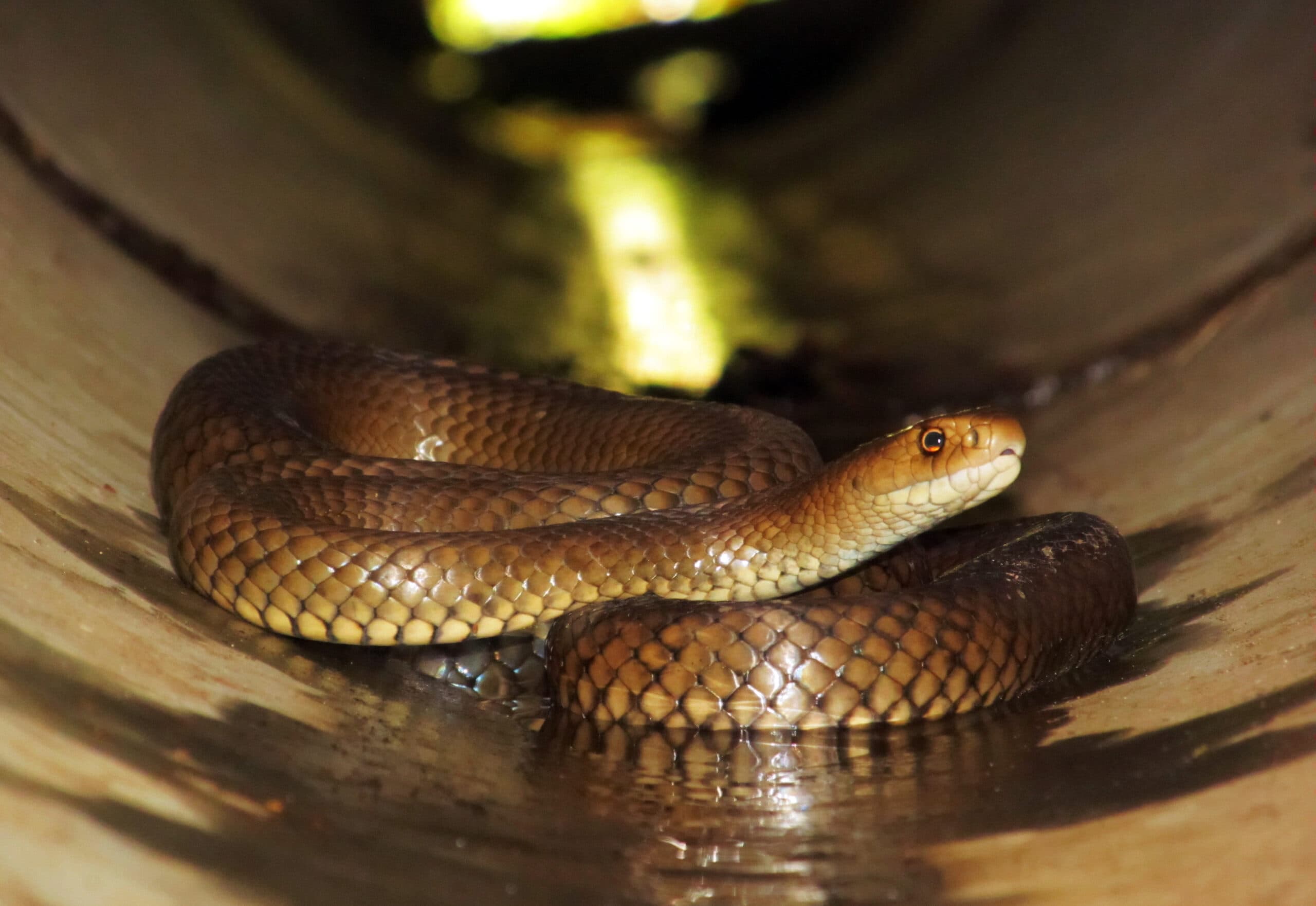
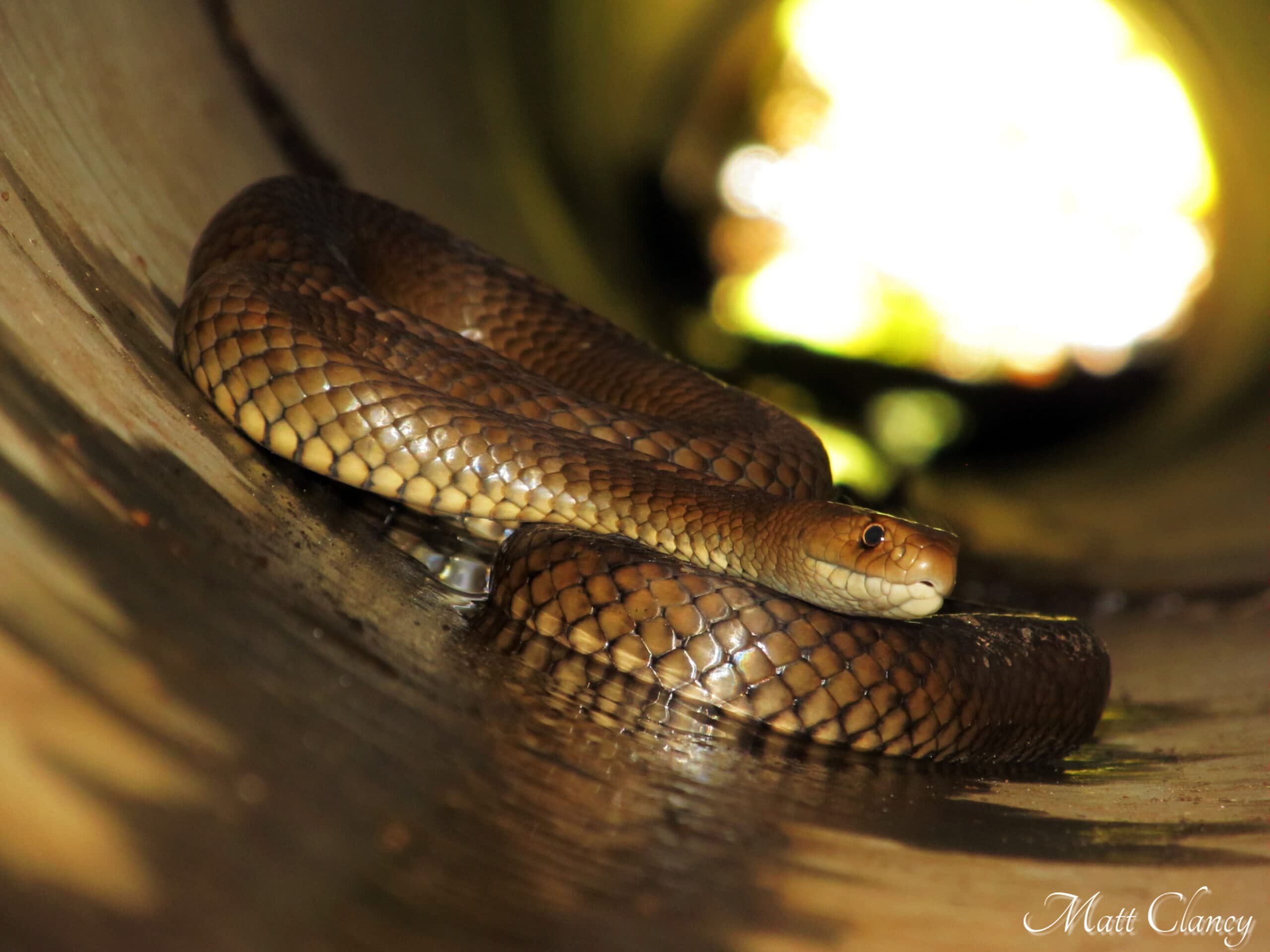
The Eastern Brown Snake (Pseudonaja textilis) is a living elapid native to Australia and southern New Guinea. It is a slender, fast-moving, mainly daytime hunter whose color can range from pale tan through reddish brown to very dark brown or nearly black. The species thrives in grassland, open woodland, farmland and some urban-edge habitats, especially where rodents are abundant. Its medically important venom demands caution, but the snake normally tries to escape when given space. Accurate identification, distance and prompt emergency care after any suspected bite are more useful than fear or attempts to capture the animal.
Identity and taxonomy
The Eastern Brown Snake is one species in the Australian brown-snake genus Pseudonaja, family Elapidae. “Brown snake” is an imprecise common name because Australia has several Pseudonaja species and unrelated brown-colored snakes. This profile concerns Pseudonaja textilis specifically. The Australian Faunal Directory accepts that name, and the Atlas of Living Australia lists “Common Brown Snake” as another English name. Closely related western, northern and speckled brown snakes can overlap in appearance, so color alone is not a dependable field character.
Adults are relatively slender with a small head that is not strongly distinct from the neck. The Australian Museum reports an average total length near 1.5 metres and a reliably measured maximum just over 2 metres. Smooth, slightly glossy scales and a medium-sized eye with a round pupil are typical. The belly is cream, yellow or orange with darker blotches. Juveniles may have a black head, a dark neck band or numerous body bands that fade as they grow. Adults vary so widely that safe identification should be left to experienced observers.
Range and habitat
The species is widespread through eastern mainland Australia, from Queensland through New South Wales and Victoria into South Australia, with isolated records farther inland and in the Northern Territory. Genetic and taxonomic work also recognizes populations in southern and eastern New Guinea. Country-level mapping therefore includes Australia and Papua New Guinea, but the snake is not evenly distributed across either country. Local climate, vegetation, prey, shelter and land use determine where it persists.
Eastern Brown Snakes occupy open forest, woodland, savanna, grassland, pasture, cropland and disturbed ground. They often do well in agricultural landscapes because grain and livestock feed support mice and rats, while sheds, rubble, cracks and burrows provide shelter. This ability to use modified habitat brings the species into contact with people. It does not mean the snake seeks humans; it is usually following prey, warmth or cover. Retaining natural refuge and controlling rodents without poison can reduce risky encounters around buildings.
Diet and hunting
Small mammals are major prey, particularly rodents, but Eastern Brown Snakes also eat lizards, frogs, birds and sometimes other snakes. Young snakes take proportionally smaller prey and may rely more heavily on reptiles before shifting toward mammals. The snake searches actively and can also pause near likely retreat sites. Chemical information collected by the forked tongue helps it follow prey trails, while vision detects movement.
Prey may be bitten and held, or released briefly and tracked after envenomation. The snake’s venom evolved for prey capture and defense; its danger to people is an unintended consequence of a close encounter. By consuming rodents, Eastern Brown Snakes perform a useful ecological service in farms and grasslands. They in turn become prey for large birds, predatory mammals and other snakes, especially while young.
Daily activity and behavior
Eastern Brown Snakes are chiefly active by day. They bask and forage when temperatures permit, retreating into burrows, logs, deep cracks and other insulated shelters during excessive heat or cold. The Australian Museum reports seasonal peaks in encounters during spring, with activity possible even on mild winter days. Males often emerge earlier in spring as they search widely for females.
A snake that detects a person usually seeks cover. If cornered or repeatedly approached, it may lift the front of the body, form an S-shaped curve, flatten the neck and open the mouth before striking. That display is a defensive warning, not evidence that the animal is hunting a person. People should stop, back away slowly and give the snake an escape route. Pets and children should be moved indoors, and a trained local snake catcher should be called when an animal must be removed from a building or busy yard.
Reproduction and development
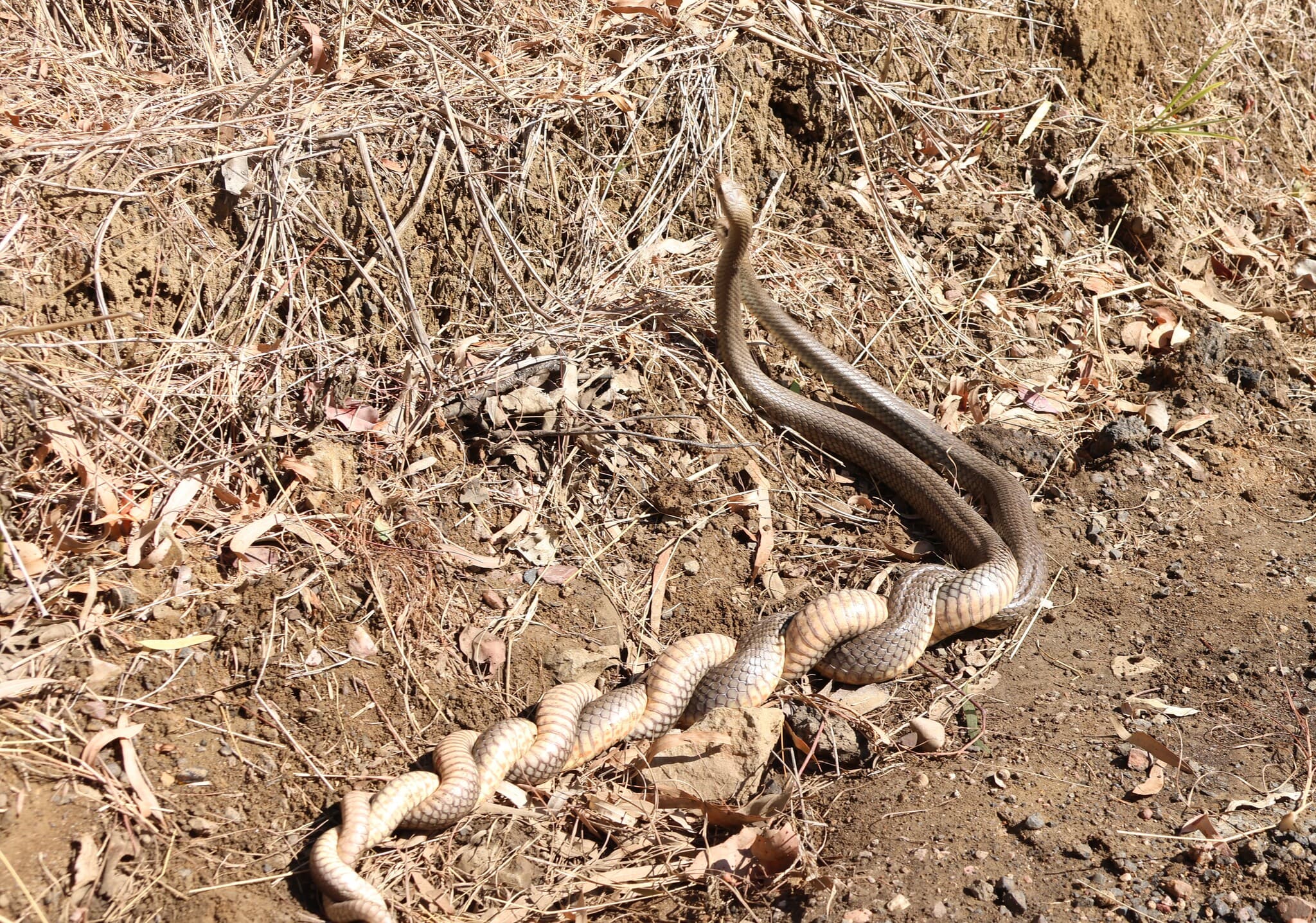
Eastern Brown Snakes lay eggs. Mating occurs mainly in spring, and males may wrestle by raising and twisting their bodies around one another. Females select warm, protected nest sites such as soil cavities, abandoned burrows or sheltered spaces under cover. Communal nesting has been documented, including many eggs in a single abandoned rabbit warren. A female may produce more than one clutch in favorable conditions, though reproductive output varies with body size, food and climate.
Incubation rate depends strongly on temperature. The Australian Museum reports hatching in about 36 days at 30°C but as long as 95 days at 25°C. Hatchlings use an egg tooth to slit the shell and may remain partly inside for hours. They are independent from emergence and already capable of the species’ defensive display. Juvenile head and body bands vary within a clutch and do not reliably predict adult color.
Venom and bite safety
This is a highly venomous snake. Its venom can disrupt blood clotting and cause collapse and other severe systemic effects, while the bite marks themselves may be small. A person should never wait for symptoms or try to identify the snake at close range. Australian health guidance treats every suspected snake bite as a medical emergency: call emergency services, keep the person still, apply pressure immobilization when trained to do so, and avoid washing the bite site because venom residue may assist identification. Do not cut the wound, suck venom, apply an arterial tourniquet or attempt to catch the snake.
Risk is best reduced through behavior. Wear closed footwear outdoors, use a light at night, lift materials with tools while standing clear, keep grass and stored goods tidy near buildings and reduce rodent food. Never place hands into holes or under debris that cannot be seen. These measures protect both people and snakes without encouraging unsafe handling.
Conservation and coexistence
The Eastern Brown Snake is widespread and is assessed globally as Least Concern. Its tolerance of farms and urban margins gives it access to abundant rodent prey, but individuals still die through deliberate killing, road traffic, machinery, domestic animals and entanglement. Local losses can occur even when the species remains secure across its full range. Native snakes are protected under Australian state and territory wildlife laws, with exact rules varying by jurisdiction.
Coexistence depends on recognizing the snake’s ecological role and maintaining distance. Photographing from far away can help a licensed remover locate an animal, but blocking it, striking it or moving closer for identification raises bite risk. A calm retreat gives the snake the option it usually takes. Public education should pair honest discussion of venom with practical first aid and the fact that Eastern Brown Snakes help control rodents.