
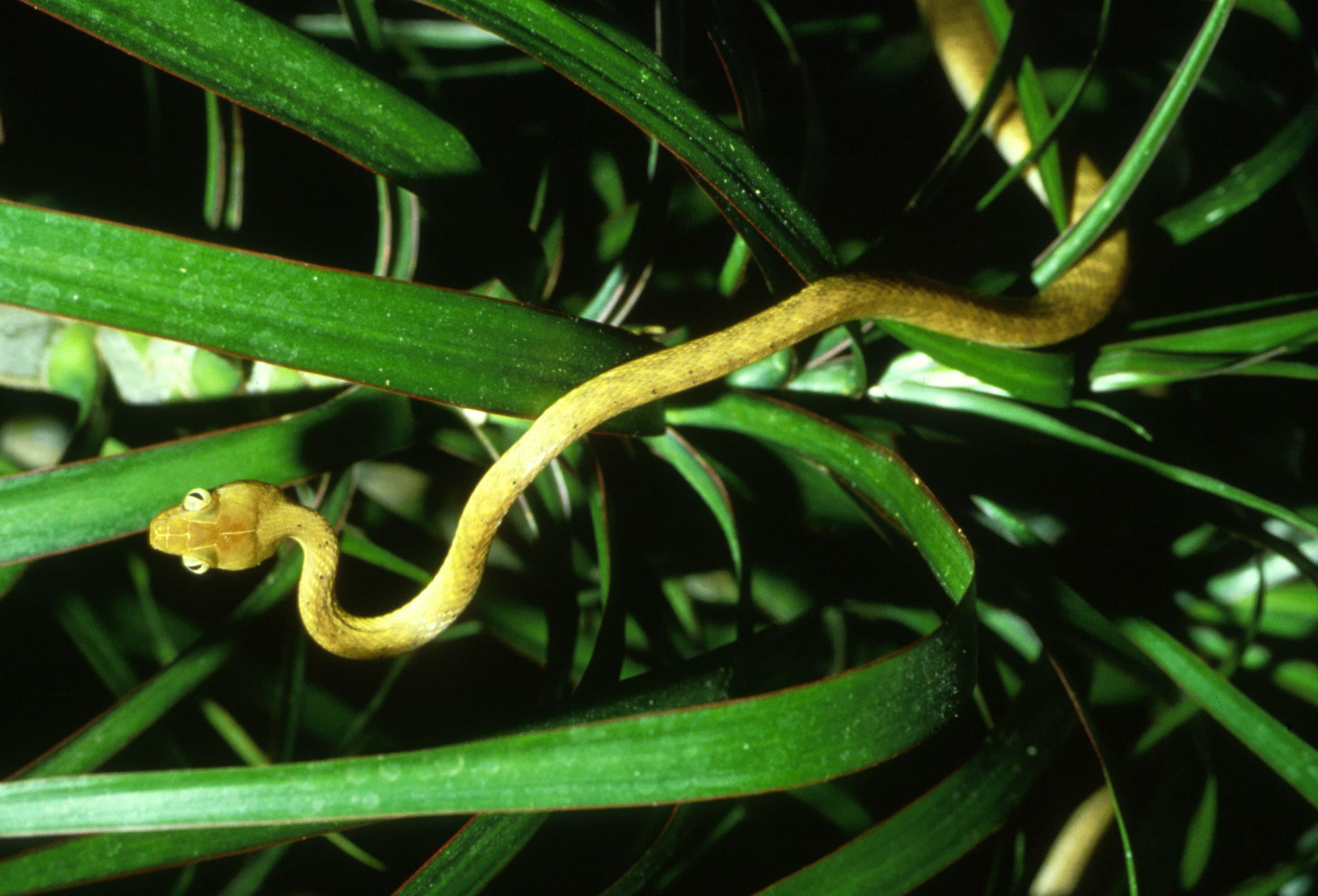
Brown Tree Snake (Boiga irregularis) is a slender nocturnal snake native to Australia, New Guinea and nearby islands. It climbs vegetation and buildings in search of lizards, birds and mammals. An accidental introduction to Guam after the Second World War produced a dense invasive population that eliminated native birds, disrupted food webs and repeatedly damaged electrical infrastructure. This guide separates well-supported biology from common assumptions and covers identification, range, habitat, diet, behavior, reproduction and conservation.
Identification
The body is long and laterally compressed with a proportionally large head, narrow neck and large eyes with vertical pupils. Color ranges from plain brown or olive to yellowish, reddish or tan with irregular darker crossbands. Guam snakes are often brown, while native populations vary widely. Rear fangs sit toward the back of the upper jaw. Females may attain greater mass while males often have proportionally longer tails. External overlap is substantial, so researchers use probing, anatomy or genetic methods for reliable sexing.
Identification should combine body shape, markings, size, voice or movement, and location. One feature by itself can overlap with a related animal, a juvenile, or an individual in unusual light.
Photographs are most useful when they preserve scale and show several diagnostic features. Handling or repositioning a wild brown tree snake for identification can cause stress and is unnecessary.
Size and physical adaptations
Brown Tree Snake typically measures commonly 1–2 m; exceptional Guam individuals may exceed 2.5 m and weighs often 0.3–1.5 kg depending on length and prey availability. Introduced Guam snakes historically reached large sizes where prey was abundant; body condition declined after severe prey depletion.
Its useful adaptations include large eyes support nocturnal hunting, vertical pupils control light entry, laterally compressed body moves through branches, long tail provides balance, rear fangs deliver prey-subduing venom, flexible diet supports invasion, strong climbing ability reaches nests and cargo. These traits work together in the animal’s normal setting rather than serving as isolated curiosities.
Published measurements may use different methods, life stages or sample locations. Comparing figures responsibly means checking what was measured rather than selecting the largest number available.
Range and distribution
The native range includes northern and eastern Australia, New Guinea, parts of eastern Indonesia and islands in Melanesia. Guam holds the major established introduced population. Individual snakes have been intercepted on other Pacific islands and in transported cargo, but interceptions do not necessarily represent breeding populations. The native range includes Australia, Indonesia, Papua New Guinea, Solomon Islands.
A country-level map indicates broad distribution, not continuous occupation. Climate, elevation, water, vegetation, prey, breeding sites, barriers and survey effort all affect where records occur.
Records near the edge of the range deserve careful documentation because they may reflect natural movement, improved survey coverage, accidental transport or a genuine distribution change.
Habitat
Tropical and subtropical forest, woodland, savanna edge, coastal vegetation, gardens, farms, caves and urban structures.
Brown tree snakes climb trunks, vines, power poles, roof spaces and cargo. During daylight they shelter in tree hollows, dense foliage, crevices or buildings. At night they move through vegetation and along edges where prey is concentrated. On Guam they occupy nearly every terrestrial habitat from limestone forest to developed land. Protecting a population therefore requires the feeding, shelter and breeding features that make a site usable, along with connections that allow movement.
Microhabitat matters. Shade, soil, current, moisture, shelter or host plants can determine whether a small area is usable even when the surrounding landscape appears suitable.
Diet and feeding
Brown Tree Snake is a opportunistic predator of vertebrates. Important foods include lizards, birds, bird eggs, bats, rodents, frogs, small snakes. The snake waits along branches or actively searches using vision and chemical cues. It seizes prey with the mouth, holds or constricts it and may work rear fangs into the tissue to introduce venom. Juveniles take many small lizards; larger snakes add birds, eggs, bats and mammals. This dietary flexibility helped the species spread across Guam.
Diet changes with age, season, location and food supply. A dramatic prey record does not establish what most individuals eat most of the time; repeated field observations provide a stronger picture.
Feeding opportunities also create risk. An animal focused on prey may be less alert to predators, traffic or people, while contaminated prey can transfer pollutants through the food web.
Behavior and communication
Primarily nocturnal, with movements influenced by temperature, rainfall, prey and moonlight; shelters by day. An agile climber, the brown tree snake can bridge gaps, ascend rough poles and enter surprisingly small openings. It often freezes or withdraws when detected. A threatened snake may form an S-shaped posture and strike repeatedly. On Guam individuals travel through forests, neighborhoods, ports and electrical corridors while hunting.
Tongue flicking samples airborne and surface chemicals used to follow prey and potential mates. Vision is important at night because the eyes are large. Courtship involves scent tracking and body contact. Defensive communication relies on posture, rapid movement and striking rather than loud sound. Behavior should be interpreted in context: alarm, courtship, feeding and temperature regulation can produce very different actions from the same animal.
Daily schedules are flexible responses, not rigid rules. Weather, breeding condition, disturbance, tides or food can move activity into a different part of the day.
Reproduction and development
Mating and egg production vary geographically and may respond to rainfall and prey. Females can store sperm, allowing fertilization well after mating. They place eggs in protected humid sites such as tree hollows, rock cavities, logs, caves or human structures. Usually 3–12 eggs, often 4–8 Embryos develop inside leathery eggs. Hatchlings emerge fully independent and prey heavily on small lizards. Growth depends on food supply; individuals mature after several years. Flexible reproduction, sperm storage and the absence of native snake predators aided the Guam invasion.
Young animals face different risks and may use different microhabitats or food than adults. Breeding success depends on adult condition, suitable sites and the survival of offspring through vulnerable early stages.
Counts of eggs or young describe reproductive output, not the number expected to reach adulthood. Mortality is normally greatest during eggs, larval or juvenile stages.
Predators and ecological role
In its native range the snake is one of many predators and prey species within complex tropical food webs. On Guam, ecological release allowed unusually high density. Predation extirpated most native forest birds, reduced bats and lizards, altered seed dispersal and pollination, and indirectly changed spider abundance and forest processes. Documented or likely predators include Monitor Lizards, Birds of Prey, Feral Pig, Humans, Coconut Crab.
This animal is both a consumer and a food source. Its influence comes through many repeated interactions, so ecological claims should be based on measured populations rather than assumptions drawn from appearance.
Predator and prey relationships differ among places. A species can be ecologically influential without being abundant everywhere, and its role can change across its range.
Relationship with people
Guam spends heavily on trapping, detector dogs, toxicant delivery and cargo inspection to prevent spread. Snakes cause power outages and threaten poultry and pets. Travelers must never move snakes or conceal wildlife in luggage. Residents should follow official reporting guidance and let trained responders handle suspected animals.
The rear-fanged venom is usually not life-threatening to a healthy adult, but bites can cause pain, swelling and systemic symptoms; infants and small children face greater risk. Never handle the snake. After a bite, keep the person calm, remove rings, wash gently and contact emergency or poison-control services. Do not cut, suck or tourniquet the wound. Responsible observation means keeping an appropriate distance, avoiding capture or feeding, protecting habitat and following local wildlife or invasive-species guidance.
Wildlife guidance should come from the responsible local agency because collection rules, reporting requests and appropriate responses differ between native and introduced ranges.
Conservation
The species is assessed as Least Concern across its broad native range. That global status does not reduce the catastrophic ecological impact of its introduced Guam population. The reported global trend is Unknown globally; controlled but still abundant on Guam.
Important pressures include local habitat loss in the native range, road mortality, persecution, control campaigns in introduced range, wildfire, extreme weather. Global status can hide local decline or recovery, so current regional monitoring and habitat management remain necessary.
The most useful conservation action follows the documented pressure. Protecting breeding sites, reducing road deaths or limiting pollutants can require different tools in different populations.