
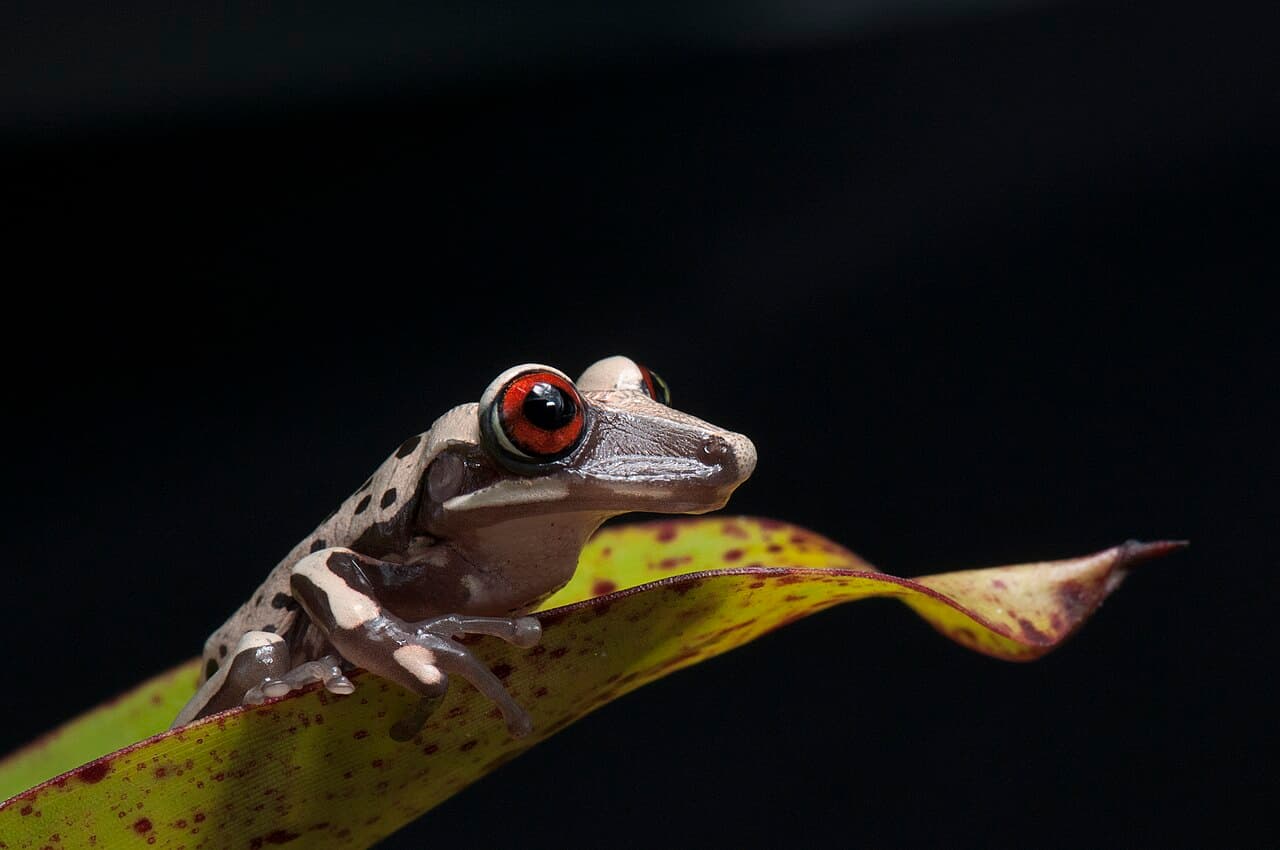
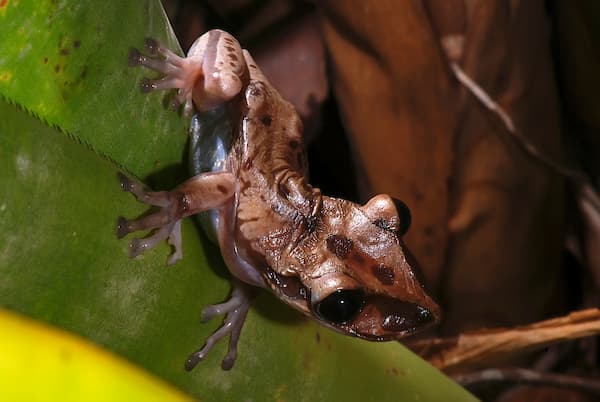
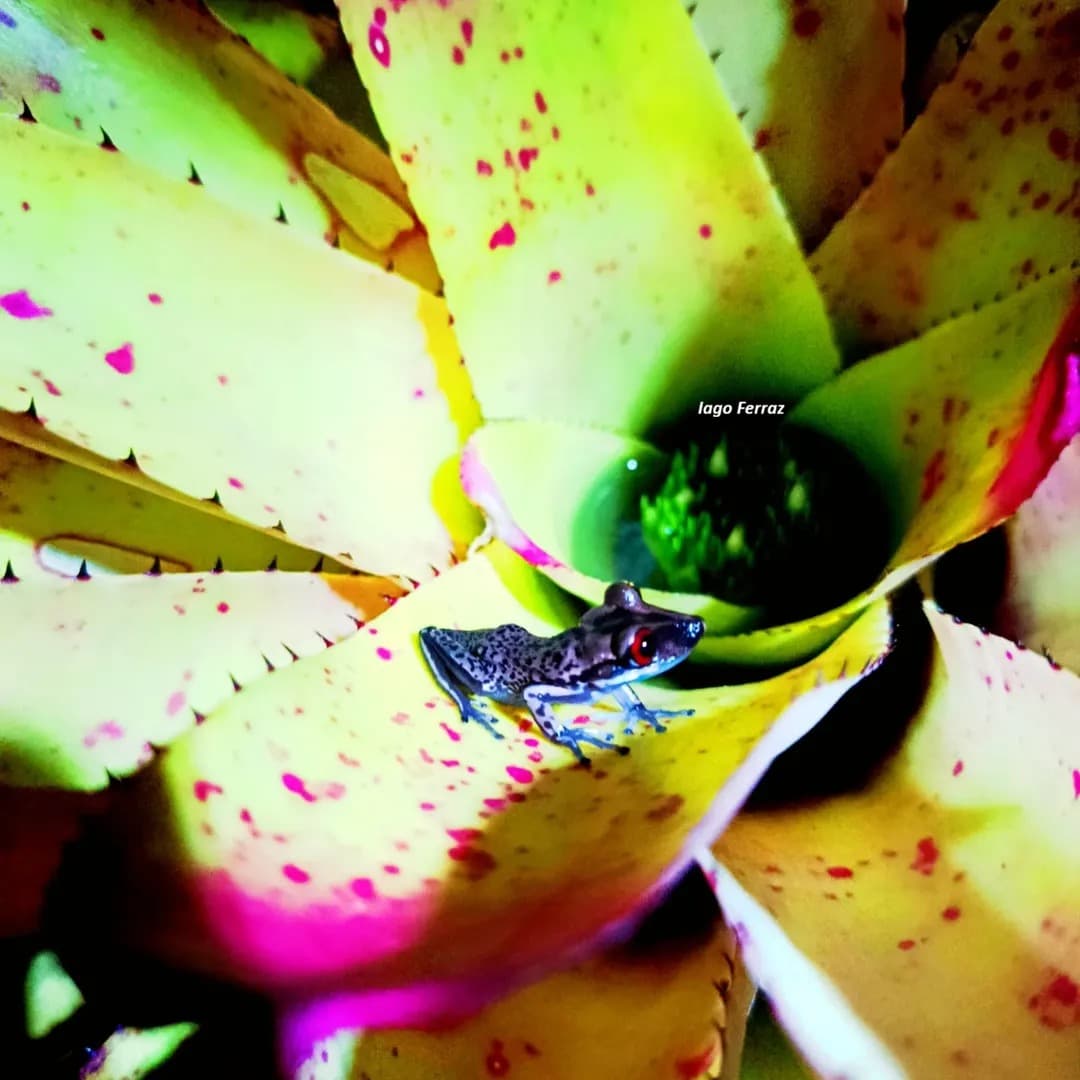
Bruno’s casque-headed frog (Nyctimantis brunoi) is a large tree frog found only in southeastern Brazil. Its flattened, heavily ossified head works like a shield at the entrance to a bromeliad or bamboo cavity, reducing water loss and blocking predators. The same head also carries small bony spines associated with toxin-producing skin glands. This unusual combination makes the frog one of the clearest examples of an amphibian that can deliver venom defensively rather than merely bearing poisonous skin.
Identification depends on the casque, eyes and body pattern
The species has a broad, triangular head with a pointed snout and a bony roof fused closely to the skin. Large forward-facing eyes and expanded toe pads suit a nocturnal climber. Adults are usually mottled tan, brown or gray, with darker patches that break up the outline against bark and bromeliad leaves. Young animals can show striking red irises and a more contrasting cream-and-brown pattern.
Females grow larger than males. Published measurements differ among sites and samples, but adults can reach roughly 8 centimetres in snout-to-vent length. The body is robust for a tree frog, while long limbs and adhesive toe discs allow movement through shrubs and the forest canopy. Identification should combine the helmet-like head, color pattern, location and expert examination because other Brazilian casque-headed frogs can look similar.
Modern taxonomy places the species in Nyctimantis
The accepted scientific name is Nyctimantis brunoi. Older literature and many image records use Aparasphenodon brunoi, the name under which much of its ecology and venom system was first described. Amphibian Species of the World places it in family Hylidae, subfamily Hylinae and the casque-headed frog tribe Lophiohylini. A broad phylogenetic study published in 2021 transferred the species into Nyctimantis.
The species was described in 1920 and is named for Brazilian physician and museum director Bruno Lobo. It is a true species profile, not a genus-level or informal group page. Records and conservation claims therefore refer specifically to N. brunoi, while findings from other casque-headed frogs are used only when clearly labeled as comparisons.
Its range follows Brazil’s southeastern Atlantic coast
Authoritative taxonomic records place the frog in coastal southeastern Brazil from Espírito Santo through Rio de Janeiro to São Paulo. It is endemic to Brazil. Within that strip it occupies Atlantic Forest and restinga, the coastal mosaic of sandy soils, shrubland, woodland, lagoons and bromeliads. A country map can show Brazil, but it cannot imply that the frog occurs across the whole nation.
The frog shelters in water-holding bromeliads, bamboo cavities and other narrow plant or tree holes. It occurs inside forest and along forest edges, but the IUCN account says it is absent from heavily degraded habitat. These small refuges buffer heat and dryness. A frog can back into an opening and seal it with the casque, a behavior called phragmosis, helping retain moisture while presenting a hard defensive surface.
Nocturnal frogs hunt insects around bromeliad refuges
Field studies describe N. brunoi as nocturnal and arboreal. Individuals hide by day, then climb and forage after dark. Recorded prey include grasshoppers and crickets, true bugs, flies and beetles. This is a generalist insect diet rather than dependence on one prey type. The frog can capture insects visiting bromeliads as well as prey encountered elsewhere in vegetation.
Activity increases with rain and humidity, especially during the wet season, although frogs have been recorded throughout the year in humid forest. Toe pads support climbing on leaves and stems. The broad casque is not a feeding weapon; it mainly protects the frog and helps close a refuge. Calls, close contact and chemical information are more relevant to reproduction than territorial combat.
The head combines armor with a venom-delivery system
Many frogs produce toxic skin secretions, but that alone makes an animal poisonous rather than venomous. Research on N. brunoi found bony spines on the skull that can pierce thin skin overlying toxin glands. When restrained, the frog can flex and drive its head against an attacker, creating a route for secretion to enter a wound. The study measured extremely high toxicity in laboratory tests, but those comparisons do not predict the outcome of every real encounter.
This defense should be treated seriously without exaggeration. Wild frogs do not hunt people, and no responsible observer should test the head-butting response. Do not touch, capture or corner one. If accidental contact produces a puncture, keep secretion away from eyes and mouth, wash exposed skin, and seek medical advice. Trained researchers use protective handling methods because both the animal and handler can be injured.
Breeding uses temporary water rather than the daytime refuge
Although adults often shelter in bromeliads, a restinga study found that they do not necessarily lay eggs inside those plants. The IUCN account reports breeding in temporary pools. Work in Atlantic Forest recorded females producing large clutches averaging about 900 small eggs, with considerable variation. Rain creates the shallow water needed for eggs and free-swimming tadpoles, so breeding activity rises during wetter periods.
Males advertise with calls after dark, and fertilization occurs externally during amplexus. Tadpoles develop in temporary freshwater before metamorphosing into froglets. Exact incubation, larval duration, age at maturity and wild lifespan are not established well enough for a dependable universal figure. Honest treatment of those gaps is more useful than borrowing values from a related frog.
Habitat protection matters despite a Least Concern listing
The IUCN assessment lists Bruno’s casque-headed frog as Least Concern, but that assessment dates from 2004 and explicitly identifies continuing habitat loss. Coastal development, tourism infrastructure, fire, drainage and clearing can remove restinga vegetation, temporary pools and mature bromeliads. Fragmentation also separates breeding water from daytime shelter. Local studies have reported declines or low abundance at some sites.
Protection must retain the full habitat network: forest and shrub cover, bromeliad-rich refuges, bamboo and tree cavities, and clean seasonal pools. Protected areas in Espírito Santo, Rio de Janeiro and São Paulo preserve portions of the range, while repeated surveys are needed to detect changes. The species should not be collected for private keeping. Its defensive secretions, specialized refuge use and conservation value make observation in place the responsible choice.
Responsible observation prevents avoidable contact
A night observer should use a dim light, remain on established paths and photograph without handling or repositioning the frog. Never pull an individual from a bromeliad or cavity; doing so destroys the protection supplied by the casque and may trigger the venom-delivery defense. Avoid damaging water-filled leaf axils, which serve as shelter for many small animals even when this frog breeds elsewhere.
Reports with date, location and an undisturbed photograph can support biodiversity records, but sensitive coordinates should follow local conservation guidance. The safest encounter is also the most informative: the frog remains in its natural posture and microhabitat, while the observer records features from a distance.
Sources
- American Museum of Natural History: Amphibian Species of the World taxonomy and distribution
- IUCN Red List: Nyctimantis brunoi assessment
- Current Biology / PubMed: Venomous Frogs Use Heads as Weapons
- Brazilian Journal of Biology: occurrence in bromeliads and restinga ecology
- Biodiversity Heritage Library: ecological and reproductive aspects in Atlantic Forest