
Species profileIUCN: LC

Bullsnake

Pituophis catenifer sayi

A large prairie constrictor whose powerful hiss and vibrating tail are defensive theater, not a venomous strike.

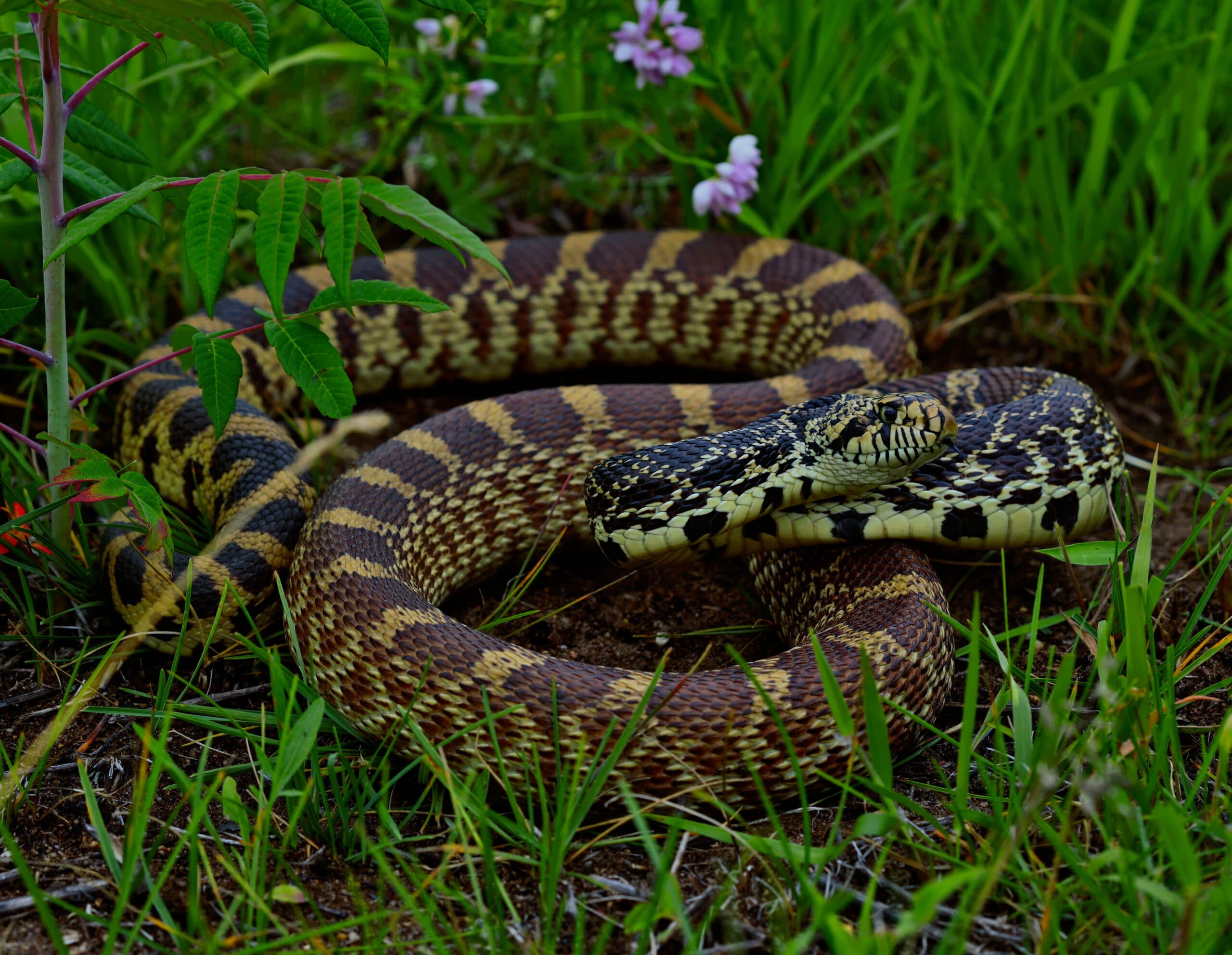
Bullsnake with tan scales and dark brown blotches moving through green prairie plants
Peter Paplanus / Wikimedia Commons / CC BY 2.0
๐ŸŒ Read in Language:

โšก At a Glance

Species profile
Also Known As
Bull Snake; Western Bullsnake
Diet Category
Carnivorous constrictor specializing in small vertebrates
Activity Rhythm
Mostly diurnal in cool weather and more crepuscular or nocturnal during summer heat; inactive underground through winter.
Wild Lifespan
Often 12โ€“15 years; individuals in managed care may live longer
Typical Weight
often 1โ€“3 kg in adults, with large individuals heavier
Conservation Status
LC
๐Ÿ’ก Key Biological Insight: A bullsnake produces its unusually loud hiss by forcing air across a modified structure in the throat, reinforcing a bluff that can resemble a rattlesnake warning.

๐ŸŒณ Scientific Taxonomy Hierarchy

Pituophis catenifer sayi is the bullsnake subspecies of the gopher snake in Colubridae. It differs geographically from the Pacific, Great Basin, Sonoran and other gopher snake subspecies. This profile applies range and natural-history statements to the bullsnake rather than to every Pituophis catenifer population.

KingdomAnimalia
PhylumChordata
ClassReptilia
OrderSquamata
FamilyColubridae
GenusPituophis
SpeciesPituophis catenifer sayi

Distinguishing Anatomical Features

  • โœ“The body is long and muscular with strongly keeled scales. Dark brown, reddish-brown or black blotches cross a yellow, cream or tan background, becoming more closely spaced toward the tail. The head is relatively narrow, the snout has an enlarged rostral scale suited to digging, and the tail ends in a point without a rattle.
  • โœ“Enlarged snout scale assists digging
  • โœ“Powerful coils subdue mammal prey
  • โœ“Keeled scales provide traction
  • โœ“Loud hiss deters predators
  • โœ“Tail vibration amplifies warning in dry vegetation
  • โœ“Chemical senses locate hidden prey
  • โœ“Deep dens protect against winter cold

๐Ÿ“ Physical Measurements

Total Lengthcommonly 4โ€“6 ft; exceptional individuals exceed 6.5 ft
Body Weightoften 2.2โ€“6.6 lb in adults
Tail LengthModerately long, tapering and without a rattle
WingspanNot applicable
Top SpeedNo dependable universal maximumMovement changes with context and conditions.

๐ŸŽจ Appearance & Distinctive Markings

YellowCreamTanBrownBlackReddish brownBrownBlackReddish brown

Skin / Covering: Dry, strongly keeled overlapping scales

Sexual Dimorphism: Males often have longer tails and may grow somewhat larger, but the sexes overlap strongly in length and pattern. Reliable sexing requires close anatomical or veterinary examination.

๐Ÿ—บ๏ธ Geographic Distribution & Habitat

Bullsnakes range from southern Alberta and Saskatchewan through the central United States into northeastern Mexico. Their distribution follows the Great Plains and adjacent open regions, with local gaps created by unsuitable forest, intensive development and major geographic barriers.

Prairie, shortgrass and mixed-grass grassland, sagebrush, sandy hills, open woodland edge, pasture, farmland margin and rocky badland.

Country-level distribution map

Native range
FijiTanzaniaWestern SaharaCanada โ€” Native rangeUnited States โ€” Native rangeKazakhstanUzbekistanPapua New GuineaIndonesiaArgentinaChileCongo - KinshasaSomaliaKenyaSudanChadHaitiDominican RepublicRussiaBahamasFalkland IslandsNorwayGreenlandFrench Southern TerritoriesTimor-LesteSouth AfricaLesothoMexico โ€” Native rangeUruguayBrazilBoliviaPeruColombiaPanamaCosta RicaNicaraguaHondurasEl SalvadorGuatemalaBelizeVenezuelaGuyanaSurinameFranceEcuadorPuerto RicoJamaicaCubaZimbabweBotswanaNamibiaSenegalMaliMauritaniaBeninNigerNigeriaCameroonTogoGhanaCรดte dโ€™IvoireGuineaGuinea-BissauLiberiaSierra LeoneBurkina FasoCentral African RepublicCongo - BrazzavilleGabonEquatorial GuineaZambiaMalawiMozambiqueEswatiniAngolaBurundiIsraelLebanonMadagascarPalestinian TerritoriesGambiaTunisiaAlgeriaJordanUnited Arab EmiratesQatarKuwaitIraqOmanVanuatuCambodiaThailandLaosMyanmar (Burma)VietnamNorth KoreaSouth KoreaMongoliaIndiaBangladeshBhutanNepalPakistanAfghanistanTajikistanKyrgyzstanTurkmenistanIranSyriaArmeniaSwedenBelarusUkrainePolandAustriaHungaryMoldovaRomaniaLithuaniaLatviaEstoniaGermanyBulgariaGreeceTรผrkiyeAlbaniaCroatiaSwitzerlandLuxembourgBelgiumNetherlandsPortugalSpainIrelandNew CaledoniaSolomon IslandsNew ZealandAustraliaSri LankaChinaTaiwanItalyDenmarkUnited KingdomIcelandAzerbaijanGeorgiaPhilippinesMalaysiaBruneiSloveniaFinlandSlovakiaCzechiaEritreaJapanParaguayYemenSaudi ArabiaCyprusMoroccoEgyptLibyaEthiopiaDjiboutiUgandaRwandaBosnia & HerzegovinaNorth MacedoniaSerbiaMontenegroKosovoTrinidad & TobagoSouth Sudan
Highlighted countries are recorded profile locations, not precise biological range boundaries.Map boundaries: Natural Earth

๐Ÿ’ก Did You Know?

  • ๐Ÿ’กEnlarged snout scale assists digging
  • ๐Ÿ’กPowerful coils subdue mammal prey
  • ๐Ÿ’กKeeled scales provide traction
  • ๐Ÿ’กLoud hiss deters predators
  • ๐Ÿ’กTail vibration amplifies warning in dry vegetation
  • ๐Ÿ’กChemical senses locate hidden prey
  • ๐Ÿ’กDeep dens protect against winter cold

๐ŸŒฟ Conservation Status & Threats

IUCN: LC โ€” Least Concern

โ€œThe parent species Pituophis catenifer is assessed as Least Concern across its broad range. Bullsnakes can still decline locally where grassland is fragmented, dens are destroyed or road mortality is heavy.โ€

Population TrendGenerally stable at broad scale; locally declining in parts of the northern range
Wild Population EstimateNo reliable range-wide estimate for the subspecies
CITESNot listed

โš ๏ธ Major Threats to Bullsnake

  • โ€ขGrassland conversion
  • โ€ขRoad mortality
  • โ€ขDeliberate killing
  • โ€ขLoss of hibernacula
  • โ€ขPersecution through misidentification
  • โ€ขIntensive agriculture
  • โ€ขIllegal collection
  • โ€ขWildfire and development

๐Ÿ”„ Life Cycle & Reproduction

Wild vs. Captivity Lifespan Comparison

๐ŸŒฟ In the WildOften 12โ€“15 years; individuals in managed care may live longer
๐Ÿ  In Captivity (with veterinary care)Experienced keepers provide secure housing, precise temperature control, hides, enrichment, clean water and whole-prey nutrition.
Clutch / Litter SizeUsually 5โ€“20 eggs; northern studies report averages near 16 and occasional larger clutches
Incubation / GestationAbout 50โ€“80 days depending on temperature and moisture
Fledging / WeaningIndependent hatchling about 30โ€“45 cm long
Sexual MaturityMales often 1โ€“2 years; females commonly 3โ€“5 years
Mating SystemInternal fertilization; egg-laying
Nesting / Den TypeUnderground chamber, mammal burrow or warm loose substrate

๐Ÿฆ… Behavior & Field Ecology

Carnivorous constrictor specializing in small vertebrates

๐ŸŒ Ecological Food Web & Relationships: Bullsnakes are major predators of burrowing rodents and can enter tunnel systems inaccessible to many larger predators. They also take birds and eggs and in turn feed hawks, eagles, badgers, coyotes and other carnivores. Their use of communal dens connects grassland food webs across seasons.

Social Group SizeMostly solitary, but several snakes can share hibernacula or nest sites
Activity RhythmMostly diurnal in cool weather and more crepuscular or nocturnal during summer heat; inactive underground through winter.
Feeding StrategyCarnivorous constrictor specializing in small vertebrates

๐Ÿฅฉ Primary Prey & Preferred Diet

โœ“ Pocket gophersโœ“ Miceโœ“ Volesโœ“ Ground squirrelsโœ“ Rabbitsโœ“ Birdsโœ“ Bird eggs

๐Ÿ“ข Communication & Territorial Signals

  • Tongue-flick chemoreception
  • Skin pheromones
  • Male combat
  • Loud hissing
  • Body inflation
  • Tail vibration

๐Ÿพ Wild Temperament & Traits

โ€ข Alertโ€ข Secretiveโ€ข Powerfulโ€ข Usually solitaryโ€ข Defensive when corneredโ€ข Nonvenomous

๐Ÿค Human Interaction & Pet Advisory

โš ๏ธ Strictly Wild Species
๐Ÿšซ

Can You Keep a Bullsnake as a Pet?

Captive care is legal only where local rules allow and should use documented captive-bred snakes. A secure enclosure needs a thermal gradient, dry hides, a humid shedding hide, clean water, deep substrate and appropriately sized whole prey. Wild collection removes effective rodent predators and exposes keepers to parasites and stress-related problems.

Domestication StatusWild subspecies; not domesticated
Danger to HumansLow medical risk; nonvenomous but capable of defensive bites
Economic & Ecotourism RoleNatural rodent control, prey for prairie predators, a research subject for reptile movement and overwintering, and an educational example of harmless defensive mimicry.

โš ๏ธ Behavioral Risk Factors & Wildlife Safety

  • Large individuals have strong jaws
  • Repeated handling increases stress
  • Wild snakes may carry oral bacteria
  • Misidentification can lead to unsafe approaches

๐ŸŒ Ecological Food Web & Relationships

๐Ÿฆ… Natural Predators (5)

Red-Tailed HawkButeo jamaicensis
American BadgerTaxidea taxus
CoyoteCanis latrans
Golden EagleAquila chrysaetos
Striped SkunkMephitis mephitis

๐Ÿงฌ Related Species (4)

Gopher SnakePituophis cateniferParent species
Great Basin Gopher SnakePituophis catenifer deserticolaWestern subspecies
Sonoran Gopher SnakePituophis catenifer affinisSouthwestern subspecies
Louisiana Pine SnakePituophis ruthveniThreatened congener

Bullsnake (Pituophis catenifer sayi) is a large nonvenomous gopher snake of the Great Plains and adjoining grasslands of North America. It hunts rodents in burrows, lays eggs underground and survives cold winters in deep communal dens. When threatened it may flatten its head, coil, hiss loudly and vibrate its tail, behavior that often causes people to mistake it for a rattlesnake. This guide separates well-supported biology from common assumptions and covers identification, range, habitat, diet, behavior, reproduction and conservation.

Identification

The body is long and muscular with strongly keeled scales. Dark brown, reddish-brown or black blotches cross a yellow, cream or tan background, becoming more closely spaced toward the tail. The head is relatively narrow, the snout has an enlarged rostral scale suited to digging, and the tail ends in a point without a rattle. Males often have longer tails and may grow somewhat larger, but the sexes overlap strongly in length and pattern. Reliable sexing requires close anatomical or veterinary examination.

Identification should combine body shape, markings, size, voice or movement, and location. One feature by itself can overlap with a related animal, a juvenile, or an individual in unusual light.

Photographs are most useful when they preserve scale and show several diagnostic features. Handling or repositioning a wild bullsnake for identification can cause stress and is unnecessary.

Size and physical adaptations

Bullsnake typically measures commonly 1.2โ€“1.8 m; exceptional individuals exceed 2 m and weighs often 1โ€“3 kg in adults, with large individuals heavier. Published maximum lengths for gopher snakes can include other subspecies; very large bullsnakes are unusual.

Its useful adaptations include enlarged snout scale assists digging, powerful coils subdue mammal prey, keeled scales provide traction, loud hiss deters predators, tail vibration amplifies warning in dry vegetation, chemical senses locate hidden prey, deep dens protect against winter cold. These traits work together in the animal’s normal setting rather than serving as isolated curiosities.

Published measurements may use different methods, life stages or sample locations. Comparing figures responsibly means checking what was measured rather than selecting the largest number available.

Range and distribution

Bullsnakes range from southern Alberta and Saskatchewan through the central United States into northeastern Mexico. Their distribution follows the Great Plains and adjacent open regions, with local gaps created by unsuitable forest, intensive development and major geographic barriers. The native range includes Canada, United States, Mexico.

A country-level map indicates broad distribution, not continuous occupation. Climate, elevation, water, vegetation, prey, breeding sites, barriers and survey effort all affect where records occur.

Records near the edge of the range deserve careful documentation because they may reflect natural movement, improved survey coverage, accidental transport or a genuine distribution change.

Habitat

Prairie, shortgrass and mixed-grass grassland, sagebrush, sandy hills, open woodland edge, pasture, farmland margin and rocky badland.

They forage on the surface and enter mammal burrows to hunt or escape heat. Sandy or friable soil supports digging and nesting, while rock fissures, abandoned burrows and deep hibernacula provide winter shelter. One snake may travel long distances between summer feeding grounds and a traditional den. Protecting a population therefore requires the feeding, shelter and breeding features that make a site usable, along with connections that allow movement.

Microhabitat matters. Shade, soil, current, moisture, shelter or host plants can determine whether a small area is usable even when the surrounding landscape appears suitable.

Diet and feeding

Bullsnake is a carnivorous constrictor specializing in small vertebrates. Important foods include pocket gophers, mice, voles, ground squirrels, rabbits, birds, bird eggs. The snake follows scent into rodent tunnels, seizes prey and wraps muscular coils around it. Small prey may be swallowed without prolonged constriction. Pocket gophers, mice, voles and ground squirrels dominate many diets; nestling birds, eggs, lizards and occasional other snakes add variety. Bullsnakes do not kill prey with venom.

Diet changes with age, season, location and food supply. A dramatic prey record does not establish what most individuals eat most of the time; repeated field observations provide a stronger picture.

Feeding opportunities also create risk. An animal focused on prey may be less alert to predators, traffic or people, while contaminated prey can transfer pollutants through the food web.

Behavior and communication

Mostly diurnal in cool weather and more crepuscular or nocturnal during summer heat; inactive underground through winter. A bullsnake usually escapes into grass or a burrow. If cornered it may coil, flatten the head, raise the front of the body, hiss and strike while vibrating its tail. Dry leaves can turn that vibration into a rattling sound. The performance is defensive mimicry; the snake has no rattle and often retreats when given space.

Tongue flicks collect chemical particles that the vomeronasal organ interprets as prey, predator and mate cues. Males follow female scent trails in spring and may wrestle rivals. Hissing, body inflation, head flattening, tail vibration and striking communicate escalating defense. Behavior should be interpreted in context: alarm, courtship, feeding and temperature regulation can produce very different actions from the same animal.

Daily schedules are flexible responses, not rigid rules. Weather, breeding condition, disturbance, tides or food can move activity into a different part of the day.

Reproduction and development

Adults emerge from winter dens and mate in spring. Males locate receptive females through scent and may engage in ritualized combat. Fertilization is internal. The female deposits eggs in warm, humid underground chambers, rotting vegetation or abandoned mammal burrows; several females may share a nest. Usually 5โ€“20 eggs; northern studies report averages near 16 and occasional larger clutches Embryos develop inside leathery eggs using stored yolk. Hatchlings cut the shell with an egg tooth and receive no parental care. They are capable hunters from emergence, taking nestling rodents and other small prey. Growth is fastest during the first few years.

Young animals face different risks and may use different microhabitats or food than adults. Breeding success depends on adult condition, suitable sites and the survival of offspring through vulnerable early stages.

Counts of eggs or young describe reproductive output, not the number expected to reach adulthood. Mortality is normally greatest during eggs, larval or juvenile stages.

Predators and ecological role

Bullsnakes are major predators of burrowing rodents and can enter tunnel systems inaccessible to many larger predators. They also take birds and eggs and in turn feed hawks, eagles, badgers, coyotes and other carnivores. Their use of communal dens connects grassland food webs across seasons. Documented or likely predators include Red-Tailed Hawk, American Badger, Coyote, Golden Eagle, Striped Skunk.

This animal is both a consumer and a food source. Its influence comes through many repeated interactions, so ecological claims should be based on measured populations rather than assumptions drawn from appearance.

Predator and prey relationships differ among places. A species can be ecologically influential without being abundant everywhere, and its role can change across its range.

Relationship with people

Bullsnakes consume rodents in rangeland and around farms, but road traffic, deliberate killing and habitat loss cause mortality. Mistaking a defensive bullsnake for a rattlesnake is common. Observe from a distance, keep pets back and allow the snake an escape route; qualified wildlife responders can move animals from buildings.

The species is nonvenomous. A handled or cornered individual can bite and leave punctures or scratches, but it does not inject venom. Do not pick up an unidentified snake. For a bite, wash with soap and water, control bleeding and seek medical care if the wound is deep or becomes infected. Responsible observation means keeping an appropriate distance, avoiding capture or feeding, protecting habitat and following local wildlife or invasive-species guidance.

Wildlife guidance should come from the responsible local agency because collection rules, reporting requests and appropriate responses differ between native and introduced ranges.

Conservation

The parent species Pituophis catenifer is assessed as Least Concern across its broad range. Bullsnakes can still decline locally where grassland is fragmented, dens are destroyed or road mortality is heavy. The reported global trend is Generally stable at broad scale; locally declining in parts of the northern range.

Important pressures include grassland conversion, road mortality, deliberate killing, loss of hibernacula, persecution through misidentification, intensive agriculture, illegal collection, wildfire and development. Global status can hide local decline or recovery, so current regional monitoring and habitat management remain necessary.

The most useful conservation action follows the documented pressure. Protecting breeding sites, reducing road deaths or limiting pollutants can require different tools in different populations.

Sources and further reading

โ“ Frequently Asked Questions

Answers to frequently asked questions verified against peer-reviewed zoological research.

The Bullsnake is Pituophis catenifer sayi, a subspecies of the North American gopher snake.