
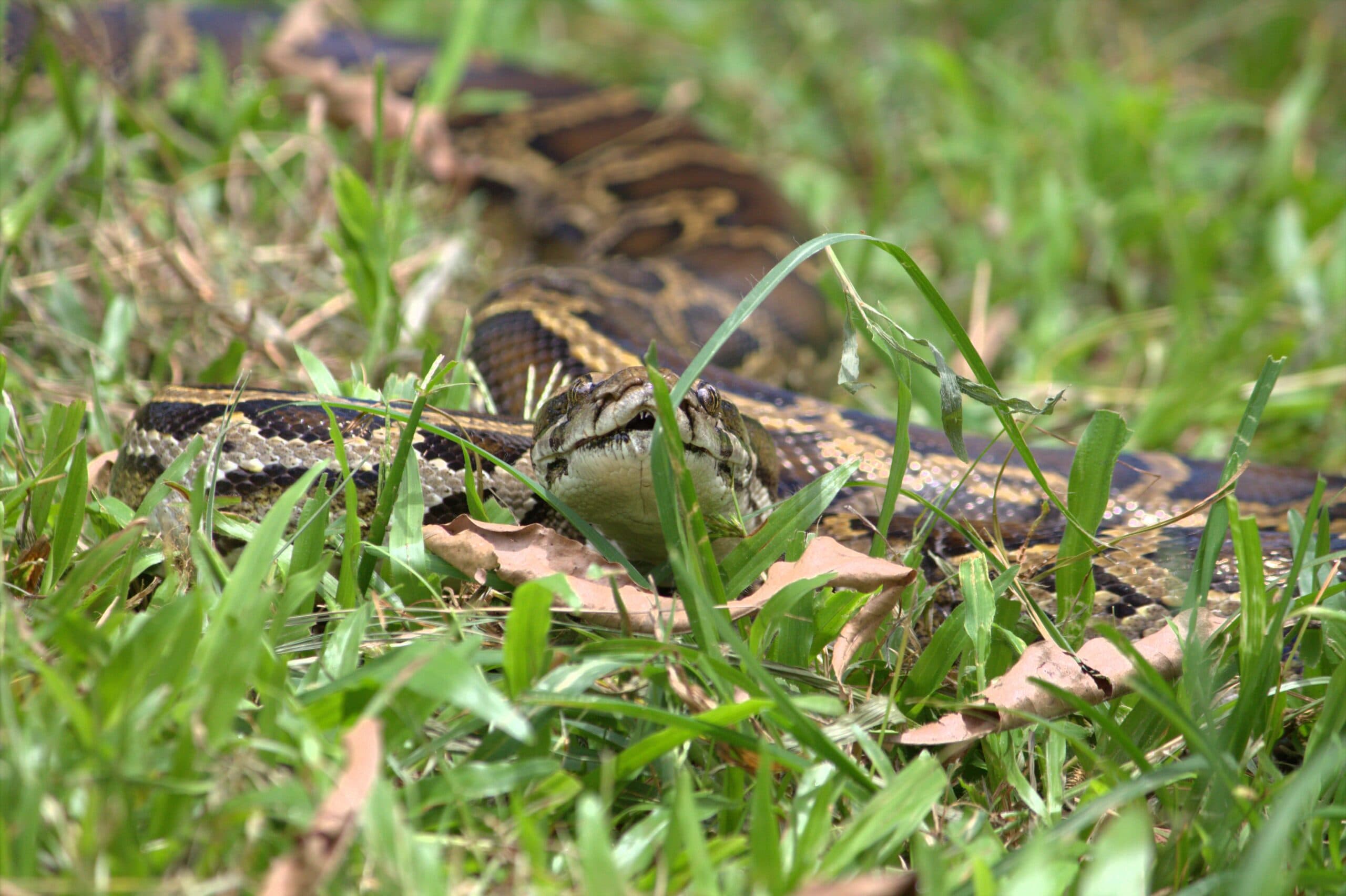
Burmese Python (Python bivittatus) is a very large, heavy-bodied python native to South and Southeast Asia. It kills prey by constriction rather than venom and uses heat-sensitive pits along the upper lip to detect warm animals. Burmese pythons are capable swimmers, climb well when young and occupy habitats from forest and marsh to farms. Their status differs sharply by region: native populations face collection and habitat pressure, while an introduced breeding population has become a damaging invasive predator in the Greater Everglades. This guide separates well-supported biology from common assumptions and covers identification, range, habitat, diet, behavior, reproduction and conservation.
Identification
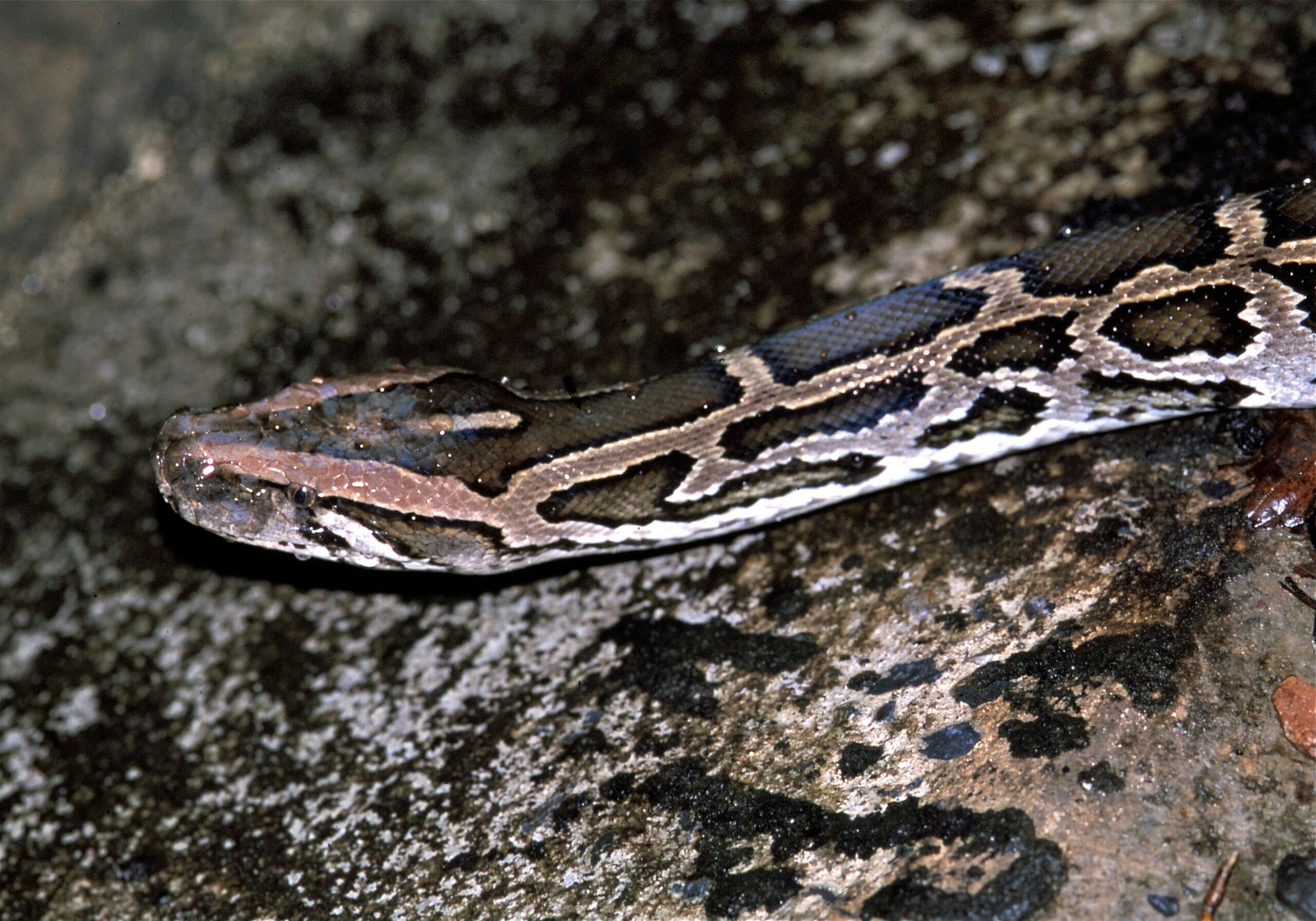
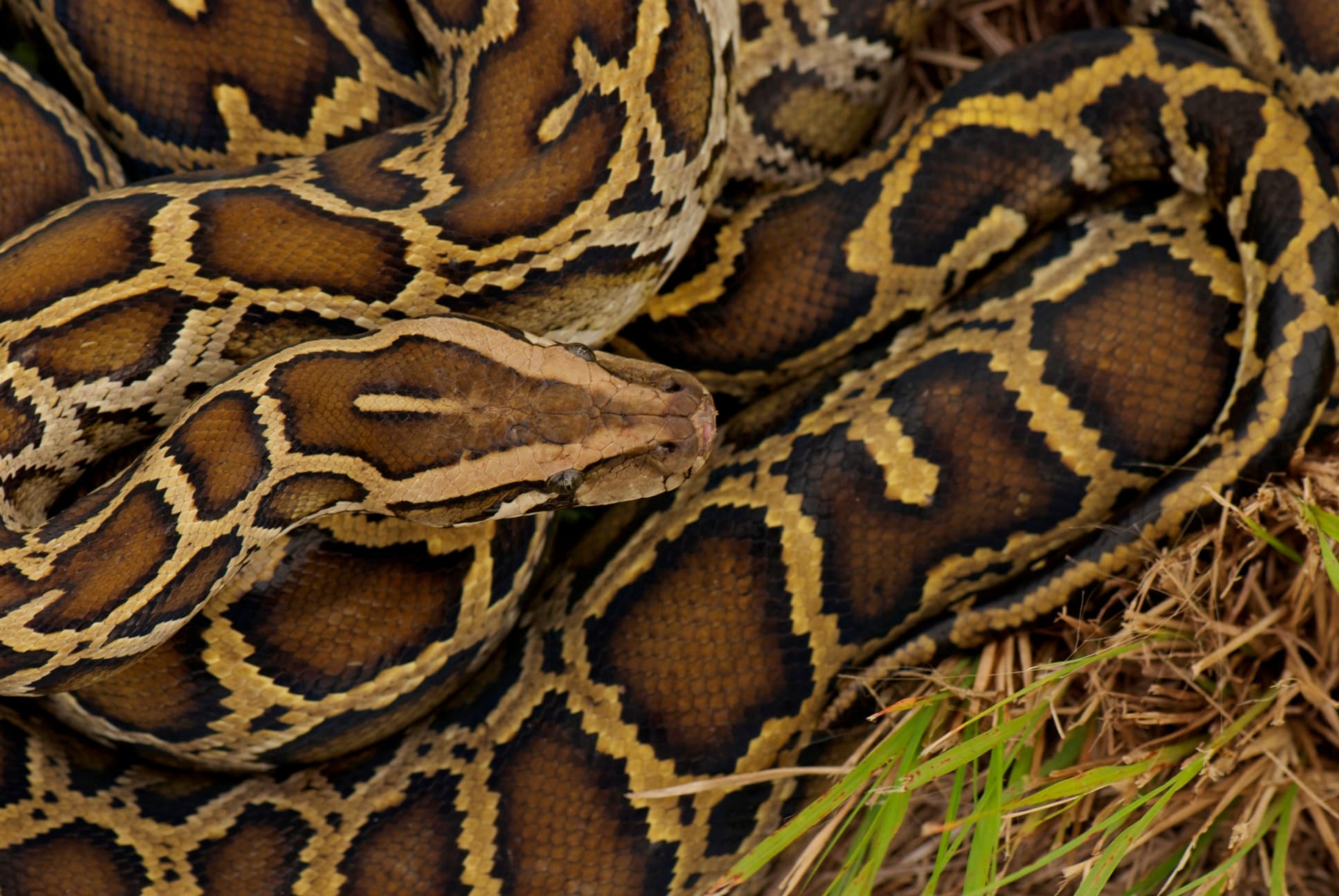
The body is thick and muscular, with a pale tan to yellow-brown ground color crossed by large dark brown blotches outlined in black or cream. A dark arrowhead-shaped marking covers the top of the head, and dark stripes pass through the eyes. Smooth glossy scales, vertical pupils and a row of heat-sensing pits along the upper lip distinguish the snake at close range. Pattern and color vary among wild populations and captive color morphs. Adult females grow substantially longer and heavier than males. Males usually have proportionally longer tails and more prominent cloacal spurs, but safe sex determination belongs to experienced professionals and should never involve handling an unknown wild snake.
Identification should combine body shape, markings, size, voice or movement, and location. One feature by itself can overlap with a related animal, a juvenile, or an individual in unusual light.
Photographs are most useful when they preserve scale and show several diagnostic features. Handling or repositioning a wild burmese python for identification can cause stress and is unnecessary.
Size and physical adaptations
Burmese Python typically measures commonly 3–5 m in large adults; exceptional individuals can exceed 5 m and weighs large females may exceed 45 kg, with exceptional wild individuals much heavier. Females are the larger sex. Records vary because captive and wild animals differ in age, condition and measurement method.
Its useful adaptations include heat-sensitive labial pits detect warm prey, powerful coils constrict captured animals, expanding jaws swallow large prey whole, camouflage breaks up the body outline, strong swimming crosses rivers and marshes, young snakes climb with prehensile support, females warm egg clutches by muscular shivering. These traits work together in the animal’s normal setting rather than serving as isolated curiosities.
Published measurements may use different methods, life stages or sample locations. Comparing figures responsibly means checking what was measured rather than selecting the largest number available.
Range and distribution
Native across parts of northeastern India, Nepal, Bhutan and Bangladesh through Myanmar, Thailand, Laos, Cambodia, Vietnam and southern China, with records on parts of Indonesia. A large introduced breeding population occupies southern Florida in the United States. Country-level mapping does not imply continuous occupancy. The native range includes Bangladesh, Bhutan, China, India, Indonesia, Laos, Myanmar, Nepal, Thailand, Vietnam.
A country-level map indicates broad distribution, not continuous occupation. Climate, elevation, water, vegetation, prey, breeding sites, barriers and survey effort all affect where records occur.
Records near the edge of the range deserve careful documentation because they may reflect natural movement, improved survey coverage, accidental transport or a genuine distribution change.
Habitat
Tropical and subtropical forest, wooded grassland, scrub, river valleys, marshes, swamps, agricultural edges and other warm landscapes with cover and dependable prey.
Water and dense cover are frequent features of occupied habitat. Pythons shelter beneath vegetation, in hollow logs, mammal burrows and limestone cavities, then use edges and animal trails to ambush prey. Juveniles spend more time climbing, while large adults are primarily terrestrial but remain powerful swimmers. In Florida, canals, levees, sawgrass marsh and tree islands connect an introduced population across the Greater Everglades. Protecting a population therefore requires the feeding, shelter and breeding features that make a site usable, along with connections that allow movement.
Microhabitat matters. Shade, soil, current, moisture, shelter or host plants can determine whether a small area is usable even when the surrounding landscape appears suitable.
Diet and feeding
Burmese Python is a carnivore. Important foods include rats and other rodents, rabbits and hares, birds, monitor lizards, civets and mongooses, deer and other medium mammals, alligators in introduced florida range. The snake waits beside a trail or searches slowly, using scent, vision and heat-sensitive pits. It strikes, grips with recurved teeth and wraps coils around the prey. Constriction rapidly interrupts circulation; the python then swallows the animal whole, usually head first. Meal size increases with snake size, and digestion may occupy days or weeks.
Diet changes with age, season, location and food supply. A dramatic prey record does not establish what most individuals eat most of the time; repeated field observations provide a stronger picture.
Feeding opportunities also create risk. An animal focused on prey may be less alert to predators, traffic or people, while contaminated prey can transfer pollutants through the food web.
Behavior and communication
Mostly nocturnal or crepuscular in warm weather, with daytime basking and seasonal shifts. Burmese pythons are usually solitary ambush predators. They often remain motionless for long periods and rely on camouflage instead of pursuit. They swim readily and can stay submerged while crossing wet habitat. Young snakes climb trees and shrubs more often than massive adults. When threatened, a python may hiss loudly, pull its head into an S-shaped striking posture and bite repeatedly.
A forked tongue carries airborne and surface chemicals to the vomeronasal organ, allowing the snake to follow prey and reproductive trails. Heat-sensitive pits detect warm animals at close range, and the body senses ground vibration. During courtship, males follow female scent and use their cloacal spurs while aligning the body. Hissing and posture communicate immediate defense. Behavior should be interpreted in context: alarm, courtship, feeding and temperature regulation can produce very different actions from the same animal.
Daily schedules are flexible responses, not rigid rules. Weather, breeding condition, disturbance, tides or food can move activity into a different part of the day.
Reproduction and development
Breeding commonly occurs during the cooler dry season. Several males may follow a female and compete for access. After laying, the female coils tightly around the clutch, guards it and produces heat through rhythmic muscle contractions. She normally remains with the eggs until hatching and then provides no extended care. Often 20–50 eggs, with larger clutches possible in very large females Hatchlings cut the leathery shell with an egg tooth and emerge fully formed. They begin life as independent predators of small mammals, birds and reptiles. Juveniles grow quickly when food and warmth are abundant, but face predation and seasonal temperature stress.
Young animals face different risks and may use different microhabitats or food than adults. Breeding success depends on adult condition, suitable sites and the survival of offspring through vulnerable early stages.
Counts of eggs or young describe reproductive output, not the number expected to reach adulthood. Mortality is normally greatest during eggs, larval or juvenile stages.
Predators and ecological role
In its native range, the Burmese Python is a high-level predator linking rodents, birds and medium-sized mammals to larger carnivores and scavengers. In southern Florida it has no equivalent historical role: intensive predation by the introduced population has been associated with severe declines of several medium-sized mammal populations and changes to Everglades food webs. Documented or likely predators include King Cobra, Tiger, Leopard, Estuarine Crocodile, American Alligator.
This animal is both a consumer and a food source. Its influence comes through many repeated interactions, so ecological claims should be based on measured populations rather than assumptions drawn from appearance.
Predator and prey relationships differ among places. A species can be ecologically influential without being abundant everywhere, and its role can change across its range.
Relationship with people
People encounter Burmese pythons through regulated wildlife work, the pet trade and, in Florida, invasive-species control. A large python can cause severe bites or constriction injuries and should never be approached or captured by an untrained person. In the native range, legal protection and trade controls aim to reduce collection. In Florida, wildlife agencies direct residents to report observations and follow local removal rules.
Keep well away from any large wild python, supervise children and pets, and contact the responsible wildlife authority. Do not attempt to pin, grab, feed or relocate it. A constriction emergency requires immediate help from other adults and emergency services; bites need careful wound cleaning and medical assessment. Rules differ between the native and introduced ranges. Responsible observation means keeping an appropriate distance, avoiding capture or feeding, protecting habitat and following local wildlife or invasive-species guidance.
Wildlife guidance should come from the responsible local agency because collection rules, reporting requests and appropriate responses differ between native and introduced ranges.
Conservation
The Burmese Python is assessed as Vulnerable in its native range because of habitat loss, killing and collection for skins, meat and the live-animal trade. This conservation concern must be kept separate from management of the abundant introduced Florida population. The reported global trend is Decreasing in the native range; established and expanding locally in southern Florida.
Important pressures include habitat loss and fragmentation, collection for skins and meat, live-animal trade, deliberate killing, road mortality, wetland conversion, weak enforcement in parts of the native range. Global status can hide local decline or recovery, so current regional monitoring and habitat management remain necessary.
The most useful conservation action follows the documented pressure. Protecting breeding sites, reducing road deaths or limiting pollutants can require different tools in different populations.