
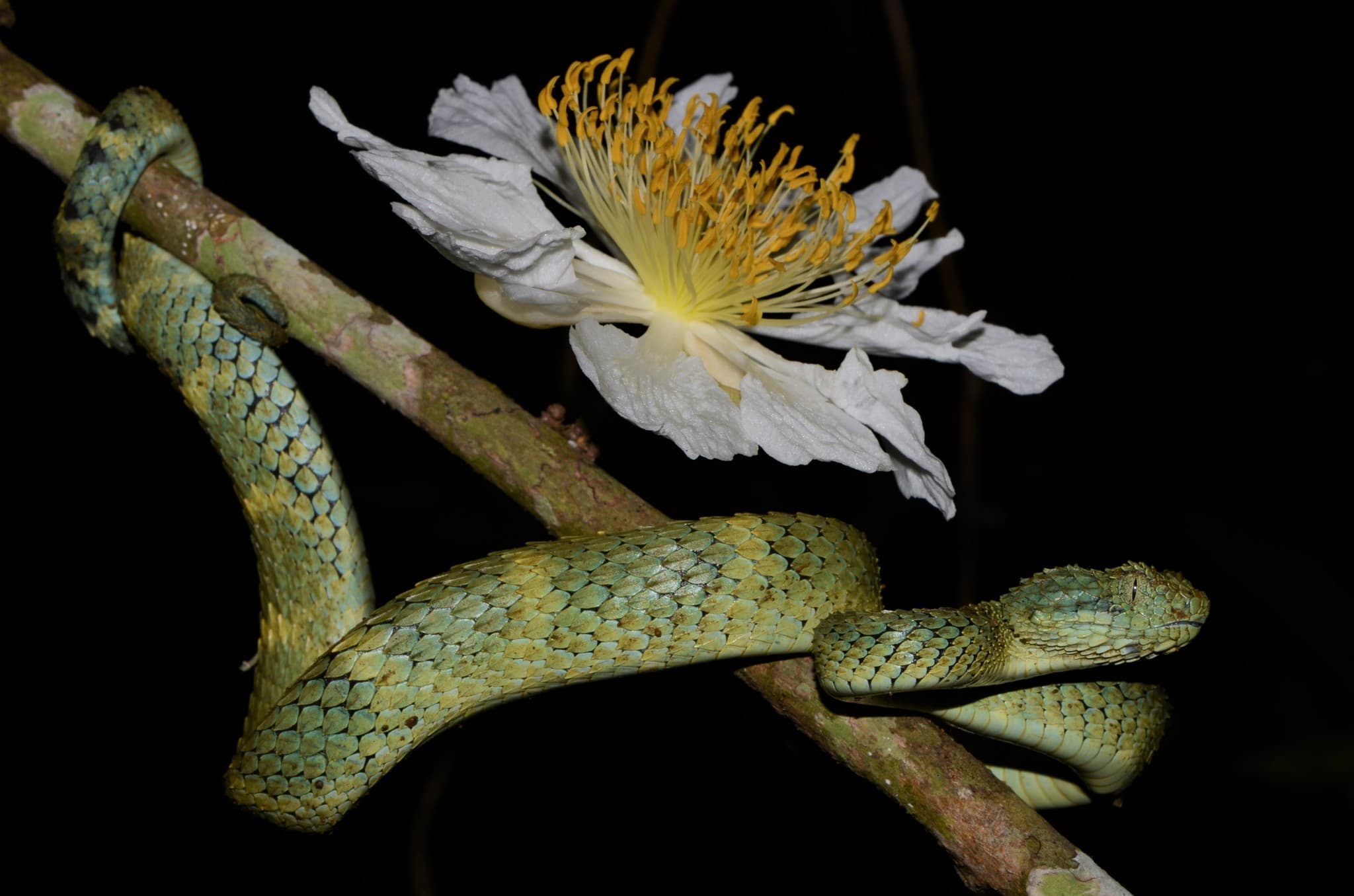
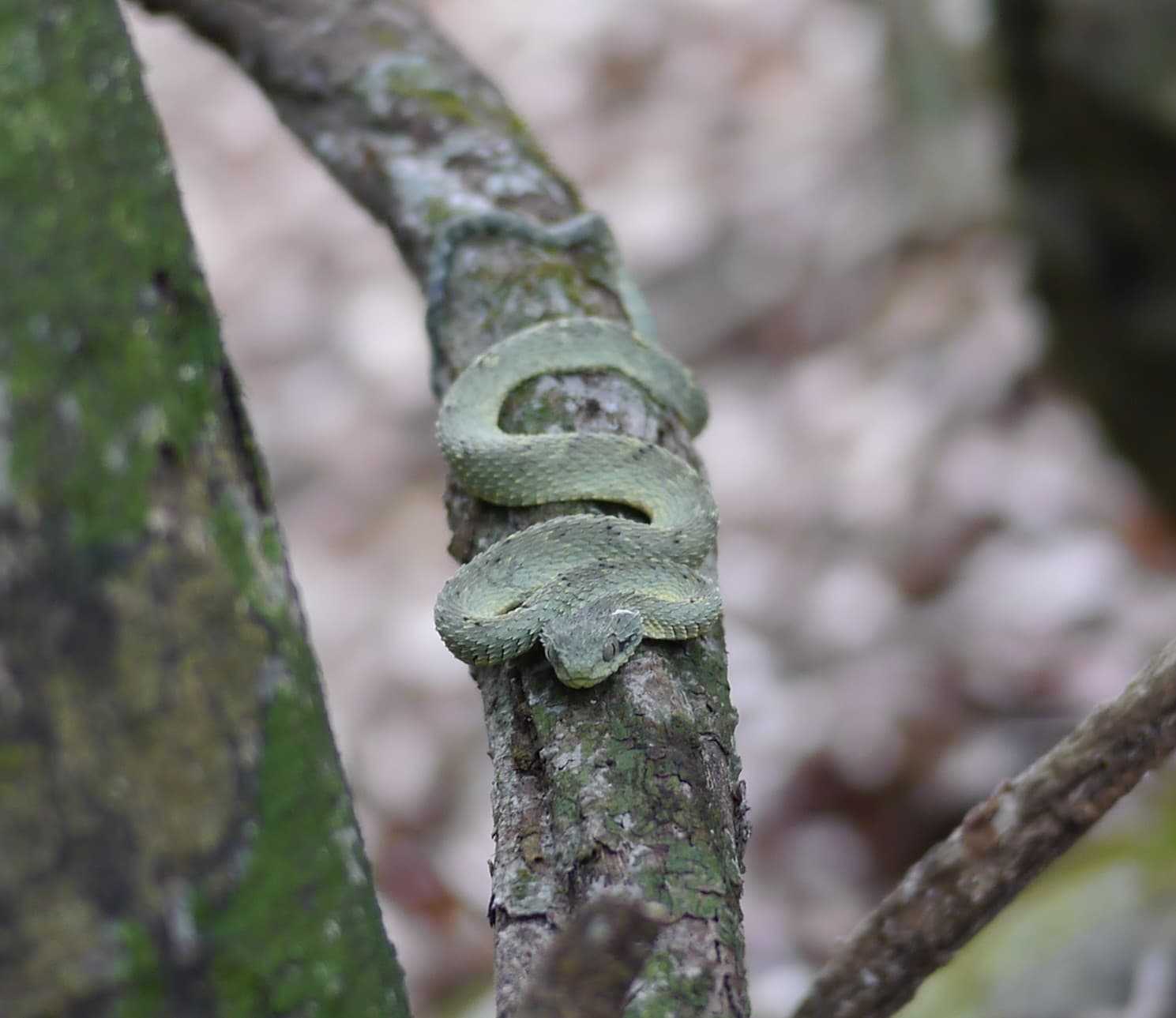
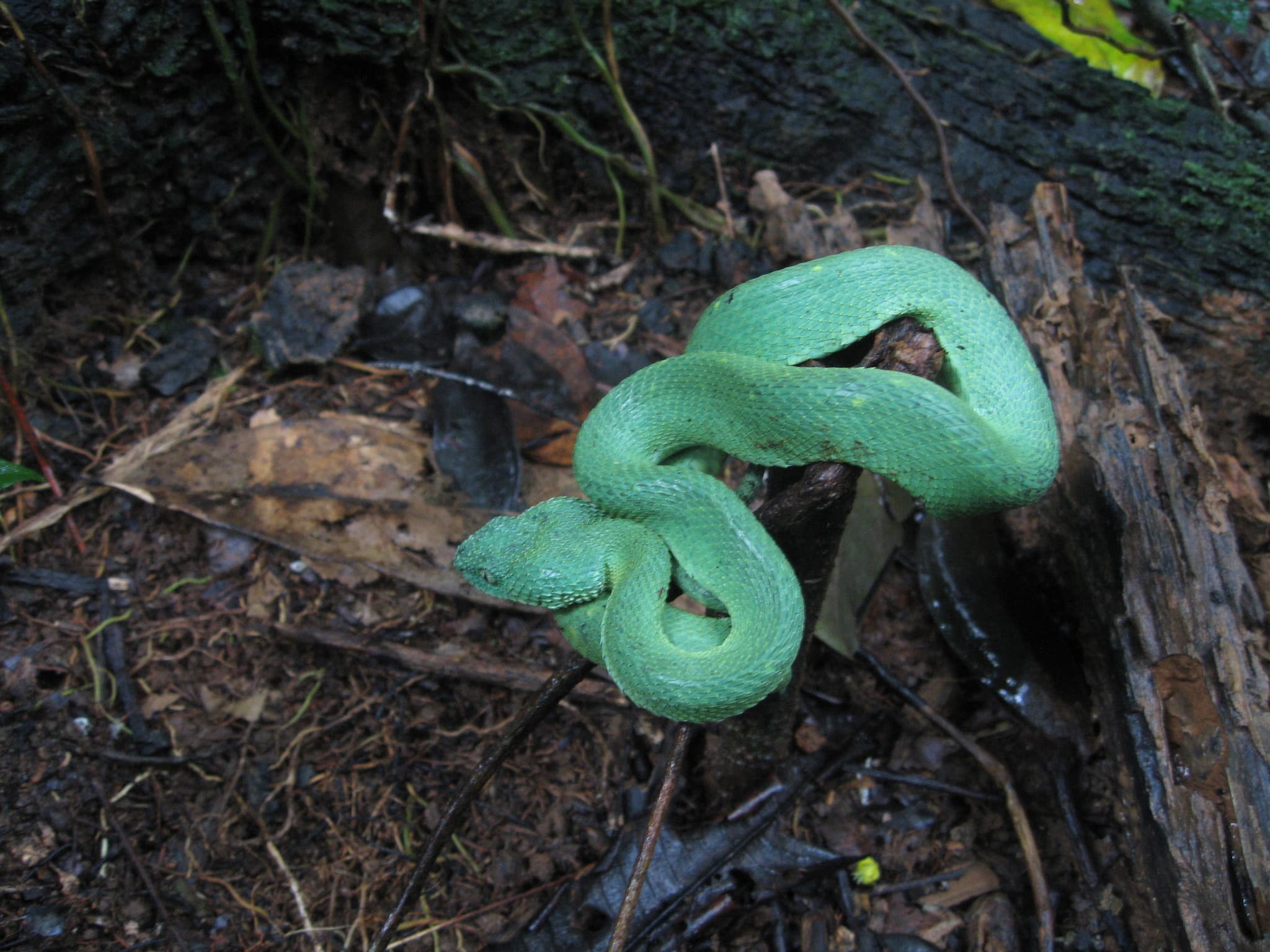
Bush Viper (Atheris) refers here to the living African vipers in genus Atheris. The Reptile Database currently lists 18 species in Atheris, ranging from the widespread variable bush viper to highly localized mountain endemics. Many species climb through shrubs and low trees with a prehensile tail, but the genus also includes more terrestrial forms. Bush vipers are true vipers without the heat-sensing facial pits of pit vipers, and every species must be treated as medically significant and observed from a distance. This guide separates well-supported biology from common assumptions and covers identification, range, habitat, diet, behavior, reproduction and conservation.
Identification
Most bush vipers have a broad triangular head, narrow neck, vertical pupils, keeled scales and a stout body ending in a tail that can grip branches. Scale texture ranges from moderately keeled in Atheris squamigera to dramatically blade-like in the spiny bush viper Atheris hispida. Green is common in some species, but individuals may be yellow, orange, brown, blue-gray, red or patterned. Color alone cannot identify a species; location, scale counts, head shape and expert review are essential. Females are often larger and heavier than males, while males of some species have relatively longer tails. Color and scale shape may overlap strongly between sexes, so external appearance is not a dependable universal method of sexing Atheris.
Identification should combine body shape, markings, size, voice or movement, and location. One feature by itself can overlap with a related animal, a juvenile, or an individual in unusual light.
Photographs are most useful when they preserve scale and show several diagnostic features. Handling or repositioning a wild bush viper for identification can cause stress and is unnecessary.
Size and physical adaptations
Bush Viper typically measures roughly 35–80 cm in many species; some individuals approach about 1 m and weighs Varies strongly by species, sex and condition; many are compact, light-bodied arboreal snakes. These are genus-wide representative values. Mountain dwarfs and large female variable bush vipers should not be described with one fixed range.
Its useful adaptations include strongly keeled scales break up the body outline, a prehensile tail anchors many species to branches, vertical pupils suit activity in dim forest light, hinged front fangs deliver venom quickly, camouflage matches leaves, moss, bark or forest litter, a compact body permits stable coiling on vegetation, slow ambush posture conserves energy. These traits work together in the animal’s normal setting rather than serving as isolated curiosities.
Published measurements may use different methods, life stages or sample locations. Comparing figures responsibly means checking what was measured rather than selecting the largest number available.
Range and distribution
Genus Atheris occurs in tropical sub-Saharan Africa, especially the rainforest belt of West and Central Africa and isolated highlands of East Africa. The country map combines documented genus-level occurrence and does not mean that every bush-viper species lives in every highlighted country. The native range includes Guinea, Sierra Leone, Liberia, Côte d’Ivoire, Ghana, Togo, Benin, Nigeria, Cameroon, Equatorial Guinea, Gabon, Republic of the Congo, Democratic Republic of the Congo, Central African Republic, Angola, Uganda, Kenya, Tanzania, Rwanda, Burundi, South Sudan, Zambia, Malawi, Mozambique.
A country-level map indicates broad distribution, not continuous occupation. Climate, elevation, water, vegetation, prey, breeding sites, barriers and survey effort all affect where records occur.
Records near the edge of the range deserve careful documentation because they may reflect natural movement, improved survey coverage, accidental transport or a genuine distribution change.
Habitat
Lowland rainforest, montane forest, bamboo, swamp-edge vegetation, moist savanna thickets, tea or coffee margins and highland grass-shrub mosaics, depending on species.
Many bush vipers wait on branches, vines or broad leaves from near ground level to several metres high. Their prehensile tails brace the body while the head faces a likely prey route. Some mountain species use dense shrubs, bamboo or grass around cool streams, and Atheris barbouri is unusually terrestrial. Humidity, shade and layered vegetation provide cover and suitable prey. Forest clearing can isolate populations on separate mountains, while simplified plantations may retain only a narrow portion of the original habitat. Protecting a population therefore requires the feeding, shelter and breeding features that make a site usable, along with connections that allow movement.
Microhabitat matters. Shade, soil, current, moisture, shelter or host plants can determine whether a small area is usable even when the surrounding landscape appears suitable.
Diet and feeding
Bush Viper is a carnivore. Important foods include small mammals, frogs, lizards, birds and nestlings, small snakes, rodents moving through vegetation. Bush vipers are primarily ambush hunters. A snake coils on a branch or among leaves and remains still until prey enters striking range. Hinged front fangs swing forward during the strike and inject venom. The snake may release mobile prey, then relocate it by scent, reducing the chance of injury during a struggle. Juveniles often take frogs and lizards, while larger adults can capture small mammals or birds. Diet differs by species, elevation and local prey supply.
Diet changes with age, season, location and food supply. A dramatic prey record does not establish what most individuals eat most of the time; repeated field observations provide a stronger picture.
Feeding opportunities also create risk. An animal focused on prey may be less alert to predators, traffic or people, while contaminated prey can transfer pollutants through the food web.
Behavior and communication
Often nocturnal or crepuscular, with resting and basking possible by day; documented schedules differ among named Atheris taxa and local temperatures. Most Atheris are solitary and secretive. They rely on camouflage and stillness rather than long pursuit, then move deliberately through vegetation using the tail as an anchor. A disturbed snake may freeze, tighten its coil, inflate or flatten the body, hiss and strike rapidly. Arboreal position does not make the animal reluctant to bite, and a branch-level snake can be difficult to see. Mountain forms may shelter closer to the ground during cool or dry conditions.
Chemical cues sampled by the tongue help bush vipers track prey and locate mates. Vision detects nearby movement, especially in dim light, while touch and body contact guide courtship. Defensive communication is mainly visual and acoustic: a tight S-shaped coil, body inflation, hissing and sudden strikes warn an approaching animal. There is no evidence that bright individuals advertise friendliness or safety. Behavior should be interpreted in context: alarm, courtship, feeding and temperature regulation can produce very different actions from the same animal.
Daily schedules are flexible responses, not rigid rules. Weather, breeding condition, disturbance, tides or food can move activity into a different part of the day.
Reproduction and development
Bush vipers give birth to live young rather than laying shelled eggs. Courtship and birth timing vary with species, altitude and rainfall. Developing embryos are retained inside the female until neonates are born in a protected part of the habitat. Litter size can range from a few young in small mountain species to more than a dozen in larger species. Because observations are sparse for many localized taxa, figures from Atheris squamigera should not be copied across the genus. Live litters range from a few young to more than a dozen, depending on species and female size Newborn bush vipers are independent, venomous and capable climbers. They take small frogs, lizards and mammals appropriate to their size. Juvenile color may differ from that of adults, and growth depends on temperature and feeding opportunity. There is no prolonged parental care after birth.
Young animals face different risks and may use different microhabitats or food than adults. Breeding success depends on adult condition, suitable sites and the survival of offspring through vulnerable early stages.
Counts of eggs or young describe reproductive output, not the number expected to reach adulthood. Mortality is normally greatest during eggs, larval or juvenile stages.
Predators and ecological role
Bush vipers are mid-level predators in African forest and mountain food webs. They reduce populations of frogs, lizards, birds and small mammals, while raptors, larger snakes and mammalian predators may take the vipers. Their dependence on intact vegetation connects them closely to forest structure. Narrow-range species can disappear from a mountain or forest fragment even when a widespread congener remains secure elsewhere, making species-level surveys essential. Documented or likely predators include Snake eagles, Hornbills, Monitor lizards, Larger snakes, Small carnivorans.
This animal is both a consumer and a food source. Its influence comes through many repeated interactions, so ecological claims should be based on measured populations rather than assumptions drawn from appearance.
Predator and prey relationships differ among places. A species can be ecologically influential without being abundant everywhere, and its role can change across its range.
Relationship with people
Bush vipers usually live in dense habitat away from heavy human traffic, but encounters occur during farming, forest work and travel through vegetation. Camouflage makes accidental proximity possible. People should use a light at night, wear protective footwear, avoid reaching blindly into shrubs and leave any snake an escape route. Conservation photography must never involve handling, pinning or repositioning a venomous animal.
Treat every Atheris as medically significant. After a suspected bite, move away, keep the patient calm and still, remove rings or tight items and arrange urgent transport to a medical facility. Do not cut the wound, suck venom, apply ice, use electric shock or tighten a tourniquet. Do not capture the snake. Treatment is supportive and species-specific antivenom may be unavailable, so professional care and monitoring are essential even when early swelling seems limited. Responsible observation means keeping an appropriate distance, avoiding capture or feeding, protecting habitat and following local wildlife or invasive-species guidance.
Wildlife guidance should come from the responsible local agency because collection rules, reporting requests and appropriate responses differ between native and introduced ranges.
Conservation
Genus Atheris has no single IUCN category. Species range from relatively widespread taxa to poorly known mountain endemics with tiny distributions. Each must be assessed separately, and missing population data should not be treated as evidence of security. The reported global trend is No single genus-wide trend; habitat loss is likely reducing several forest and mountain populations.
Important pressures include rainforest clearing, montane habitat loss, agricultural expansion, forest fragmentation, illegal or unsustainable collection, road development into remote forests, climate change in isolated highlands. Global status can hide local decline or recovery, so current regional monitoring and habitat management remain necessary.
The most useful conservation action follows the documented pressure. Protecting breeding sites, reducing road deaths or limiting pollutants can require different tools in different populations.