
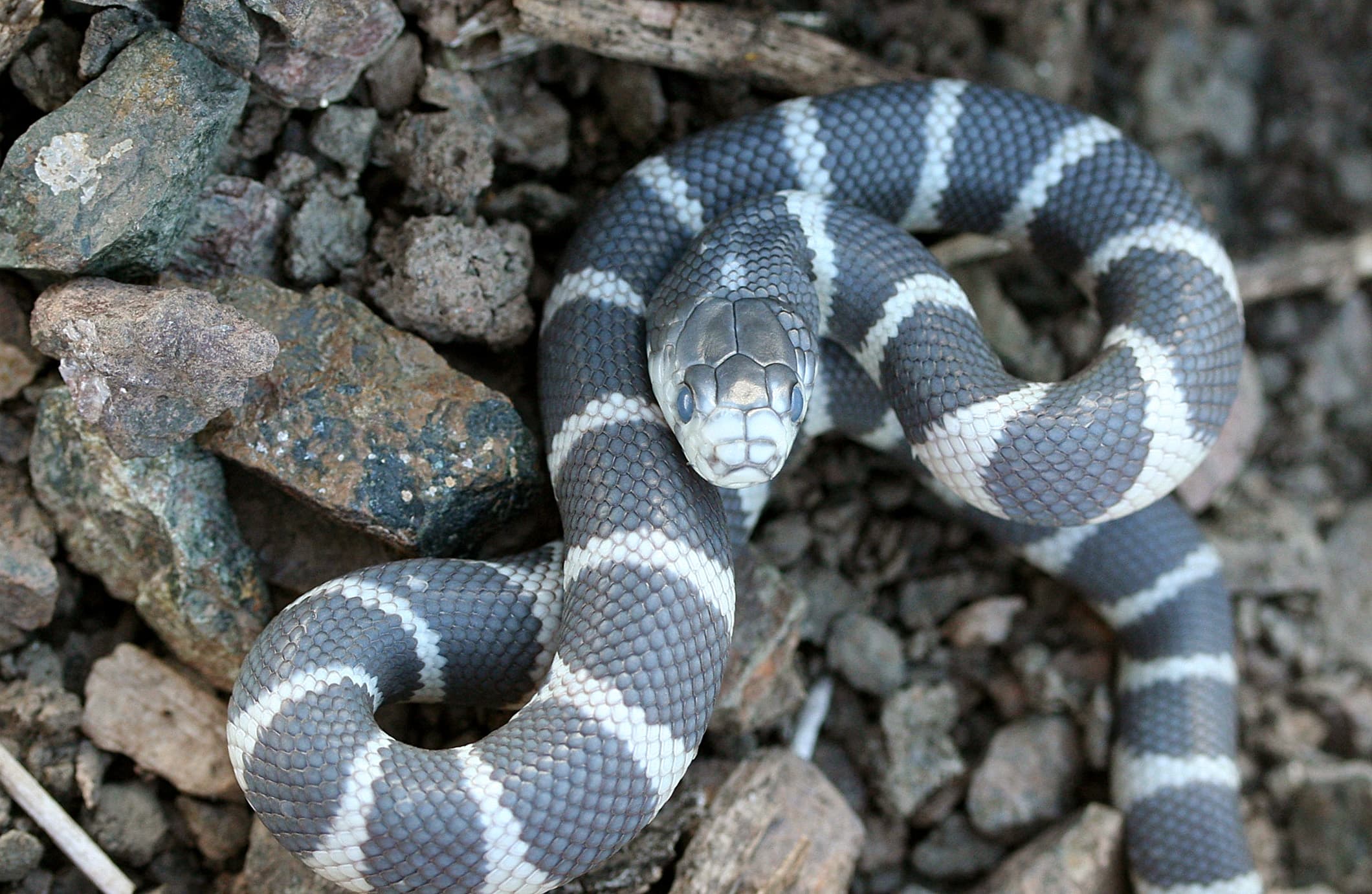
California Kingsnake (Lampropeltis californiae) is a medium-sized nonvenomous snake native to the western United States and northwestern Mexico. Most individuals are dark brown or black with contrasting cream or yellow bands, although striped and nearly black regional forms occur. It uses many habitats, from desert scrub and farmland to woodland and riparian corridors. The name kingsnake reflects its frequent predation on other snakes, including rattlesnakes. This guide separates well-supported biology from common assumptions and covers identification, range, habitat, diet, behavior, reproduction and conservation.
Identification
The body is muscular with smooth glossy scales. A typical animal has 21–44 broad light bands on a black or dark brown background, with the bands widening on the sides. Coastal southern California also supports a striped form with a narrow pale line running along the dark back. The head is only slightly wider than the neck, pupils are round and the belly is patterned in black and cream. Juveniles resemble small adults. Males and females overlap in size and pattern. Males generally have relatively longer tails beyond the cloaca, while females may become heavier. Reliable sexing requires trained examination.
Identification should combine body shape, markings, size, voice or movement, and location. One feature by itself can overlap with a related animal, a juvenile, or an individual in unusual light.
Photographs are most useful when they preserve scale and show several diagnostic features. Handling or repositioning a wild california kingsnake for identification can cause stress and is unnecessary.
Size and physical adaptations
California Kingsnake typically measures usually 76–122 cm total length, with exceptional animals approaching 2 m and weighs commonly several hundred grams, varying with length and condition. Extremely long records are unusual and should not be presented as the normal adult size.
Its useful adaptations include strong coils subdue vertebrate prey, resistance reduces effects of some rattlesnake venoms, smooth scales aid movement under cover, variable pattern camouflages local habitats, forked tongue follows chemical trails, flexible activity avoids temperature extremes, broad diet supports many habitats. These traits work together in the animal’s normal setting rather than serving as isolated curiosities.
Published measurements may use different methods, life stages or sample locations. Comparing figures responsibly means checking what was measured rather than selecting the largest number available.
Range and distribution
Native from southern Oregon through California, western Nevada, southern Utah and Arizona into Baja California and Sonora in Mexico. It has been introduced to Gran Canaria in Spain, where it is invasive. Country maps are broad and do not show local gaps or distinguish native from introduced range. The native range includes United States, Mexico, Spain.
A country-level map indicates broad distribution, not continuous occupation. Climate, elevation, water, vegetation, prey, breeding sites, barriers and survey effort all affect where records occur.
Records near the edge of the range deserve careful documentation because they may reflect natural movement, improved survey coverage, accidental transport or a genuine distribution change.
Habitat
Desert scrub, chaparral, grassland, woodland, riparian corridors, wetlands, rocky slopes, farmland and suburban edges from sea level to about 2,100 m.
Individuals shelter in rodent burrows, rock fissures, hollow logs, dense vegetation and beneath flat surface cover. Riparian zones and irrigated farmland can support abundant prey. In mountains they use deep winter dens, while desert snakes shift activity to cooler hours and remain underground through severe heat. Protecting a population therefore requires the feeding, shelter and breeding features that make a site usable, along with connections that allow movement.
Microhabitat matters. Shade, soil, current, moisture, shelter or host plants can determine whether a small area is usable even when the surrounding landscape appears suitable.
Diet and feeding
California Kingsnake is a generalist constrictor and snake predator. Important foods include rodents, lizards, rattlesnakes, other snakes, birds, bird eggs, frogs, occasional turtle eggs. The kingsnake searches by scent, seizes prey and applies tight coils that rapidly stop circulation. It can swallow prey headfirst or from another angle depending on resistance. Other snakes form an important part of the diet, but rodents, lizards, eggs and birds are also common. Cannibalism can occur.
Diet changes with age, season, location and food supply. A dramatic prey record does not establish what most individuals eat most of the time; repeated field observations provide a stronger picture.
Feeding opportunities also create risk. An animal focused on prey may be less alert to predators, traffic or people, while contaminated prey can transfer pollutants through the food web.
Behavior and communication
Diurnal in mild weather and increasingly crepuscular or nocturnal during hot summer conditions. A California Kingsnake usually hides or escapes when detected. If cornered it may coil, hiss, vibrate its tail, release foul-smelling musk and bite. These defenses can lead to confusion with a rattlesnake, but it has no rattle and no venom. It climbs and swims competently but spends much time on or below the ground.
A forked tongue samples chemical trails for prey and mates. Courtship uses pheromones, alignment and touch. Tail vibration, hissing, musk and defensive posture communicate alarm at close range, while ground vibration signals the approach of large animals. Behavior should be interpreted in context: alarm, courtship, feeding and temperature regulation can produce very different actions from the same animal.
Daily schedules are flexible responses, not rigid rules. Weather, breeding condition, disturbance, tides or food can move activity into a different part of the day.
Reproduction and development
Mating occurs mainly in spring after winter emergence. Males follow female scent and may compete physically. Following internal fertilization, the female places eggs in loose soil, a burrow, rotten wood or another warm, humid cavity. Usually 3–13 eggs, with larger clutches reported Hatchlings cut the shell with an egg tooth and receive no parental care. They begin with lizards, small snakes and newborn rodents. Growth and survival depend on prey, safe cover and avoiding raptors, mammals and larger snakes.
Young animals face different risks and may use different microhabitats or food than adults. Breeding success depends on adult condition, suitable sites and the survival of offspring through vulnerable early stages.
Counts of eggs or young describe reproductive output, not the number expected to reach adulthood. Mortality is normally greatest during eggs, larval or juvenile stages.
Predators and ecological role
California Kingsnakes regulate rodents, lizards and other snakes and are themselves prey for hawks, owls, mammals and larger reptiles. Their venom-resistant snake predation influences local reptile communities. On Gran Canaria, the same flexible diet harms endemic reptiles, showing how ecological value in a native range can become damage after introduction. Documented or likely predators include Red-Tailed Hawk, Great Horned Owl, Coyote, Gopher Snake, Feral Cat.
This animal is both a consumer and a food source. Its influence comes through many repeated interactions, so ecological claims should be based on measured populations rather than assumptions drawn from appearance.
Predator and prey relationships differ among places. A species can be ecologically influential without being abundant everywhere, and its role can change across its range.
Relationship with people
This snake benefits farms and neighborhoods by consuming rodents and is harmless when left alone. Give a wild snake space and contact a licensed relocator if necessary. Collection and possession rules differ among states and Mexico. On Gran Canaria, authorities control the introduced population to protect endemic wildlife; releasing captive snakes is illegal and ecologically damaging.
It is nonvenomous but can bite if restrained. Never handle an unidentified snake based on banding alone. Wash a bite with soap and water and seek care for deep punctures or infection. Keep hands away during feeding, and wash after reptile contact because healthy snakes can carry Salmonella. Responsible observation means keeping an appropriate distance, avoiding capture or feeding, protecting habitat and following local wildlife or invasive-species guidance.
Wildlife guidance should come from the responsible local agency because collection rules, reporting requests and appropriate responses differ between native and introduced ranges.
Conservation
The California Kingsnake is widespread and generally treated as Least Concern across its native range. Regional populations can still decline through road mortality, development, persecution, disease and collection. On Gran Canaria it is an invasive species subject to control rather than conservation. The reported global trend is Stable overall in the native range, with local declines and an expanding introduced population.
Important pressures include road mortality, urban development, habitat fragmentation, deliberate killing, wild collection, snake fungal disease, feral predators, invasive spread through pet release. Global status can hide local decline or recovery, so current regional monitoring and habitat management remain necessary.
The most useful conservation action follows the documented pressure. Protecting breeding sites, reducing road deaths or limiting pollutants can require different tools in different populations.