
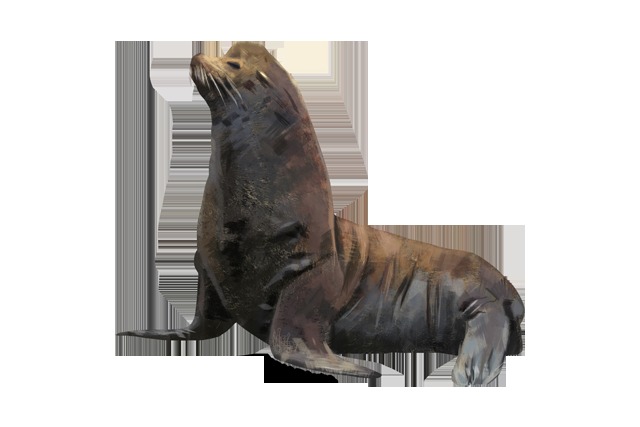
California Sea Lion (Zalophus californianus) is the familiar barking marine mammal seen along the Pacific coast of North America. Unlike a true seal, it has visible external ear flaps, long foreflippers and hind flippers that rotate beneath the body, allowing it to walk efficiently on land. It is intelligent and adaptable, but remains protected wildlife whose behavior is shaped by ocean conditions. This guide separates well-supported biology from common assumptions and covers identification, range, habitat, diet, behavior, reproduction and conservation.
Identification
Females and juveniles are slender, tan to blonde and have a long narrow muzzle. Adult males become much larger and dark chocolate brown, developing a thick neck and a raised sagittal crest on the forehead that often carries pale hair. Both sexes have visible ear flaps, broad foreflippers and three to five claws on each hind flipper. Pups are dark brown at birth and molt to a lighter coat after several months. Adult males can weigh nearly three times as much as females and develop a prominent forehead crest and thick neck.
Identification should combine body shape, markings, size, voice or movement, and location. One feature by itself can overlap with a related animal, a juvenile, or an individual in unusual light.
Photographs are most useful when they preserve scale and show several diagnostic features. Handling or repositioning a wild california sea lion for identification can cause stress and is unnecessary.
Size and physical adaptations
California Sea Lion typically measures females about 1.8 m; males up to about 2.3 m and weighs females about 100–110 kg; males commonly 250–320 kg. Adult male mass changes greatly through the breeding season as territorial bulls fast and lose stored fat.
Its useful adaptations include streamlined body for fast swimming, long foreflippers provide underwater propulsion, rotating hind flippers support walking on land, sensitive whiskers detect water movement, closable nostrils during dives, thick blubber stores energy and limits heat loss, high blood volume and oxygen-binding proteins support diving. These traits work together in the animal’s normal setting rather than serving as isolated curiosities.
Published measurements may use different methods, life stages or sample locations. Comparing figures responsibly means checking what was measured rather than selecting the largest number available.
Range and distribution
Coastal waters of the eastern North Pacific from central Mexico and the Gulf of California north along the United States West Coast into British Columbia and, seasonally, southeastern Alaska. Major breeding rookeries lie from the Channel Islands south along Baja California and in the Gulf of California. The native range includes Canada, Mexico, United States.
A country-level map indicates broad distribution, not continuous occupation. Climate, elevation, water, vegetation, prey, breeding sites, barriers and survey effort all affect where records occur.
Records near the edge of the range deserve careful documentation because they may reflect natural movement, improved survey coverage, accidental transport or a genuine distribution change.
Habitat
Productive coastal ocean, continental-shelf waters, island beaches, rocky coves, caves, jetties, navigation buoys and marina docks.
Breeding females and pups gather at warm southern rookeries, while many males migrate north after breeding to forage off California, Oregon, Washington, British Columbia and Alaska. At sea the animals seek squid and schooling fish in upwelling zones. On land they choose sites that allow rest, social contact and quick water access, including artificial docks where crowding can damage property. Protecting a population therefore requires the feeding, shelter and breeding features that make a site usable, along with connections that allow movement.
Microhabitat matters. Shade, soil, current, moisture, shelter or host plants can determine whether a small area is usable even when the surrounding landscape appears suitable.
Diet and feeding
California Sea Lion is a carnivore. Important foods include anchovies, sardines, mackerel, hake, rockfish, salmonids, market squid, other schooling fish and cephalopods. California Sea Lions are opportunistic pursuit predators. They locate prey with vision and exquisitely sensitive whiskers, chase individual fish or concentrate on schools and swallow most food whole. Diet shifts with season, location and ocean conditions. During strong marine heat waves or poor upwelling, mothers may travel farther to find energy-rich prey, increasing the nutritional strain on nursing pups.
Diet changes with age, season, location and food supply. A dramatic prey record does not establish what most individuals eat most of the time; repeated field observations provide a stronger picture.
Feeding opportunities also create risk. An animal focused on prey may be less alert to predators, traffic or people, while contaminated prey can transfer pollutants through the food web.
Behavior and communication
Active by day and night at sea; rests in dense groups on shore between foraging trips. These sea lions are highly social at haul-outs and communicate constantly with barks, growls and posture. In water they travel alone or in groups, porpoising at the surface and sometimes rafting together while resting. Adult bulls establish breeding territories and patrol boundaries, using displays and fights to exclude rivals. Outside the breeding season, animals mix more freely around feeding and resting sites.
Mothers and pups learn individually distinctive calls and can recognize each other amid thousands of animals. Territorial males bark repeatedly and display their size, while growls, lunges and open-mouth threats regulate spacing. Whisker and nose contact convey information at close range. Their hearing works in air and underwater, supporting social contact across the shoreline. Behavior should be interpreted in context: alarm, courtship, feeding and temperature regulation can produce very different actions from the same animal.
Daily schedules are flexible responses, not rigid rules. Weather, breeding condition, disturbance, tides or food can move activity into a different part of the day.
Reproduction and development
Most pups are born from May through July on island or mainland rookeries. Bulls arrive first and establish territories, then mate with females after they give birth. Implantation of the embryo is delayed, helping keep annual births synchronized. A mother alternates shore visits for nursing with multi-day foraging trips at sea and identifies her pup by voice and smell. Usually one pup A newborn pup weighs about 7–9 kilograms and depends completely on rich milk. It begins swimming in sheltered water after several weeks and gradually learns to forage. Nursing commonly continues for 6–11 months and can occasionally last longer. Young animals refine diving, prey capture and social behavior through exploration and play.
Young animals face different risks and may use different microhabitats or food than adults. Breeding success depends on adult condition, suitable sites and the survival of offspring through vulnerable early stages.
Counts of eggs or young describe reproductive output, not the number expected to reach adulthood. Mortality is normally greatest during eggs, larval or juvenile stages.
Predators and ecological role
California Sea Lions connect productive offshore food webs with island and coastal ecosystems. They consume fish and squid and are prey for white sharks and killer whales. Their guano transfers marine nutrients to haul-out sites. Because they feed high in the food chain, domoic acid from harmful algal blooms can concentrate in their prey and cause seizures, heart damage, reproductive failure or death. Documented or likely predators include Great White Shark, Killer Whale, Human, Coyote.
This animal is both a consumer and a food source. Its influence comes through many repeated interactions, so ecological claims should be based on measured populations rather than assumptions drawn from appearance.
Predator and prey relationships differ among places. A species can be ecologically influential without being abundant everywhere, and its role can change across its range.
Relationship with people
This species was once killed heavily for oil and other products, but legal protection allowed strong recovery. Today California Sea Lions support tourism, public education and marine research while sometimes competing with fisheries or damaging docks. NOAA authorizes specific management actions under law, but private harassment, feeding and shooting remain illegal. Rescue networks treat entanglement, malnutrition and toxic-algae cases.
Stay at least 50 feet away where NOAA guidance applies, keep dogs leashed, never feed or touch an animal and leave it a clear path to the water. A resting pup is not automatically abandoned; call the regional stranding network rather than intervening. Adult males are powerful, fast on land and capable of a severe bite. Responsible observation means keeping an appropriate distance, avoiding capture or feeding, protecting habitat and following local wildlife or invasive-species guidance.
Wildlife guidance should come from the responsible local agency because collection rules, reporting requests and appropriate responses differ between native and introduced ranges.
Conservation
The species is globally assessed as Least Concern and the U.S. stock increased strongly after federal protection. Local colonies still face years of poor prey, harmful algal blooms, disease, entanglement, illegal shooting and disturbance. The reported global trend is Generally stable or increasing overall, with regional and annual fluctuations.
Important pressures include domoic acid from harmful algal blooms, entanglement in nets, lines and packing bands, reduced prey during marine heat waves, illegal feeding and shooting, plastic ingestion and pollutants, disturbance at rookeries and haul-outs. Global status can hide local decline or recovery, so current regional monitoring and habitat management remain necessary.
The most useful conservation action follows the documented pressure. Protecting breeding sites, reducing road deaths or limiting pollutants can require different tools in different populations.