
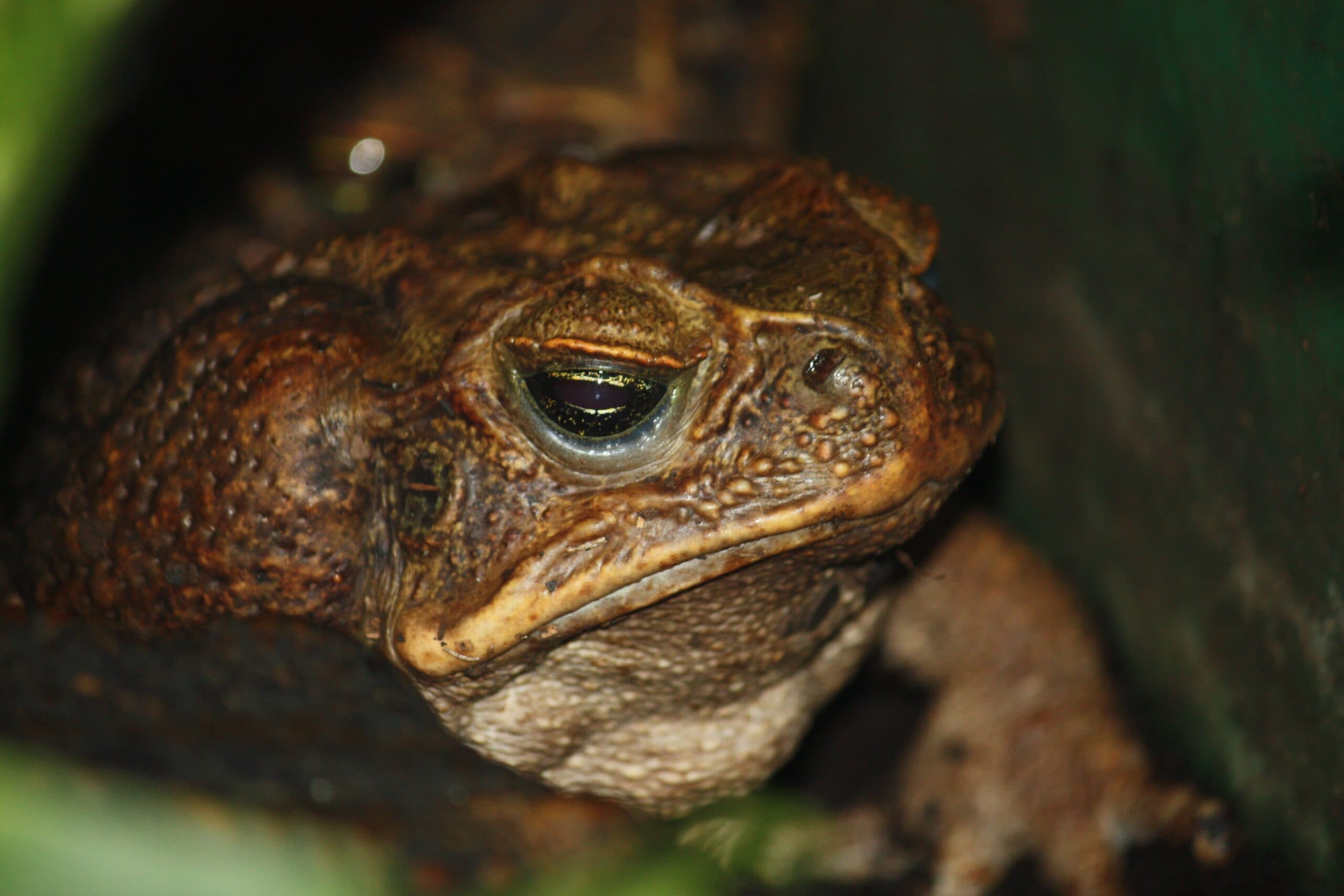
Cane Toad (Rhinella marina) is a large terrestrial amphibian native to South America east of the Andes. It thrives in warm open habitats near breeding water and eats almost any small animal it can overpower. Humans transported cane toads around the tropics in failed attempts to control crop insects, and their toxins, high reproductive output and ability to use disturbed landscapes made them notorious invaders. This guide separates well-supported biology from common assumptions and covers identification, range, habitat, diet, behavior, reproduction and conservation.
Identification
Adults are heavy-bodied with dry warty skin, a broad head, horizontal pupils and golden irises. Angular bony ridges cross the head above the eyes. The most important field mark is a pair of very large triangular parotoid glands behind the eyes, which extend down the shoulder and release milky toxin under pressure. Color ranges from tan and olive to dark mottled brown; the belly is pale and often spotted. Females grow larger and often have smoother, more mottled backs. Breeding males develop rough nuptial pads on the thumbs and stronger forelimbs for holding a female.
Identification should combine body shape, markings, size, voice or movement, and location. One feature by itself can overlap with a related animal, a juvenile, or an individual in unusual light.
Photographs are most useful when they preserve scale and show several diagnostic features. Handling or repositioning a wild cane toad for identification can cause stress and is unnecessary.
Size and physical adaptations
Cane Toad typically measures commonly 10–18 cm snout to vent; exceptional animals about 24 cm and weighs large adults can exceed 1 kg; exceptional females approach 1.5 kg. Introduced populations and moist productive regions can produce especially large females.
Its useful adaptations include parotoid glands secrete potent bufotoxins, warty water-resistant skin reduces moisture loss, broad diet includes live prey, carrion and discarded food, tolerates brackish breeding water better than many amphibians, large clutches colonize temporary water quickly, strong juveniles disperse through open disturbed ground, can aestivate during cold or dry periods. These traits work together in the animal’s normal setting rather than serving as isolated curiosities.
Published measurements may use different methods, life stages or sample locations. Comparing figures responsibly means checking what was measured rather than selecting the largest number available.
Range and distribution
Native across much of tropical and subtropical South America east of the Andes. Human introductions created populations in Australia, Florida, Hawaii, Puerto Rico, many Caribbean and Pacific islands, Papua New Guinea and the Philippines. Some populations long labeled R. marina may contain or represent R. horribilis, so taxonomic confirmation matters. The native range includes Argentina, Bolivia, Brazil, Colombia, Ecuador, French Guiana, Guyana, Paraguay, Peru, Suriname, Uruguay, Venezuela.
A country-level map indicates broad distribution, not continuous occupation. Climate, elevation, water, vegetation, prey, breeding sites, barriers and survey effort all affect where records occur.
Records near the edge of the range deserve careful documentation because they may reflect natural movement, improved survey coverage, accidental transport or a genuine distribution change.
Habitat
Forest edge, savanna, riverside grassland, farms, gardens, golf courses, drainage canals, suburban lots and other warm disturbed habitats near standing water.
Adults spend most time on land and shelter by day beneath logs, debris, vegetation or shallow soil. At night they forage in open areas and gather under artificial lights where insects concentrate. Rain triggers movement toward ponds, ditches and slow water for breeding. Roads and cleared corridors accelerate spread, while severe cold and prolonged dryness restrict survival. Protecting a population therefore requires the feeding, shelter and breeding features that make a site usable, along with connections that allow movement.
Microhabitat matters. Shade, soil, current, moisture, shelter or host plants can determine whether a small area is usable even when the surrounding landscape appears suitable.
Diet and feeding
Cane Toad is a opportunistic carnivore. Important foods include beetles, ants and termites, cockroaches, spiders, snails, small frogs and lizards, carrion, pet food and refuse. A Cane Toad waits for movement, then lunges and flips prey into its mouth with a sticky tongue. Unlike many frogs it can also use smell to locate immobile food. Adults take an unusually broad range of invertebrates and small vertebrates and may eat smaller cane toads. In towns they exploit pet food, garbage and insects drawn to porch lights, behavior that brings them close to dogs and people.
Diet changes with age, season, location and food supply. A dramatic prey record does not establish what most individuals eat most of the time; repeated field observations provide a stronger picture.
Feeding opportunities also create risk. An animal focused on prey may be less alert to predators, traffic or people, while contaminated prey can transfer pollutants through the food web.
Behavior and communication
Mostly nocturnal, especially in hot climates; emerges in numbers after warm rain. Adults are largely solitary outside breeding gatherings. They move in short firm hops and often sit upright while scanning for prey. When threatened, a toad inflates its body, lowers its head and presents the parotoid glands. Pressure from a predator’s bite can squeeze toxin into the mouth. During drought or cool weather the animal becomes inactive in a protected retreat and resumes feeding when warmth and moisture return.
Breeding males call from the water with a low, pulsing trill often compared with a distant tractor. The vocal sac amplifies sound, and choruses help females locate breeding sites. Toads also perceive ground vibration, touch and chemical cues. Tadpoles release alarm chemicals when attacked, and chemical signals influence schooling and avoidance. Behavior should be interpreted in context: alarm, courtship, feeding and temperature regulation can produce very different actions from the same animal.
Daily schedules are flexible responses, not rigid rules. Weather, breeding condition, disturbance, tides or food can move activity into a different part of the day.
Reproduction and development
Cane Toads can breed through much of the year in warm climates, especially after heavy rain. A male clasps a female behind the forelimbs in amplexus while she releases two long strings of eggs and he fertilizes them externally. Ponds, canals, puddles and even mildly brackish water may be used. Adults provide no care after spawning. About 5,000–32,000 eggs in gelatinous strings Small black tadpoles school in shallow warm water and graze algae, detritus and organic matter. They contain toxins that can kill predators unfamiliar with cane toads. Metamorphosis may occur within a few weeks, producing tiny dark toadlets that leave water in dense waves. Rapid juvenile growth and dispersal help colonize new habitat.
Young animals face different risks and may use different microhabitats or food than adults. Breeding success depends on adult condition, suitable sites and the survival of offspring through vulnerable early stages.
Counts of eggs or young describe reproductive output, not the number expected to reach adulthood. Mortality is normally greatest during eggs, larval or juvenile stages.
Predators and ecological role
In its native range the Cane Toad is one component of a diverse predator community, and some predators tolerate or avoid its toxins. In invaded regions, large lizards, snakes, crocodilians and marsupials may die after trying to eat it. Toads also consume native animals and compete for food and breeding water. Native predators can evolve or learn avoidance, but ecological effects vary among habitats and species. Documented or likely predators include Keelback Snake, Caiman, Birds, Human, Domestic Dog.
This animal is both a consumer and a food source. Its influence comes through many repeated interactions, so ecological claims should be based on measured populations rather than assumptions drawn from appearance.
Predator and prey relationships differ among places. A species can be ecologically influential without being abundant everywhere, and its role can change across its range.
Relationship with people
The common name comes from releases intended to control beetles in sugarcane. The toads rarely solved those pest problems because crop beetles and terrestrial toads often occupied different places. In Australia and on islands, agencies now focus on containment, humane removal, pet safety, community reporting and protection of vulnerable predators. Native South American populations are ordinary wildlife rather than pests.
Never lick, squeeze or handle a Cane Toad with bare hands. Keep children and pets away, bring pet food indoors and supervise dogs outside at night. If toxin contacts eyes or mouth, rinse with abundant water while keeping runoff out of the throat and contact a poison center, veterinarian or emergency service immediately. Follow local rules for identification and humane removal. Responsible observation means keeping an appropriate distance, avoiding capture or feeding, protecting habitat and following local wildlife or invasive-species guidance.
Wildlife guidance should come from the responsible local agency because collection rules, reporting requests and appropriate responses differ between native and introduced ranges.
Conservation
Rhinella marina is widespread and assessed as Least Concern in its native range. Conservation concern focuses on damage caused by introduced populations, while careless control can harm native amphibians that resemble young Cane Toads. The reported global trend is Stable overall and expanding in many introduced regions.
Important pressures include local habitat loss in native wetlands, road mortality, disease and drought, control campaigns in invaded areas, taxonomic confusion with native or related toads. Global status can hide local decline or recovery, so current regional monitoring and habitat management remain necessary.
The most useful conservation action follows the documented pressure. Protecting breeding sites, reducing road deaths or limiting pollutants can require different tools in different populations.