
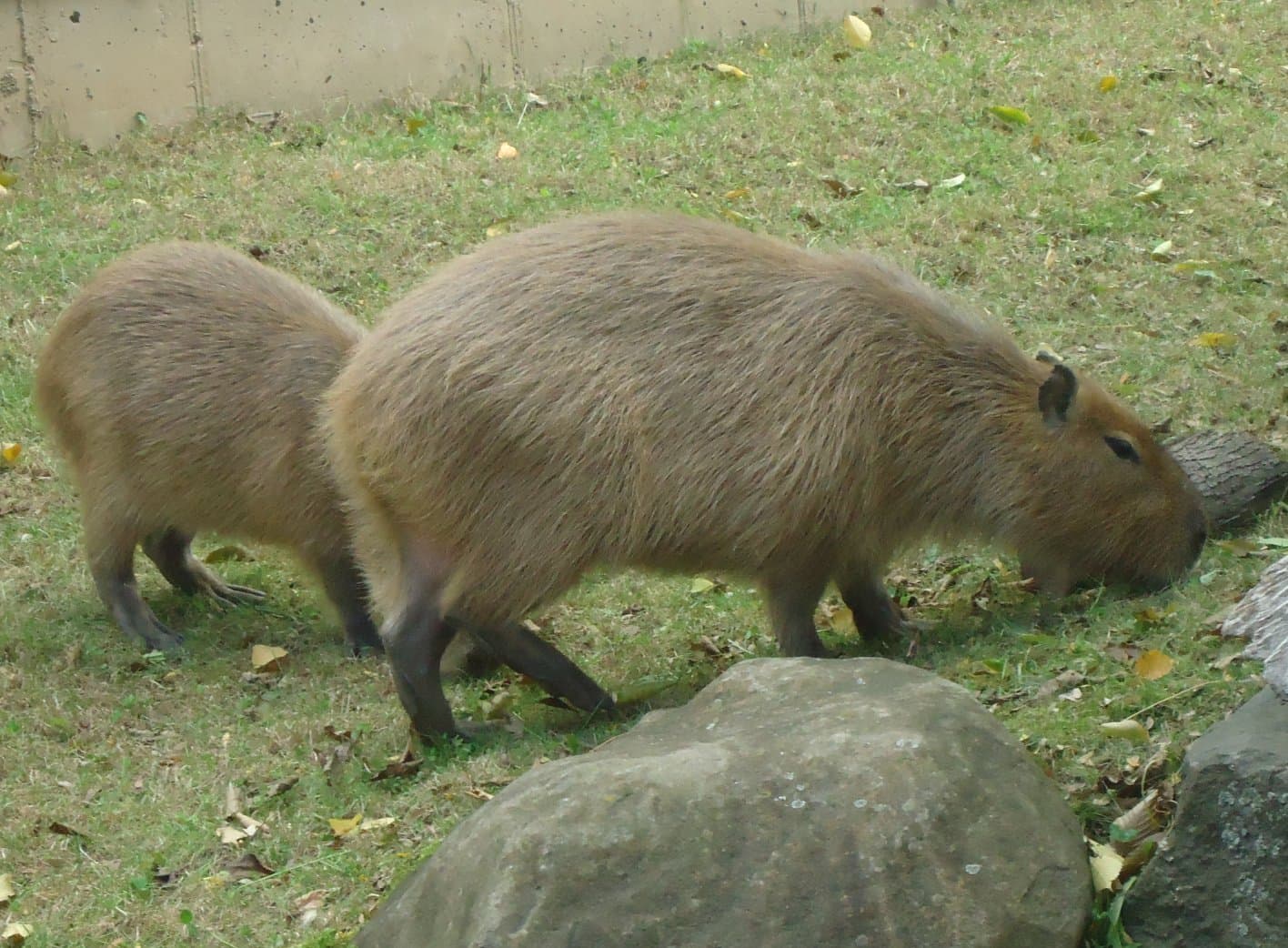
Capybara (Hydrochoerus hydrochaeris) is a large semiaquatic rodent native to tropical and temperate South America. It lives wherever grazing ground lies close to dependable water, from seasonally flooded savannas and marshes to gallery forest, ranchland and urban wetlands. Its calm appearance hides a highly social, alert animal whose daily schedule follows heat, water and predation risk. This guide separates well-supported biology from common assumptions and covers identification, range, habitat, diet, behavior, reproduction and conservation.
Identification
A Capybara has a deep barrel-shaped body, blunt rectangular head, small rounded ears and almost no visible tail. The coarse sparse coat ranges from reddish brown to gray-brown, becoming paler below. Eyes, ears and nostrils sit high on the head, allowing the animal to watch, hear and breathe while most of its body remains submerged. Its forefeet have four toes, hind feet three, and the toes are partly webbed. Females average slightly heavier than males. Adult males carry a conspicuous dark scent gland, called a morrillo, on the top of the snout.
Identification should combine body shape, markings, size, voice or movement, and location. One feature by itself can overlap with a related animal, a juvenile, or an individual in unusual light.
Photographs are most useful when they preserve scale and show several diagnostic features. Handling or repositioning a wild capybara for identification can cause stress and is unnecessary.
Size and physical adaptations
Capybara typically measures about 106–134 cm head and body and weighs commonly 35–66 kg, with exceptional animals heavier. Body mass varies with sex, age, season and food supply; females tend to be slightly larger.
Its useful adaptations include eyes, ears and nostrils positioned high on the head, partly webbed toes for efficient swimming, dense body and short limbs for moving through water, continuously growing incisors for cropping tough plants, hindgut fermentation of fibrous forage, coprophagy to recover nutrients from specially produced feces, scent glands used to mark group territory. These traits work together in the animal’s normal setting rather than serving as isolated curiosities.
Published measurements may use different methods, life stages or sample locations. Comparing figures responsibly means checking what was measured rather than selecting the largest number available.
Range and distribution
Lowland South America east of the Andes, from Venezuela and the Guianas through the Amazon and Pantanal south to Uruguay and northern and central Argentina. The species is naturally absent from Chile and most high Andean country. Local abundance rises and falls with wetland condition, hunting and ranch management. The native range includes Argentina, Bolivia, Brazil, Colombia, Ecuador, French Guiana, Guyana, Paraguay, Peru, Suriname, Uruguay, Venezuela.
A country-level map indicates broad distribution, not continuous occupation. Climate, elevation, water, vegetation, prey, breeding sites, barriers and survey effort all affect where records occur.
Records near the edge of the range deserve careful documentation because they may reflect natural movement, improved survey coverage, accidental transport or a genuine distribution change.
Habitat
Riverbanks, marshes, flooded savannas, lakeshores, gallery forest, seasonally wet grassland, cattle ranches and urban wetlands with permanent water nearby.
Water is essential for cooling, mating and escape. Groups rest in shade or shallow water during the hottest hours, graze on nearby grass at cooler times and retreat to deep water when threatened. In seasonally flooded landscapes they shift feeding sites as water levels change. They usually remain within a short run of water, although drought can concentrate many animals around the remaining pools. Protecting a population therefore requires the feeding, shelter and breeding features that make a site usable, along with connections that allow movement.
Microhabitat matters. Shade, soil, current, moisture, shelter or host plants can determine whether a small area is usable even when the surrounding landscape appears suitable.
Diet and feeding
Capybara is a herbivore. Important foods include grasses, aquatic plants, sedges, leaves, bark, fruit when available, cultivated crops near wetlands. Capybaras are selective grazers that crop protein-rich grasses during the wet season and broaden the diet when dry conditions reduce fresh growth. Their orange incisors grow continuously and withstand repeated cutting. Microbes in the enlarged cecum ferment cellulose after food passes the stomach. The animals practice coprophagy, reingesting soft nutrient-rich feces, usually in the morning, so vitamins and microbial protein can be absorbed on a second pass.
Diet changes with age, season, location and food supply. A dramatic prey record does not establish what most individuals eat most of the time; repeated field observations provide a stronger picture.
Feeding opportunities also create risk. An animal focused on prey may be less alert to predators, traffic or people, while contaminated prey can transfer pollutants through the food web.
Behavior and communication
Often crepuscular, with morning and evening grazing; more nocturnal where people, heat or hunting create disturbance. A typical group contains a dominant male, several adult females, subordinate males and young. Group size often expands in the dry season when animals gather around limited water. Members rest, graze and travel together, and adults may share vigilance around young. On alarm a Capybara barks and the group rushes into water; it can swim strongly and remain almost fully submerged. Stable dominance reduces constant fighting, although males chase and spar over breeding access.
The vocal repertoire includes sharp alarm barks, whistles, squeals, grunts, purr-like contact sounds and tooth chattering. Scent is equally important. Both sexes possess anal scent glands, and males rub the enlarged morrillo on vegetation. Odor marks advertise identity, status and reproductive condition, while close group members maintain contact through calls and touch. Behavior should be interpreted in context: alarm, courtship, feeding and temperature regulation can produce very different actions from the same animal.
Daily schedules are flexible responses, not rigid rules. Weather, breeding condition, disturbance, tides or food can move activity into a different part of the day.
Reproduction and development
Breeding can occur throughout the year where food and water remain stable, but births often peak with favorable wet-season forage. Courtship and mating commonly take place in water. A dominant male gains many matings, yet subordinate males may also reproduce. Females give birth on land without building a nest. Usually 2–8 pups, commonly about 4 Pups are precocial: they are furred, open-eyed and mobile soon after birth. They begin nibbling grass within days while nursing for several months. Young may suckle from females other than their mother, and several females help maintain the nursery group. Juveniles learn feeding areas, alarm responses and routes between grazing sites and water by following adults.
Young animals face different risks and may use different microhabitats or food than adults. Breeding success depends on adult condition, suitable sites and the survival of offspring through vulnerable early stages.
Counts of eggs or young describe reproductive output, not the number expected to reach adulthood. Mortality is normally greatest during eggs, larval or juvenile stages.
Predators and ecological role
Capybaras convert wetland grasses into prey biomass for large carnivores and scavengers. Jaguars, pumas and large caimans can kill adults, while anacondas, ocelots, foxes and raptors more often take young. Grazing influences waterside vegetation, and dung returns nutrients to soil and water. Capybaras also host ticks and other parasites, making their abundance relevant to veterinary and public-health monitoring in some regions. Documented or likely predators include Jaguar, Puma, Black Caiman, Green Anaconda, Human.
This animal is both a consumer and a food source. Its influence comes through many repeated interactions, so ecological claims should be based on measured populations rather than assumptions drawn from appearance.
Predator and prey relationships differ among places. A species can be ecologically influential without being abundant everywhere, and its role can change across its range.
Relationship with people
People hunt Capybaras for meat, hide and grease, and some ranches manage harvests under wildlife regulations. Elsewhere the animals are valued for tourism or tolerated because cattle pasture and artificial ponds create favorable habitat. Conflict arises when dense populations eat crops, damage landscaping or increase vehicle-collision and tick concerns. Effective management protects wetland function, regulates harvest and avoids feeding habituated urban groups.
Observe from a distance, keep dogs leashed and never corner or hand-feed a Capybara. Although usually calm, it has long incisors and can bite when frightened or defending young. Avoid touching wild animals or their ticks, and follow local health advice in regions where capybara-associated ticks transmit disease. Drivers should slow near wetlands at dawn and dusk. Responsible observation means keeping an appropriate distance, avoiding capture or feeding, protecting habitat and following local wildlife or invasive-species guidance.
Wildlife guidance should come from the responsible local agency because collection rules, reporting requests and appropriate responses differ between native and introduced ranges.
Conservation
The IUCN assesses the greater Capybara as Least Concern because it remains widespread and can thrive in some modified landscapes. Local populations can still be depleted by unregulated hunting, wetland loss, drought, road mortality and persecution. The reported global trend is Generally stable at species level, with strong regional variation.
Important pressures include wetland drainage and river alteration, unregulated hunting and poaching, severe drought and wildfire, road collisions, conflict over crops and landscaping, disease-control killing without ecological planning. Global status can hide local decline or recovery, so current regional monitoring and habitat management remain necessary.
The most useful conservation action follows the documented pressure. Protecting breeding sites, reducing road deaths or limiting pollutants can require different tools in different populations.