
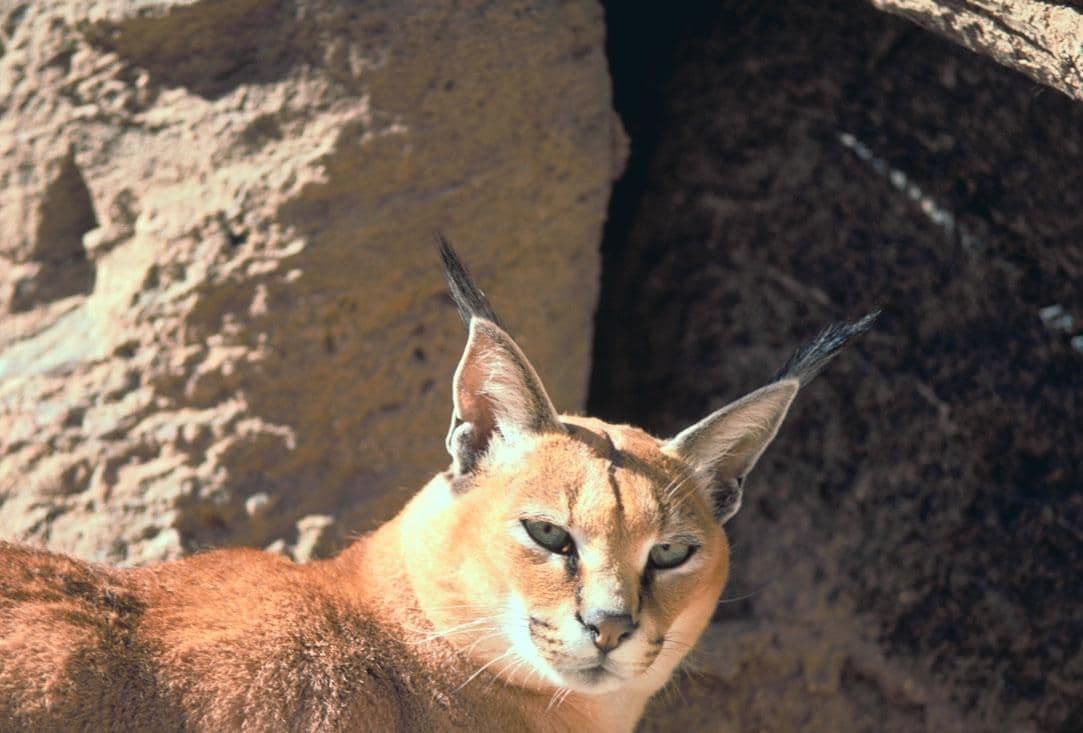
Caracal (Caracal caracal) is a medium-sized wild cat recognized by its plain reddish coat, athletic build and exceptionally long black ear tufts. It occupies a huge but uneven range across Africa and into southwestern and central Asia. The cat is secretive, usually solitary and often active after dark, so it may live near farms and villages while remaining rarely seen. This guide separates well-supported biology from common assumptions and covers identification, range, habitat, diet, behavior, reproduction and conservation.
Identification
The body is slender yet muscular, with long hind legs, a short face and a relatively short tail. Most adults are uniform tawny, sandy or brick red above and cream below. Black facial lines run from the eyes toward the nose, and the backs of the pointed ears are black. Each ear ends in a flexible black tuft that can exceed 4 centimeters. Rare melanistic animals are nearly black. Males are usually larger and heavier than females, but both sexes share the same coat pattern and long ear tufts.
Identification should combine body shape, markings, size, voice or movement, and location. One feature by itself can overlap with a related animal, a juvenile, or an individual in unusual light.
Photographs are most useful when they preserve scale and show several diagnostic features. Handling or repositioning a wild caracal for identification can cause stress and is unnecessary.
Size and physical adaptations
Caracal typically measures about 62–91 cm head and body and weighs females commonly 6–16 kg; males about 8–20 kg. Size varies geographically, and males overlap females at the ends of their ranges.
Its useful adaptations include powerful elongated hind legs for explosive leaps, retractable claws for gripping prey, large mobile ears for locating small animals, ear tufts used in visual signaling, sand-colored coat for concealment, efficient kidneys suited to dry habitats, flexible diet across many prey sizes. These traits work together in the animal’s normal setting rather than serving as isolated curiosities.
Published measurements may use different methods, life stages or sample locations. Comparing figures responsibly means checking what was measured rather than selecting the largest number available.
Range and distribution
Patchily distributed across much of Africa outside the deepest central rain forest and driest sand deserts, then through the Arabian Peninsula and Middle East into Central Asia, Pakistan and northwestern India. African strongholds are more continuous than many Asian populations, which are sparse and fragmented. The native range includes Algeria, Angola, Botswana, Burkina Faso, Cameroon, Central African Republic, Chad, Egypt, Ethiopia, India, Iran, Iraq, Israel, Jordan, Kazakhstan, Kenya, Morocco, Mozambique, Namibia, Oman, Pakistan, Saudi Arabia, South Africa, Sudan, Tanzania, Turkmenistan, United Arab Emirates, Uzbekistan, Yemen, Zambia, Zimbabwe.
A country-level map indicates broad distribution, not continuous occupation. Climate, elevation, water, vegetation, prey, breeding sites, barriers and survey effort all affect where records occur.
Records near the edge of the range deserve careful documentation because they may reflect natural movement, improved survey coverage, accidental transport or a genuine distribution change.
Habitat
Savanna, thorn scrub, dry woodland, semi-desert, rocky hills, montane steppe, forest edges and livestock rangeland with cover for stalking.
Caracals favor dry landscapes that still provide shrubs, rocks or tall vegetation for concealment. They shelter by day in dense cover, crevices, hollow trees or abandoned burrows and travel widely while hunting. They tolerate areas with little surface water because prey supplies much of their moisture. Pure open sand desert and dense humid forest are generally avoided. Protecting a population therefore requires the feeding, shelter and breeding features that make a site usable, along with connections that allow movement.
Microhabitat matters. Shade, soil, current, moisture, shelter or host plants can determine whether a small area is usable even when the surrounding landscape appears suitable.
Diet and feeding
Caracal is a obligate carnivore. Important foods include rodents, hares, hyraxes, small antelopes, ground birds, reptiles, small monkeys, domestic poultry or sheep on occasion. A Caracal listens and watches from cover, stalks close and finishes the chase with a few fast bounds. Powerful hindquarters let it jump vertically at flushed birds and change direction in the air. Small prey is killed with a bite to the nape; larger antelope is held at the throat. An unfinished carcass may be covered with soil or vegetation and revisited, while tree caching is less common than in leopards.
Diet changes with age, season, location and food supply. A dramatic prey record does not establish what most individuals eat most of the time; repeated field observations provide a stronger picture.
Feeding opportunities also create risk. An animal focused on prey may be less alert to predators, traffic or people, while contaminated prey can transfer pollutants through the food web.
Behavior and communication
Mainly nocturnal or crepuscular in hot or disturbed areas, but can hunt by day in cool, quiet conditions. Adults usually travel and hunt alone except during mating or while a mother raises kittens. Each animal maintains a home range that overlaps those of neighbors, with males generally ranging farther than females. Scent marks, scrapes and calls reduce surprise encounters. Caracals climb well but hunt mostly on the ground. When threatened they prefer concealment or escape; if cornered, the cat can defend itself vigorously.
Caracals communicate with urine, feces, cheek rubbing, claw scrapes and scent from glands between the toes and on the face. Their movable ear tufts probably strengthen visual signals during close encounters. Vocalizations include hisses, growls, mews, purrs and a distinctive uneasy “wah-wah” call. A female advertises reproductive readiness through scent and calls. Behavior should be interpreted in context: alarm, courtship, feeding and temperature regulation can produce very different actions from the same animal.
Daily schedules are flexible responses, not rigid rules. Weather, breeding condition, disturbance, tides or food can move activity into a different part of the day.
Reproduction and development
Mating is not locked to one universal season and may follow local rainfall and prey abundance. A female in estrus leaves scent marks that attract several males, and she may mate repeatedly over several days. The male provides no parental care. The mother selects a protected den in a rock cavity, hollow tree, dense vegetation or abandoned aardvark or porcupine burrow. 1–6 kittens, usually 2–3 Kittens are born blind and dependent, opening their eyes at roughly 10 days. They begin sampling meat at one to two months and follow their mother as mobility improves. Through play and observation they learn stalking, prey handling and safe travel. Permanent teeth appear at about four to five months, and young usually disperse near their first year.
Young animals face different risks and may use different microhabitats or food than adults. Breeding success depends on adult condition, suitable sites and the survival of offspring through vulnerable early stages.
Counts of eggs or young describe reproductive output, not the number expected to reach adulthood. Mortality is normally greatest during eggs, larval or juvenile stages.
Predators and ecological role
As a mid-sized predator, the Caracal regulates rodents, hares, hyraxes and small antelopes and competes with jackals, servals and other carnivores. Leopards, lions, hyenas and African wild dogs may kill or displace it. Its ability to live in rangeland links natural food webs with livestock management, making conflict prevention central to conservation. Documented or likely predators include Leopard, Lion, Spotted Hyena, African Wild Dog, Human.
This animal is both a consumer and a food source. Its influence comes through many repeated interactions, so ecological claims should be based on measured populations rather than assumptions drawn from appearance.
Predator and prey relationships differ among places. A species can be ecologically influential without being abundant everywhere, and its role can change across its range.
Relationship with people
Caracals were historically trained in parts of Persia and India to catch birds and small game, giving rise to stories of cats set among pigeons. Today their main human relationship is conflict on sheep, goat and poultry farms. Guard animals, secure night enclosures, rapid carcass removal and compensation programs can reduce killing while preserving the rodent control Caracals provide.
Never approach, feed or attempt to corner a wild Caracal. Keep small livestock and poultry in predator-resistant night pens, supervise pets near wild habitat and give a sighted cat a clear escape route. Report injured or habituated animals to wildlife authorities. Private ownership is restricted in many places and cannot meet the needs of a wide-ranging wild predator. Responsible observation means keeping an appropriate distance, avoiding capture or feeding, protecting habitat and following local wildlife or invasive-species guidance.
Wildlife guidance should come from the responsible local agency because collection rules, reporting requests and appropriate responses differ between native and introduced ranges.
Conservation
The IUCN lists the Caracal as Least Concern globally because it remains widespread and common in parts of sub-Saharan Africa. That status conceals serious regional decline: populations in North Africa, the Middle East, Central Asia and India are sparse, fragmented or poorly known. The reported global trend is Globally considered stable to decreasing, with marked regional declines in Asia and North Africa.
Important pressures include retaliatory killing after livestock loss, habitat conversion and fragmentation, decline of wild prey, road collisions, illegal capture and trade, poisoning and indiscriminate predator control. Global status can hide local decline or recovery, so current regional monitoring and habitat management remain necessary.
The most useful conservation action follows the documented pressure. Protecting breeding sites, reducing road deaths or limiting pollutants can require different tools in different populations.