
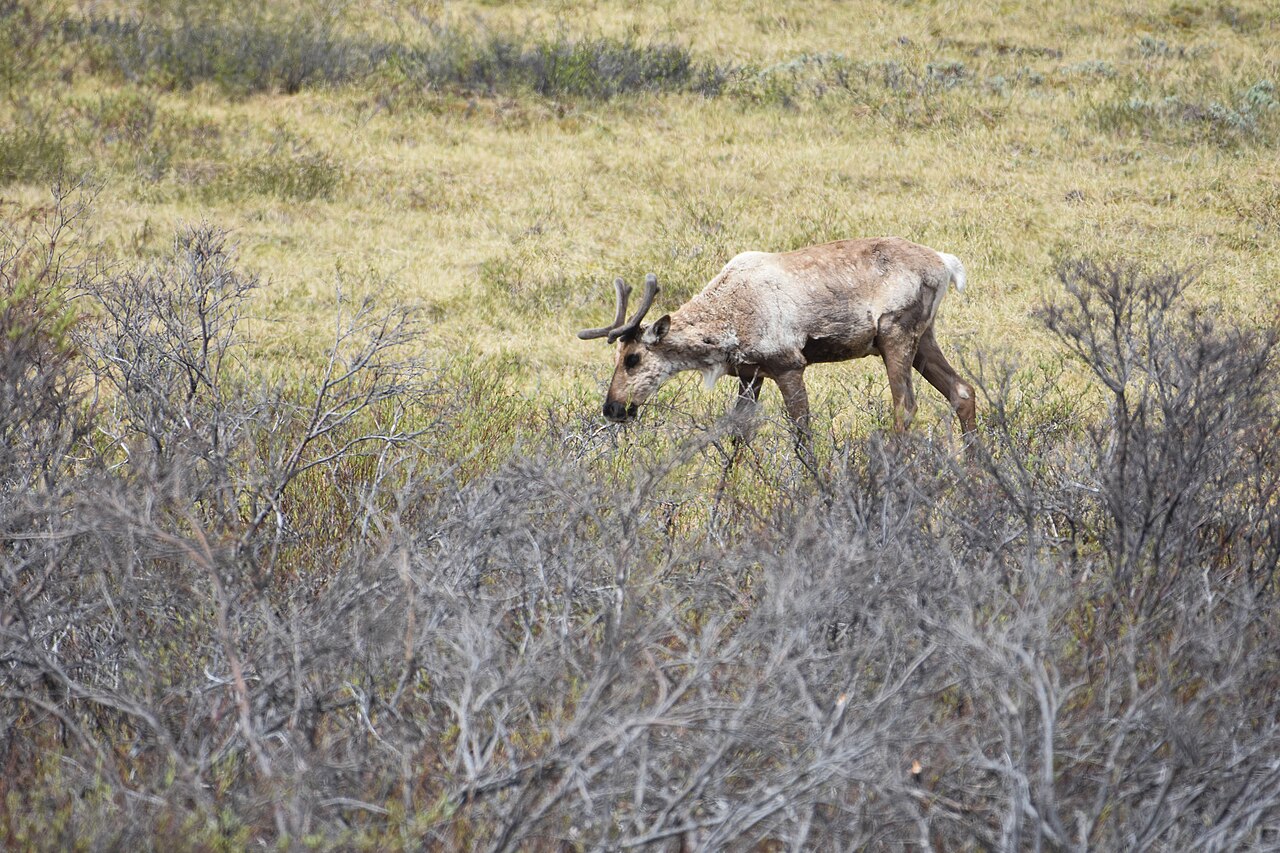
Caribou (Rangifer tarandus) is the North American name for Rangifer tarandus, the same species called Reindeer in Eurasia. Wild populations span Arctic tundra, mountains and boreal forest. Caribou have hollow insulating hair, broad hooves and specialized noses that warm cold air. Some forest populations remain relatively local, while barren-ground herds travel thousands of kilometers between winter range and traditional calving grounds. This guide separates well-supported biology from common assumptions and covers identification, range, habitat, diet, behavior, reproduction and conservation.
Identification
Caribou have a long muzzle, compact ears, short tail and dense coat ranging from dark brown to pale gray or nearly white. The neck and rump are often lighter. Both males and females usually grow antlers, unique among living deer. Male antlers are larger and more branched; one brow tine may spread into a shovel above the muzzle. Large, concave, spreading hooves support the body on snow and soft tundra. Males are generally larger and carry much heavier antlers. Adult bulls shed antlers after the autumn rut, while pregnant females may retain theirs through winter and calving.
Identification should combine body shape, markings, size, voice or movement, and location. One feature by itself can overlap with a related animal, a juvenile, or an individual in unusual light.
Photographs are most useful when they preserve scale and show several diagnostic features. Handling or repositioning a wild caribou for identification can cause stress and is unnecessary.
Size and physical adaptations
Caribou typically measures About 1.5–2.3 m, varying greatly among populations and weighs About 55–318 kg, with males much heavier. Woodland forms are generally larger than high-Arctic forms, and sex differences can be pronounced.
Its useful adaptations include hollow guard hairs trap insulating air, dense underfur resists arctic cold, broad hooves spread on snow and soft ground, sharp hoof edges dig through crusted snow, nasal turbinates warm and moisten inhaled air, both sexes grow antlers, tendon movement makes audible foot clicks, strong swimming aided by buoyant coat and broad hooves. These traits work together in the animal’s normal setting rather than serving as isolated curiosities.
Published measurements may use different methods, life stages or sample locations. Comparing figures responsibly means checking what was measured rather than selecting the largest number available.
Range and distribution
Circumpolar across northern North America, Greenland and Eurasia. Wild Caribou occupy Alaska, Canada and Greenland; wild and domestic Reindeer occur from Fennoscandia through Russia. Historical range extended farther south. Distribution is now fragmented in many forest regions, while some tundra herds range across enormous seasonal landscapes. The native range includes Canada, United States, Greenland, Norway, Sweden, Finland, Russia.
A country-level map indicates broad distribution, not continuous occupation. Climate, elevation, water, vegetation, prey, breeding sites, barriers and survey effort all affect where records occur.
Records near the edge of the range deserve careful documentation because they may reflect natural movement, improved survey coverage, accidental transport or a genuine distribution change.
Habitat
Arctic tundra, alpine tundra, boreal forest, peatland, open lichen woodland and coastal plains.
Habitat use changes through the year. Migratory females seek windswept or open calving grounds that reduce predators, then follow newly emerging plants. Summer herds move to windy ridges, snowfields and coasts to escape insects. Wintering animals dig craters through snow to reach lichens and choose forests or tundra where snow is shallow enough to forage. Woodland populations need large, connected, quiet ranges. Protecting a population therefore requires the feeding, shelter and breeding features that make a site usable, along with connections that allow movement.
Microhabitat matters. Shade, soil, current, moisture, shelter or host plants can determine whether a small area is usable even when the surrounding landscape appears suitable.
Diet and feeding
Caribou is a herbivore. Important foods include ground lichens, willow leaves, birch leaves, sedges, grasses, mushrooms, dwarf shrubs, aquatic plants. Winter diet often relies on lichens, which Caribou smell beneath snow and uncover by pawing with broad hooves. In spring and summer they switch to protein-rich new leaves, sedges, grasses, flowers and mushrooms to restore body reserves and support milk production. Their four-chambered stomach and microbes ferment plant fiber. Diet varies widely among forest, mountain and tundra populations.
Diet changes with age, season, location and food supply. A dramatic prey record does not establish what most individuals eat most of the time; repeated field observations provide a stronger picture.
Feeding opportunities also create risk. An animal focused on prey may be less alert to predators, traffic or people, while contaminated prey can transfer pollutants through the food web.
Behavior and communication
Active in repeated feeding and resting cycles by day and night, with seasonal long-distance movement. Caribou are social, but group size ranges from small forest bands to tundra aggregations numbering tens of thousands. Migratory herds follow learned routes between seasonal ranges and show strong fidelity to calving areas. Mosquitoes and biting flies can drive frantic summer movement. During winter, animals conserve energy and use their hooves to excavate feeding craters. Bulls spar and herd females during the rut.
Caribou use scent, posture and sound. Bulls advertise during the rut with grunts, displays and urine marking. Mothers and calves recognize one another through voice and smell. A clicking sound comes from tendons moving over bones in the feet; it may help group members remain together in fog, darkness or dense herds. Antler position and body orientation communicate challenge or submission. Behavior should be interpreted in context: alarm, courtship, feeding and temperature regulation can produce very different actions from the same animal.
Daily schedules are flexible responses, not rigid rules. Weather, breeding condition, disturbance, tides or food can move activity into a different part of the day.
Reproduction and development
The rut occurs in autumn. Mature bulls compete, display and guard groups of females, eating little during the peak. After winter pregnancy, females migrate to traditional calving grounds and usually give birth to one calf in late spring. Births are synchronized in many barren-ground herds, temporarily overwhelming predators. Usually one calf; twins are rare A reddish-brown calf stands and nurses within hours and can follow its mother quickly. Migratory calves may travel many kilometers within days. Rich milk fuels rapid growth during the short northern summer. Mother and calf maintain close vocal and scent contact, but the calf begins grazing early and is weaned before or during its first winter.
Young animals face different risks and may use different microhabitats or food than adults. Breeding success depends on adult condition, suitable sites and the survival of offspring through vulnerable early stages.
Counts of eggs or young describe reproductive output, not the number expected to reach adulthood. Mortality is normally greatest during eggs, larval or juvenile stages.
Predators and ecological role
Caribou transfer nutrients across vast northern landscapes through grazing, migration, dung and carcasses. They are vital prey for Wolves, Bears and people; calves also face Golden Eagles. Grazing and trampling shape lichen, shrub and tundra plant communities. Population cycles influence predators and scavengers, while blocked migration can affect ecosystems far from a development site. Documented or likely predators include Gray Wolf, Brown Bear, American Black Bear, Golden Eagle.
This animal is both a consumer and a food source. Its influence comes through many repeated interactions, so ecological claims should be based on measured populations rather than assumptions drawn from appearance.
Predator and prey relationships differ among places. A species can be ecologically influential without being abundant everywhere, and its role can change across its range.
Relationship with people
Caribou have supported Indigenous northern peoples for millennia with food, hides, sinew, bone, tools and cultural identity. Reindeer herding remains central to Sámi and other Eurasian cultures. Harvest management depends on community knowledge and herd-specific monitoring. Roads, mines, energy projects and traffic must be planned around sensitive calving and migration routes. Visitors should avoid approaching or redirecting moving herds.
Caribou usually avoid people, but adult bulls can charge during the rut and females defend calves. Antlers and hooves can cause severe injury. Observe from far away, never enter a moving herd or block a migration corridor, control dogs and obey seasonal closures. Northern weather and river crossings create additional hazards for observers. Responsible observation means keeping an appropriate distance, avoiding capture or feeding, protecting habitat and following local wildlife or invasive-species guidance.
Wildlife guidance should come from the responsible local agency because collection rules, reporting requests and appropriate responses differ between native and introduced ranges.
Conservation
The IUCN assessment lists Rangifer tarandus as Vulnerable because global abundance declined substantially over several generations, though trends differ among herds. Some populations have stabilized or increased while others remain at historic lows. Conservation must be herd-specific and protect seasonal ranges and the routes connecting them. The reported global trend is Declining globally with major natural and regional variation.
Important pressures include climate change and icing events, roads, mines and industrial disturbance, habitat fragmentation, insect harassment and heat, disease and parasites, unsustainable harvest in some areas, changes in predators and wildfire. Global status can hide local decline or recovery, so current regional monitoring and habitat management remain necessary.
The most useful conservation action follows the documented pressure. Protecting breeding sites, reducing road deaths or limiting pollutants can require different tools in different populations.