
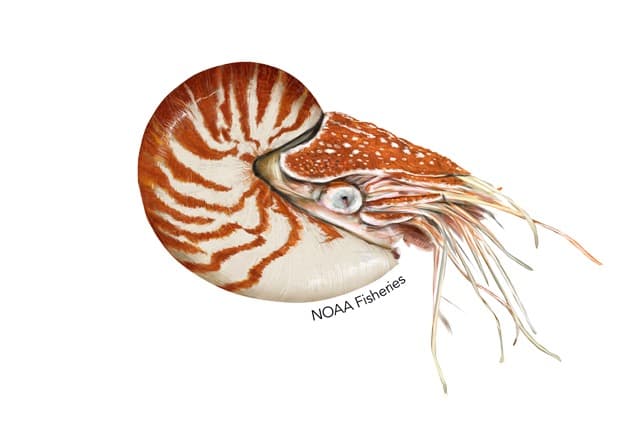
Chambered Nautilus (Nautilus pompilius) is a slow-growing cephalopod of the tropical Indo-Pacific. Unlike an octopus or squid, it carries a hard external shell divided into sealed chambers. The animal occupies the newest outer chamber while a tissue tube called the siphuncle adjusts liquid and gas in older chambers, providing buoyancy. This ancient body plan survives on steep reef slopes, where nautiluses descend by day and rise into shallower water after dark to feed. This guide separates well-supported biology from common assumptions and covers identification, range, habitat, diet, behavior, reproduction and conservation.
Identification
The coiled shell is creamy white with irregular reddish-brown or orange bands that are strongest on the upper surface. A leathery hood can close the opening when the animal withdraws. More than 90 slender, suckerless tentacles surround a sharp beak. Its simple pinhole eyes lack lenses, and a muscular funnel directs water for jet propulsion. Mature shells commonly measure 13–23 centimeters across. Males are usually larger and have modified tentacles, including a spadix, used in mating. Females have fewer reproductive specializations visible around the mouth.
Identification should combine body shape, markings, size, voice or movement, and location. One feature by itself can overlap with a related animal, a juvenile, or an individual in unusual light.
Photographs are most useful when they preserve scale and show several diagnostic features. Handling or repositioning a wild chambered nautilus for identification can cause stress and is unnecessary.
Size and physical adaptations
Chambered Nautilus typically measures Adult shell typically about 13–23 cm across and weighs Often around 0.5–1.3 kg depending on shell size. Shell diameter is the standard size measure; regional populations differ and isolated dwarf forms occur.
Its useful adaptations include chambered shell provides protection and buoyancy, siphuncle regulates liquid and gas in old chambers, more than 90 tentacles detect and hold food, leathery hood seals the shell opening, pinhole eyes function in dim water, four gills extract oxygen, jet propulsion enables backward swimming, powerful chemical senses locate carrion. These traits work together in the animal’s normal setting rather than serving as isolated curiosities.
Published measurements may use different methods, life stages or sample locations. Comparing figures responsibly means checking what was measured rather than selecting the largest number available.
Range and distribution
Patchy populations occur along tropical western Pacific and eastern Indian Ocean reef slopes, from northern Australia and Indonesia through the Philippines, Papua New Guinea, Palau, Melanesia and parts of the South Pacific. Deep ocean and warm surface water form barriers, so animals rarely cross between island groups and depleted populations recover slowly. The native range includes Australia, Papua New Guinea, Indonesia, Philippines, Palau, Fiji, Vanuatu, New Caledonia, Solomon Islands, Samoa.
A country-level map indicates broad distribution, not continuous occupation. Climate, elevation, water, vegetation, prey, breeding sites, barriers and survey effort all affect where records occur.
Records near the edge of the range deserve careful documentation because they may reflect natural movement, improved survey coverage, accidental transport or a genuine distribution change.
Habitat
Steep coral and rocky reef slopes, fore-reef drop-offs and deep benthic habitat, usually from about 100 to 500 meters with nightly movement into shallower water.
Nautiluses remain deep during daylight, where cool dim water reduces exposure to visual predators. After sunset they may ascend along the reef to forage around 70–150 meters, then retreat before warming surface water becomes physiologically stressful. Their shells can implode at extreme depth, while prolonged temperatures above their tolerance restrict movement across shallow seas. Protecting a population therefore requires the feeding, shelter and breeding features that make a site usable, along with connections that allow movement.
Microhabitat matters. Shade, soil, current, moisture, shelter or host plants can determine whether a small area is usable even when the surrounding landscape appears suitable.
Diet and feeding
Chambered Nautilus is a opportunistic carnivore and scavenger. Important foods include crustaceans, small fishes, fish carrion, mollusks, molted exoskeletons, other organic remains. Long tentacles carry ridges and adhesive secretions rather than suckers. They sample odors, grasp carrion or living prey and pass it toward a parrotlike beak. A radula rasps food into smaller pieces. Powerful chemoreception allows a nautilus to follow odor plumes in darkness, which is why baited underwater cameras are effective for population surveys.
Diet changes with age, season, location and food supply. A dramatic prey record does not establish what most individuals eat most of the time; repeated field observations provide a stronger picture.
Feeding opportunities also create risk. An animal focused on prey may be less alert to predators, traffic or people, while contaminated prey can transfer pollutants through the food web.
Behavior and communication
Nocturnal vertical migrant, resting deeper by day and foraging higher on the reef after dark. The animal usually swims backward by drawing water into the mantle cavity and expelling it through a flexible funnel. Tentacles trail ahead to explore, while the hood shields the head if danger approaches. Buoyancy changes are slow, so fine depth control also depends on jetting and shell orientation. Individuals are attracted to carrion and may gather at bait, yet they do not form stable social groups.
Nautilus communication is poorly known. Chemical cues probably reveal food, reproductive condition and nearby individuals. Touch with tentacles is important during courtship and mating. The limited pinhole eye can distinguish light, shape and movement but does not produce the sharp images used by squid and octopuses for complex visual displays. Behavior should be interpreted in context: alarm, courtship, feeding and temperature regulation can produce very different actions from the same animal.
Daily schedules are flexible responses, not rigid rules. Weather, breeding condition, disturbance, tides or food can move activity into a different part of the day.
Reproduction and development
Males transfer a sperm packet to the female using modified tentacles. Females lay only a few large eggs each year, attaching them to hard reef surfaces in protected crevices. Unlike most other living cephalopods, adults can survive and reproduce in more than one season. Low egg output and long generation time make heavy collection especially damaging. A few large eggs laid individually over a season A hatchling emerges with a small shell containing several chambers and begins adding new shell at the opening. As the body moves forward, it seals the abandoned space with a septum and retains connection through the siphuncle. Growth is slow, and maturity may take 10–15 years. New chambers record changing chemistry and growth much like a natural archive.
Young animals face different risks and may use different microhabitats or food than adults. Breeding success depends on adult condition, suitable sites and the survival of offspring through vulnerable early stages.
Counts of eggs or young describe reproductive output, not the number expected to reach adulthood. Mortality is normally greatest during eggs, larval or juvenile stages.
Predators and ecological role
Chambered Nautiluses are both predators and scavengers, recycling carrion while consuming crustaceans and small fishes. Sharks, triggerfish, groupers and octopuses can break or penetrate shells. Their slow movements between depths transport nutrients along reef slopes. Empty shells may drift far from the living range, so a beach shell alone is not proof that a local population survives nearby. Documented or likely predators include Octopus, Triggerfish, Reef Shark, Grouper, Human.
This animal is both a consumer and a food source. Its influence comes through many repeated interactions, so ecological claims should be based on measured populations rather than assumptions drawn from appearance.
Predator and prey relationships differ among places. A species can be ecologically influential without being abundant everywhere, and its role can change across its range.
Relationship with people
The spiral shell has been traded for jewelry, inlay, souvenirs and decorative objects for centuries. Modern baited traps can remove many animals from small isolated populations, while discarded shells conceal the loss. Scientific studies use remote video, tagging, shell chemistry and genetics to estimate abundance and connectivity. Choosing shell-free souvenirs reduces demand for newly harvested animals.
Chambered Nautiluses are not dangerous to swimmers. Their beak can pinch if handled, and bringing an animal rapidly to the surface can injure it. Divers should never collect, feed, chase or remove a nautilus from depth. Shell products should be avoided unless legal origin and pre-existing provenance are independently documented. Responsible observation means keeping an appropriate distance, avoiding capture or feeding, protecting habitat and following local wildlife or invasive-species guidance.
Wildlife guidance should come from the responsible local agency because collection rules, reporting requests and appropriate responses differ between native and introduced ranges.
Conservation
The IUCN lists Nautilus pompilius as Vulnerable. NOAA lists the species as threatened under the U.S. Endangered Species Act, and international trade in all nautilids is regulated under CITES Appendix II. Slow growth, maturity after roughly a decade and few eggs make local depletion difficult to reverse. The reported global trend is Declining in harvested areas, with isolated populations showing uneven status.
Important pressures include targeted shell harvest, illegal and poorly documented international trade, very slow population recovery, reef degradation, ocean warming and deoxygenation, small isolated populations. Global status can hide local decline or recovery, so current regional monitoring and habitat management remain necessary.
The most useful conservation action follows the documented pressure. Protecting breeding sites, reducing road deaths or limiting pollutants can require different tools in different populations.