
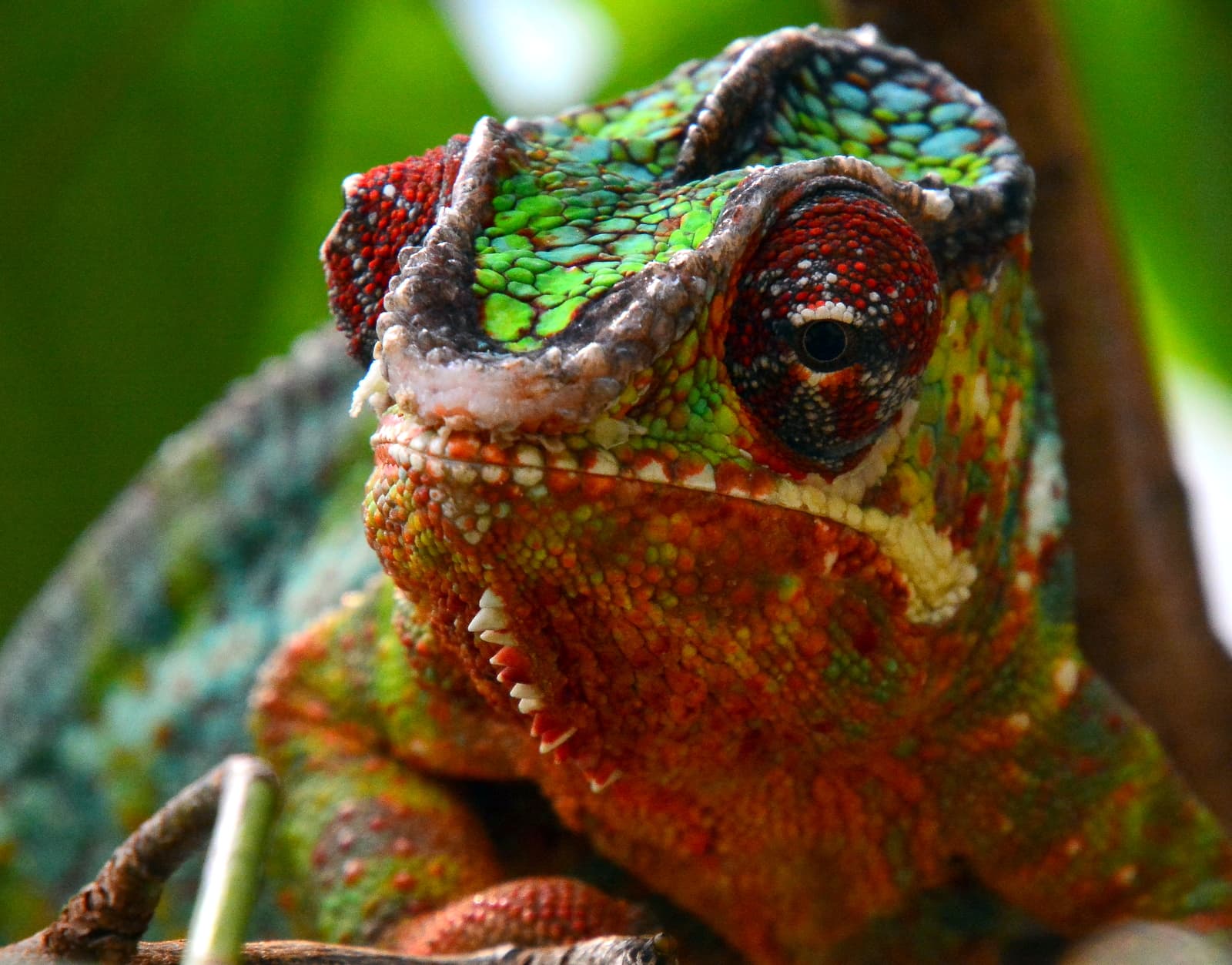
Chameleon (Chamaeleonidae) is any member of the lizard family Chamaeleonidae. The Reptile Database recognized 241 living species in October 2026. Most occur in Africa and Madagascar, with others in southern Europe, the Arabian Peninsula, India, Sri Lanka and islands of the western Indian Ocean. They range from tiny leaf-litter species to large tree-dwellers, so this family profile describes shared patterns rather than one universal body size, color or conservation status. This guide separates well-supported biology from common assumptions and covers identification, range, habitat, diet, behavior, reproduction and conservation.
Identification
Chameleons are recognizable by independently rotating turret-shaped eyes, grasping feet with opposing bundles of toes, a laterally compressed body and a projectile tongue in most species. Arboreal species commonly have a prehensile tail, while tiny leaf chameleons have shorter tails and walk through low vegetation and litter. Horns, casques, crests and nose projections vary by species and sex. Sex differences depend on species. Males of many larger species grow bigger and carry taller casques, horns or brighter display colors. In several dwarf chameleons females are larger. Females may also show distinct receptive or gravid color patterns, but no single color reliably determines sex across the family.
Identification should combine body shape, markings, size, voice or movement, and location. One feature by itself can overlap with a related animal, a juvenile, or an individual in unusual light.
Photographs are most useful when they preserve scale and show several diagnostic features. Handling or repositioning a wild chameleon for identification can cause stress and is unnecessary.
Size and physical adaptations
Chameleon typically measures about 2–3 cm total length in the smallest Brookesia to roughly 68 cm in the largest species and weighs well under 1 g in the smallest species to more than 1 kg in the largest. Family-wide extremes combine tiny leaf-litter chameleons with large arboreal species; each species has a much narrower adult range.
Its useful adaptations include eyes that scan independently before converging on prey, a rapidly projected tongue with a sticky muscular tip, zygodactyl feet that grip narrow branches, a prehensile tail in many arboreal species, color change used for signaling and temperature regulation, slow swaying movement that can resemble vegetation. These traits work together in the animal’s normal setting rather than serving as isolated curiosities.
Published measurements may use different methods, life stages or sample locations. Comparing figures responsibly means checking what was measured rather than selecting the largest number available.
Range and distribution
Chameleons are centered in Madagascar and sub-Saharan Africa. Native species also reach Mediterranean Europe and North Africa, the Arabian Peninsula, India, Sri Lanka, the Seychelles and Comoros. Introduced populations of a few species occur outside their native range, including Hawaii and Florida. No individual species occupies the entire family range shown. The native range includes Madagascar and nearby western Indian Ocean islands, Sub-Saharan Africa, Parts of North Africa and southern Europe, Arabian Peninsula, India and Sri Lanka.
A country-level map indicates broad distribution, not continuous occupation. Climate, elevation, water, vegetation, prey, breeding sites, barriers and survey effort all affect where records occur.
Records near the edge of the range deserve careful documentation because they may reflect natural movement, improved survey coverage, accidental transport or a genuine distribution change.
Habitat
Rainforest, montane forest, dry forest, savanna, scrub, coastal vegetation, farms, gardens and leaf litter, depending on species.
Arboreal chameleons rely on connected shrubs and trees for feeding, concealment and travel. Ground and leaf species depend on intact litter, low plants, humidity and cool refuges. Many mountain endemics occupy small climatic zones, so clearing or drying a single forest patch can remove much of their usable habitat. Protecting a population therefore requires the feeding, shelter and breeding features that make a site usable, along with connections that allow movement.
Microhabitat matters. Shade, soil, current, moisture, shelter or host plants can determine whether a small area is usable even when the surrounding landscape appears suitable.
Diet and feeding
Chameleon is a primarily insectivore. Important foods include crickets, grasshoppers and mantises, flies, moths and beetles, spiders and other arthropods, snails and slugs in some species, small lizards or birds in some large species, leaves or fruit occasionally in selected species. A hunting chameleon usually waits or stalks slowly while its eyes search independently. When prey is located, both eyes aim forward for depth perception. The tongue accelerates outward, and its enlarged sticky tip grips the target before retracting it to the jaws. Tongue performance remains effective across cool temperatures that slow ordinary muscle, although very large prey may be seized directly.
Diet changes with age, season, location and food supply. A dramatic prey record does not establish what most individuals eat most of the time; repeated field observations provide a stronger picture.
Feeding opportunities also create risk. An animal focused on prey may be less alert to predators, traffic or people, while contaminated prey can transfer pollutants through the food web.
Behavior and communication
Mostly diurnal, with activity controlled by temperature, sunlight and rainfall. Chameleons climb with a deliberate rocking gait and clamp opposing toe bundles around supports. Many spend nights gripping thin branches where predators can be detected through movement. They bask to warm, shift posture and color, hide behind branches, inflate the body or gape when threatened. Dwarf species may drop into litter and become motionless.
Vision dominates chameleon communication. Color, body flattening, head bobbing, gaping and lateral display reveal courtship, rivalry, submission or distress. Bright color does not always mean camouflage; rapid changes often carry a social message. Touch and vibration matter at close range, while scent appears less central than in many other lizards. Behavior should be interpreted in context: alarm, courtship, feeding and temperature regulation can produce very different actions from the same animal.
Daily schedules are flexible responses, not rigid rules. Weather, breeding condition, disturbance, tides or food can move activity into a different part of the day.
Reproduction and development
Most chameleons lay eggs, while several mountain and dwarf lineages give birth to live young. Egg-laying females descend to dig nesting chambers in soil, a risky journey for tree-dwelling animals. Clutch size, incubation and breeding season vary greatly. Females of some species can store sperm and produce more than one clutch after mating. One or two young in some dwarf species to several dozen eggs in large species Hatchlings or newborns are independent and use the same basic climbing, visual hunting and color-control systems as adults. Growth can be rapid in short-lived seasonal species. In Furcifer labordi, much of the population’s life cycle is synchronized with Madagascar’s wet season.
Young animals face different risks and may use different microhabitats or food than adults. Breeding success depends on adult condition, suitable sites and the survival of offspring through vulnerable early stages.
Counts of eggs or young describe reproductive output, not the number expected to reach adulthood. Mortality is normally greatest during eggs, larval or juvenile stages.
Predators and ecological role
Chameleons are small to medium predators of insects and other invertebrates, and larger species sometimes take vertebrates. They in turn feed snakes, birds and mammals. By moving between canopy, shrubs and litter, different species occupy narrow hunting niches. Many have small ranges, making them sensitive indicators of local forest condition. Documented or likely predators include Snakes, Birds of prey, Shrikes and other birds, Small carnivorans, Humans.
This animal is both a consumer and a food source. Its influence comes through many repeated interactions, so ecological claims should be based on measured populations rather than assumptions drawn from appearance.
Predator and prey relationships differ among places. A species can be ecologically influential without being abundant everywhere, and its role can change across its range.
Relationship with people
People value chameleons for research, ecotourism and their striking appearance. Wild collection and trade require careful species-level controls because similar-looking animals can come from very small populations. Observers should avoid touching, moving or provoking color displays, since handling and prolonged exposure can be stressful.
Chameleons are not venomous and normally avoid conflict with people. A frightened animal can bite, gape or grip firmly, but serious injury is unusual. Wild animals should be left in place. Captive animals need hand-washing and calm, minimal handling because reptiles can carry Salmonella and stress may contribute to illness. Responsible observation means keeping an appropriate distance, avoiding capture or feeding, protecting habitat and following local wildlife or invasive-species guidance.
Wildlife guidance should come from the responsible local agency because collection rules, reporting requests and appropriate responses differ between native and introduced ranges.
Conservation
The family Chamaeleonidae has no single IUCN category. The IUCN Chameleon Specialist Group assesses species individually because widespread adaptable chameleons and tiny single-site endemics face very different risks. The tracker’s group-wide Least Concern label is therefore not used. The reported global trend is No single family-wide trend; many narrow-range forest species are declining.
Important pressures include forest clearing and fragmentation, agricultural expansion and charcoal production, climate change in mountain habitats, unsustainable or illegal collection, invasive predators on islands, small ranges and isolated populations. Global status can hide local decline or recovery, so current regional monitoring and habitat management remain necessary.
The most useful conservation action follows the documented pressure. Protecting breeding sites, reducing road deaths or limiting pollutants can require different tools in different populations.
