
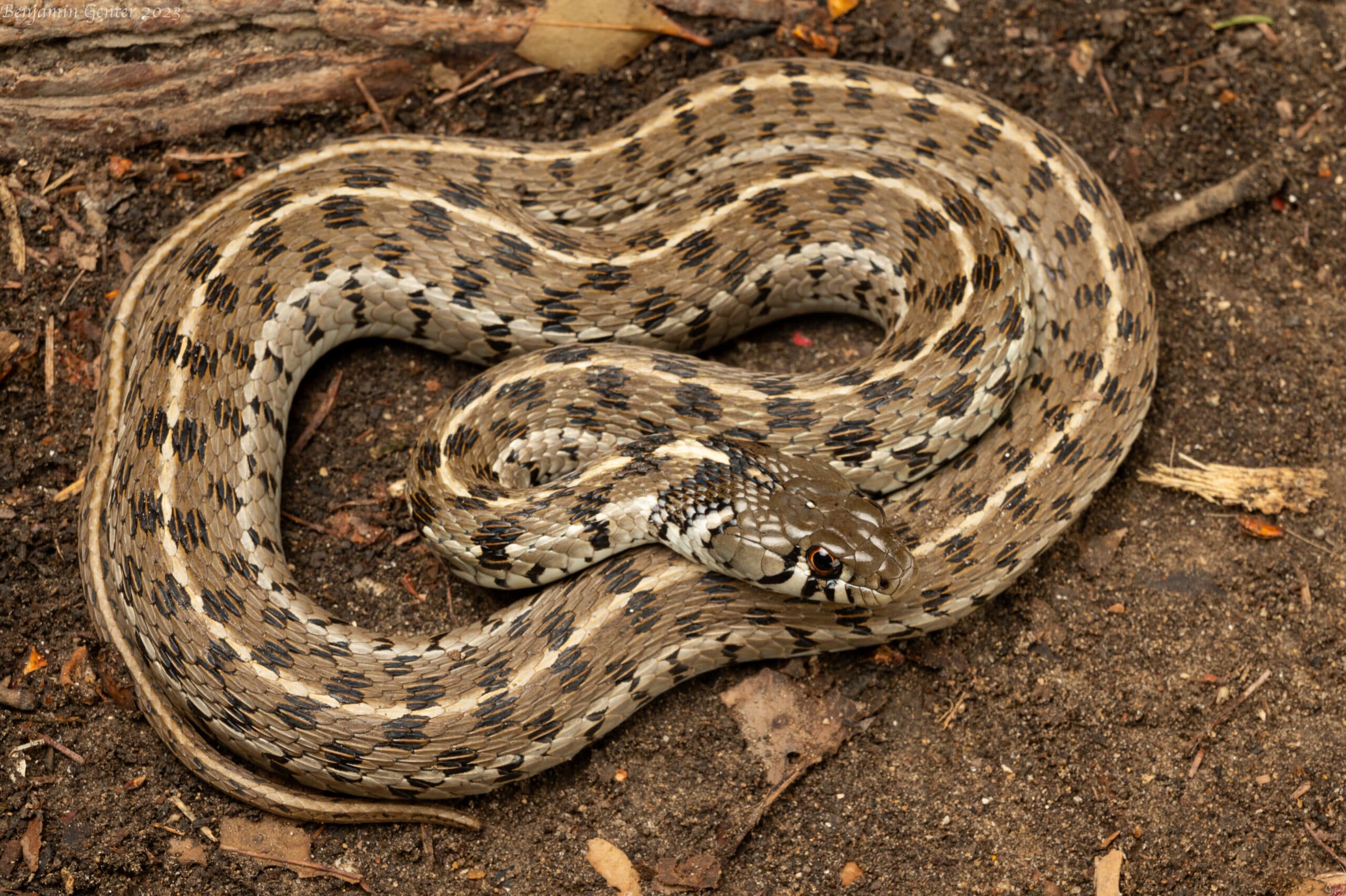
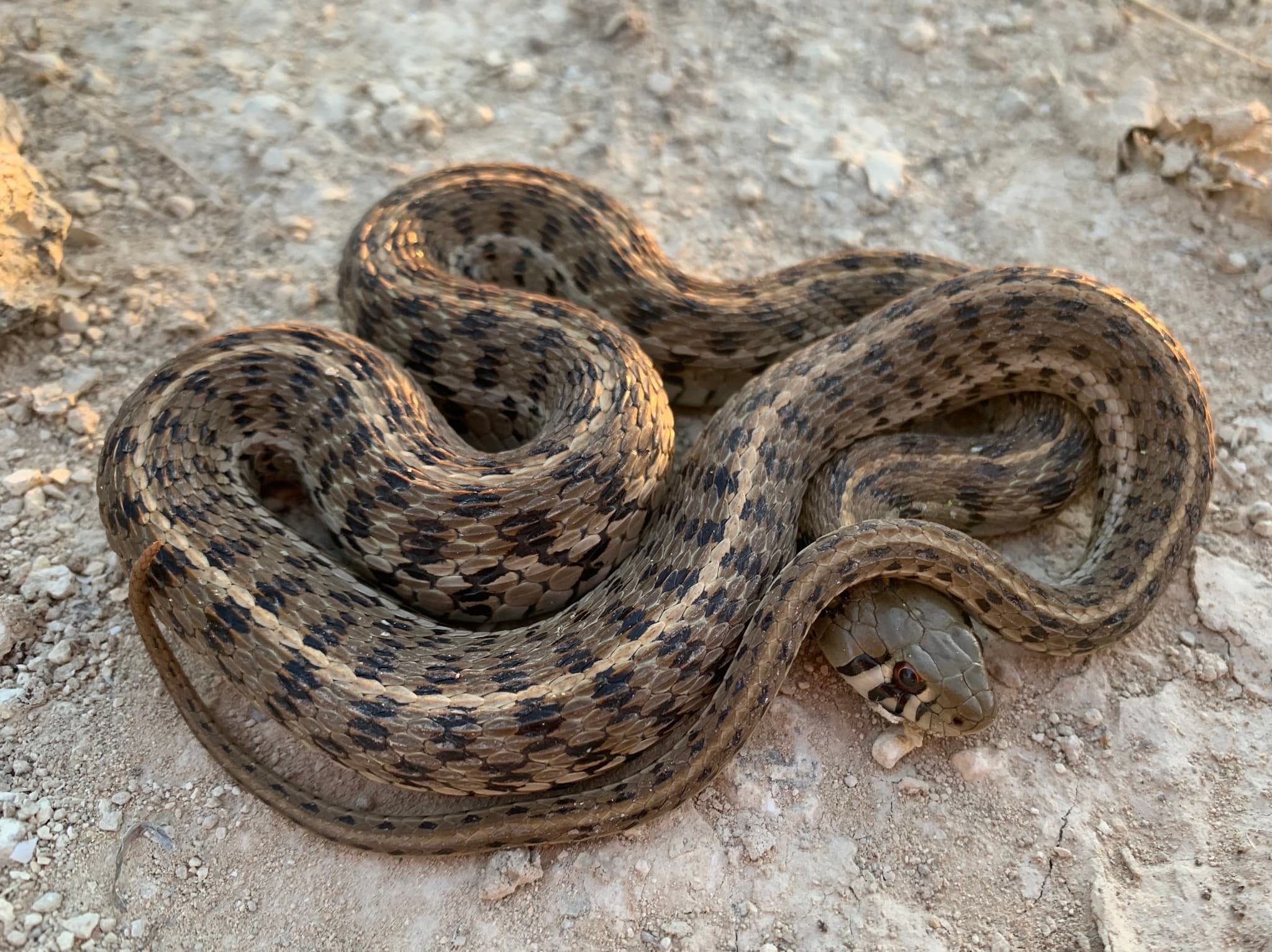
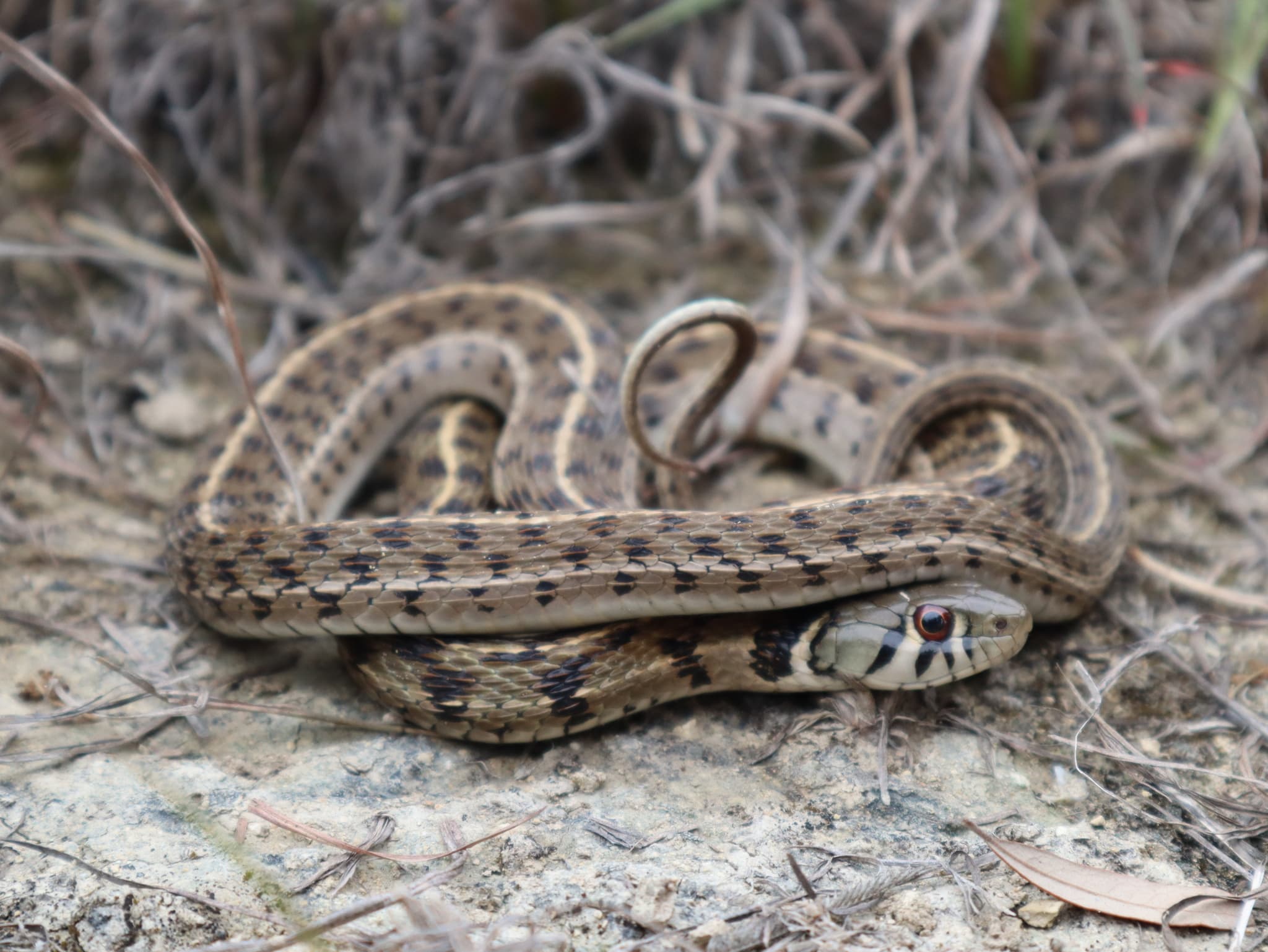
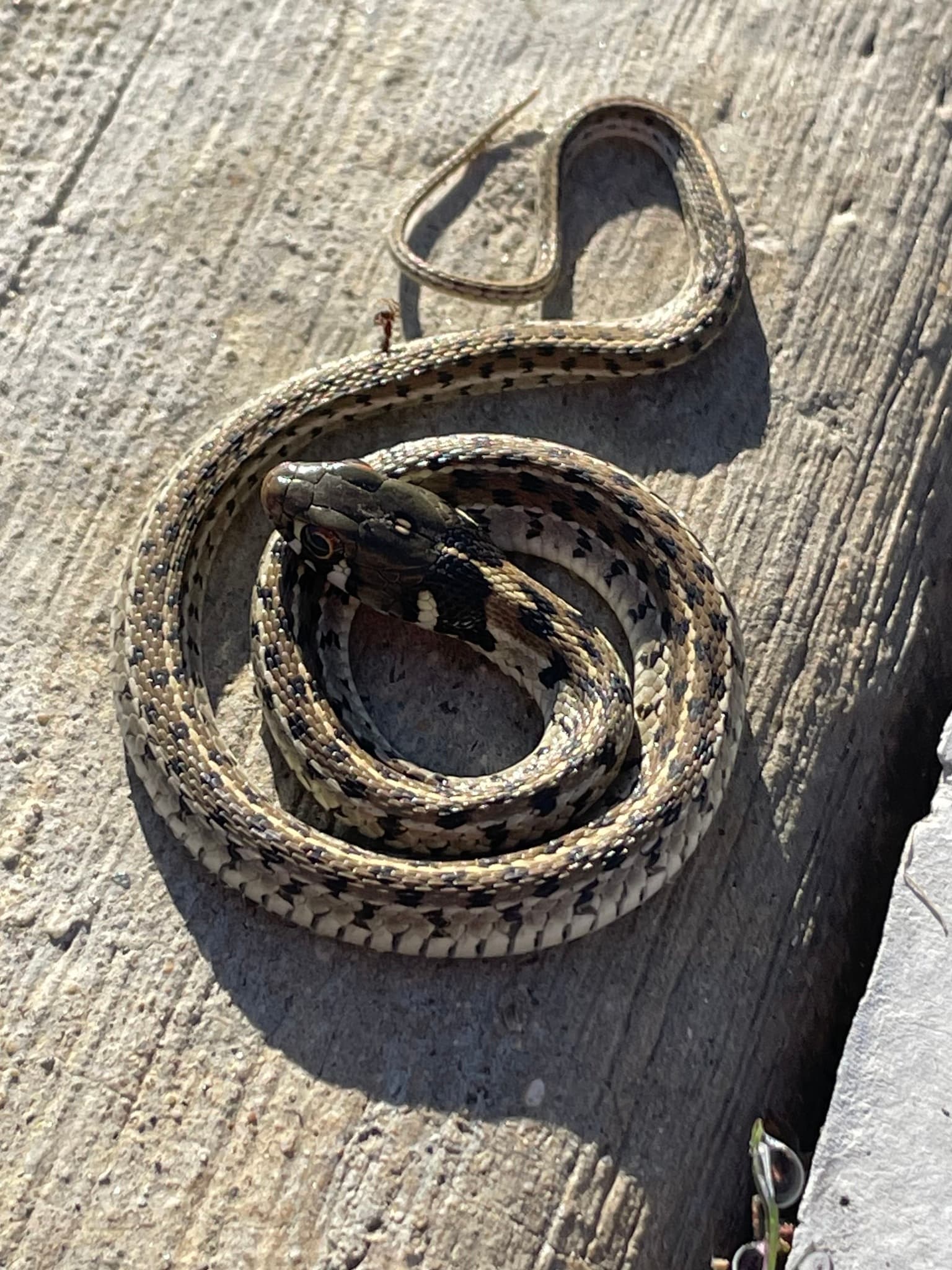
Checkered Garter Snake (Thamnophis marcianus) is a living North American natricine snake recognized by a pale mid-dorsal stripe set against rows of dark, checker-like marks. It occurs from the southwestern United States through much of Mexico and into parts of Central America, usually near water or in places where frogs, fish and earthworms are available. Like other garter snakes, it is mildly venomous to small prey but is not considered medically dangerous to people. This species profile covers identification, range, habitat, feeding, behavior, reproduction, ecological relationships and conservation while separating reliable field knowledge from claims that remain uncertain.
Identification
The checkered garter snake has a slender body, keeled scales and a head only moderately wider than the neck. Most individuals show a light stripe running along the center of the back, with two additional pale stripes along the sides. Dark rectangular blotches between the stripes create the checkered pattern behind the common name. Ground color varies from tan and olive to brown or gray, and the lips often carry dark vertical bars. The large round pupils distinguish it from the vertical pupils of many nocturnal snakes, although eye shape alone is never enough for identification.
Adults are usually under one metre long, but size varies with sex, locality, age and food supply. Females generally grow larger and heavier than males. Pattern intensity also varies, and captive-bred color forms should not be used as a guide to wild appearance. A responsible identification combines locality, scale texture, stripe placement, head markings and body proportions. Wild snakes should be photographed from a respectful distance rather than handled or repositioned.
Taxonomy and name
Thamnophis marcianus belongs to the family Colubridae and subfamily Natricinae. The species was named in the nineteenth century, and modern databases continue to recognize it as a valid living species. Older literature may divide populations into subspecies or apply historical synonyms, so records should be checked against current taxonomic references. The species name honors Randolph B. Marcy, an American army officer and explorer whose surname also appears in the scientific name.
The checkered garter snake is one member of the diverse genus Thamnophis. It is related to the common garter snake, plains garter snake and black-necked garter snakes, but a shared striped body plan does not make those animals interchangeable. Range and scale characters matter, especially where two garter snake species occur together.
Range and distribution
The native range extends from the southern United States through Mexico and into northern Central America. In the United States it is associated especially with parts of Texas, New Mexico and Arizona. Southward, records span a broad but uneven area of Mexico and continue into Belize, Guatemala, Honduras, Nicaragua and Costa Rica in current range summaries. Country presence does not mean the snake occurs everywhere within national borders. Local water, elevation, vegetation, temperature and prey determine where populations persist.
Some checkered garter snakes have appeared outside the native range through the pet trade or accidental transport. Such records should not be folded into the natural distribution without evidence of a breeding population. Range maps are also approximations: survey effort is uneven, and closely related garter snakes can be misidentified. Verified observations with photographs and location data are therefore more useful than isolated anecdotal reports.
Habitat
This snake is strongly associated with moist habitats in otherwise dry or seasonally dry landscapes. It uses stream margins, ponds, irrigation ditches, marshy ground, wet meadows, ranch tanks and gardens with dependable water. Vegetation, rocks, debris and burrows provide hiding places, while sunlit banks provide basking sites. It can also move across drier ground between feeding areas and shelters, especially after rain.
Useful habitat is a mosaic rather than a single feature. A pond without vegetated margins may offer prey but little protection, while dense cover without water may support fewer amphibians. Healthy riparian corridors allow snakes to move between feeding, shelter and breeding sites. Draining wetlands, lining channels, clearing every patch of cover and building roads beside water can reduce that connectivity even when some open water remains.
Diet and feeding
Checkered garter snakes are carnivores that take prey they can overpower and swallow whole. Frogs and tadpoles are important in many populations, while fish, earthworms, slugs and other soft-bodied animals may also be eaten. Small vertebrates can be included when opportunity and snake size permit. Diet changes with age, season, habitat and local abundance, so a prey item reported once should not be presented as the universal staple.
The snake hunts by combining chemical and visual information. Its forked tongue samples scent particles and carries them to the vomeronasal organs, helping it follow prey along wet ground or in shallow water. Teeth hold slippery prey, and mild venom delivered from enlarged rear teeth can help subdue small animals. This feeding system is adapted to prey capture and does not make the species a major medical threat to humans. Bites are uncommon unless the snake is restrained, and any bite should still be washed and monitored.
Behavior and communication
Activity shifts with weather. In moderate conditions the snake may forage or bask by day, while intense heat can push movement toward morning, evening or sheltered periods. Cold weather reduces activity, and snakes may use underground refuges during seasonal dormancy. Individuals are usually encountered alone, although suitable shelters can bring several snakes into the same area.
Chemical cues organize much of a garter snake’s life. Tongue-flicking helps detect prey, predators and potential mates. Body posture and rapid retreat communicate alarm, while a cornered snake may flatten, strike, release musk or bite. These are defensive responses rather than evidence that the animal seeks conflict. Giving a wild snake a clear escape route is safer for both observer and animal.
Reproduction and development
Like other garter snakes, the checkered garter snake gives birth to live young rather than laying shelled eggs. Courtship and mating generally follow seasonal activity patterns, but timing differs across the species’ large range. After internal development, a female produces a litter of independent neonates. Published litter sizes vary widely because female size, condition and locality affect reproductive output.
Newborn snakes receive no prolonged parental care. They must find small prey, suitable temperatures and secure cover immediately. Juveniles face heavy predation from birds, mammals and larger snakes, and many do not survive to adulthood. Claims about an exact gestation period, maturity age or lifespan should be treated cautiously unless the source identifies the population and whether the observations came from the wild or captivity.
Predators and ecological role
Checkered garter snakes transfer energy between aquatic and terrestrial food webs. By eating amphibians, worms, fish and other small prey, they influence local prey communities. They are also food for hawks, herons, roadrunners, mammalian carnivores and larger snakes. Their dependence on wet edges makes them part of the ecological link between streams, ponds and surrounding uplands.
Their presence alone is not a complete measure of ecosystem health, but repeated records can add useful information about wetland condition and connectivity. Protecting them also supports frogs, invertebrates and other wildlife that need clean water and vegetated margins. Avoiding broad pesticide use near water helps reduce both direct exposure and contamination of prey.
Relationship with people
People may encounter this species around irrigated land, garden ponds, livestock water or drainage channels. It is not considered dangerous to people, and most individuals try to escape. A restrained snake can bite and release strong-smelling musk. The safest response is to keep pets and children back, remove immediate hazards and allow the snake to leave. Anyone bitten should clean the wound and seek medical advice if swelling, persistent pain or infection develops.
Wild snakes should not be collected. Laws differ across the range, and pet-trade demand can pressure local populations or move animals beyond their native distribution. Captive husbandry information does not justify removing an animal from nature. Licensed wildlife professionals can help when a snake is trapped indoors or cannot reach safe cover.
Conservation
The species has a wide distribution, but local populations can still be harmed by wetland loss, water diversion, pollution, road mortality, deliberate killing and collection. Broad global status should not hide declines in a particular stream or valley. Protection is most effective when it keeps water clean, retains vegetated banks, preserves nearby shelter and maintains safe connections between habitat patches.
Monitoring should use current taxonomy and verifiable records. Community observations can help document seasonal activity and distribution when photographs are collected without disturbing the snake and sensitive locations are handled responsibly. Regional wildlife agencies remain the best source for current legal status and local conservation priorities.