
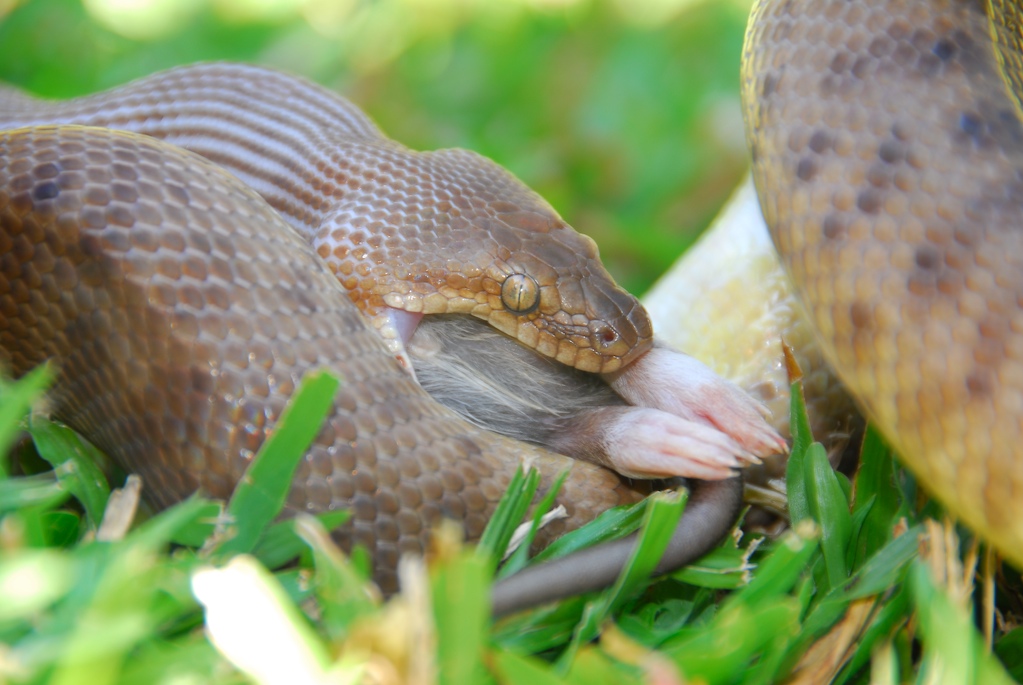
Children’s Python (Antaresia childreni) is a small nonvenomous python native to northern Australia. Its name honors nineteenth-century zoologist John George Children and does not mean it is automatically suitable for children. The snake shelters in rocky crevices, caves, hollow trees, termite mounds and abandoned burrows, emerging mainly at night. Juveniles carry distinct brown blotches that often fade as adults become more uniformly reddish or gray-brown. This guide separates well-supported biology from common assumptions and covers identification, range, habitat, diet, behavior, reproduction and conservation.
Identification
The body is slender for a python, with smooth glossy scales and a moderately distinct head. Ground color ranges from pale brown and tan to reddish brown or gray-brown. Juveniles show rounded darker blotches along the back and sides; these markings often weaken with age. The belly is cream or yellowish. Small heat-sensitive pits occur along the lips and help locate warm prey in darkness. Females are generally longer and heavier than males, while males have relatively longer tails and paired reproductive structures. Color and blotching overlap too widely for visual sexing.
Identification should combine body shape, markings, size, voice or movement, and location. One feature by itself can overlap with a related animal, a juvenile, or an individual in unusual light.
Photographs are most useful when they preserve scale and show several diagnostic features. Handling or repositioning a wild children’s python for identification can cause stress and is unnecessary.
Size and physical adaptations
Children’s Python typically measures typically about 75 cm, with large individuals near 1 m and weighs commonly a few hundred grams; exact adult mass varies with sex and condition. Some reports combine several Antaresia species and give larger maxima, so species-specific measurements are preferred.
Its useful adaptations include heat-sensitive lip pits locate warm prey, muscular coils restrain vertebrates, small body enters narrow crevices, glossy scales ease movement in shelters, climbing ability reaches birds and bats, maternal egg brooding stabilizes temperature, flexible diet suits seasonal northern habitats. These traits work together in the animal’s normal setting rather than serving as isolated curiosities.
Published measurements may use different methods, life stages or sample locations. Comparing figures responsibly means checking what was measured rather than selecting the largest number available.
Range and distribution
Native to northern Australia from the Kimberley and Northern Territory east toward the Gulf of Carpentaria and northeastern Queensland, including some Torres Strait islands. Current taxonomy separates neighboring Antaresia species, so older maps that cover most of inland Australia may be overly broad. The native range includes Australia.
A country-level map indicates broad distribution, not continuous occupation. Climate, elevation, water, vegetation, prey, breeding sites, barriers and survey effort all affect where records occur.
Records near the edge of the range deserve careful documentation because they may reflect natural movement, improved survey coverage, accidental transport or a genuine distribution change.
Habitat
Rocky outcrops, escarpments, caves, dry woodland, savanna, coastal forest, spinifex country, watercourse margins and termite mounds.
Individuals use deep crevices, hollow timber, abandoned burrows, root cavities and termite structures as daytime refuges. Cave populations exploit bats, while woodland snakes climb for birds or shelter. Refuges buffer heat and dryness, making the quality of small rock and hollow features as important as broad vegetation type. Protecting a population therefore requires the feeding, shelter and breeding features that make a site usable, along with connections that allow movement.
Microhabitat matters. Shade, soil, current, moisture, shelter or host plants can determine whether a small area is usable even when the surrounding landscape appears suitable.
Diet and feeding
Children’s Python is a small-vertebrate constrictor. Important foods include geckos, skinks, small rodents, microbats, frogs, small birds, nestlings. The python detects scent with its tongue and warm prey with lip pits, then strikes and wraps coils around larger prey. It may ambush at cave entrances or search crevices and vegetation. Juveniles emphasize small lizards and frogs, while adults can take rodents, birds and bats.
Diet changes with age, season, location and food supply. A dramatic prey record does not establish what most individuals eat most of the time; repeated field observations provide a stronger picture.
Feeding opportunities also create risk. An animal focused on prey may be less alert to predators, traffic or people, while contaminated prey can transfer pollutants through the food web.
Behavior and communication
Mostly nocturnal, with occasional daytime basking or movement during mild weather. By day, the snake usually remains concealed and may expose only part of its body to warm. At night it forages on the ground and climbs rock or vegetation. When threatened it may retreat, coil tightly, hiss or bite. It is nonvenomous, and its defensive behavior is a response to close approach rather than pursuit of people.
A forked tongue samples chemical trails from prey and mates. Lip pits detect the direction of warm animals at close range. Courtship involves scent, alignment and tactile stimulation, while hissing and a coiled posture communicate defense. Ground vibration warns of approaching large animals. Behavior should be interpreted in context: alarm, courtship, feeding and temperature regulation can produce very different actions from the same animal.
Daily schedules are flexible responses, not rigid rules. Weather, breeding condition, disturbance, tides or food can move activity into a different part of the day.
Reproduction and development
Courtship and mating occur during the cooler dry-season months. After internal fertilization, the female lays a compact clutch in a protected cavity and coils around the eggs. She may tighten or reposition her coils to control heat and moisture. Usually 7–12 eggs, with variation among females Hatchlings cut through the shell with an egg tooth and remain briefly within the clutch before dispersing. They are independent and begin feeding after the first shed. Their stronger blotched pattern provides camouflage among rock, bark and litter.
Young animals face different risks and may use different microhabitats or food than adults. Breeding success depends on adult condition, suitable sites and the survival of offspring through vulnerable early stages.
Counts of eggs or young describe reproductive output, not the number expected to reach adulthood. Mortality is normally greatest during eggs, larval or juvenile stages.
Predators and ecological role
Children’s Pythons link insects and plants indirectly to higher predators by consuming small lizards, rodents, frogs, birds and bats. In turn they feed raptors, monitors and larger snakes. Their use of caves, hollows and termite mounds shows why intact shelter features are necessary even across apparently extensive woodland. Documented or likely predators include Brown Goshawk, Black-Breasted Buzzard, Yellow-Spotted Monitor, Mulga Snake, Feral Cat.
This animal is both a consumer and a food source. Its influence comes through many repeated interactions, so ecological claims should be based on measured populations rather than assumptions drawn from appearance.
Predator and prey relationships differ among places. A species can be ecologically influential without being abundant everywhere, and its role can change across its range.
Relationship with people
This python often benefits people by eating rodents and is harmless when left alone. If found near a home, keep pets away and allow it to leave or contact a licensed snake handler. Australian states and territories regulate keeping and movement of native reptiles. Captive animals must have documented legal origin and should never be released outside their source population.
The species is nonvenomous but can bite, especially if it mistakes a warm hand for food. Do not grab a wild snake. Wash a bite with soap and water and seek medical care for deep punctures, heavy bleeding or infection. If identification is uncertain, contact emergency or poison advice services. Responsible observation means keeping an appropriate distance, avoiding capture or feeding, protecting habitat and following local wildlife or invasive-species guidance.
Wildlife guidance should come from the responsible local agency because collection rules, reporting requests and appropriate responses differ between native and introduced ranges.
Conservation
The IUCN Red List classifies Children’s Python as Least Concern because it has a broad northern Australian range and occupies varied habitats. Local populations can still be affected by habitat degradation, loss of hollows and crevices, changed fire regimes, roads, feral predators and illegal collection. The reported global trend is Stable overall, with incomplete local monitoring.
Important pressures include habitat degradation, loss of hollow trees and rock refuges, road mortality, feral cats, inappropriate fire regimes, illegal collection, climate-driven heat extremes. Global status can hide local decline or recovery, so current regional monitoring and habitat management remain necessary.
The most useful conservation action follows the documented pressure. Protecting breeding sites, reducing road deaths or limiting pollutants can require different tools in different populations.