
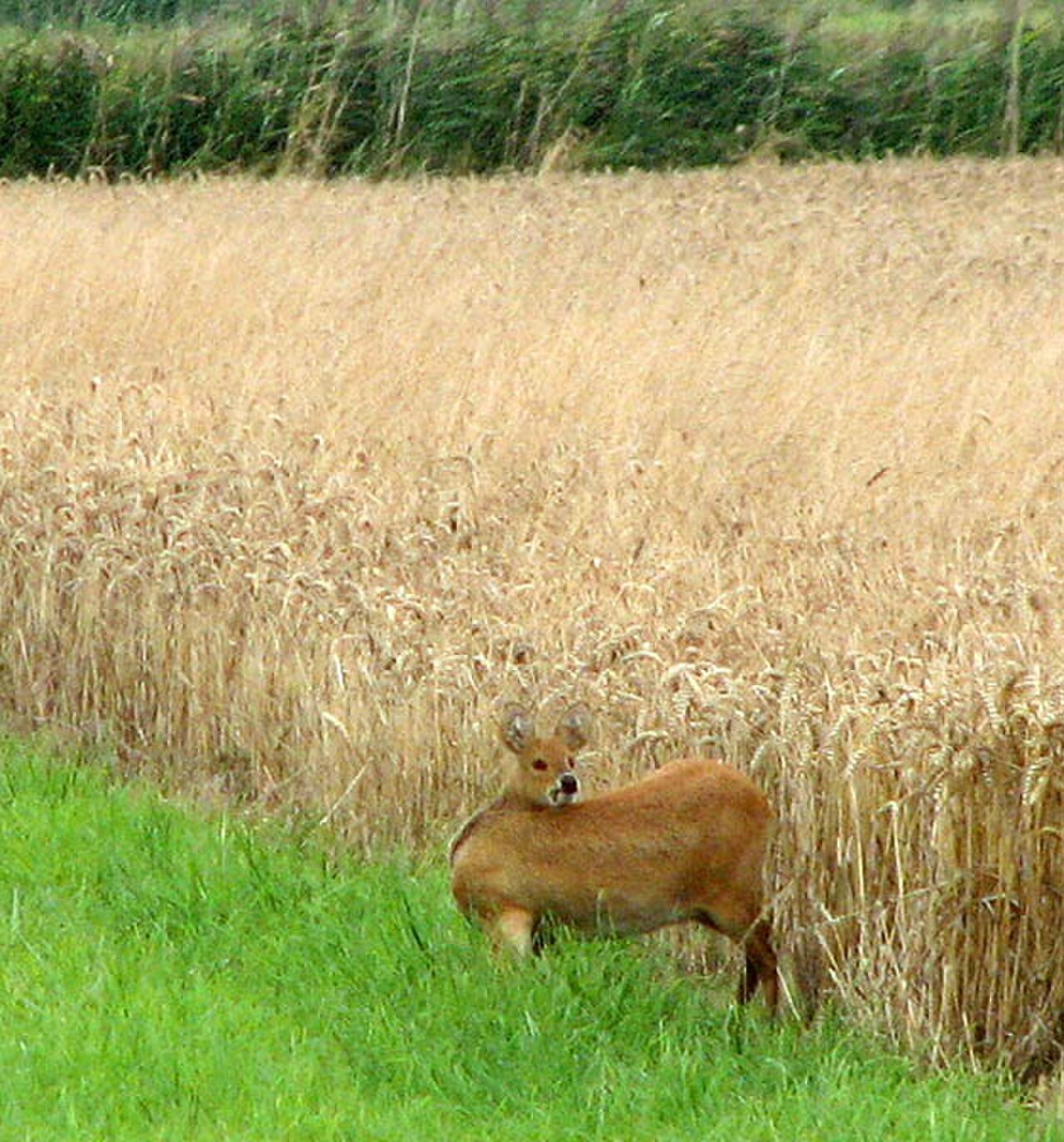
Chinese Water Deer (Hydropotes inermis) is native to China and the Korean Peninsula and introduced in parts of Europe. This guide separates well-supported biology from common assumptions and covers identification, range, habitat, diet, behavior, reproduction and conservation.
Identification
A compact deer with rounded ears, a short tail, coarse brown coat and hindquarters higher than the shoulders. Neither sex grows antlers; adult males carry long upper canines. Males have conspicuous protruding canine tusks; females lack long exposed canines and may be slightly smaller.
Identification should combine body shape, markings, size, voice or movement, and location. One feature by itself can overlap with a related animal, a juvenile, or an individual in unusual light.
Photographs are most useful when they preserve scale and show several diagnostic features. Handling or repositioning a wild chinese water deer for identification can cause stress and is unnecessary.
Size and physical adaptations
Chinese Water Deer typically measures 77–100 cm body length and weighs 9–15 kg. Measurements differ between Chinese and Korean populations and introduced animals.
Its useful adaptations include dense coat insulates in wet habitat, strong hind legs aid bounding, males use mobile canine tusks in contests, young have spotted camouflage. These traits work together in the animal’s normal setting rather than serving as isolated curiosities.
Published measurements may use different methods, life stages or sample locations. Comparing figures responsibly means checking what was measured rather than selecting the largest number available.
Range and distribution
Native to eastern China and the Korean Peninsula, with established introduced populations in Britain and a small part of France. The native range includes China, North Korea, South Korea.
A country-level map indicates broad distribution, not continuous occupation. Climate, elevation, water, vegetation, prey, breeding sites, barriers and survey effort all affect where records occur.
Records near the edge of the range deserve careful documentation because they may reflect natural movement, improved survey coverage, accidental transport or a genuine distribution change.
Habitat
Marshes, reedbeds, river margins, wet grassland and nearby scrub or farmland.
Dense vegetation provides daytime cover, while edges and fields supply grasses and herbs. Protecting a population therefore requires the feeding, shelter and breeding features that make a site usable, along with connections that allow movement.
Microhabitat matters. Shade, soil, current, moisture, shelter or host plants can determine whether a small area is usable even when the surrounding landscape appears suitable.
Diet and feeding
Chinese Water Deer is a herbivore. Important foods include grasses, sedges, reeds, herbs, leaves. It browses and grazes selectively, often emerging from cover during quiet periods.
Diet changes with age, season, location and food supply. A dramatic prey record does not establish what most individuals eat most of the time; repeated field observations provide a stronger picture.
Feeding opportunities also create risk. An animal focused on prey may be less alert to predators, traffic or people, while contaminated prey can transfer pollutants through the food web.
Behavior and communication
Most active around dawn, dusk and night where disturbed. Usually solitary, it moves through dense cover with high bounding leaps and may swim across channels.
Scent marks, barks, whistles and posture communicate alarm and reproductive status. Behavior should be interpreted in context: alarm, courtship, feeding and temperature regulation can produce very different actions from the same animal.
Daily schedules are flexible responses, not rigid rules. Weather, breeding condition, disturbance, tides or food can move activity into a different part of the day.
Reproduction and development
The rut occurs in late autumn and early winter. Usually two to four fawns, occasionally more. undefined
Young animals face different risks and may use different microhabitats or food than adults. Breeding success depends on adult condition, suitable sites and the survival of offspring through vulnerable early stages.
Counts of eggs or young describe reproductive output, not the number expected to reach adulthood. Mortality is normally greatest during eggs, larval or juvenile stages.
Predators and ecological role
A wetland browser and prey species whose introduced populations also influence European vegetation. Documented or likely predators include Leopard, Gray Wolf, Humans.
This animal is both a consumer and a food source. Its influence comes through many repeated interactions, so ecological claims should be based on measured populations rather than assumptions drawn from appearance.
Predator and prey relationships differ among places. A species can be ecologically influential without being abundant everywhere, and its role can change across its range.
Relationship with people
Introduced British populations are managed as wild deer, while native populations require wetland conservation.
Do not approach fawns or corner adults; males can use their canines defensively. Responsible observation means keeping an appropriate distance, avoiding capture or feeding, protecting habitat and following local wildlife or invasive-species guidance.
Wildlife guidance should come from the responsible local agency because collection rules, reporting requests and appropriate responses differ between native and introduced ranges.
Conservation
Vulnerable globally because native populations face habitat loss and hunting, despite secure introduced populations in Britain. The reported global trend is Decreasing in parts of the native range.
Important pressures include wetland loss, hunting, agricultural expansion, road mortality. Global status can hide local decline or recovery, so current regional monitoring and habitat management remain necessary.
The most useful conservation action follows the documented pressure. Protecting breeding sites, reducing road deaths or limiting pollutants can require different tools in different populations.
Conservation priorities differ between the native and introduced ranges. Native wetlands need protection from conversion and hunting, whereas European wildlife agencies may manage introduced herds according to local ecological goals.