
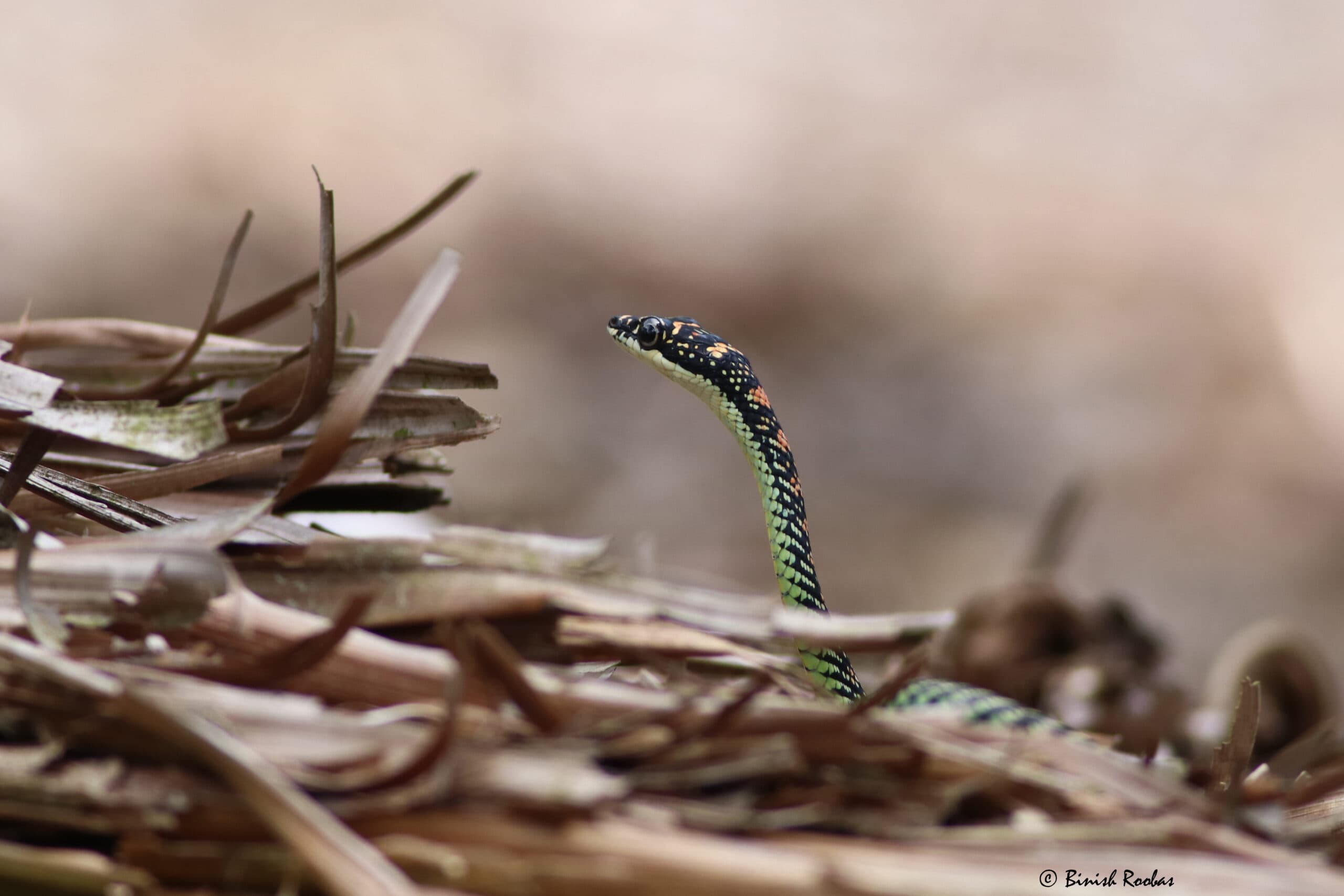
Chrysopelea Flying Snakes (Chrysopelea) are the five recognized species in the arboreal snake genus Chrysopelea. They do not fly under power. Instead, they launch from elevated perches, spread their ribs to reshape the trunk, and use aerial undulation to control a descending glide. This is a genus-level profile, so size, pattern, range, prey and conservation status must be checked for the individual species. This guide separates well-supported biology from common assumptions and covers identification, range, habitat, diet, behavior, reproduction and conservation.
Identification
These snakes have a long, slender body, a distinct narrow head, large eyes with round pupils, smooth scales and a long tail suited to climbing. Pattern varies substantially: ornate flying snakes often show black-edged green or yellow scales, paradise flying snakes may carry vivid red or orange dorsal spots, and other species have their own diagnostic markings. Reliable identification requires location, scale counts and several pattern features rather than color alone. Males and females are broadly similar in pattern. Adult females are often larger, but the amount of size difference depends on species and population.
Identification should combine body shape, markings, size, voice or movement, and location. One feature by itself can overlap with a related animal, a juvenile, or an individual in unusual light.
Photographs are most useful when they preserve scale and show several diagnostic features. Handling or repositioning a wild chrysopelea flying snakes for identification can cause stress and is unnecessary.
Size and physical adaptations
Chrysopelea Flying Snakes typically measures roughly 60–140 cm across the genus and weighs Species, sex and body size strongly affect mass; no dependable genus-wide range is available. These endpoints describe different species and individuals, not the normal adult size of every flying snake.
Its useful adaptations include mobile ribs flatten and widen the trunk before a glide, a concave cross-section generates aerodynamic lift, lateral aerial undulation improves stability and control, a long tail assists balance and steering, ventral scales grip bark during vertical climbing, large eyes support visually guided movement among branches. These traits work together in the animal’s normal setting rather than serving as isolated curiosities.
Published measurements may use different methods, life stages or sample locations. Comparing figures responsibly means checking what was measured rather than selecting the largest number available.
Range and distribution
Members of Chrysopelea occur from the Indian subcontinent and Sri Lanka east through mainland Southeast Asia to the Malay Archipelago and the Philippines. The five species do not all occupy this entire area, and island distributions are especially species-specific. The native range includes South Asia, Mainland Southeast Asia, The Malay Peninsula, The Philippines, The Greater and Lesser Sunda Islands, Parts of southern China.
A country-level map indicates broad distribution, not continuous occupation. Climate, elevation, water, vegetation, prey, breeding sites, barriers and survey effort all affect where records occur.
Records near the edge of the range deserve careful documentation because they may reflect natural movement, improved survey coverage, accidental transport or a genuine distribution change.
Habitat
Tropical and subtropical forest, forest edge, wooded gardens, plantations and other places with connected trees or tall vegetation.
Flying snakes spend much of their active time on trunks and branches, where they hunt, shelter and move between canopy levels. Some species tolerate parks, gardens and buildings near forest, especially where geckos are abundant. A glide begins from a raised perch and ends on a trunk, branch or the ground, so canopy structure and safe landing surfaces shape how the behavior is used. Protecting a population therefore requires the feeding, shelter and breeding features that make a site usable, along with connections that allow movement.
Microhabitat matters. Shade, soil, current, moisture, shelter or host plants can determine whether a small area is usable even when the surrounding landscape appears suitable.
Diet and feeding
Chrysopelea Flying Snakes is a carnivorous predator of small vertebrates. Important foods include arboreal lizards and geckos, frogs, small birds, bats in occasional records, other small vertebrates. A snake searches branches, bark and vegetation, then seizes prey with the mouth. Chrysopelea are rear-fanged and produce venom used on small prey, but feeding records differ among species and localities. Lizards are prominent in published observations, while unusual items should not be presented as the normal diet of every member of the genus.
Diet changes with age, season, location and food supply. A dramatic prey record does not establish what most individuals eat most of the time; repeated field observations provide a stronger picture.
Feeding opportunities also create risk. An animal focused on prey may be less alert to predators, traffic or people, while contaminated prey can transfer pollutants through the food web.
Behavior and communication
Primarily diurnal and strongly arboreal, with activity influenced by weather and prey. On a tree, the snake climbs by gripping irregularities with its ventral surface and body curves. To cross open space, it may hang in a J-shaped loop, accelerate outward, flatten the body and send lateral waves toward the tail. The animal remains in a controlled descent rather than gaining height through powered flight, and researchers have documented active control of heading during the glide.
Chemical cues sampled by the tongue and vomeronasal system help locate prey and mates. Vision is especially important during movement through trees and for selecting a launch or landing point. Touch, body posture and chemical signals are more relevant than sound. Behavior should be interpreted in context: alarm, courtship, feeding and temperature regulation can produce very different actions from the same animal.
Daily schedules are flexible responses, not rigid rules. Weather, breeding condition, disturbance, tides or food can move activity into a different part of the day.
Reproduction and development
Flying snakes reproduce sexually and lay eggs. Published natural-history information is uneven across the five species, so clutch size and seasonal timing should be attached to the species and locality from which each observation came. Species-specific clutches of eggs; no single number applies across the genus Hatchlings emerge as independent miniature snakes. They must climb, hunt and avoid predators without parental feeding. Their small size changes aerodynamic performance, and experimental work indicates that body size affects gliding behavior and performance.
Young animals face different risks and may use different microhabitats or food than adults. Breeding success depends on adult condition, suitable sites and the survival of offspring through vulnerable early stages.
Counts of eggs or young describe reproductive output, not the number expected to reach adulthood. Mortality is normally greatest during eggs, larval or juvenile stages.
Predators and ecological role
Chrysopelea link canopy food webs by consuming lizards, frogs and other small vertebrates while serving as prey for raptors, larger snakes and mammalian predators. Their unusual locomotion allows rapid escape and efficient movement between separated trees, but the relative importance of hunting, escape and routine travel requires field evidence rather than assumption. Documented or likely predators include Birds of Prey, Larger Snakes, Monitor Lizards, Small Carnivorans.
This animal is both a consumer and a food source. Its influence comes through many repeated interactions, so ecological claims should be based on measured populations rather than assumptions drawn from appearance.
Predator and prey relationships differ among places. A species can be ecologically influential without being abundant everywhere, and its role can change across its range.
Relationship with people
People often encounter flying snakes in wooded gardens, parks or roof spaces in tropical Asia. They are best watched from a distance because capture can injure the snake and provoke a bite. Their gliding biomechanics have inspired research in aerodynamics and robotics, while wildlife trade and habitat disturbance may affect particular species or populations.
Chrysopelea are rear-fanged and mildly venomous to their small prey. They are not regarded as medically important snakes, but any bite should be cleaned and assessed by a medical professional if pain, swelling or other symptoms develop. Never handle a wild snake for a photograph or identification. Responsible observation means keeping an appropriate distance, avoiding capture or feeding, protecting habitat and following local wildlife or invasive-species guidance.
Wildlife guidance should come from the responsible local agency because collection rules, reporting requests and appropriate responses differ between native and introduced ranges.
Conservation
Chrysopelea is a genus and is not assessed as one IUCN Red List taxon. Each of the five species has its own distribution, population evidence and assessment history, so a single Least Concern or threatened label cannot be assigned to the whole group. The reported global trend is Unknown at genus level; trends must be evaluated species by species.
Important pressures include forest loss and canopy fragmentation, road and building mortality near forest edges, persecution caused by fear or misidentification, collection for wildlife trade, limited population data for range-restricted species. Global status can hide local decline or recovery, so current regional monitoring and habitat management remain necessary.
The most useful conservation action follows the documented pressure. Protecting breeding sites, reducing road deaths or limiting pollutants can require different tools in different populations.
Sources and further reading
- The Reptile Database: Chrysopelea species search
- PubMed: Gliding flight in the paradise tree snake
- Journal of Experimental Biology: Aerodynamics of the flying snake
- Nature Physics: Undulation enables gliding in flying snakes
- Smithsonian National Zoo: snake locomotion and flying snakes
- Wikimedia Commons image and license record
