
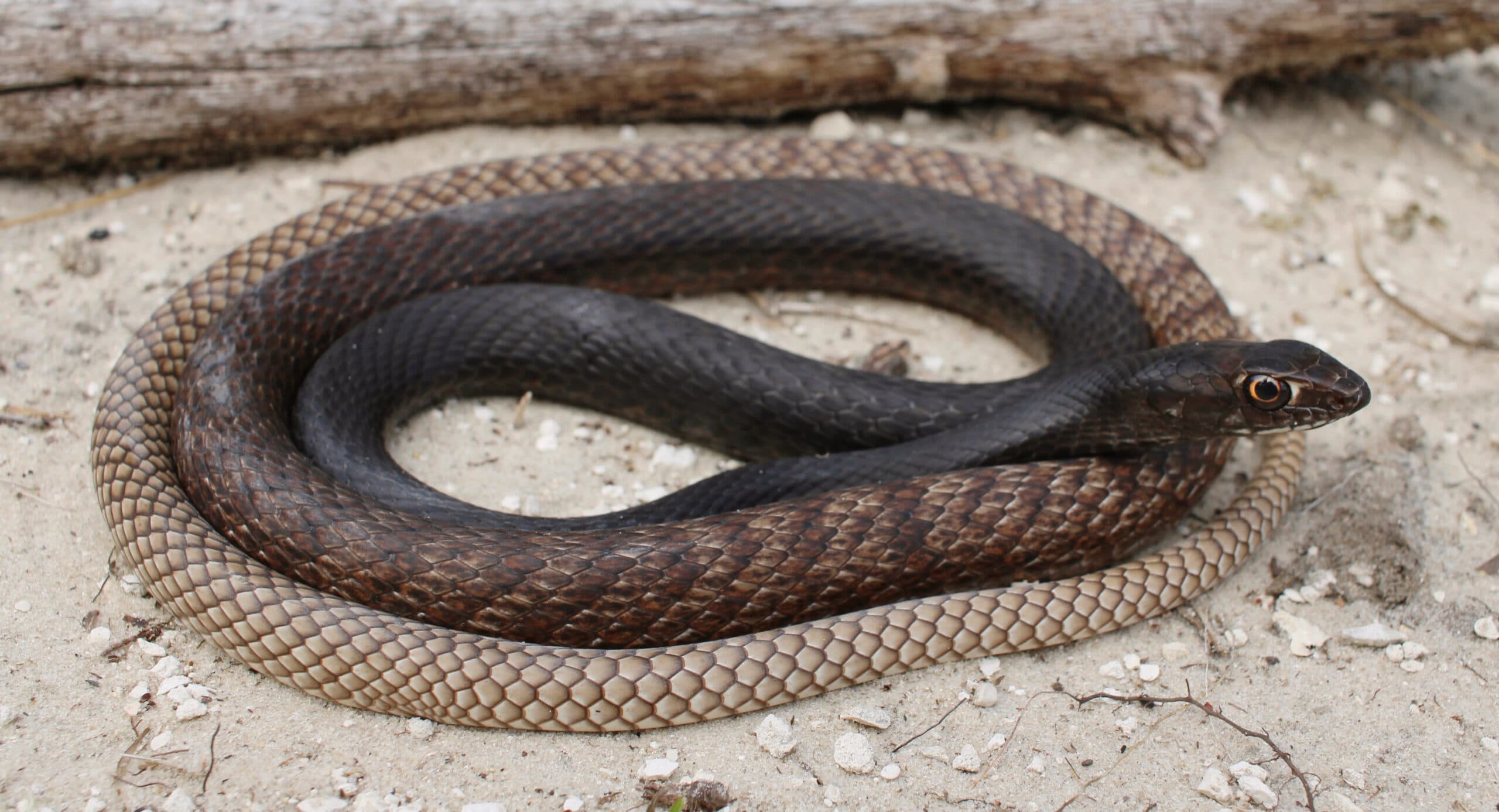
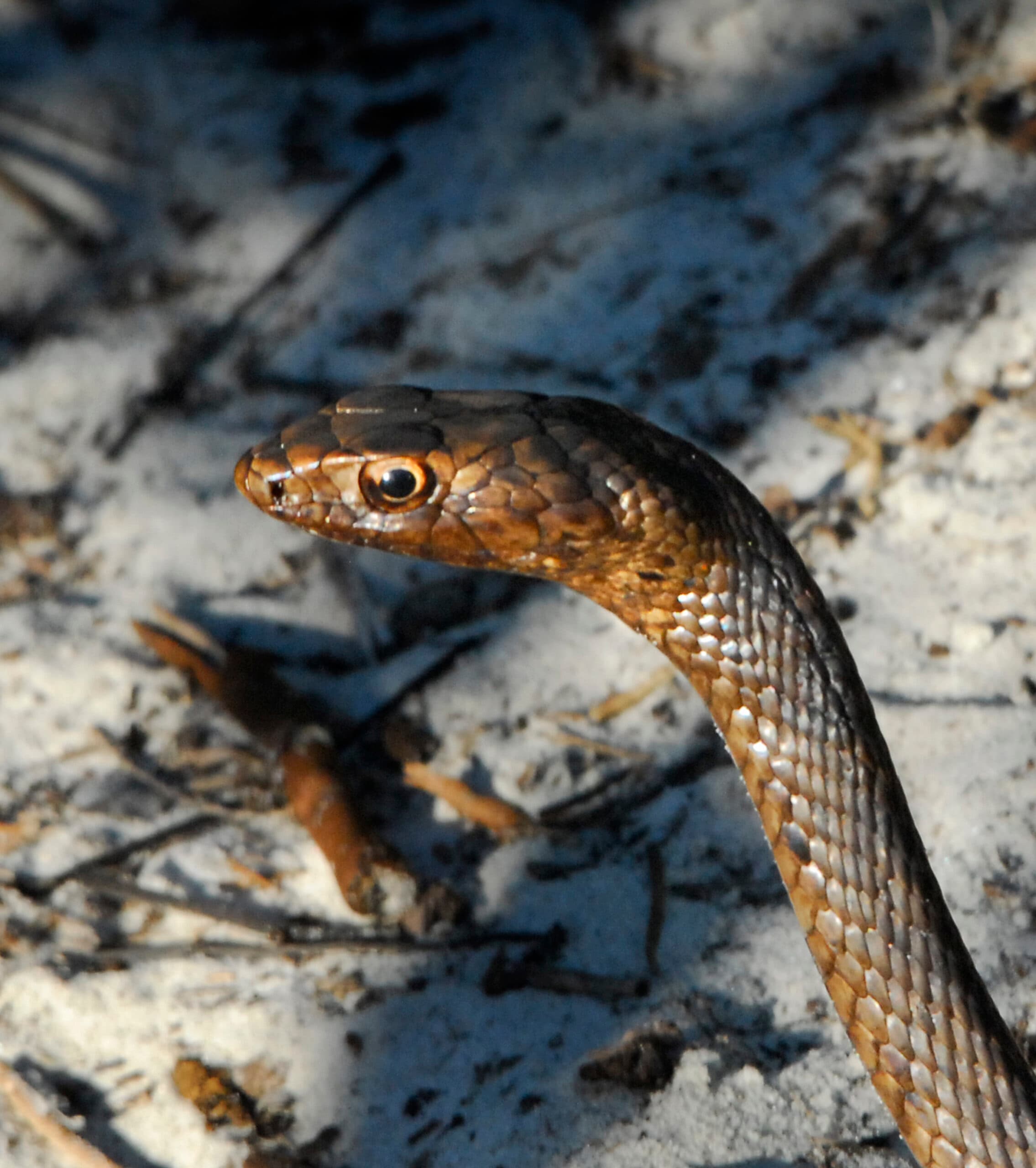
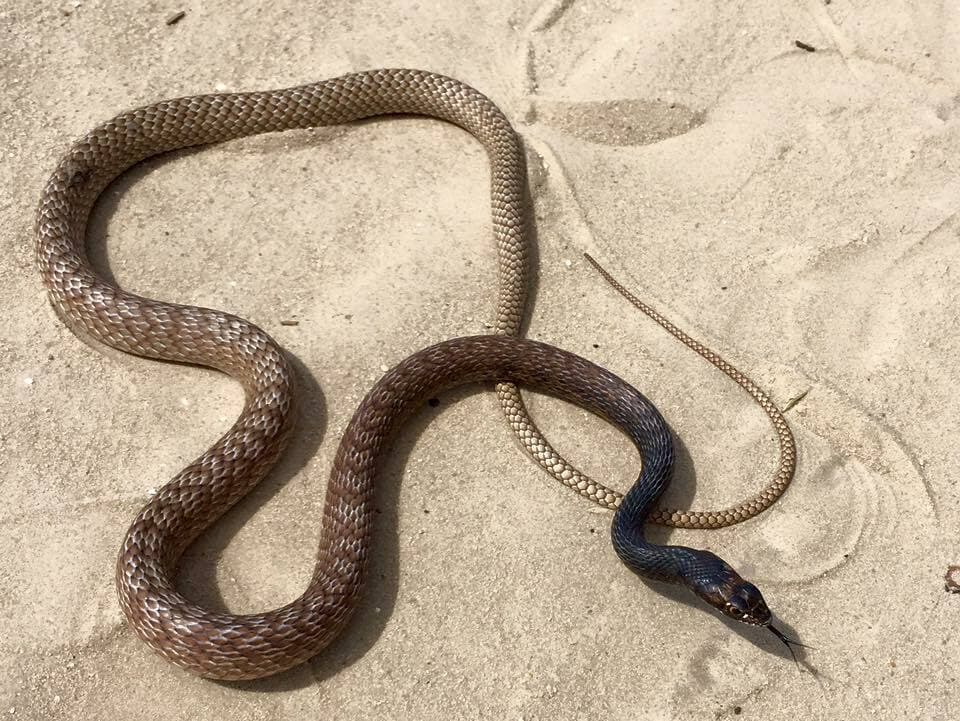
Coachwhip Snake (Masticophis flagellum) is a slender, nonvenomous colubrid built for active hunting in warm, open habitats. Its large eyes scan ahead while the snake races over sand, through scrub and even into low trees. Adults often darken toward the head and become lighter toward the tail, creating the braided-whip appearance behind the common name. Coachwhips do not lash people with their tails or deliberately chase them; when given space, they normally use their speed to escape. This guide separates well-supported biology from common assumptions and covers identification, range, habitat, diet, behavior, reproduction and conservation.
Identification
Coachwhips have a narrow head, large round pupils, smooth scales and an extremely long, tapering body. Many adults are black or very dark brown over the head and front third, fading through reddish brown or tan toward a pale tail. Color varies geographically, and some animals appear mostly tan, pinkish or reddish. Young snakes are usually gray or tan with darker crossbands that fade as they mature. The scale pattern on the tail can resemble a braided leather whip, but the tail is not used as a weapon. Males and females look broadly alike. Males may average longer tails and somewhat larger adult size, but external appearance overlaps too much for casual visual sexing to be reliable.
Identification should combine body shape, markings, size, voice or movement, and location. One feature by itself can overlap with a related animal, a juvenile, or an individual in unusual light.
Photographs are most useful when they preserve scale and show several diagnostic features. Handling or repositioning a wild coachwhip snake for identification can cause stress and is unnecessary.
Size and physical adaptations
Coachwhip Snake typically measures commonly about 1.1–1.8 m; exceptional adults can approach 2.6 m and weighs Highly variable and poorly standardized; adults are notably slender for their length. Total length includes the very long tail. Regional populations differ in average size, and old records may include taxa now split from this species.
Its useful adaptations include large eyes support visual hunting, long slender body enables rapid movement, smooth scales reduce drag through scrub, strong climbing ability opens access to bird prey, cryptic color blends with sand and vegetation, high daytime activity exploits warm conditions, flexible diet follows locally abundant prey. These traits work together in the animal’s normal setting rather than serving as isolated curiosities.
Published measurements may use different methods, life stages or sample locations. Comparing figures responsibly means checking what was measured rather than selecting the largest number available.
Range and distribution
Open regions across much of the southern United States and into northern Mexico. The exact western boundary depends on modern taxonomic treatment because several populations once included within Masticophis flagellum are now recognized as separate species. The native range includes United States, Mexico.
A country-level map indicates broad distribution, not continuous occupation. Climate, elevation, water, vegetation, prey, breeding sites, barriers and survey effort all affect where records occur.
Records near the edge of the range deserve careful documentation because they may reflect natural movement, improved survey coverage, accidental transport or a genuine distribution change.
Habitat
Grasslands, sandy scrub, coastal dunes, desert margins, open woodland, rocky slopes, old fields and other sunny terrain with scattered cover.
Coachwhips need warmth, visibility and places to retreat. They forage across open ground but repeatedly use shrubs, brush piles, burrows, rock crevices and low trees for cover. Sandy soils help provide nesting and refuge sites, while a mosaic of clear ground and vegetation supports both rapid pursuit and concealment. On barrier islands and coastal dunes they move through scrub and beach-edge vegetation; inland they occupy grassland, chaparral, pine openings and desert wash country. Roads that cut across these habitats create a serious collision hazard for a fast-moving snake with a large home range. Protecting a population therefore requires the feeding, shelter and breeding features that make a site usable, along with connections that allow movement.
Microhabitat matters. Shade, soil, current, moisture, shelter or host plants can determine whether a small area is usable even when the surrounding landscape appears suitable.
Diet and feeding
Coachwhip Snake is a carnivore. Important foods include lizards, small snakes, rodents, young rabbits, birds and nestlings, frogs, large insects, eggs. A Coachwhip actively searches rather than waiting in ambush. It raises the front of its body to look across low vegetation, investigates burrows and brush, and pursues prey with bursts of speed. Small prey may be swallowed quickly, while larger animals are pinned in the jaws or pressed against the ground. Coachwhips are not constrictors and do not inject venom. Large eyes and daytime activity make vision especially important, though scent collected by the tongue also guides close-range tracking.
Diet changes with age, season, location and food supply. A dramatic prey record does not establish what most individuals eat most of the time; repeated field observations provide a stronger picture.
Feeding opportunities also create risk. An animal focused on prey may be less alert to predators, traffic or people, while contaminated prey can transfer pollutants through the food web.
Behavior and communication
Diurnal and especially active on warm, sunny days, with seasonal timing adjusted to local heat. Coachwhips are alert, fast and usually intent on escape. A disturbed snake may race for the nearest shrub, burrow or tree, and its movement toward cover can be mistaken for pursuit if a person stands in the same direction. When cornered or grabbed it can coil, vibrate its tail, strike and bite repeatedly. The species also climbs well and may rest or hunt above ground. In cold weather it shelters underground and becomes inactive until temperatures rise.
Like other snakes, Coachwhips rely heavily on chemical information. The forked tongue gathers airborne and ground-borne particles and transfers them to the vomeronasal organs in the roof of the mouth. Vision helps detect prey and threats at a distance. Body posture, rapid movement, tail vibration and striking communicate a defensive warning at close range, while reproductive encounters depend on scent trails and touch. Behavior should be interpreted in context: alarm, courtship, feeding and temperature regulation can produce very different actions from the same animal.
Daily schedules are flexible responses, not rigid rules. Weather, breeding condition, disturbance, tides or food can move activity into a different part of the day.
Reproduction and development
Breeding generally occurs in spring or early summer after seasonal activity resumes. Males follow chemical trails to locate females. The female later deposits a clutch in a protected warm site such as loose soil, rotting vegetation, a burrow or space beneath cover. Development continues without parental guarding, and young hatch equipped to hunt insects and small vertebrates. Usually 4–24 eggs, averaging around 11 in published summaries Hatchlings are distinctly banded and feed on insects, small lizards and other manageable prey. Their pattern becomes less obvious with growth, and many adults develop a pronounced dark-to-light color gradient. Young receive no parental care and must immediately find cover, regulate body temperature and avoid predators.
Young animals face different risks and may use different microhabitats or food than adults. Breeding success depends on adult condition, suitable sites and the survival of offspring through vulnerable early stages.
Counts of eggs or young describe reproductive output, not the number expected to reach adulthood. Mortality is normally greatest during eggs, larval or juvenile stages.
Predators and ecological role
Coachwhips connect several levels of open-country food webs. They consume insects, lizards, snakes, birds and small mammals, then become prey for raptors, owls, mammalian carnivores and larger snakes. Their wide-ranging searches can help regulate locally abundant rodents and reptiles. Because they use open ground, brush and trees, healthy populations depend on varied habitat structure rather than a single vegetation type. Preserving connected scrub and grassland also reduces the need to cross dangerous roads. Documented or likely predators include Red-tailed Hawk, Great Horned Owl, Coyote, Kingsnake, Roadrunner.
This animal is both a consumer and a food source. Its influence comes through many repeated interactions, so ecological claims should be based on measured populations rather than assumptions drawn from appearance.
Predator and prey relationships differ among places. A species can be ecologically influential without being abundant everywhere, and its role can change across its range.
Relationship with people
People most often see Coachwhips crossing roads, moving through yards near natural habitat or disappearing into scrub. Their size and speed can be startling, but they provide useful pest control and are nonvenomous. The safest response is to keep pets and children back, give the snake a clear escape route and allow it to leave. Habitat protection, wildlife-friendly fencing and slower driving on warm roads reduce avoidable deaths.
Do not chase, corner or pick up a wild Coachwhip. Although nonvenomous, a restrained snake can bite repeatedly and leave cuts that require cleaning. Step back, supervise pets and let it move to cover. Seek medical advice for a deep bite, persistent bleeding or signs of infection, and contact a licensed wildlife professional if a snake is trapped indoors. Responsible observation means keeping an appropriate distance, avoiding capture or feeding, protecting habitat and following local wildlife or invasive-species guidance.
Wildlife guidance should come from the responsible local agency because collection rules, reporting requests and appropriate responses differ between native and introduced ranges.
Conservation
The Coachwhip is assessed as Least Concern across its broad range, but local populations can decline where open habitat is converted, fragmented or crossed by busy roads. Taxonomic splits also mean regional status should be evaluated with current species boundaries. The reported global trend is Generally stable at the broad scale, with localized declines possible.
Important pressures include road mortality, loss of scrub and grassland, habitat fragmentation, deliberate killing from fear, illegal collection, fire or land management that removes all cover. Global status can hide local decline or recovery, so current regional monitoring and habitat management remain necessary.
The most useful conservation action follows the documented pressure. Protecting breeding sites, reducing road deaths or limiting pollutants can require different tools in different populations.