
Home/Animals/Cephalopoda/Coconut Octopus
Species profileIUCN: NE

Coconut Octopus

Amphioctopus marginatus

A small Indo-Pacific octopus famous for carrying shells and coconut halves as portable shelter.

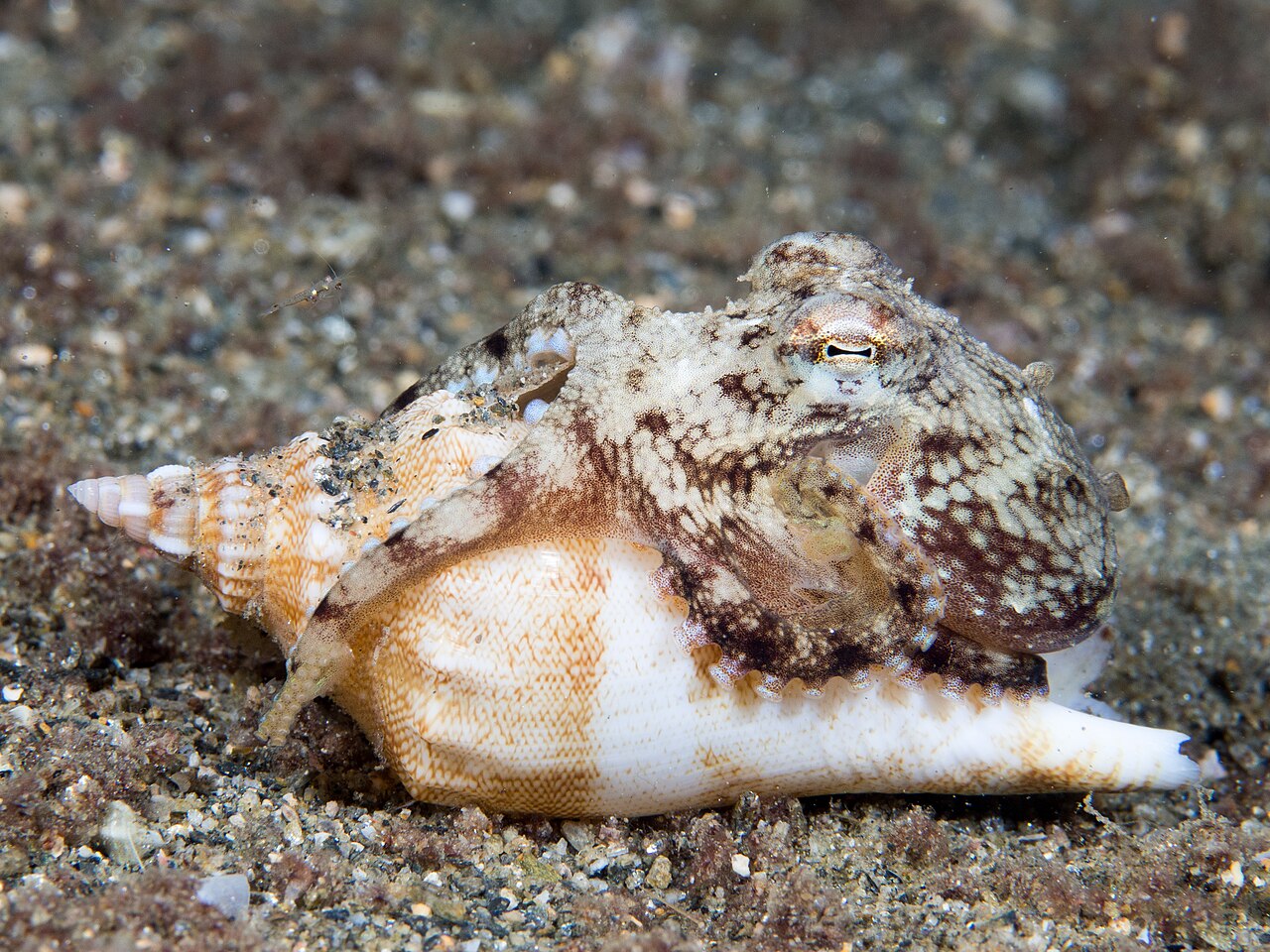
Coconut octopus resting on a gastropod shell
Rickard Zerpe / Wikimedia Commons / CC BY 2.0
๐ŸŒ Read in Language:

โšก At a Glance

Species profile
Also Known As
Veined octopus
Diet Category
Marine carnivore
Activity Rhythm
Often active at dusk or night, with behavior influenced by disturbance and prey.
Wild Lifespan
Probably about one to two years
Typical Weight
usually well under 1 kg
Conservation Status
NE
๐Ÿ’ก Key Biological Insight: It can carry paired shell or coconut pieces and assemble them into a shelter later.

๐ŸŒณ Scientific Taxonomy Hierarchy

The coconut octopus is an incirrate octopus in family Octopodidae; it is also called the veined octopus.

KingdomAnimalia
PhylumMollusca
ClassCephalopoda
OrderOctopoda
FamilyOctopodidae
GenusAmphioctopus
SpeciesAmphioctopus marginatus

Distinguishing Anatomical Features

  • โœ“A small octopus with dark vein-like lines over a pale to brown mantle, white suckers and a distinctive dark margin along the arms. Pattern and texture can change rapidly.
  • โœ“Chromatophores change color rapidly
  • โœ“Flexible arms manipulate objects
  • โœ“Suckers taste and grip surfaces
  • โœ“Shells provide portable armor

๐Ÿ“ Physical Measurements

Total Lengthmantle roughly 3 in; total length around 6 in
Body Weightusually well under 2.2 lb
Tail LengthNot applicable
WingspanNot applicable
Top SpeedNo dependable universal maximumMovement changes with context and conditions.

๐ŸŽจ Appearance & Distinctive Markings

BrownCreamWhiteDark purple

Skin / Covering: Soft muscular skin with chromatophores

Sexual Dimorphism: Females grow larger than males; mature males possess a modified reproductive arm called a hectocotylus.

๐Ÿ—บ๏ธ Geographic Distribution & Habitat

Shallow tropical waters of the western Pacific and eastern Indian Ocean, especially around Indonesia and the Philippines.

Open sandy or muddy seabeds, seagrass margins and rubble areas where fixed hiding places are scarce.

Country-level distribution map

Native range
FijiTanzaniaWestern SaharaCanadaUnited StatesKazakhstanUzbekistanPapua New Guinea โ€” Native rangeIndonesia โ€” Native rangeArgentinaChileCongo - KinshasaSomaliaKenyaSudanChadHaitiDominican RepublicRussiaBahamasFalkland IslandsNorwayGreenlandFrench Southern TerritoriesTimor-Leste โ€” Native rangeSouth AfricaLesothoMexicoUruguayBrazilBoliviaPeruColombiaPanamaCosta RicaNicaraguaHondurasEl SalvadorGuatemalaBelizeVenezuelaGuyanaSurinameFranceEcuadorPuerto RicoJamaicaCubaZimbabweBotswanaNamibiaSenegalMaliMauritaniaBeninNigerNigeriaCameroonTogoGhanaCรดte dโ€™IvoireGuineaGuinea-BissauLiberiaSierra LeoneBurkina FasoCentral African RepublicCongo - BrazzavilleGabonEquatorial GuineaZambiaMalawiMozambiqueEswatiniAngolaBurundiIsraelLebanonMadagascarPalestinian TerritoriesGambiaTunisiaAlgeriaJordanUnited Arab EmiratesQatarKuwaitIraqOmanVanuatuCambodiaThailandLaosMyanmar (Burma)VietnamNorth KoreaSouth KoreaMongoliaIndiaBangladeshBhutanNepalPakistanAfghanistanTajikistanKyrgyzstanTurkmenistanIranSyriaArmeniaSwedenBelarusUkrainePolandAustriaHungaryMoldovaRomaniaLithuaniaLatviaEstoniaGermanyBulgariaGreeceTรผrkiyeAlbaniaCroatiaSwitzerlandLuxembourgBelgiumNetherlandsPortugalSpainIrelandNew CaledoniaSolomon IslandsNew ZealandAustraliaSri LankaChinaTaiwanItalyDenmarkUnited KingdomIcelandAzerbaijanGeorgiaPhilippines โ€” Native rangeMalaysia โ€” Native rangeBruneiSloveniaFinlandSlovakiaCzechiaEritreaJapanParaguayYemenSaudi ArabiaCyprusMoroccoEgyptLibyaEthiopiaDjiboutiUgandaRwandaBosnia & HerzegovinaNorth MacedoniaSerbiaMontenegroKosovoTrinidad & TobagoSouth Sudan
Highlighted countries are recorded profile locations, not precise biological range boundaries.Map boundaries: Natural Earth

๐Ÿ’ก Did You Know?

  • ๐Ÿ’กChromatophores change color rapidly
  • ๐Ÿ’กFlexible arms manipulate objects
  • ๐Ÿ’กSuckers taste and grip surfaces
  • ๐Ÿ’กShells provide portable armor

๐ŸŒฟ Conservation Status & Threats

IUCN: NE โ€” NE

โ€œNot Evaluated by the IUCN; no robust global population estimate is available.โ€

Population TrendUnknown
Wild Population EstimateNo single dependable global total is available.

โš ๏ธ Major Threats to Coconut Octopus

  • โ€ขCoastal habitat degradation
  • โ€ขBottom disturbance
  • โ€ขCollection for seafood or aquaria
  • โ€ขPollution

๐Ÿ”„ Life Cycle & Reproduction

Wild vs. Captivity Lifespan Comparison

๐ŸŒฟ In the WildProbably about one to two years
๐Ÿ  In Captivity (with veterinary care)Can differ under managed care.
Clutch / Litter SizeNumerous small eggs attached in strings.
Incubation / GestationSeveral weeks, depending strongly on temperature
Fledging / WeaningHatchlings enter a small planktonic stage before settling to the bottom.
Sexual MaturityWithin a short cephalopod lifespan
Mating SystemPolygynandrous encounters with internal sperm transfer
Nesting / Den TypeEgg strings guarded in a den or enclosed shelter

๐Ÿฆ… Behavior & Field Ecology

Marine carnivore

๐ŸŒ Ecological Food Web & Relationships: Predator of bottom-dwelling invertebrates and prey for larger fish and cephalopods.

Social Group SizeSolitary outside mating
Activity RhythmOften active at dusk or night, with behavior influenced by disturbance and prey.
Feeding StrategyMarine carnivore

๐Ÿฅฉ Primary Prey & Preferred Diet

โœ“ Shrimpโœ“ Crabsโœ“ Clamsโœ“ Small fishโœ“ Other benthic invertebrates

๐Ÿ“ข Communication & Territorial Signals

  • Color pattern
  • Skin texture
  • Arm posture

๐Ÿพ Wild Temperament & Traits

โ€ข Secretiveโ€ข Curiousโ€ข Solitary

๐Ÿค Human Interaction & Pet Advisory

โš ๏ธ Strictly Wild Species
๐Ÿšซ

Can You Keep a Coconut Octopus as a Pet?

Unsuitable for casual home aquaria; cephalopod care requires specialist systems and welfare expertise.

Domestication StatusWild and not domesticated
Danger to HumansAvoid handling
Economic & Ecotourism RoleResearch value in cognition, object use and animal behavior; ecotourism interest.

โš ๏ธ Behavioral Risk Factors & Wildlife Safety

  • A beak can bite
  • Wild octopuses should not be identified by apparent tameness

๐ŸŒ Ecological Food Web & Relationships

๐Ÿฆ… Natural Predators (3)

Reef FishActinopterygii
Moray EelsMuraenidae
Larger OctopusesOctopoda

๐Ÿงฌ Related Species (2)

Common Sydney OctopusOctopus tetricusRelated shallow-water octopod
Blue-ringed OctopusHapalochlaena speciesSmall octopod sharing parts of the region

Coconut Octopus (Amphioctopus marginatus) is a benthic cephalopod of shallow tropical seafloors. This guide separates well-supported biology from common assumptions and covers identification, range, habitat, diet, behavior, reproduction and conservation.

Identification

A small octopus with dark vein-like lines over a pale to brown mantle, white suckers and a distinctive dark margin along the arms. Pattern and texture can change rapidly. Females grow larger than males; mature males possess a modified reproductive arm called a hectocotylus.

Identification should combine body shape, markings, size, voice or movement, and location. One feature by itself can overlap with a related animal, a juvenile, or an individual in unusual light.

Photographs are most useful when they preserve scale and show several diagnostic features. Handling or repositioning a wild coconut octopus for identification can cause stress and is unnecessary.

Size and physical adaptations

Coconut Octopus typically measures mantle roughly 8 cm; total length around 15 cm and weighs usually well under 1 kg. Published measurements differ with method and maturity.

Its useful adaptations include chromatophores change color rapidly, flexible arms manipulate objects, suckers taste and grip surfaces, shells provide portable armor. These traits work together in the animal’s normal setting rather than serving as isolated curiosities.

Published measurements may use different methods, life stages or sample locations. Comparing figures responsibly means checking what was measured rather than selecting the largest number available.

Range and distribution

Shallow tropical waters of the western Pacific and eastern Indian Ocean, especially around Indonesia and the Philippines. The native range includes Indonesia, Philippines, Malaysia, Papua New Guinea, Timor-Leste.

A country-level map indicates broad distribution, not continuous occupation. Climate, elevation, water, vegetation, prey, breeding sites, barriers and survey effort all affect where records occur.

Records near the edge of the range deserve careful documentation because they may reflect natural movement, improved survey coverage, accidental transport or a genuine distribution change.

Habitat

Open sandy or muddy seabeds, seagrass margins and rubble areas where fixed hiding places are scarce.

It buries in sediment and uses discarded shells, coconut halves and other objects as refuge on exposed bottoms. Protecting a population therefore requires the feeding, shelter and breeding features that make a site usable, along with connections that allow movement.

Microhabitat matters. Shade, soil, current, moisture, shelter or host plants can determine whether a small area is usable even when the surrounding landscape appears suitable.

Diet and feeding

Coconut Octopus is a marine carnivore. Important foods include shrimp, crabs, clams, small fish, other benthic invertebrates. It probes sediment and crevices with flexible arms, restrains prey with suckers and uses the beak and saliva during feeding.

Diet changes with age, season, location and food supply. A dramatic prey record does not establish what most individuals eat most of the time; repeated field observations provide a stronger picture.

Feeding opportunities also create risk. An animal focused on prey may be less alert to predators, traffic or people, while contaminated prey can transfer pollutants through the food web.

Behavior and communication

Often active at dusk or night, with behavior influenced by disturbance and prey. It walks across the bottom, buries itself, changes appearance and carries shelter components beneath its body.

Body pattern, skin texture, posture and touch convey defense and reproductive condition. Behavior should be interpreted in context: alarm, courtship, feeding and temperature regulation can produce very different actions from the same animal.

Daily schedules are flexible responses, not rigid rules. Weather, breeding condition, disturbance, tides or food can move activity into a different part of the day.

Reproduction and development

A male transfers spermatophores with the hectocotylus; the female tends attached eggs in a protected den. Numerous small eggs attached in strings. undefined

Young animals face different risks and may use different microhabitats or food than adults. Breeding success depends on adult condition, suitable sites and the survival of offspring through vulnerable early stages.

Counts of eggs or young describe reproductive output, not the number expected to reach adulthood. Mortality is normally greatest during eggs, larval or juvenile stages.

Predators and ecological role

Predator of bottom-dwelling invertebrates and prey for larger fish and cephalopods. Documented or likely predators include Reef Fish, Moray Eels, Larger Octopuses.

This animal is both a consumer and a food source. Its influence comes through many repeated interactions, so ecological claims should be based on measured populations rather than assumptions drawn from appearance.

Predator and prey relationships differ among places. A species can be ecologically influential without being abundant everywhere, and its role can change across its range.

Relationship with people

Divers value the species for its unusual object use, but crowding or moving shells disrupts natural behavior.

Do not handle any unidentified octopus. Observe without blocking escape routes or rearranging its shelter. Responsible observation means keeping an appropriate distance, avoiding capture or feeding, protecting habitat and following local wildlife or invasive-species guidance.

Wildlife guidance should come from the responsible local agency because collection rules, reporting requests and appropriate responses differ between native and introduced ranges.

Conservation

Not Evaluated by the IUCN; no robust global population estimate is available. The reported global trend is Unknown.

Important pressures include coastal habitat degradation, bottom disturbance, collection for seafood or aquaria, pollution. Global status can hide local decline or recovery, so current regional monitoring and habitat management remain necessary.

The most useful conservation action follows the documented pressure. Protecting breeding sites, reducing road deaths or limiting pollutants can require different tools in different populations.

Sources and further reading

โ“ Frequently Asked Questions

Answers to frequently asked questions verified against peer-reviewed zoological research.

Individuals have been filmed carrying discarded coconut-shell halves and later assembling them into a protective shelter.