
Identity and Taxonomy
The corn snake is a living North American ratsnake with the scientific name Pantherophis guttatus. It belongs to the family Colubridae and is a single species, not a catch-all name for every orange patterned snake. Older books may place it in Elaphe, but current references such as the Reptile Database use Pantherophis guttatus. The closely related Great Plains ratsnake, Pantherophis emoryi, is treated as a separate species.
The common name may refer to the species being found around grain stores, where mice gather, or to the checkerboard belly pattern that resembles kernels of maize. “Red ratsnake” is another established name. Wild corn snakes differ from the many selectively bred color forms kept in captivity, so bright white, gray, or patternless pet morphs should not be assumed to represent normal wild coloration.
Appearance and Identification
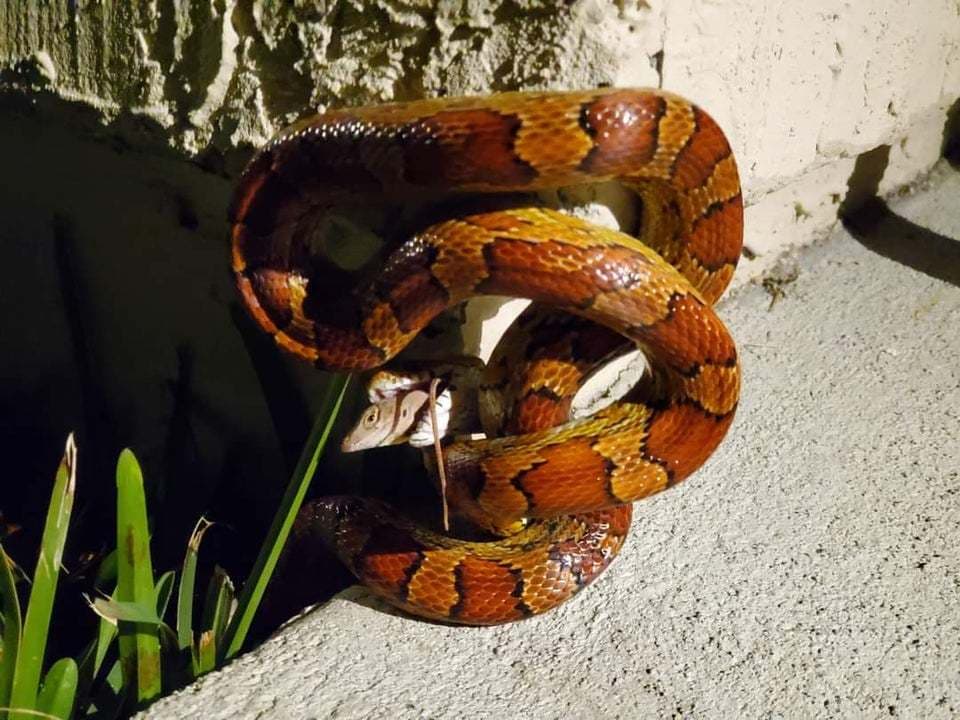
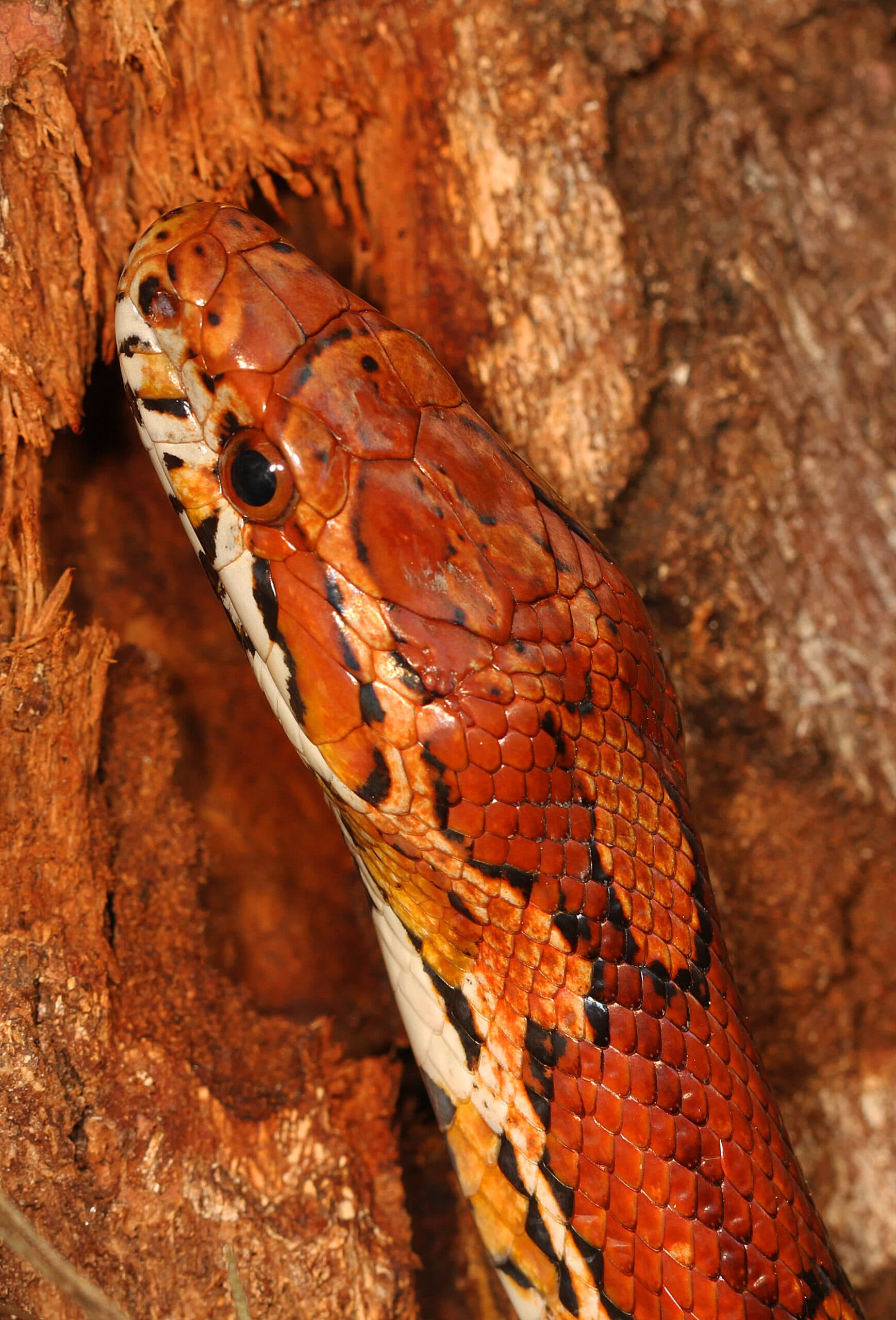
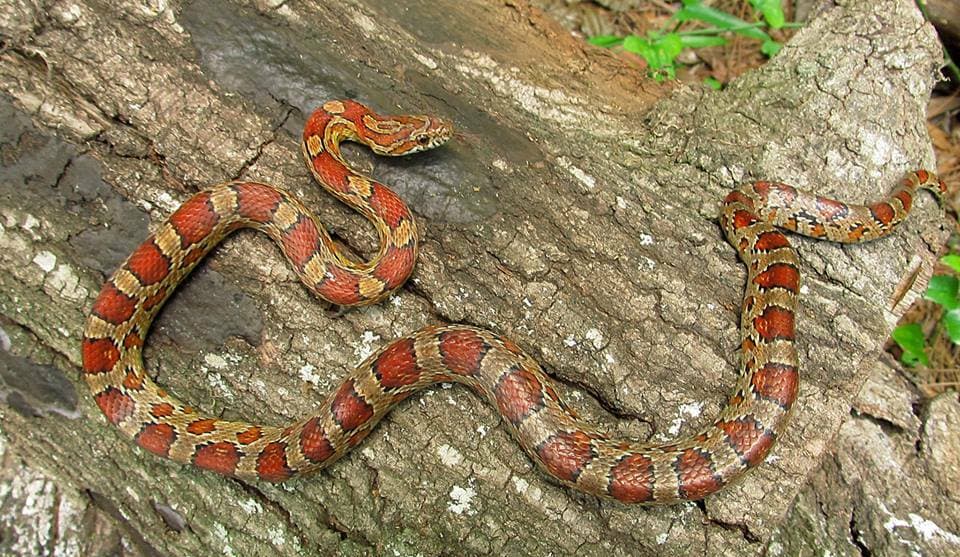
A typical wild corn snake has an orange, yellowish brown, or gray ground color crossed by red or reddish brown dorsal blotches edged in black. Smaller side blotches alternate with the larger saddles. The underside usually bears a striking black-and-white checkerboard pattern, while the head has a spear-shaped marking and round pupils. The body is slender but muscular, with smooth-looking scales and a long tapering tail.
Adults commonly measure about 61 to 182 centimetres, or two to six feet, according to the Smithsonian’s National Zoo. Size varies with sex, age, food, and locality. Identification should combine pattern, head shape, scale details, and range. Harmless corn snakes are sometimes killed after being mistaken for copperheads, but copperheads have hourglass-shaped crossbands, a heavier build, and vertical pupils. No uncertain snake should be handled for a closer look.
Range and Habitat
Corn snakes are native to the eastern and southeastern United States. Their range extends from New Jersey south through Florida and west toward Louisiana and parts of Kentucky. The exact edge varies among references and verified locality records. They occupy pine woods, hardwood forest edges, rocky hillsides, overgrown fields, farms, and suburban margins. Barns and abandoned buildings can provide shelter and abundant rodents, but the species does not depend on cornfields.
These snakes use cover carefully. Loose bark, logs, stone piles, rodent burrows, and building foundations offer protection from predators and temperature extremes. They can climb well and may search trees or rafters for prey. In colder parts of the range they spend winter in sheltered communal or solitary refuges, becoming active again as temperatures rise. Road traffic, indiscriminate killing, and loss of connected cover can cause local mortality even where the species remains widespread.
Diet and Hunting
Corn snakes are nonvenomous constrictors. Adults feed mainly on mice and other small mammals, while birds, nestlings, bats, and eggs may also be taken. Young snakes eat more lizards and small frogs before shifting toward mammals as they grow. A hunting snake samples airborne and surface chemicals with its forked tongue, follows scent trails, seizes prey with small recurved teeth, and wraps muscular coils around it.
Constriction stops effective circulation quickly; the snake then swallows prey whole, usually head first. Feeding frequency changes with prey availability, body size, temperature, and reproduction. By consuming rodents, corn snakes provide useful pest control around farms and buildings. They are also prey for hawks, owls, mammals, and larger snakes, placing them in the middle of local food webs rather than at the top.
Behavior and Seasonal Activity
Corn snakes are usually solitary and avoid confrontation. They may be active by day in mild weather, shift toward dusk or night during hot periods, and remain hidden for long intervals while digesting or shedding. Climbing ability helps them exploit trees, shrubs, and structures, although much activity occurs on or below the ground. When discovered, most try to flee into cover.
A cornered individual may freeze, vibrate its tail in dry leaves, release musk, coil, or strike. These actions are defensive and do not mean the snake is pursuing a person. A bite can puncture skin but lacks venom and is rarely medically serious. Wild snakes should still be observed without touching, both to avoid injury and to prevent stress or accidental displacement from a familiar refuge.
Reproduction and Life Cycle
Breeding generally occurs after winter dormancy, although timing varies with latitude and weather. Males follow chemical cues left by females. After mating, a female deposits a clutch in a warm, humid, protected site such as rotting vegetation, loose soil, or a sheltered cavity. The Animal Diversity Web reports clutches commonly within a broad range of roughly 10 to 30 eggs and incubation of about two months.
Hatchlings emerge fully independent and receive no parental care. They must find small prey and safe cover immediately. Growth depends heavily on food and climate, and sexual maturity is often reached after roughly two to three years. Lifespan in the wild is not well quantified because long-term recapture data are limited. Captive animals can live for more than two decades under skilled care, but that maximum should not be treated as typical wild survival.
Conservation and Responsible Coexistence
The corn snake is generally considered widespread and of relatively low conservation concern, with an overall stable population assessment. That broad status does not protect every local population from habitat fragmentation, road mortality, persecution, or illegal collection. The pet trade is supplied largely by captive breeding, and removing wild snakes is unnecessary, ecologically harmful, and restricted or illegal in some places.
Coexistence is simple: leave the snake an escape route, keep pets back, and avoid using glue traps or loose plastic netting that can entangle wildlife. Seal building gaps only after confirming that no animal is trapped inside, and reduce spilled grain that attracts rodents. If a snake must be moved from a dangerous indoor location, contact a qualified local wildlife professional. A distant photograph can support identification without handling.
Sources and Review Notes
This profile was checked against the Reptile Database for current taxonomy, Smithsonian’s National Zoo for identification, size, range, diet, and life-history information, and the University of Michigan’s Animal Diversity Web for ecology and reproduction. Measurements and breeding values are presented as ranges because individuals and climates differ. Pet morphs, captive longevity, and husbandry records are not used to redefine the normal biology of wild corn snakes.