
Identity and classification
The cottonmouth is a living venomous pit viper of the southeastern United States. This profile uses the scientific name Agkistrodon piscivorus, the species that many modern references call the northern cottonmouth. Its closest American relative is the copperhead. The Florida cottonmouth is often treated today as a separate species, Agkistrodon conanti, so older sources that place every Florida population under A. piscivorus should be read with that taxonomic change in mind. The name “water moccasin” is widely used, but it is also applied carelessly to harmless watersnakes. A snake seen swimming is not automatically a cottonmouth.
Cottonmouths belong to the viper family Viperidae and the pit-viper subfamily Crotalinae. A heat-sensitive pit lies between each eye and nostril. These organs help the snake detect warm prey in darkness. The species is extant, native to North America and fully distinct from fossil-only animals. The Integrated Taxonomic Information System lists A. piscivorus as a valid species, while current range treatments should be checked for how they handle the Florida cottonmouth split.
Appearance and identification
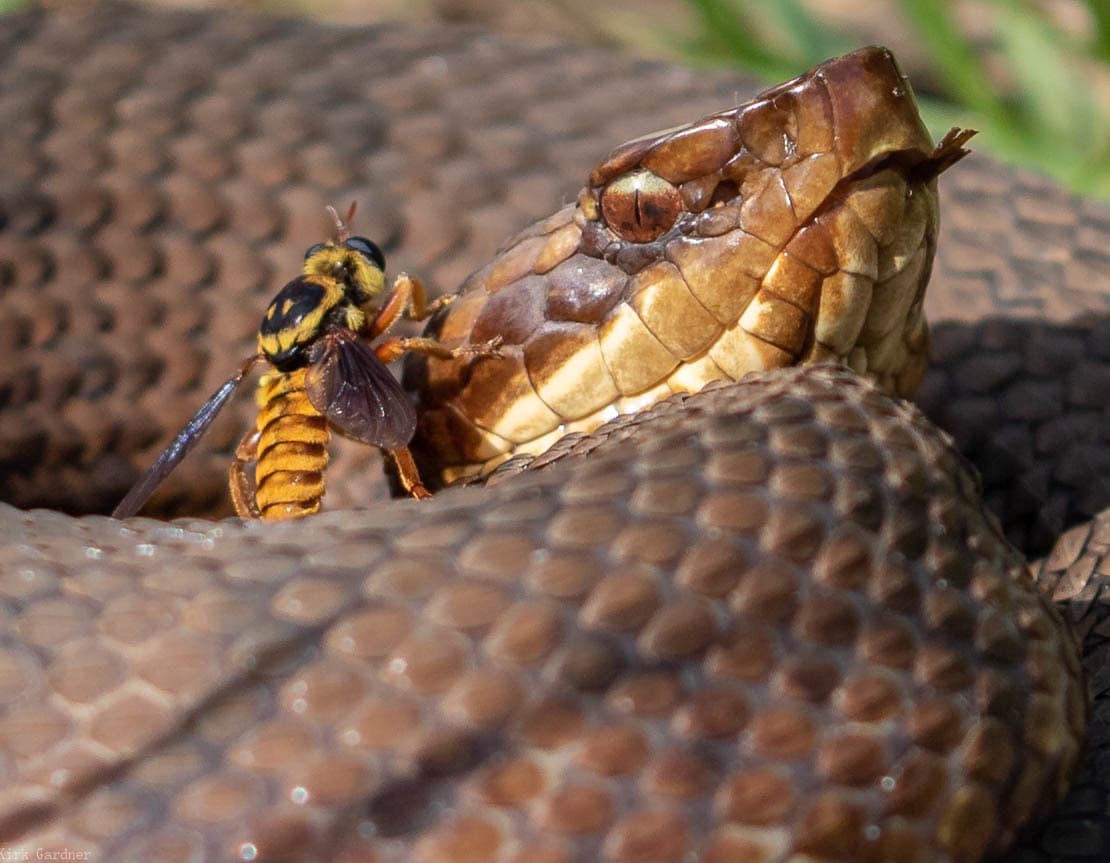
An adult cottonmouth is stout, muscular and broad-headed, with strongly keeled scales and a short-looking tail relative to its heavy body. Ground color varies from brown and olive to nearly black. Broad crossbands may remain obvious in younger snakes but often fade as the animal ages. A dark stripe through the eye, pale lines along the face and a head that is noticeably wider than the neck can help identification when viewed from a safe distance. The pupil is vertical in bright light, but observers should never approach a snake merely to inspect its eyes.
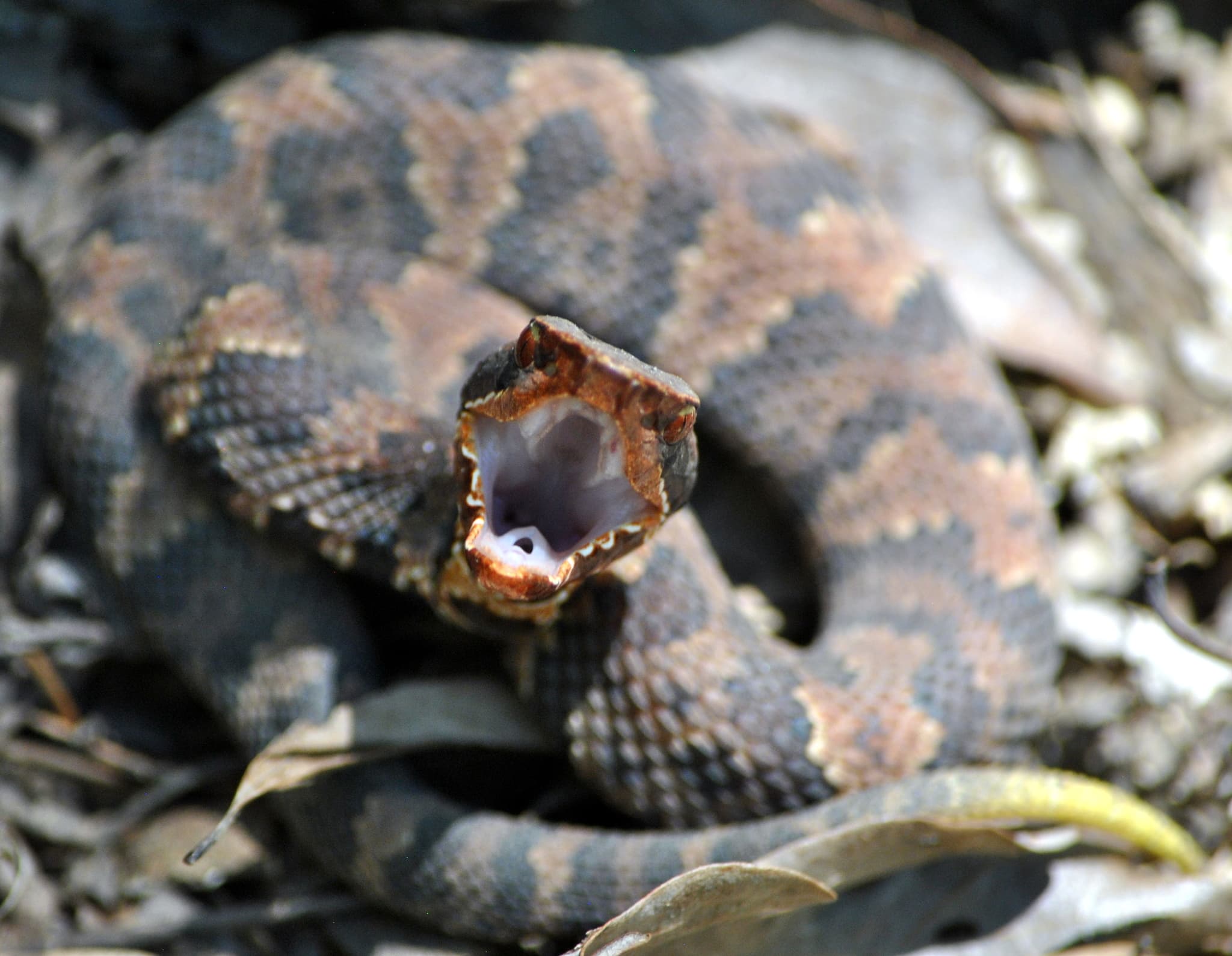
Juveniles are more vividly patterned and usually carry a yellow or greenish-yellow tail tip. They wiggle that tip as a lure, drawing frogs and small prey within striking range. The best-known defensive signal is the open mouth: its pale lining resembles a wad of white cotton and inspired the common name. This gape is a warning, not evidence that the snake is chasing people. Cottonmouths can flatten or angle the head, vibrate the tail, release musk, coil, strike or move away. Individual responses depend on distance, cover, temperature and prior disturbance.
Size and physical adaptations
Most cottonmouths are far shorter than sensational reports suggest. Adults commonly fall around 60–120 centimeters (2–4 feet), although exceptional individuals can be longer. Males tend to grow larger and heavier than females. Published maxima and average measurements differ among regions and studies, so one precise figure should not be treated as universal. The broad body stores substantial muscle and energy, while the expandable jaws permit the snake to swallow bulky prey.
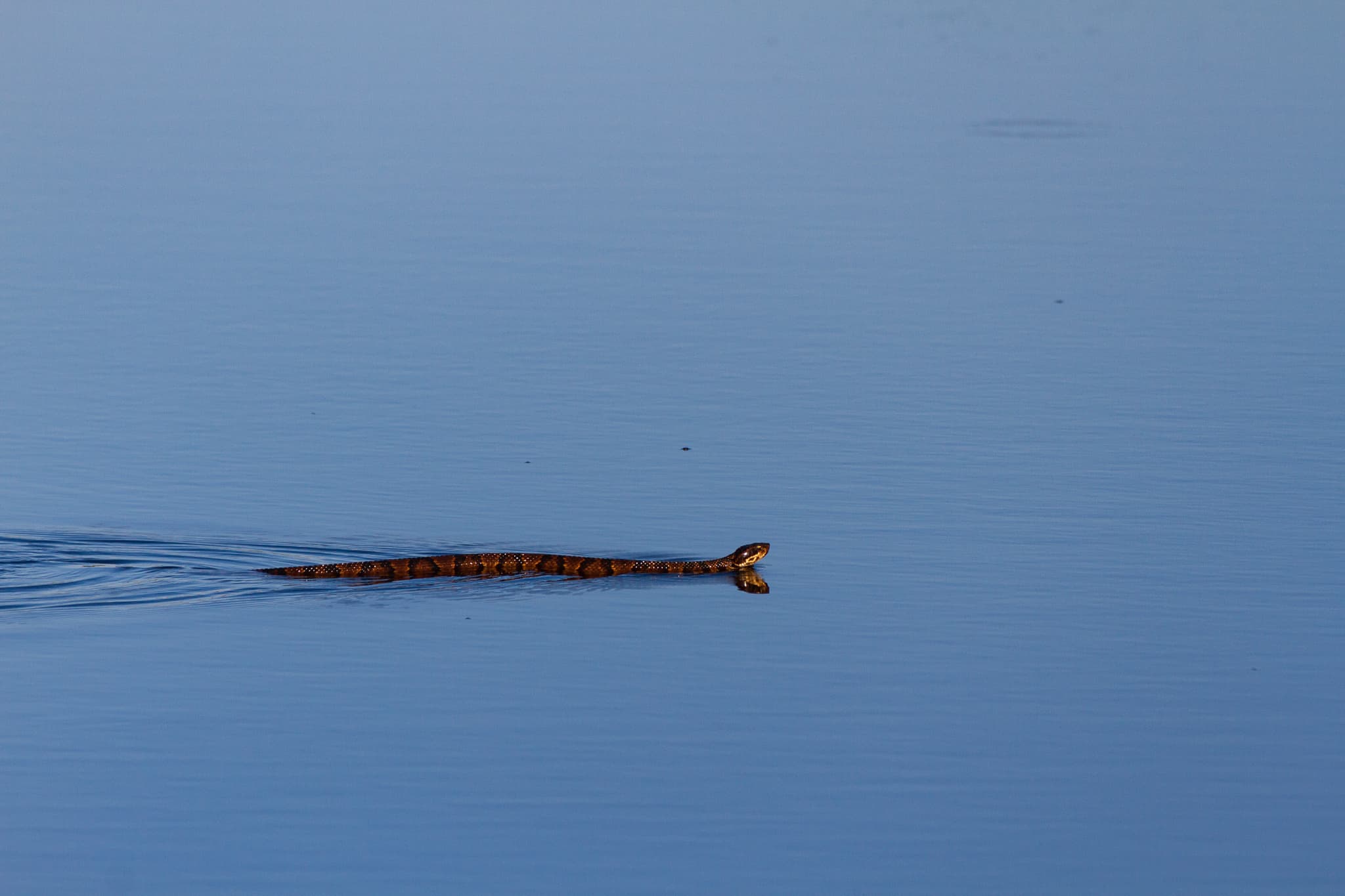
Cottonmouths swim well. They may cross open water with much of the body visible at the surface, but swimming posture alone is not a safe identification rule. Their venom apparatus consists of hinged front fangs connected to venom glands. Venom begins prey capture and digestion and also provides defense. Because a bite can cause severe pain, swelling and tissue injury, any suspected bite requires urgent medical evaluation. Cutting the wound, applying ice, using a tourniquet or attempting to suck out venom can make injury worse.
Range and wetland habitat
The northern cottonmouth occupies parts of the southeastern and south-central United States, from the Atlantic coastal plain west through the lower Mississippi region and into eastern Texas and Oklahoma, with northern extensions along major river systems. Exact boundaries vary with the taxonomic treatment used. The U.S. Geological Survey species profile documents the native distribution, identification and ecology and distinguishes native range from isolated introductions.
Swamps, marshes, sloughs, slow rivers, lake margins, flooded forests, drainage ditches and wooded stream corridors provide typical habitat. Cottonmouths also use dry land, especially when moving between wetlands, shedding, mating, basking or sheltering. They may rest under logs, in root tangles, among rocks or in mammal burrows. Seasonal flooding can open new feeding areas, while drought may concentrate snakes and prey around remaining water. Shoreline development, wetland drainage, road traffic and deliberate killing reduce local survival.
Diet and hunting
Cottonmouths are opportunistic carnivores. Fish and amphibians are important prey, but the menu can also include crayfish, small turtles, other snakes, lizards, birds and small mammals. Carrion is sometimes eaten. The species hunts both in water and on land, using chemical cues, vision and heat sensing. A snake may wait beside a travel route and ambush an animal, or actively search shallow water and shoreline cover.
After a venomous strike, the snake may hold small prey or release a larger animal and follow its scent trail. Juvenile tail luring is especially effective with frogs and lizards. By consuming abundant wetland vertebrates, cottonmouths transfer energy through aquatic and terrestrial food webs. They are also prey themselves: raptors, kingsnakes, large wading birds and mammalian predators may take young or adult snakes.
Daily life and seasonal behavior
Activity changes with weather and season. Cottonmouths may bask or forage by day during cool periods, then become more crepuscular or nocturnal in hot summer weather. In the northern part of the range, they shelter communally or singly through winter in protected crevices, burrows and other frost-free sites. They are usually solitary outside mating or shared shelter sites. Like other snakes, they gather chemical information by tongue-flicking and delivering odor particles to the vomeronasal organs in the roof of the mouth.
Field observations do not support the popular story that cottonmouths routinely pursue people. A threatened snake can stand its ground, and close disturbance may provoke a strike, but retreat, concealment and warning displays are common responses. Give any wild snake a wide path, keep children and pets away, and let the animal leave. Around homes, reducing brush piles, spilled bird seed and rodent shelter can lower the chance of encounters without harming native wildlife.
Reproduction and life cycle
Cottonmouths mate through internal fertilization and give birth to live young rather than laying exposed eggs. Courtship and mating commonly occur in spring, with additional autumn activity reported in parts of the range. Females can store sperm, and reproduction may not occur every year when food or body reserves are limited. Litters are generally born in late summer or early autumn; size varies with the female and population. The Animal Diversity Web account summarizes published information on habitat, body size, behavior and reproduction.
Newborns are independent and venomous. Their bright tail tips fade as they mature. Growth is fastest when prey is plentiful, while maturity and lifespan vary with climate, sex and local conditions. Reliable wild longevity is difficult to measure because individuals must be marked and followed for many years. Captive records should not be presented as a universal wild lifespan.
Conservation and coexistence
The cottonmouth remains widespread, but abundance is uneven and local populations can decline when wetlands are filled, waterways are polluted, roads divide habitat or people kill snakes on sight. Protecting connected floodplain forests and clean wetland edges benefits cottonmouths as well as fish, frogs, turtles, birds and many other species. A single global-style population estimate is not available, and conservation labels should always be matched to the exact taxon and assessment date.
Safe coexistence begins with distance. Wear boots and use a light when walking near water after dark. Never reach into dense cover where you cannot see your hand. If a cottonmouth is in a building or a high-use area, contact a trained local wildlife professional rather than attempting capture. Photographing from far away with zoom is safer for both observer and snake. These animals are native wetland predators, not pests that need to be removed from every natural encounter.