
Identity and rediscovery
The crested gecko, Correlophus ciliatus, is a living arboreal lizard found only in New Caledonia. French zoologist Alphonse Guichenot described it in 1866. After more than a century with few confirmed records, scientists feared that it might have disappeared. Field workers rediscovered the species in 1994, turning it into one of the best-known examples of a supposedly lost reptile found alive. Wild populations remain geographically restricted even though captive-bred crested geckos are now common in many countries.
The species belongs to the family Diplodactylidae. It was long placed in the genus Rhacodactylus, but a 2012 phylogenetic revision restored Correlophus for the crested gecko and its close relatives. The Reptile Database records the accepted name, taxonomic history, egg-laying reproduction and New Caledonian distribution. Captive popularity must not be confused with security in nature: the wild species has a small island range and is assessed as Vulnerable.
Appearance and climbing adaptations
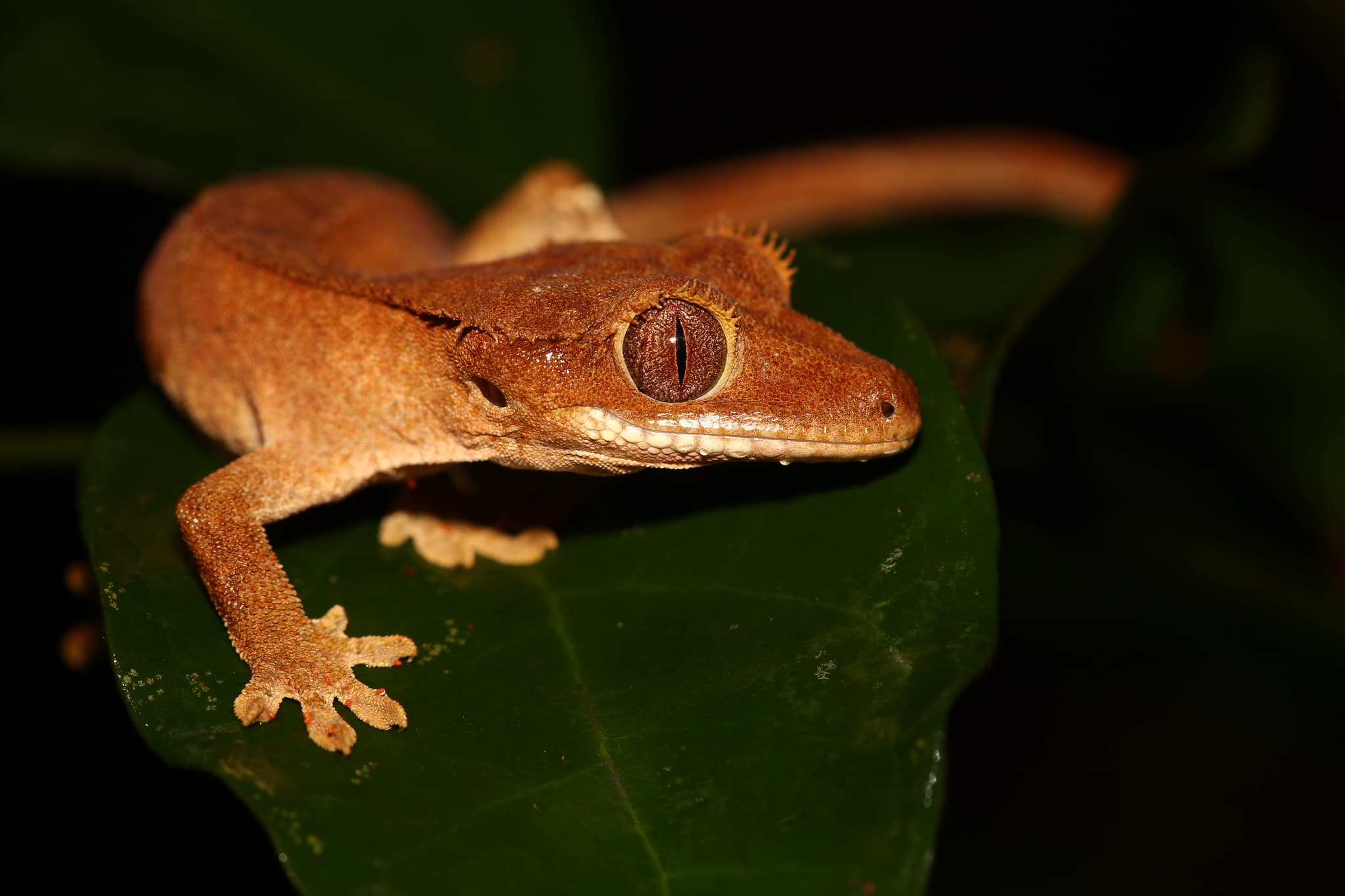
A crested gecko has a broad triangular head, large lidless eyes and two rows of soft pointed scales that begin above the eyes and continue along the back. Those projections resemble eyelashes, inspiring both “crested gecko” and “eyelash gecko.” The animal cannot blink. It cleans the transparent spectacle over each eye with its tongue. Wild coloration includes brown, tan, reddish, yellowish and olive shades, often broken by stripes, spots or contrasting sides. Selective breeding has produced many additional color and pattern combinations in captivity.
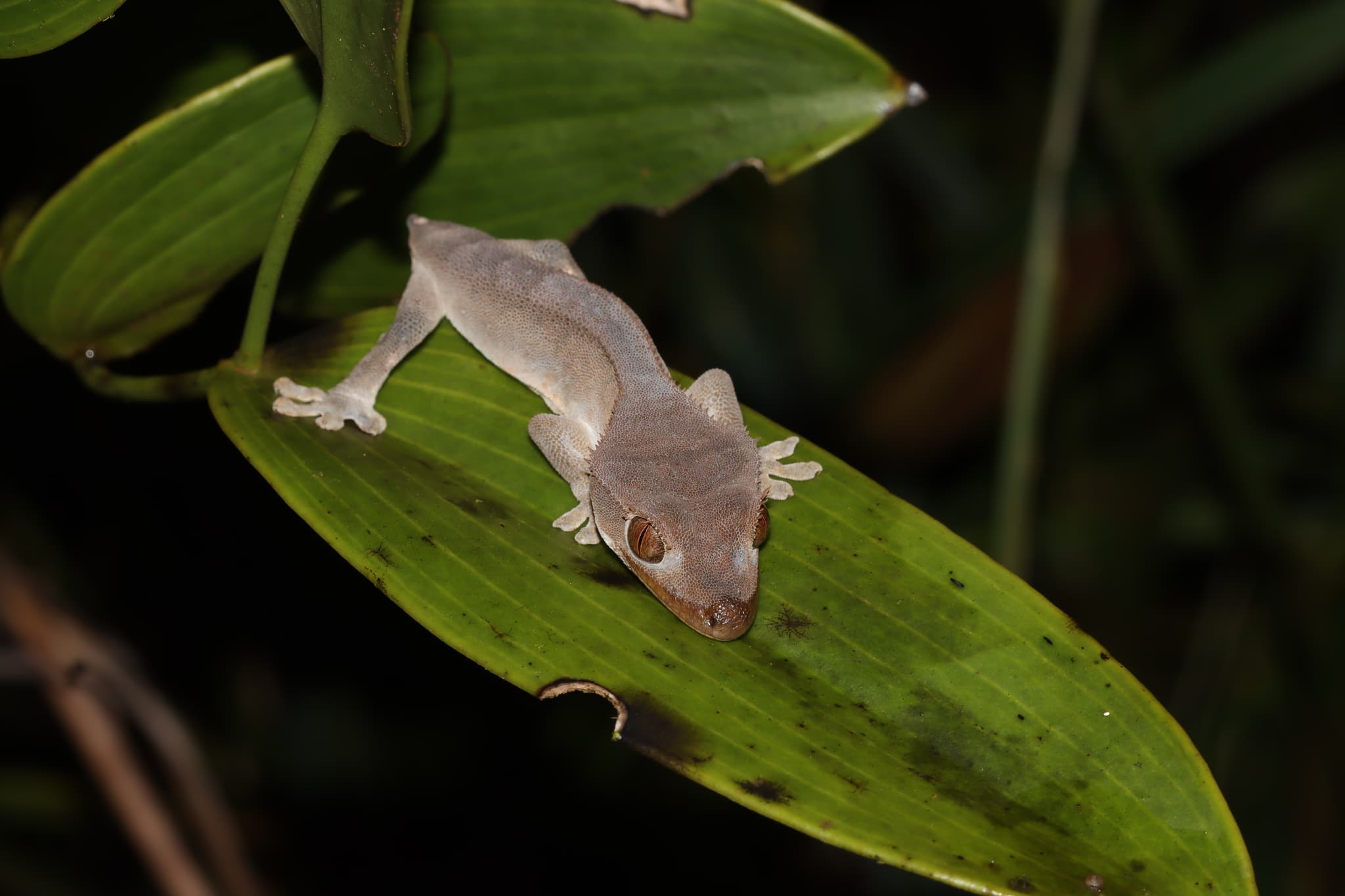
Expanded pads beneath the toes carry microscopic structures that grip surfaces through intermolecular forces. Small claws add purchase on bark, and moderate webbing helps the toes conform to branches. A prehensile tail supports balance and can also adhere near its tip. Research on tail anatomy shows that this adhesive organ develops differently from the non-adhesive tail of some other geckos. Crested geckos can shed the tail when threatened, but unlike many familiar geckos they do not regenerate it. Wild adults without tails can still climb, feed and reproduce.
Size and movement
Adults commonly reach about 18–25 centimeters (7–10 inches) in total length, with roughly half that measurement in the tail when it is present. Body mass depends on age, sex, condition and whether the tail has been lost. Males develop obvious precloacal pores and hemipenal bulges as they mature, while adult females are often heavier through the body when carrying eggs. A single number cannot describe every healthy individual.
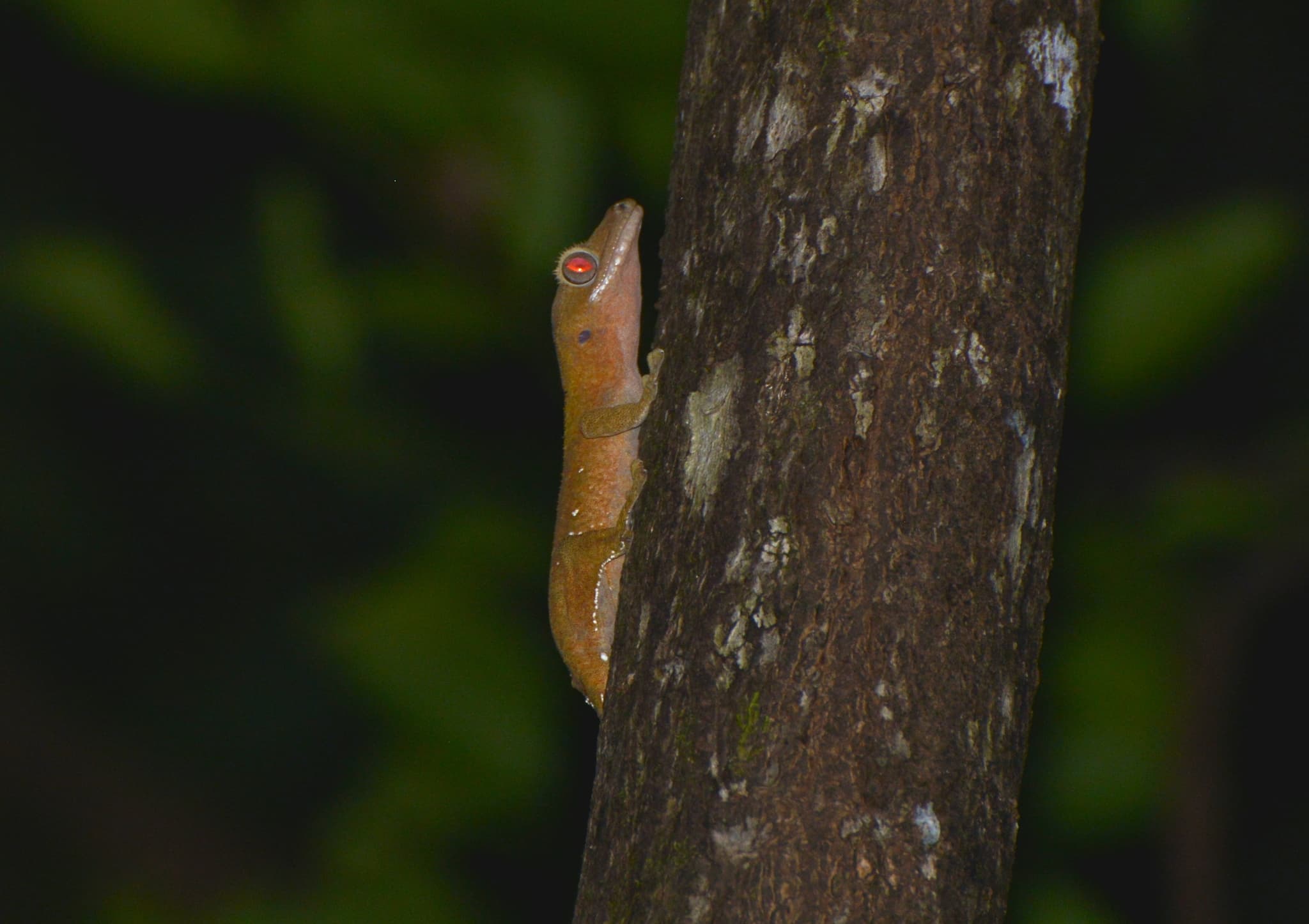
This gecko climbs rather than sprinting over open ground. It walks with deliberate steps, grips vertical bark and jumps between nearby supports. A study of arboreal gecko jumping found that branch diameter changes takeoff and landing mechanics. At rest, the animal often crouches lengthwise on a branch or hides in foliage and tree hollows. Its soft skin and cryptic colors make it difficult to notice against lichen, bark and dead leaves.
Range and habitat
Wild crested geckos are endemic to New Caledonia in the southwest Pacific. Confirmed populations occur in scattered forested areas of southern Grande Terre and on the Île des Pins region. Recent surveys continue to refine the known distribution. A 2020 field survey in Herpetology Notes documented crested geckos living alongside several other native gecko species on Île des Pins and reported encounter rates from systematic night searches.
The species uses humid forest from lowlands into upland sites. It moves through shrubs and trees, sheltering in dense vegetation by day and becoming active after dark. New Caledonia’s forests occur on islands with many animals found nowhere else. Clearing, fragmentation, fire, mining, invasive predators and changes in forest quality can therefore affect a large share of a species’ habitat at once. Captive abundance does not replace functioning wild populations or their ecological roles.
Diet and foraging
Crested geckos are omnivores. In nature they take insects and other small invertebrates, lick nectar, and eat soft ripe fruit. Their broad diet lets them exploit foods that appear at different times and heights in the forest. They locate prey by sight and movement in dim light, then seize it with a quick forward bite. Fruit pulp and nectar also provide water and carbohydrates.
Captive feeding research and practice should not be projected carelessly onto wild ecology. Commercial complete diets are formulated for managed animals; they do not prove that a wild gecko eats a uniform fruit mixture. In forest food webs, crested geckos consume invertebrates, may move some plant material or seeds, and become prey for larger reptiles, birds and introduced mammals. Their nocturnal activity reduces competition with daytime lizards while placing them among other night-active forest animals.
Daily activity and communication
The crested gecko is primarily nocturnal. It rests during daylight and emerges after dusk to climb, forage and interact. Large eyes gather available light, while chemical cues and touch help at close range. Individuals are generally solitary, and adults may defend space from one another. Visual posture, scent and sounds all contribute to communication. Chirps or squeaks may occur during courtship, disputes or handling, but context matters.
Color can appear lighter or darker with activity, temperature, moisture and stress, a change often called “firing up” or “firing down” by keepers. This is not a fixed transformation into a different morph. When alarmed, the gecko may freeze, jump, bite or release its tail. Tail loss can distract a predator, but because the tail never regrows, the escape has a permanent cost.
Reproduction and development
Crested geckos reproduce sexually through internal fertilization and lay eggs. A female generally deposits a small clutch in moist soil, leaf litter or another protected substrate. Incubation time varies with temperature and moisture, and hatchlings emerge as fully formed, independent geckos. Females can retain sperm, so a mating may contribute to more than one clutch. Repeated egg production requires substantial energy and mineral reserves.
The eggshell has attracted scientific interest because its structure differs from that of many other squamates. Developmental work has also used crested gecko embryos to study the origin of the adhesive tail pad. A Royal Society study of crested gecko tails describes their anatomy, development and biomechanics, including the species’ inability to regrow a lost tail.
Conservation and responsible care
The crested gecko is assessed as Vulnerable because its wild range is small and habitat quality continues to decline. A recent genome study summarizes its endemic distribution, restricted area of occupancy and conservation concerns. Protecting New Caledonian forest, controlling invasive predators, limiting fire and preventing unregulated collection are more relevant to wild survival than the number of animals in private collections.
People considering a captive crested gecko should choose a documented captive-bred animal and prepare for a long commitment. It needs a tall, secure, planted enclosure with climbing structure, suitable temperature and humidity gradients, clean water, appropriate nutrition, ultraviolet lighting considered with veterinary guidance, and access to an experienced reptile veterinarian. Handling should be gentle and limited; never grab the tail. Ownership rules and animal-welfare standards vary by location. A popular pet remains a wild species whose natural habitat deserves protection.