
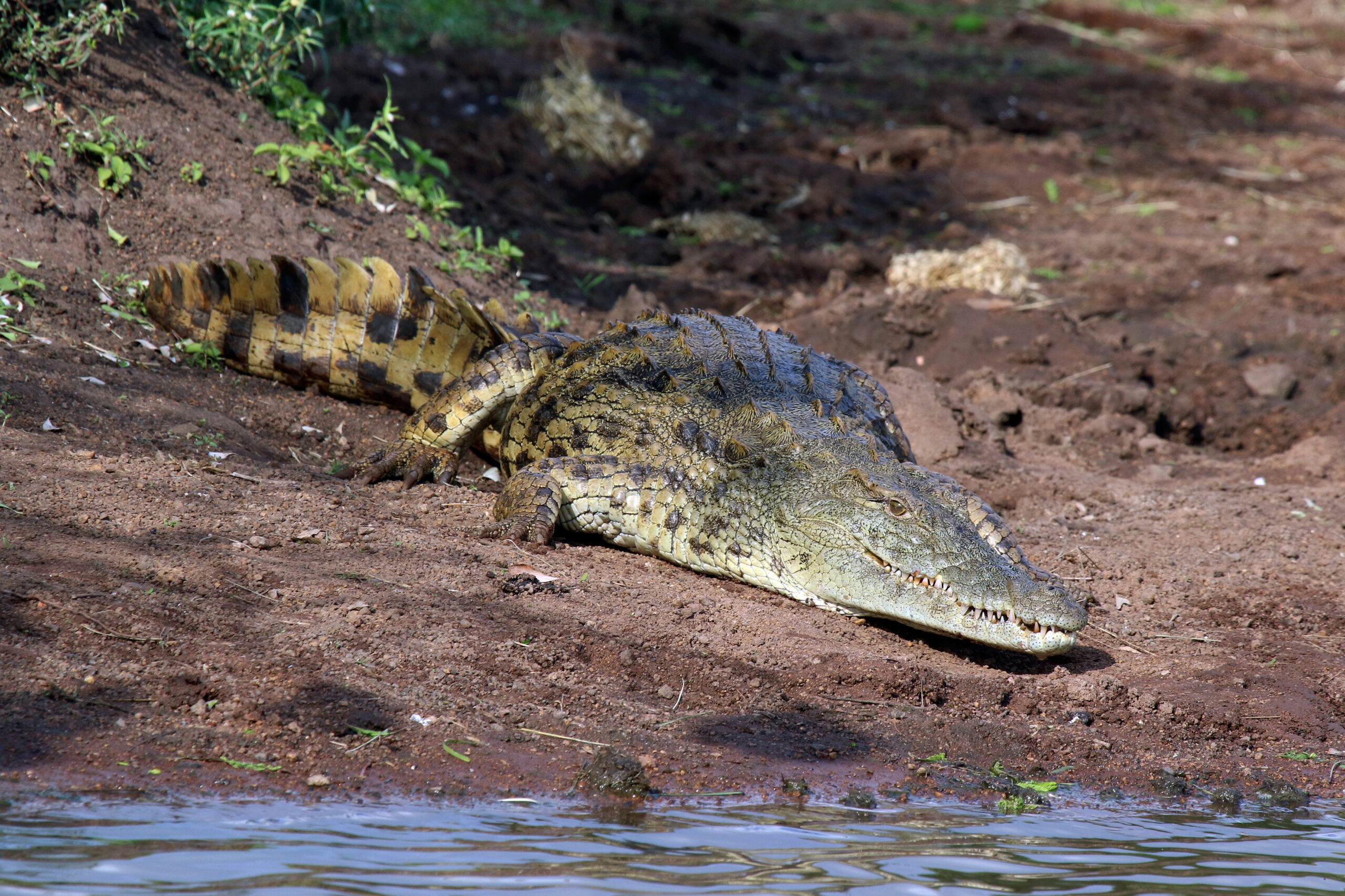
A crocodile is a semiaquatic reptile belonging to the family Crocodylidae. Crocodiles are part of the larger crocodilian order, which also includes alligators, caimans and gharials. In this guide, “crocodile” means a true crocodile; “crocodilian” means the wider group. San Diego Zoo Wildlife Alliance.
This distinction prevents a common mix-up. Facts about one crocodile species cannot automatically be applied to every alligator, caiman or gharial—or even to every other crocodile.
Crocodile species: four useful examples
| Species | Scientific name | What makes it useful to know? |
|---|---|---|
| Saltwater or estuarine crocodile | Crocodylus porosus | The largest living reptile; uses fresh water as well as coastal habitats |
| Australian freshwater crocodile | Crocodylus johnstoni | A smaller, slender-snouted crocodile of northern Australia |
| American crocodile | Crocodylus acutus | Occurs in south Florida and coastal areas around the Caribbean |
| Siamese crocodile | Crocodylus siamensis | A threatened freshwater species native to Southeast Asia |
Sources: Australian Museum accounts of the saltwater crocodile and freshwater crocodile; FWC; Crocodiles of the World. These are examples, not a complete species list.
How can you tell a crocodile from an alligator?
In Florida, an American crocodile generally has a more tapered snout and a lighter, gray-green appearance than an American alligator. Its large fourth lower tooth remains visible when the jaws close; the corresponding tooth is concealed in an alligator. Alligators can still show upper teeth, so “no visible teeth” is not a reliable rule. FWC identification guide.
Keep the scope of that comparison in mind. It helps distinguish two Florida species; it is not a complete identification key for every crocodilian worldwide.
Do crocodiles live in fresh water or salt water?
Both, depending on the species and location. Saltwater crocodiles occupy rivers, swamps, lagoons and estuaries, and can travel across open sea. Their common name does not mean they are restricted to seawater. Australian Museum.
Australian freshwater crocodiles occupy northern rivers, pools, creeks and other freshwater habitats. Seasonal flooding connects some of these places; as water retreats, suitable refuges become important. The museum also records occasional use of brackish water. Habitat names are a useful starting point, but actual distributions are more complicated than a strict fresh-versus-salt division. Australian Museum.
American crocodiles in south Florida commonly use coastal brackish or salty habitats, including mangrove waterways, but can also occur farther inland in fresh water. FWC range information.
How large do crocodiles grow?
Species identity comes first. The saltwater crocodile is the largest living reptile, while the Australian freshwater crocodile has a much lighter build and reaches around 3 m (9.8 ft). A photograph of a giant saltwater crocodile is not a good guide to the adult size of every crocodile species. Saltwater crocodile profile; freshwater crocodile profile.
When comparing measurements, check whether a figure describes a typical adult, a male or female, or an exceptional individual. Also check that length includes the tail before comparing figures from different accounts.
What do crocodiles eat?
Diet varies. The Australian freshwater crocodile takes small animals such as fish and insects and can ambush larger prey, including waterbirds. Its slender jaws and smaller build give it a different feeding profile from a giant saltwater crocodile. Australian Museum.
Adult Siamese crocodiles mainly eat fish but also take other animals, including amphibians, reptiles and small mammals. “Crocodiles eat mammals” is therefore incomplete: fish can be central to a species’ diet. Siamese crocodile profile.
Why do crocodiles bask with their mouths open?
Crocodiles use their surroundings to regulate body temperature. They can warm themselves in sunlight or move between warmer and cooler water and air. FWC explains that an American crocodile resting with an open mouth may be regulating its temperature; the posture alone does not demonstrate aggression. It is also not an invitation to approach. FWC behavior guide.
Do crocodiles look after their young?
Some do. Crocodiles of the World reports that both male and female Siamese crocodiles care for hatchlings in captivity. That observation shows why reptiles should not automatically be described as abandoning their offspring, but it should not be generalized into a claim that every crocodile family behaves identically in the wild. Siamese crocodile account.
Are crocodiles endangered?
There is no single conservation status for all crocodiles. The Australian Museum lists the saltwater crocodile as Least Concern, while the Siamese crocodile is described as Critically Endangered by Crocodiles of the World. Those categories apply to different species. Neither describes the condition of every local population. Australian Museum; Siamese crocodile conservation.
For Siamese crocodiles, documented threats include habitat loss, collection of animals and eggs, and accidental capture in fishing gear. Protecting nesting and wetland habitat addresses a different problem from merely increasing the number of animals held in captivity. Crocodiles of the World.
Watching crocodiles safely
Follow local wildlife warnings, keep clear of water edges in crocodile habitat, and never attract animals with food or fish scraps. The Australian Museum advises camping well away from water and avoiding the disposal of carcasses or fish waste near places people use. Australian Museum safety guidance.
Frequently asked questions
Is every crocodilian a crocodile?
Not in the strict family-level sense used here. Crocodilians include the distinct alligator, caiman and gharial groups as well as true crocodiles.
Can saltwater crocodiles live in rivers?
Yes. Freshwater rivers are among their habitats, despite the name “saltwater crocodile.”
Does an open mouth mean a crocodile is about to attack?
Not necessarily; it can be a temperature-regulation behavior. Keep your distance regardless of the posture.
This overview covers living crocodiles as a family-level group; the Saltwater Crocodile profile provides a species-level comparison.