
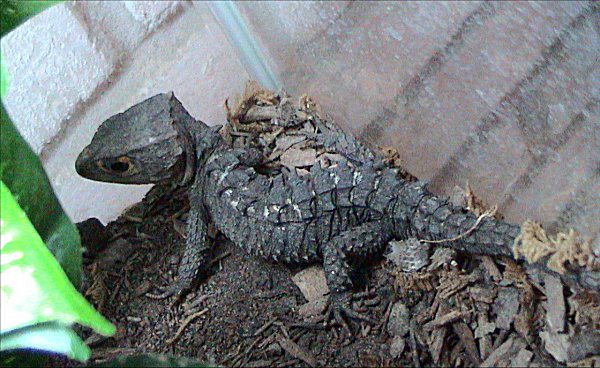
Red-Eyed Crocodile Skink (Tribolonotus gracilis) is a small, heavily sculptured skink endemic to New Guinea. It lives among wet leaf litter, rotting wood and streamside cover in lowland rainforest and disturbed forest. The bright orange-red skin around each eye contrasts with a dark body and rows of pointed scales that resemble miniature crocodile armor. It is shy rather than aggressive, often freezing, hiding or feigning death when alarmed, and it is one of the few skinks documented to vocalize. This guide separates well-supported biology from common assumptions and covers identification, range, habitat, diet, behavior, reproduction and conservation.
Identification
The head is broad and triangular, with a conspicuous orange-red ring of bare skin around the dark eye. Four longitudinal rows of sharply keeled dorsal scales form raised ridges from the head toward the tail. The body is dark brown to nearly black, while the underside is lighter. Legs are sturdy, toes are slender, and the tail is laterally compressed. Juveniles may have paler head and body markings before adult color develops. Adult males have enlarged pores on the hind feet and may show a broader head, while females lack those obvious pore patches. External differences can be subtle, and expert examination is safer than repeated handling.
Identification should combine body shape, markings, size, voice or movement, and location. One feature by itself can overlap with a related animal, a juvenile, or an individual in unusual light.
Photographs are most useful when they preserve scale and show several diagnostic features. Handling or repositioning a wild red-eyed crocodile skink for identification can cause stress and is unnecessary.
Size and physical adaptations
Red-Eyed Crocodile Skink typically measures about 18–25 cm total length, including the tail and weighs often roughly 35–60 g in healthy adults, with limited wild data. Published captive measurements vary, and wild population-wide data are sparse. Snout-to-vent length is much shorter than total length because the tail contributes substantially.
Its useful adaptations include keeled scales form protective dorsal armor, dark color blends with wet leaf litter, strong limbs move through forest debris, flattened tail assists movement near water, vocal distress calls warn at close range, freezing and death-feigning reduce detection, low clutch size is paired with parental attendance. These traits work together in the animal’s normal setting rather than serving as isolated curiosities.
Published measurements may use different methods, life stages or sample locations. Comparing figures responsibly means checking what was measured rather than selecting the largest number available.
Range and distribution
Native to New Guinea, with reliable records concentrated in the northern portion of the island in Papua New Guinea and Indonesian New Guinea. Some older island records are uncertain. A country map is necessarily broad and must not imply that the species occupies all of either country. The native range includes Papua New Guinea, Indonesia.
A country-level map indicates broad distribution, not continuous occupation. Climate, elevation, water, vegetation, prey, breeding sites, barriers and survey effort all affect where records occur.
Records near the edge of the range deserve careful documentation because they may reflect natural movement, improved survey coverage, accidental transport or a genuine distribution change.
Habitat
Humid lowland tropical rainforest, secondary forest, stream margins, damp leaf litter, rotting logs and debris-rich ground with dense cover.
This skink spends much of its time concealed beneath litter, bark, logs, stones or root tangles. Moist soil and nearby shallow water help maintain hydration, while cover provides insects and escape routes. It tolerates some disturbed habitat, including shaded plantations, but drying, clearing and removal of forest-floor debris reduce usable microhabitat. Protecting a population therefore requires the feeding, shelter and breeding features that make a site usable, along with connections that allow movement.
Microhabitat matters. Shade, soil, current, moisture, shelter or host plants can determine whether a small area is usable even when the surrounding landscape appears suitable.
Diet and feeding
Red-Eyed Crocodile Skink is a small terrestrial invertebrate predator. Important foods include crickets, beetles, cockroaches, worms, isopods, spiders, other small arthropods. It searches the forest floor and cover for small prey, using vision and chemical cues at close range. Prey size is limited by the skink’s head and body size. Wild diet is less completely quantified than captive feeding, so varied arthropod records should not be converted into rigid percentages.
Diet changes with age, season, location and food supply. A dramatic prey record does not establish what most individuals eat most of the time; repeated field observations provide a stronger picture.
Feeding opportunities also create risk. An animal focused on prey may be less alert to predators, traffic or people, while contaminated prey can transfer pollutants through the food web.
Behavior and communication
Mostly crepuscular and nocturnal, with concealed daytime activity possible in cool, humid conditions. Red-Eyed Crocodile Skinks are secretive and usually remain close to shelter. When exposed, an individual may freeze, flee into cover, squeak, wriggle or become limp in apparent death-feigning. They can swim and may enter shallow water, but they are forest-floor lizards rather than fully aquatic animals. Adults may defend small shelter areas from rivals.
Short squeaks or chirps are used during distress and social encounters. Scent sampled by tongue flicking helps locate food and recognize other skinks. Touch and close visual posture matter during courtship and territorial encounters. Reported parent-young calls and attendance are especially unusual among lizards, although behavior varies among pairs. Behavior should be interpreted in context: alarm, courtship, feeding and temperature regulation can produce very different actions from the same animal.
Daily schedules are flexible responses, not rigid rules. Weather, breeding condition, disturbance, tides or food can move activity into a different part of the day.
Reproduction and development
Courtship and mating occur in humid shelter, followed by internal fertilization. The female usually deposits a single relatively large egg in a hidden moist cavity. She may remain near it, turn or guard it, and adults have been reported attending hatchlings for a short period. Usually one egg at a time, with repeated clutches possible under favorable conditions The hatchling emerges fully formed and may remain close to the nest shelter and adults. It can vocalize and feed on very small invertebrates. There is no larval stage. Slow production of one egg at a time limits rapid replacement when adults are removed from the wild.
Young animals face different risks and may use different microhabitats or food than adults. Breeding success depends on adult condition, suitable sites and the survival of offspring through vulnerable early stages.
Counts of eggs or young describe reproductive output, not the number expected to reach adulthood. Mortality is normally greatest during eggs, larval or juvenile stages.
Predators and ecological role
By consuming insects, worms and other small invertebrates, the skink participates in decomposition-linked forest-floor food webs. It is also prey for snakes, birds and larger lizards. Because it depends on cool humid cover, local presence can reflect the condition of leaf litter and streamside microhabitat even where the surrounding forest canopy appears intact. Documented or likely predators include New Guinea Small-Eyed Snake, Mangrove Monitor, Papuan Hawk-Owl, Feral Cat, Domestic Chicken.
This animal is both a consumer and a food source. Its influence comes through many repeated interactions, so ecological claims should be based on measured populations rather than assumptions drawn from appearance.
Predator and prey relationships differ among places. A species can be ecologically influential without being abundant everywhere, and its role can change across its range.
Relationship with people
International demand for exotic pets has moved wild-caught crocodile skinks through poorly documented trade, even though the genus is not listed by CITES. Buyers cannot assume an animal is captive-bred simply because it is sold legally. Responsible institutions document origin, avoid depleted collection sites and support habitat protection and transparent trade monitoring.
The species is nonvenomous and poses little danger, but handling causes stress and a frightened animal can bite. Support the whole body, keep handling to essential health care, wash hands afterward and keep reptiles away from food-preparation areas because apparently healthy reptiles can carry Salmonella. Responsible observation means keeping an appropriate distance, avoiding capture or feeding, protecting habitat and following local wildlife or invasive-species guidance.
Wildlife guidance should come from the responsible local agency because collection rules, reporting requests and appropriate responses differ between native and introduced ranges.
Conservation
The IUCN Red List classifies Tribolonotus gracilis as Least Concern. It has a relatively broad New Guinea distribution and tolerates some modified forest, but habitat loss and poorly documented international pet trade can still affect local populations. Least Concern does not mean that all collection is sustainable. The reported global trend is Unknown, with local pressure possible from habitat change and collection.
Important pressures include lowland forest clearing, drying of leaf-litter habitat, streamside disturbance, wild collection for pet trade, poor trade traceability, disease during transport, introduced predators. Global status can hide local decline or recovery, so current regional monitoring and habitat management remain necessary.
The most useful conservation action follows the documented pressure. Protecting breeding sites, reducing road deaths or limiting pollutants can require different tools in different populations.