
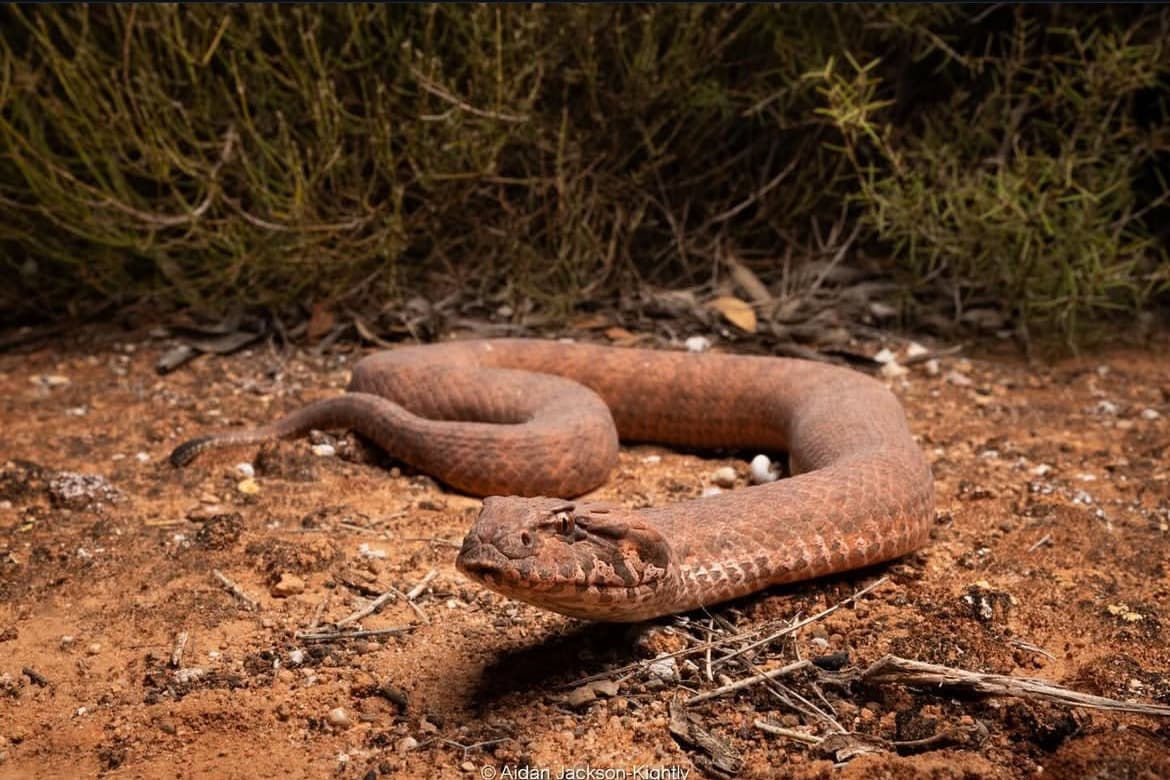
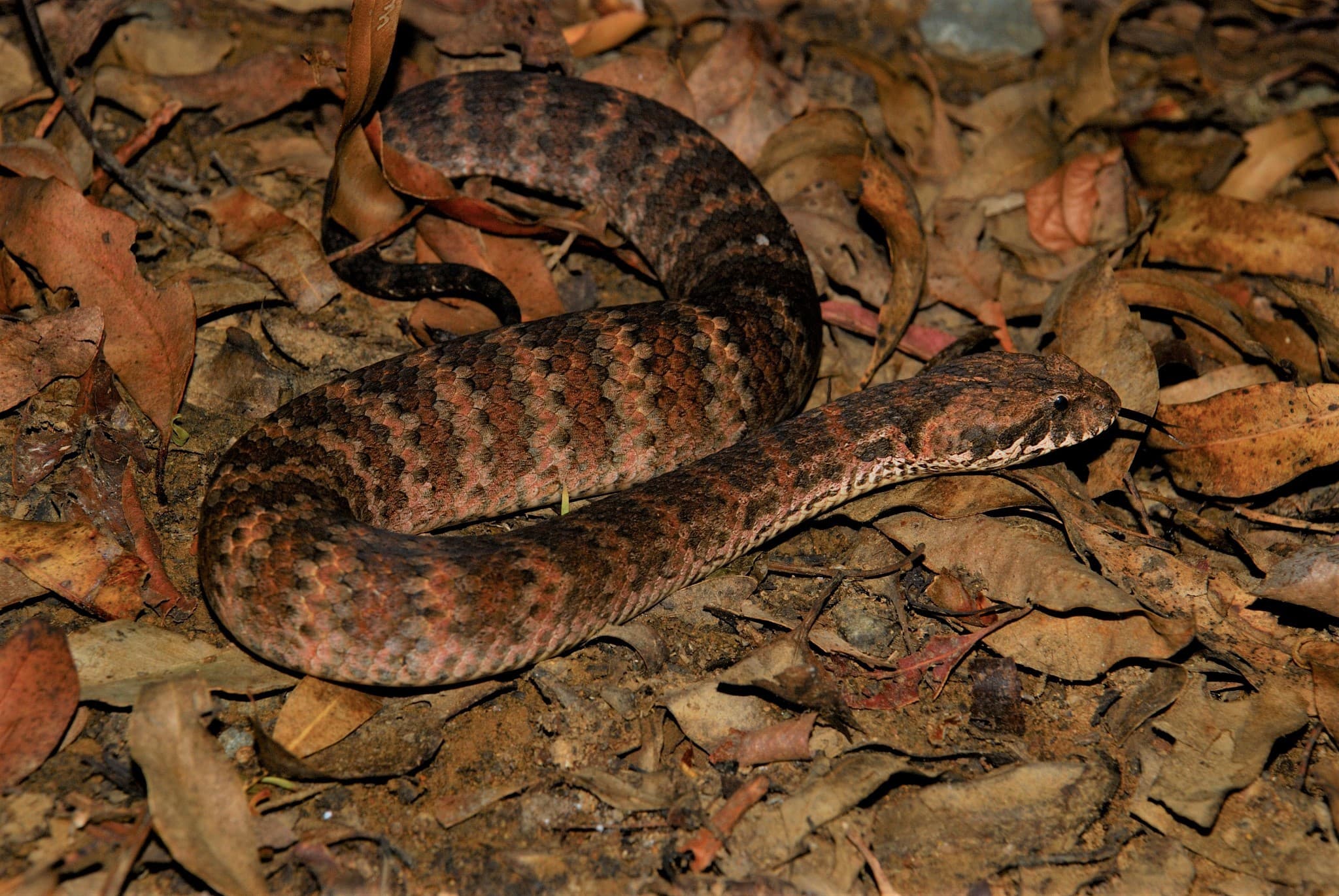
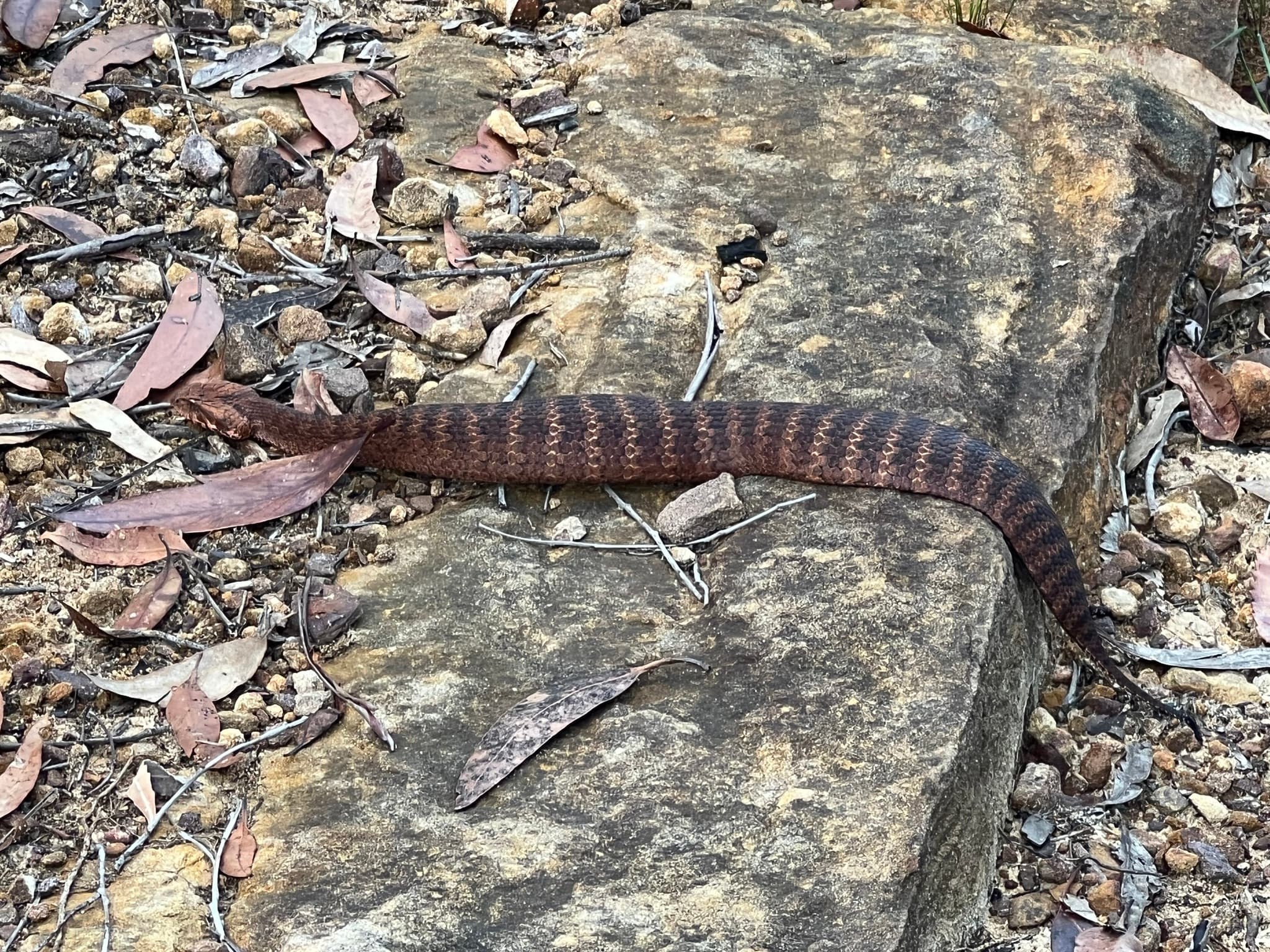
The Common Death Adder (Acanthophis antarcticus) is a living venomous snake native to mainland Australia. Its broad head, narrow neck, stout body and short tail make it look more like a viper than most Australian elapids, yet it belongs to the cobra-and-sea-snake family Elapidae. Instead of actively searching over long distances, it hides in leaf litter and waits. A pale, worm-like tail tip twitches near its head to attract frogs, lizards, birds and small mammals. This remarkable hunting method also explains why people can approach dangerously close before noticing the snake.
Identity and taxonomy
The accepted scientific name is Acanthophis antarcticus. “Common Death Adder” is the established Australian name, while “Southern Death Adder” is also used. Australia has several other Acanthophis species, including desert, northern and rough-scaled death adders. Records should therefore be assigned by geography and diagnostic features rather than by body shape alone. The Atlas of Living Australia recognizes the species in family Elapidae and maps more than two thousand occurrence records.
Adults are usually 40 to 100 centimetres long. Females tend to be larger than males. The head is triangular, the body is short and heavy, and irregular bands break up its outline. Color varies from gray and tan to reddish or dark brown, often matching local soil and leaves. The tail narrows abruptly and ends in a contrasting lure. That tip is a modified scale used in hunting; it is not a stinger and cannot inject venom.
Range and habitat
Common Death Adders occur across mainland Australia in a broad but discontinuous pattern. The Australian Museum lists the Northern Territory, Queensland, New South Wales, Victoria, South Australia and Western Australia. The species uses forests, open woodlands, grasslands and heath, provided there is loose ground cover for concealment. Deep leaf litter, fallen bark, grass tussocks and sandy soil can all provide ambush sites.
Local populations depend on intact ground structure. Clearing understorey, removing litter, fragmenting bushland and changing fire frequency can reduce both shelter and prey. Roads add mortality when snakes cross between habitat patches. In northern and eastern areas, invasive cane toads are another threat: a death adder that eats a toxic toad may die. Regional conservation listings reflect these pressures even though the species still occupies a wide continental range.
Ambush hunting and diet
Most Australian elapids actively search for prey, but the Common Death Adder is a sit-and-wait specialist. It settles into litter, sometimes covering much of its body, and remains nearly motionless. The thin tail tip is brought close to the head and wriggled like an insect larva. A curious frog, lizard, bird or small mammal moves toward the lure, placing itself within reach.
The strike is extremely fast. Long front fangs inject venom, after which the snake may release the prey and wait until movement stops. Chemical cues then help relocate it. This method saves energy and lets the snake exploit prey paths for long periods. It also makes camouflage essential: a poorly hidden individual would alert prey before the lure worked.
Daily activity and defense
Death adders are mainly crepuscular and nocturnal, especially in warm weather. During daylight they often remain concealed. Their first defense is stillness, which differs from snakes that immediately flee. A person walking through litter or moving firewood can therefore come close without seeing one. Closed footwear, a light at night and care when placing hands near cover reduce risk.
When threatened at close range, the snake can strike quickly. It does not hunt people or deliberately block paths. Give any unidentified snake several metres of space, keep children and pets away and contact a trained local snake catcher if removal is necessary. Attempting to move or kill the animal greatly increases the chance of a bite and may violate wildlife law.
Reproduction and life cycle
Common Death Adders give birth to live young rather than laying eggs. The Australian Museum reports litters of up to 24. Embryos develop inside the female, and newborns emerge fully formed and independent. They receive no parental care and begin using miniature prey and shelter appropriate to their size.
Growth, maturity and reproductive timing vary with temperature and food. Females must accumulate enough energy to support a litter, so breeding may not occur every year. Young snakes face predation from birds, monitor lizards and other snakes, while adults remain vulnerable to roads, habitat loss, deliberate killing and cane toad poisoning. Reliable wild lifespan figures are scarce because hidden, sedentary animals are difficult to follow for many years.
Venom and first aid
This species is highly venomous. Its venom acts strongly on the nervous system and can cause progressive paralysis, including failure of breathing muscles. The fangs are long for an elapid and can penetrate light clothing. Historic fatality figures predate modern antivenom and intensive care, but they underline why a suspected bite must never be watched at home.
Australian health guidance says to call Triple Zero immediately, keep the person still and apply a pressure-immobilisation bandage to a bitten limb when trained. Splint the limb and wait for emergency care. Do not wash the bite, cut the wound, suck venom, use an arterial tourniquet or try to catch the snake. Identification can be handled clinically; another bite helps nobody.
Conservation and coexistence
A current global IUCN category was not confirmed for this profile, so the structured record uses Not Evaluated rather than copying an unsupported label. Regional evidence is more concerning: the Atlas of Living Australia reports the species as Vulnerable in Queensland and Critically Endangered in Victoria, with a Priority 3 listing in Western Australia. These categories apply within jurisdictions and should not be treated as one national status.
Protecting leaf litter, coarse woody debris and connected ground cover benefits death adders and their prey. Responsible fire planning, cane toad control, road awareness and keeping cats indoors also reduce pressure. Public education needs both honesty and restraint: this is a medically important snake, yet its ecological role as a native predator matters. Distance, professional removal and sound first aid protect people without encouraging needless killing.