
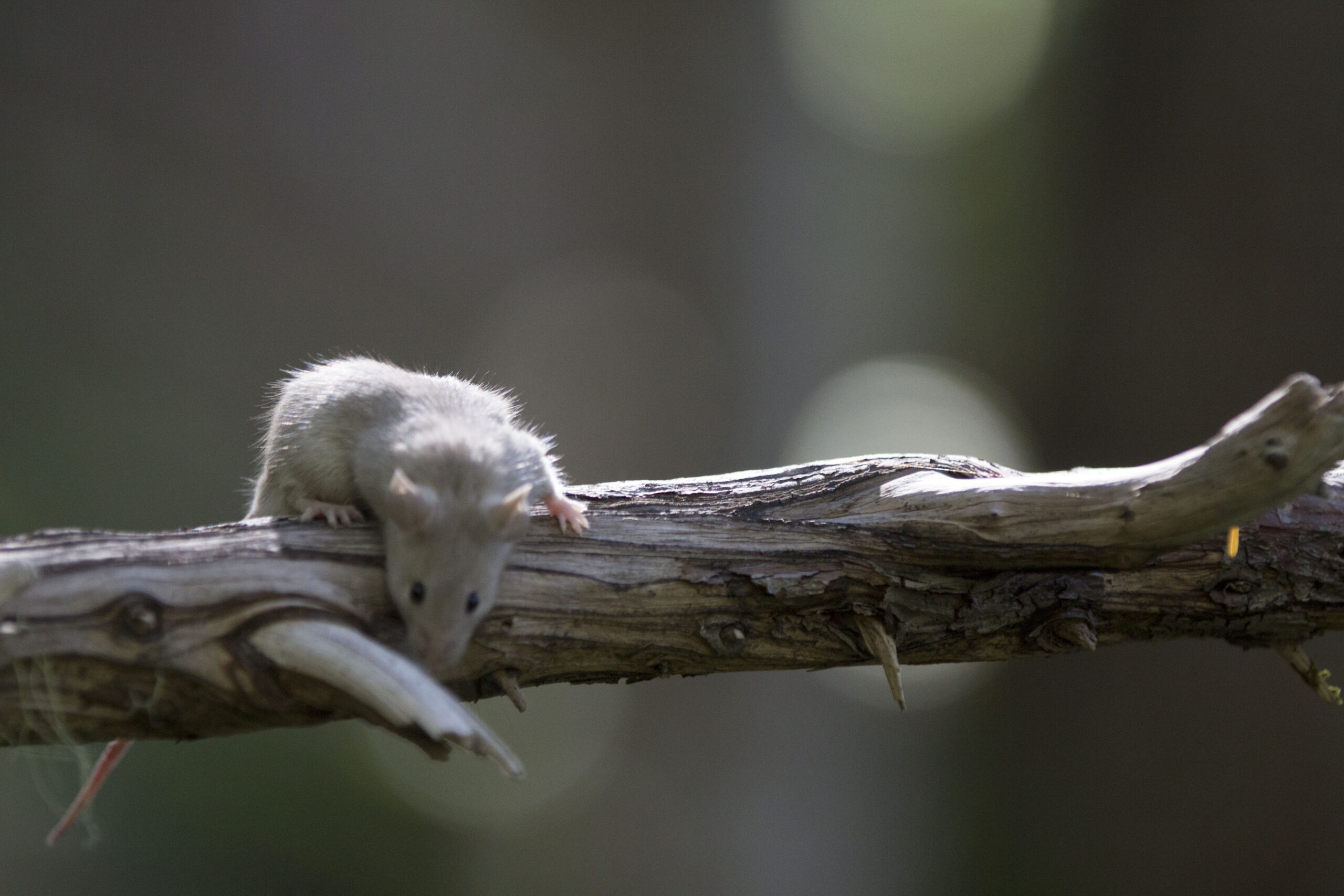
Deer Mouse (Peromyscus maniculatus) is the eastern deer mouse, a small native North American rodent recognized by its brown back, clean white underside and sharply two-toned tail. Modern mammal taxonomy separates several western and Mexican populations once included in this name, so this profile follows Peromyscus maniculatus in its current, narrower species sense. This guide separates well-supported biology from common assumptions and covers identification, range, habitat, diet, behavior, reproduction and conservation.
Identification
The deer mouse has a slender body, pointed muzzle, prominent dark eyes and relatively large, thinly furred ears. Its upperparts range from gray-brown to reddish brown while the belly and feet are white. A strongly bicolored tail, dark above and pale below, is a useful field mark, although external appearance overlaps with the white-footed mouse and reliable identification may require measurements or genetic evidence. Males and females look broadly alike. Size, coat shade and tail proportions vary more among populations and habitats than between the sexes.
Identification should combine body shape, markings, size, voice or movement, and location. One feature by itself can overlap with a related animal, a juvenile, or an individual in unusual light.
Photographs are most useful when they preserve scale and show several diagnostic features. Handling or repositioning a wild deer mouse for identification can cause stress and is unnecessary.
Size and physical adaptations
Deer Mouse typically measures 11.9–22.2 cm and weighs 10–24 g. Published measurements come from the historically broad deer-mouse concept; current eastern populations vary with age, season and locality.
Its useful adaptations include large eyes and ears support nocturnal activity, strong hind limbs aid quick bounding movement, grasping feet help climbing shrubs and logs, cheek and jaw mechanics process hard seeds, food caching buffers winter shortages, daily torpor can reduce energy use in cold weather. These traits work together in the animal’s normal setting rather than serving as isolated curiosities.
Published measurements may use different methods, life stages or sample locations. Comparing figures responsibly means checking what was measured rather than selecting the largest number available.
Range and distribution
Under current taxonomy, Peromyscus maniculatus occupies eastern North America from Quebec and neighboring eastern Canada south through much of the eastern United States, west toward the Mississippi River and northwest into Manitoba. Records from western Canada, the western United States and Mexico in older references often belong to recently separated species. The native range includes Canada, United States.
A country-level map indicates broad distribution, not continuous occupation. Climate, elevation, water, vegetation, prey, breeding sites, barriers and survey effort all affect where records occur.
Records near the edge of the range deserve careful documentation because they may reflect natural movement, improved survey coverage, accidental transport or a genuine distribution change.
Habitat
Deciduous and coniferous woodland, brushy edges, grassland, old fields, rocky slopes, farms and other places with ground cover and nest cavities.
Individuals forage mostly on or near the ground but readily climb shrubs, logs and low trees. Nests are tucked into burrows, hollow logs, tree cavities, rock crevices, brush piles or human structures, using dry grass, roots, moss and soft fibers. Protecting a population therefore requires the feeding, shelter and breeding features that make a site usable, along with connections that allow movement.
Microhabitat matters. Shade, soil, current, moisture, shelter or host plants can determine whether a small area is usable even when the surrounding landscape appears suitable.
Diet and feeding
Deer Mouse is a flexible omnivore dominated by seeds and arthropods. Important foods include grass and forb seeds, tree seeds and nuts, berries and small fruits, beetles and caterpillars, spiders and other arthropods, fungi. Deer mice gather food at night, carrying items to sheltered eating places or caches. The balance shifts with habitat and season: seeds and nuts can dominate when crops are abundant, while insects provide important protein in warmer months. Stored food helps sustain activity when winter conditions limit foraging.
Diet changes with age, season, location and food supply. A dramatic prey record does not establish what most individuals eat most of the time; repeated field observations provide a stronger picture.
Feeding opportunities also create risk. An animal focused on prey may be less alert to predators, traffic or people, while contaminated prey can transfer pollutants through the food web.
Behavior and communication
Nocturnal and active year-round, with reduced surface activity during cold or wet weather. A deer mouse spends daylight in a lined nest and emerges after dusk to forage along logs, vegetation and familiar ground routes. Home ranges overlap, especially outside the breeding season, and several animals may share a winter nest to conserve heat. Individuals can enter short daily torpor during energetic stress but do not undergo prolonged hibernation.
Scent marks and close-range odors carry information about identity and reproductive condition. Deer mice also use touch, posture and high-frequency vocalizations that may be inaudible to people. Young give calls that help maintain contact with their mother. Behavior should be interpreted in context: alarm, courtship, feeding and temperature regulation can produce very different actions from the same animal.
Daily schedules are flexible responses, not rigid rules. Weather, breeding condition, disturbance, tides or food can move activity into a different part of the day.
Reproduction and development
Breeding is seasonal across much of the range and responds strongly to food and weather. Females build insulated nests and may produce several litters in a favorable year. Gestation is generally about three to four weeks, with nursing able to extend the interval in some females. Usually 3–6 young, with broader reported ranges Young are born blind, nearly naked and dependent. Fur develops during the first two weeks, eyes open at roughly two to three weeks, and weaning follows soon afterward. Juveniles disperse as they approach adult size and sexual maturity.
Young animals face different risks and may use different microhabitats or food than adults. Breeding success depends on adult condition, suitable sites and the survival of offspring through vulnerable early stages.
Counts of eggs or young describe reproductive output, not the number expected to reach adulthood. Mortality is normally greatest during eggs, larval or juvenile stages.
Predators and ecological role
Deer mice consume and cache seeds, disperse fungal spores, eat insects and provide food for owls, snakes, foxes, weasels and many other predators. Their quick response to seed crops, disturbance and vegetation change can strongly influence local food webs. Documented or likely predators include Barn Owl, Red Fox, Long-tailed Weasel, Garter Snakes.
This animal is both a consumer and a food source. Its influence comes through many repeated interactions, so ecological claims should be based on measured populations rather than assumptions drawn from appearance.
Predator and prey relationships differ among places. A species can be ecologically influential without being abundant everywhere, and its role can change across its range.
Relationship with people
Deer mice are valuable native wildlife and important research animals, but they may enter sheds, cabins and food stores. The CDC identifies deer mice as a reservoir for Sin Nombre virus, which can cause hantavirus pulmonary syndrome. Infection risk comes mainly from breathing contaminated dust or contacting urine, droppings or saliva, not from simply seeing a mouse outdoors.
Do not sweep or vacuum dry rodent droppings. Ventilate enclosed spaces, wet contaminated material with an appropriate disinfectant, wear gloves and follow current public-health cleanup guidance. Seal entry points and store food in rodent-resistant containers. Responsible observation means keeping an appropriate distance, avoiding capture or feeding, protecting habitat and following local wildlife or invasive-species guidance.
Wildlife guidance should come from the responsible local agency because collection rules, reporting requests and appropriate responses differ between native and introduced ranges.
Conservation
The IUCN Red List and Mammal Diversity Database list Peromyscus maniculatus as Least Concern. The current species remains widespread in eastern North America, although its taxonomy is still being refined and local populations respond to habitat change, food and disease. The reported global trend is Stable overall, with substantial local fluctuations.
Important pressures include local habitat loss, rodenticide poisoning, domestic cats, severe weather and food shortages, taxonomic uncertainty masking local trends. Global status can hide local decline or recovery, so current regional monitoring and habitat management remain necessary.
The most useful conservation action follows the documented pressure. Protecting breeding sites, reducing road deaths or limiting pollutants can require different tools in different populations.
