
Diamond Python Overview
The Diamond Python (Morelia spilota spilota) is a living subspecies of carpet python native to southeastern Australia. It is the cool-climate member of the widespread Morelia spilota complex and is especially associated with coastal and near-coastal New South Wales. The Reptile Database recognizes it as a subspecies rather than a separate species, so this profile uses the full three-part scientific name. That scope distinguishes Diamond Pythons from Jungle, Coastal and other carpet-python forms.
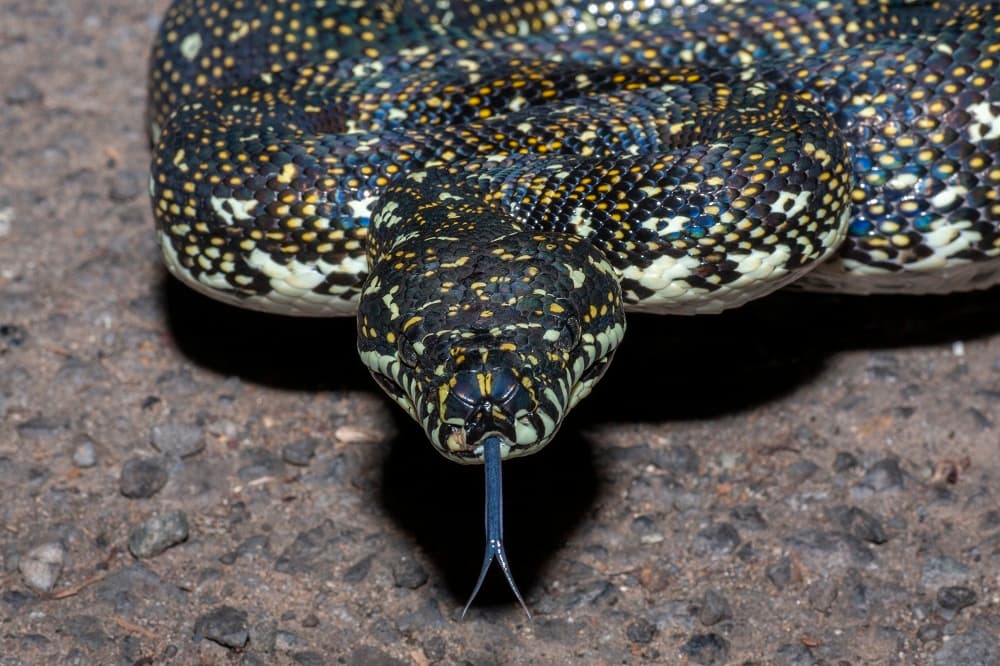
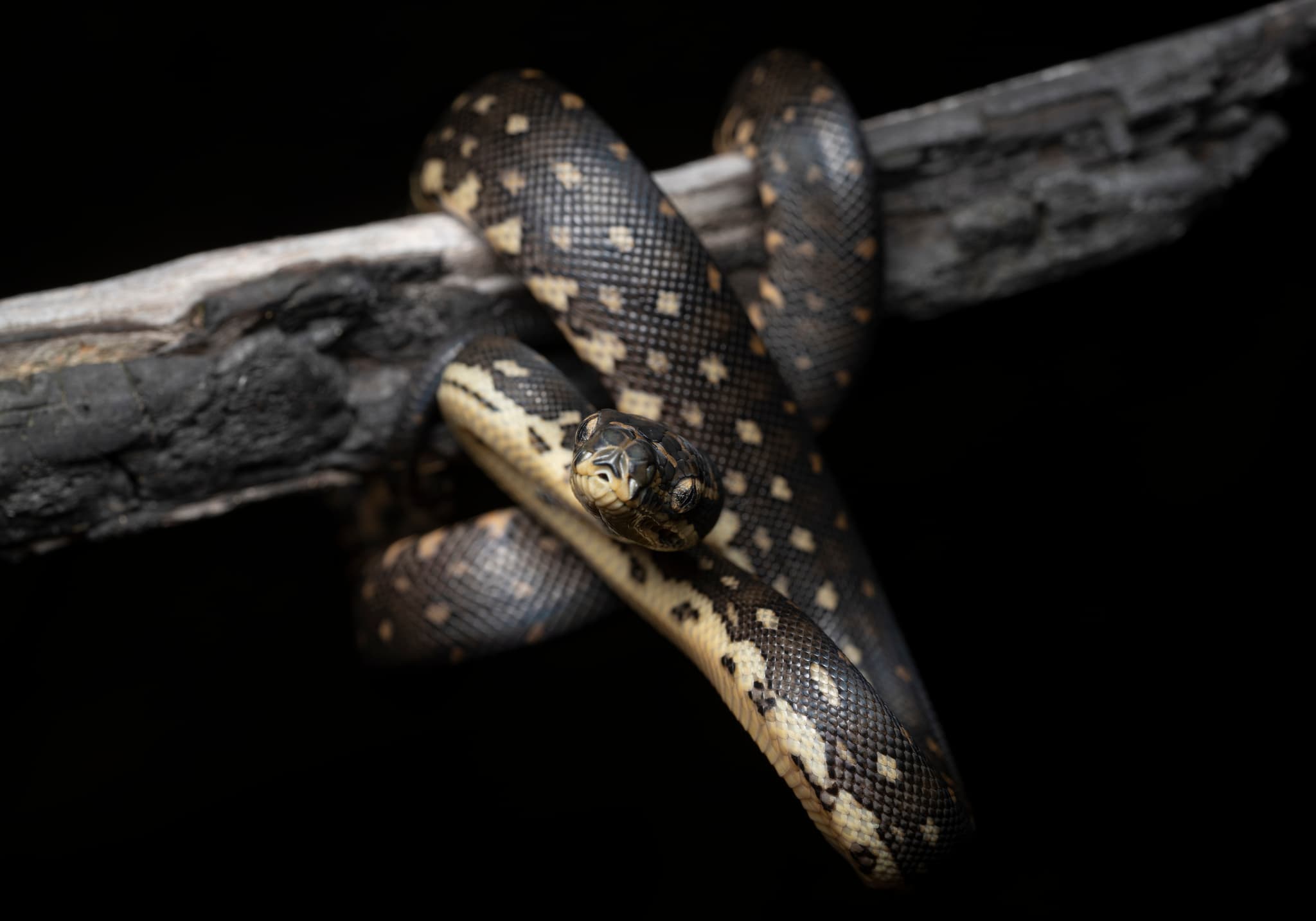
Its common name comes from pale cream or yellow markings arranged across a dark body. Many markings form rosettes or broken diamond shapes, while smaller spots scatter between them. The head is dark and often heavily speckled. Adults are powerfully built, though the body remains more elongated than that of a heavy ambush python. Australian Museum accounts describe a usual length of about two to three metres. Individuals vary, and apparent size can be exaggerated when a long snake is stretched across a path or tree.
Range and Habitat
Diamond Pythons occur in southeastern New South Wales, including the Sydney region and country extending south toward the Victorian border. Records also reach adjoining parts of eastern Victoria. Within this range they occupy heath, woodland, dry and wet forest, rocky escarpments and vegetated suburban margins. They are capable climbers but also spend substantial time on the ground, moving between basking sites, shelter and hunting areas.
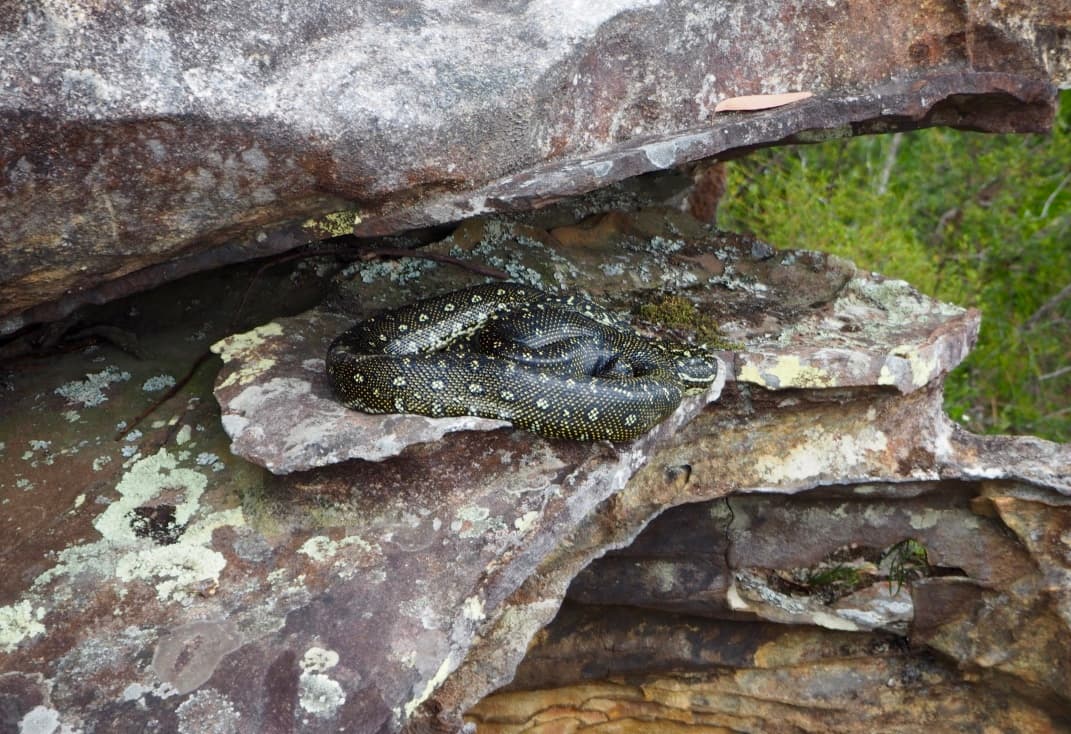
Shelter is essential in a climate with cool winters and changeable weather. New South Wales fire-management guidance records Diamond Pythons using hollow trunks and limbs, disused burrows, caves, rock crevices and spaces beneath boulders. Dense vegetation, fallen timber and mature hollow-bearing trees therefore offer more than scenery: they provide thermal refuges and secure resting places. In towns, pythons may use roof spaces or sheltered gardens when those places resemble natural cavities, which can bring them close to people without making them aggressive.
Diet and Hunting
Diamond Pythons are nonvenomous constrictors. Their diet centers on warm-blooded vertebrates, including rodents, possums and birds, with prey choice changing according to the snake’s size and local opportunity. A python follows chemical trails with its forked tongue, which transfers scent particles to sensory organs in the roof of the mouth. Heat-sensitive pits along the lips help it locate warm prey, particularly in dim conditions.
After striking, the python holds prey with backward-curving teeth and wraps it in muscular coils. Constriction rapidly disrupts circulation; it is not a slow process of crushing bones. Flexible skull joints then allow the snake to swallow an intact meal. Digestion is metabolically demanding, so a python may remain inactive in a protected place afterward. It does not need to feed every day, and wild feeding intervals vary with prey availability, temperature and the size of the previous meal.
Behavior and Seasonal Activity
Like other carpet pythons, the Diamond Python is usually solitary. It may bask on rocks, branches or sunny forest edges to raise its body temperature, then retreat before overheating. Seasonal conditions strongly shape activity. Warm months allow wider movement and feeding, while cold periods bring long stays in insulated shelters. A snake may reuse a dependable refuge or return to a productive basking area, making connected habitat important even when an individual is not visible.
When approached, most Diamond Pythons rely first on stillness, concealment or escape. A cornered animal may coil defensively, hiss and strike. The species has no venom, but a bite can puncture skin and should receive normal medical cleaning. Wild pythons should never be handled for a photograph. Giving the snake an open route away protects both people and the animal, and a trained wildlife rescuer can address a snake that has entered a building.
Reproduction and Development
Diamond Pythons lay eggs. After mating, a female selects a protected nest site and coils around her clutch. Australian Museum information notes that she remains with the eggs and can produce heat through muscular shivering. This maternal behavior helps stabilize incubation in the comparatively cool southern part of the carpet python’s range. The female does not leave to hunt during this period, so reproduction represents a substantial energetic investment.
Hatchlings emerge fully formed and receive no feeding or extended care from the female. They begin hunting small suitable prey and face predation from birds, mammals and larger reptiles. Growth depends on temperature and feeding success rather than a single fixed timetable. Young snakes can be mistaken for other patterned species, which is another reason residents should avoid capture and seek identification from qualified local wildlife authorities.
Ecological Role and Conservation
As a predator of rodents, possums and birds, the Diamond Python influences small-vertebrate communities and transfers energy through the food web. It also becomes prey, especially when young. The snake’s dependence on tree hollows, rocky refuges and intact ground cover connects its welfare to the health of forests and heathlands. Large old trees, fallen logs and unsealed rock crevices can remain valuable long after a fire or storm changes the surrounding vegetation.
No global IUCN category is assigned specifically to the Diamond Python subspecies in the sources used for this profile, so it is recorded here as Not Evaluated rather than given the status of a broader taxon. The Australian Museum does not describe it as endangered, but identifies habitat destruction as a pressure. Other risks include road mortality, deliberate killing, illegal collection and intense fire that removes shelters. Retaining habitat structure and allowing safe road crossings are practical local protections.
Living Safely Alongside Diamond Pythons
A Diamond Python in a garden is often moving between shelter, warmth and prey. Keep children and pets back, watch from a distance and leave an escape route. Do not pin, grab or attempt to bag it. If the snake must be moved from a house or other high-conflict location, contact a licensed snake catcher or wildlife rescue service. These steps avoid defensive bites and prevent injuries caused by improvised capture.
Homeowners can reduce unwanted encounters by sealing roof and wall gaps, storing animal feed securely and controlling rodents without scattering poisons through the food web. Keeping some natural habitat away from buildings still benefits native wildlife. On roads, a stationary driver can allow a crossing python to finish moving when traffic conditions make that safe. Coexistence is usually straightforward because this large patterned snake is nonvenomous and prefers avoidance over confrontation.