
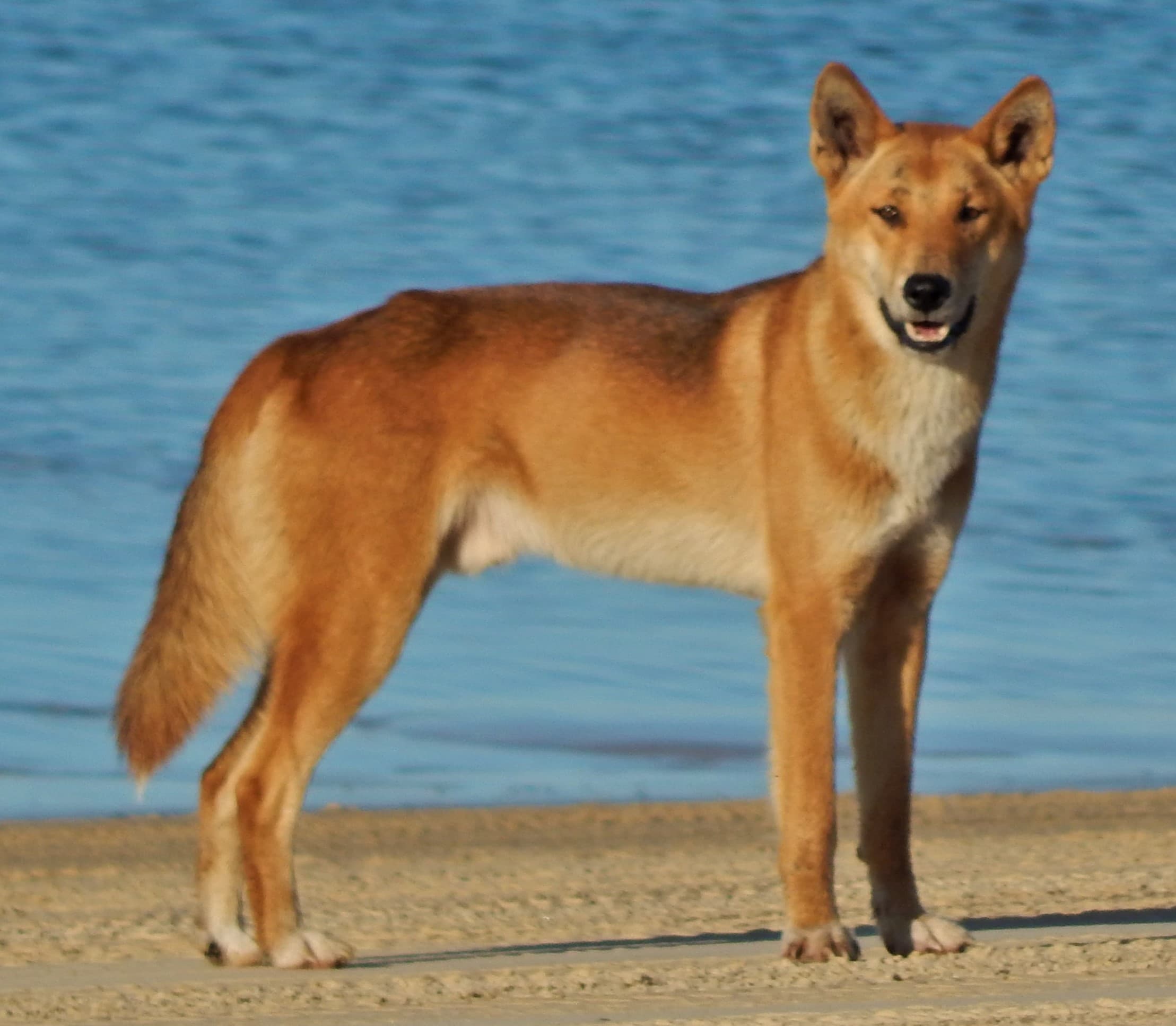
Dingo (Canis lupus dingo) is a free-living dog lineage established in Australia thousands of years before European colonization. Its ancestry lies among early domestic dogs brought by Asian seafarers, yet generations of natural selection produced a self-sustaining predator central to Australian ecosystems and many Aboriginal cultures. Dingoes remain taxonomically debated and legally treated differently across jurisdictions. This guide separates well-supported biology from common assumptions and covers identification, range, habitat, diet, behavior, reproduction and conservation.
Identification
A typical Dingo is lean, medium-sized and squarely built, with a broad wedge-shaped head, long tapered muzzle, upright triangular ears and a brushy tail carried low. Ginger or sandy coats with white feet, chest and tail tip are familiar, but genetically intact Dingoes can also be black and tan, cream, white or dark. Coat color alone cannot prove ancestry; genetic testing is needed where hybridization is a concern. Adult males are generally taller and heavier than females, while both sexes share the same range of coat colors.
Identification should combine body shape, markings, size, voice or movement, and location. One feature by itself can overlap with a related animal, a juvenile, or an individual in unusual light.
Photographs are most useful when they preserve scale and show several diagnostic features. Handling or repositioning a wild dingo for identification can cause stress and is unnecessary.
Size and physical adaptations
Dingo typically measures about 86–123 cm including head and body and weighs commonly 12–24 kg. Body size varies by sex, region and food supply; northern and tropical animals can differ from desert populations.
Its useful adaptations include flexible social system shifts between solitary and pack hunting, large erect ears detect prey and release heat, efficient long-distance travel in arid country, annual breeding cycle matches seasonal resources, broad diet includes native and introduced prey, howls coordinate widely separated animals, strong digging ability creates cool nursery dens. These traits work together in the animal’s normal setting rather than serving as isolated curiosities.
Published measurements may use different methods, life stages or sample locations. Comparing figures responsibly means checking what was measured rather than selecting the largest number available.
Range and distribution
Widespread across mainland Australia but absent from Tasmania. Dingo density is highest across northern, central and western regions and lower or actively suppressed in many southeastern sheep-grazing districts. The Dingo Barrier Fence separates much livestock country from populations farther north and west. Related ancient free-living dogs occur in New Guinea and parts of Southeast Asia but are not identical populations. The native range includes Australia.
A country-level map indicates broad distribution, not continuous occupation. Climate, elevation, water, vegetation, prey, breeding sites, barriers and survey effort all affect where records occur.
Records near the edge of the range deserve careful documentation because they may reflect natural movement, improved survey coverage, accidental transport or a genuine distribution change.
Habitat
Desert, tropical savanna, grassland, woodland, shrubland, alpine country and forest edge wherever water and prey are available.
Dingoes occupy almost every mainland biome and adjust movements to rainfall, prey and human pressure. They den in caves, hollow logs, wombat or rabbit burrows and enlarged holes near water. Packs maintain territories around dependable resources, while young dispersers can travel great distances. Roads, cattle tracks and fence lines provide efficient travel routes but increase collision and control risk. Protecting a population therefore requires the feeding, shelter and breeding features that make a site usable, along with connections that allow movement.
Microhabitat matters. Shade, soil, current, moisture, shelter or host plants can determine whether a small area is usable even when the surrounding landscape appears suitable.
Diet and feeding
Dingo is a opportunistic carnivore. Important foods include kangaroos, wallabies, rabbits, rodents, possums, wombats, birds and reptiles, feral pigs, goats and livestock. Dingoes hunt small prey alone and cooperate when pursuing kangaroos or other large mammals. They stalk, rush and maintain a chase until the target can be seized. Diet changes across the continent: rabbits and rodents dominate some arid regions, wallabies or possums in forests, and waterbirds or marine carrion near coasts. Livestock losses occur, but carcasses and poor husbandry can attract predators and complicate attribution.
Diet changes with age, season, location and food supply. A dramatic prey record does not establish what most individuals eat most of the time; repeated field observations provide a stronger picture.
Feeding opportunities also create risk. An animal focused on prey may be less alert to predators, traffic or people, while contaminated prey can transfer pollutants through the food web.
Behavior and communication
Often crepuscular or nocturnal near people; may hunt by day in remote cool conditions. A Dingo may live alone, travel as a pair or belong to a stable family pack. Pack members defend a territory, share large kills and cooperate in raising the dominant pair’s pups. Solitary dispersers search for vacant habitat and mates. Dingoes rarely give the repetitive bark of domestic dogs; howls carry farther and advertise identity, location and territorial ownership. Daily travel can cover many kilometers.
Long rising and falling howls locate pack mates and warn neighboring groups. Dingoes also use growls, whines, yelps and short barks. Urine, feces, ground scratching and body odors mark territory and reproductive condition. Tail height, ear position, facial tension and play bows control close social encounters and reduce unnecessary fights. Behavior should be interpreted in context: alarm, courtship, feeding and temperature regulation can produce very different actions from the same animal.
Daily schedules are flexible responses, not rigid rules. Weather, breeding condition, disturbance, tides or food can move activity into a different part of the day.
Reproduction and development
Most wild females breed once a year, usually mating in autumn so pups arrive in winter. In stable packs, reproduction is concentrated in the dominant pair and relatives help at the den. The female selects a cave, hollow log or enlarged burrow, sometimes moving pups among several dens. The father and helpers bring food and guard the area. Usually 4–6 pups; recorded range about 1–10 Pups are born blind and dependent, open their eyes after roughly two weeks and first emerge near three weeks. Milk is gradually supplemented with regurgitated meat and water from adults. By two months the family shifts from the birth den to rendezvous sites. Juveniles learn prey handling, routes and social rules over many months and may remain as helpers.
Young animals face different risks and may use different microhabitats or food than adults. Breeding success depends on adult condition, suitable sites and the survival of offspring through vulnerable early stages.
Counts of eggs or young describe reproductive output, not the number expected to reach adulthood. Mortality is normally greatest during eggs, larval or juvenile stages.
Predators and ecological role
As Australia’s largest widespread terrestrial predator, Dingoes suppress or alter the behavior of kangaroos, wallabies, feral goats, pigs, rabbits, foxes and cats. Effects vary with rainfall and habitat, but their presence can reduce mesopredator pressure on some small native mammals. They also scavenge carcasses and compete with wedge-tailed eagles. Removing predators can trigger complex food-web changes rather than a simple increase in livestock safety. Documented or likely predators include Human, Dingo, Saltwater Crocodile, Wedge-tailed Eagle.
This animal is both a consumer and a food source. Its influence comes through many repeated interactions, so ecological claims should be based on measured populations rather than assumptions drawn from appearance.
Predator and prey relationships differ among places. A species can be ecologically influential without being abundant everywhere, and its role can change across its range.
Relationship with people
Dingoes have deep cultural, spiritual and practical importance for Aboriginal peoples and appear in stories, kin relationships and archaeological burials. Pastoral expansion recast them as livestock pests, leading to fences, poison baiting and legal persecution. Modern management must balance cultural authority, ecological function, livestock protection and public safety, using husbandry and guardian animals where practical.
Never feed or approach a Dingo, especially at tourist sites. Secure food, rubbish and bait, supervise children closely, travel in groups and back away calmly if an animal approaches. Do not run or encourage interaction for photographs. On K’gari and other managed areas, follow ranger instructions because habituated Dingoes can become assertive and may be destroyed after repeated incidents. Responsible observation means keeping an appropriate distance, avoiding capture or feeding, protecting habitat and following local wildlife or invasive-species guidance.
Wildlife guidance should come from the responsible local agency because collection rules, reporting requests and appropriate responses differ between native and introduced ranges.
Conservation
Global Red List treatment is complicated because Dingoes are often classified within the domestic dog and lack a consistent standalone assessment. Australian conservation concern centers on loss of genetically distinctive populations through lethal control and interbreeding with modern domestic dogs. Status and protection vary sharply among states and territories. The reported global trend is Regionally variable; secure in large remote areas but declining or genetically threatened elsewhere.
Important pressures include poison baiting, trapping and shooting, hybridization with modern domestic dogs, habitat fragmentation and roads, deliberate and accidental feeding, disease from domestic dogs, conflicting legal classification. Global status can hide local decline or recovery, so current regional monitoring and habitat management remain necessary.
The most useful conservation action follows the documented pressure. Protecting breeding sites, reducing road deaths or limiting pollutants can require different tools in different populations.