
Javan Flying Dragon Overview
The Javan Flying Dragon (Draco volans) is a living agamid lizard native to Java and Bali in Indonesia. It is one of many species in the genus Draco, so older accounts that use the name for flying dragons across a much wider part of Asia can blur several distinct species together. The current IUCN assessment restricts D. volans to Java and Bali, while ITIS recognizes it as a valid species in the family Agamidae.
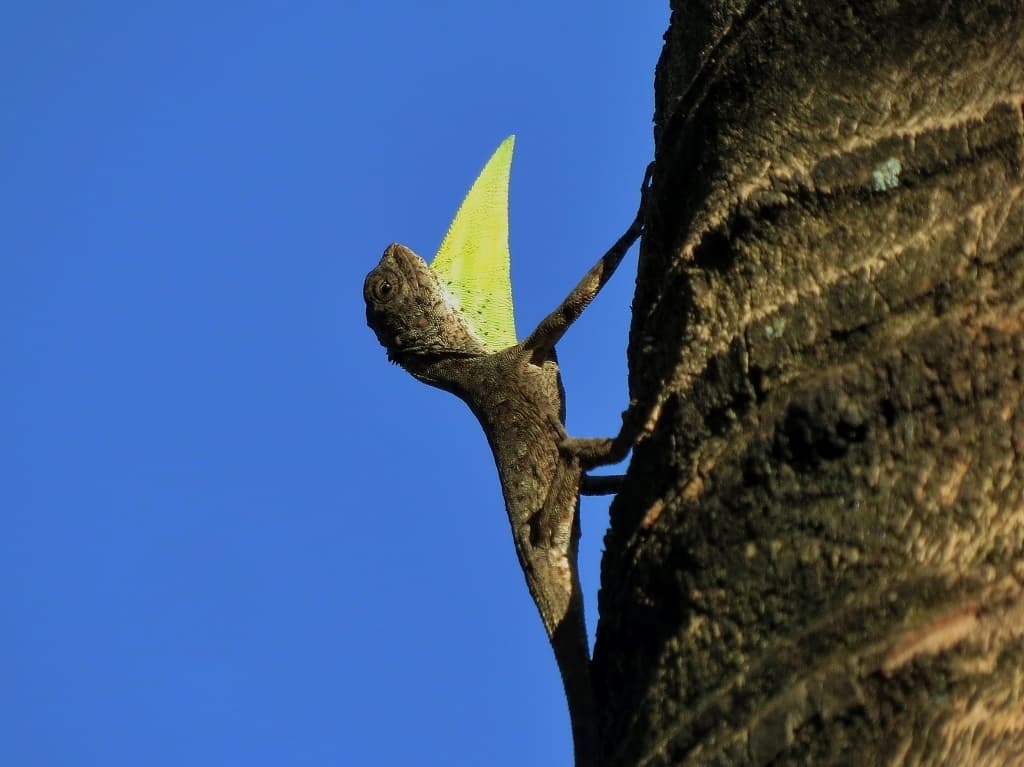
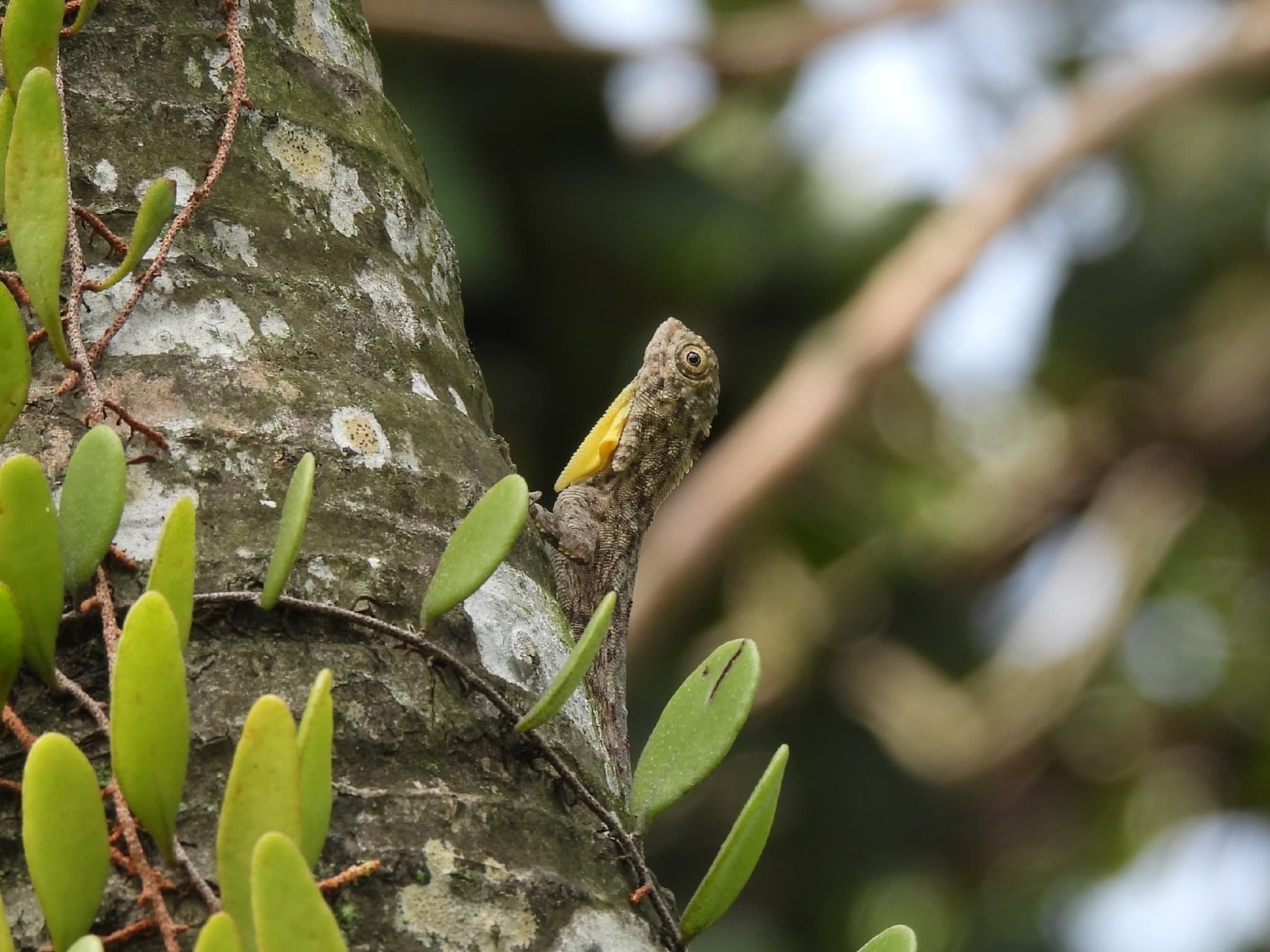
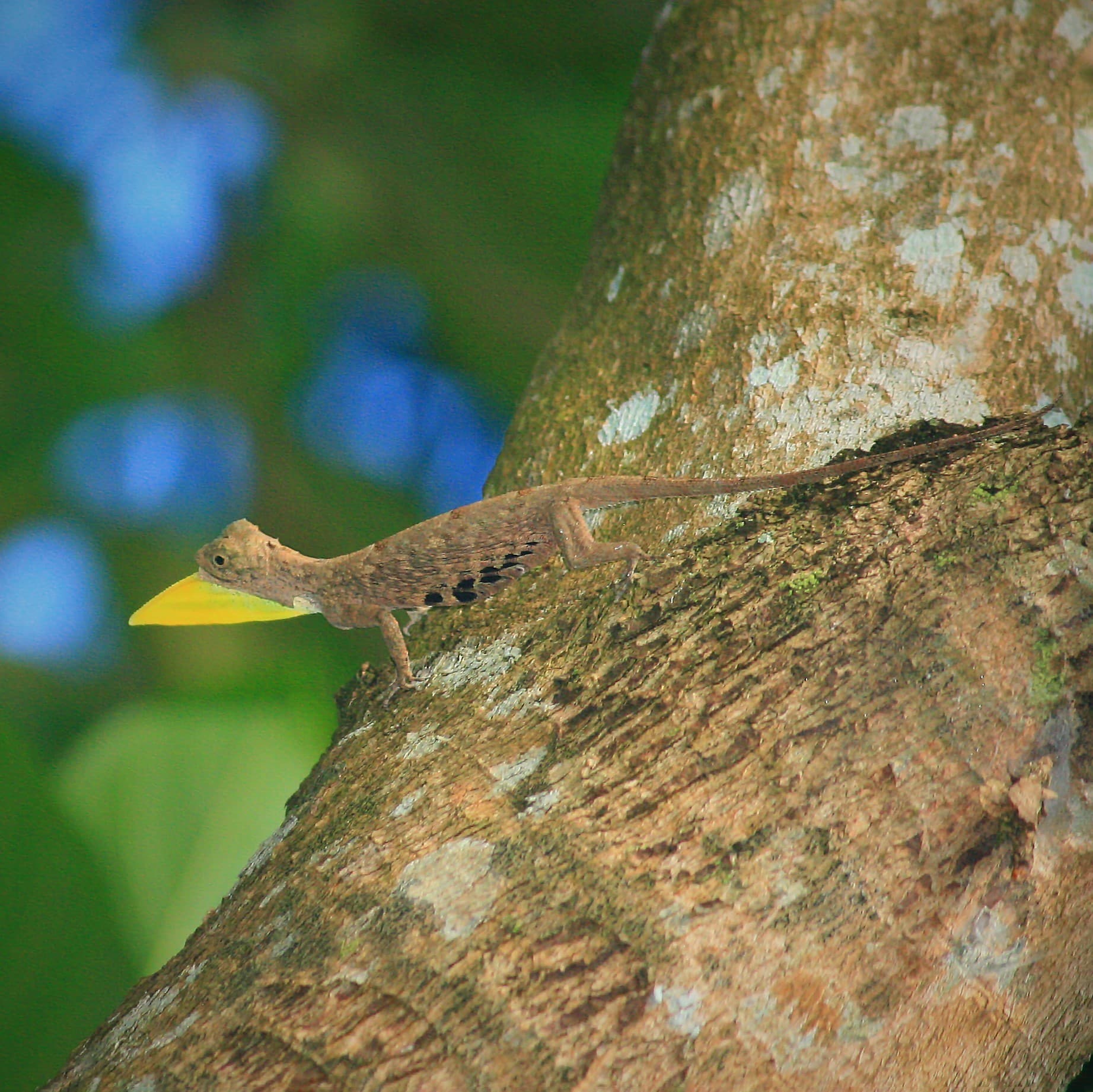
This small arboreal lizard cannot produce powered flight. Instead, it glides on a pair of skin membranes called patagia, each supported by elongated movable ribs. At rest, the membranes fold against the flanks and help the animal resemble bark. During a leap, the ribs swing outward, the patagia spread into aerodynamic surfaces and the long tail helps with stability and steering. Males also display a conspicuous yellow dewlap beneath the throat.
Range and Habitat
The verified native range lies on the Indonesian islands of Java and Bali, from lowlands to about 1,500 metres elevation. Javan Flying Dragons inhabit forest and tree-rich modified habitats. The IUCN notes that the species can tolerate disturbance when suitable trees remain, an important qualification: adaptation to gardens, plantations or forest edges does not mean it can live without a connected vertical structure.
A tree trunk serves as feeding station, display arena, lookout and launch point. A neighboring trunk becomes a landing target. The lizard’s daily world is therefore shaped by spacing between trees and by clear routes through branches and leaves. Bark color and texture also support camouflage. Removing trees can break glide paths even when some greenery remains, while retaining mature trees and connected crowns allows movement without repeated trips across dangerous open ground.
Gliding Anatomy and Performance
Draco lizards are among the most specialized living vertebrate gliders. Research reviewed by McGuire and Dudley describes a coordinated apparatus that includes elongated ribs, expandable patagia, forelimbs that help control the wing edge and a long balancing tail. The lizard launches headfirst, extends the membranes and adjusts posture during descent. It pitches upward near the destination so the feet can meet the target trunk.
Studies of free-ranging flying lizards show that a glide is more than a passive fall. Animals choose routes with fewer obstacles, turn in midair and use visual information while approaching a landing. Distance varies with launch height, target position, body size and surrounding vegetation. A figure from one observation should not be treated as a guaranteed range for every individual. The central advantage is efficient travel between trees without descending to the forest floor.
Diet and Foraging
The Javan Flying Dragon is an insectivore that feeds mainly on small ants and termites. It usually waits against a trunk and takes prey moving across the bark. This sit-and-wait method conserves energy and keeps the lizard close to camouflage and a launch surface. Quick movements of the head and jaws are enough to seize tiny insects without a long chase.
Because colonies of social insects can provide repeated feeding opportunities, a productive tree may support both hunting and territorial behavior. The lizard in turn forms part of the forest food web, converting abundant small insects into prey for birds, snakes and other predators. Gliding helps it move among feeding sites, but climbing remains essential. When disturbed, a flying dragon may circle to the opposite side of a trunk or climb upward rather than immediately launch.
Behavior and Communication
Javan Flying Dragons are active by day. Males use dewlaps, body movements and partial or full patagium extension in visual displays. The bright signal contrasts with a body otherwise adapted to blend into bark. Displaying can advertise ownership of a small group of trees, warn another male or court a female. Females have different coloration and a smaller throat display structure.
Territorial behavior does not make the animal dangerous to people. It is a small, nonvenomous lizard whose first defenses are camouflage, climbing and escape. Rain and strong wind can make gliding less useful, so activity changes with weather. Body temperature also influences performance because muscles and reaction speed depend on external warmth. Periods of sun and shade allow the lizard to balance activity against overheating.
Reproduction and Development
Unlike most of its daily life, egg laying brings the female to the ground. She excavates a small nest in soil, lays a small clutch and covers it. A detailed historical account summarized by Animal Diversity Web reports five eggs, about one day of nest guarding and roughly 32 days of incubation, but these figures come from limited observations and should not be assumed for every female or locality.
After hatching, young lizards receive no extended parental care. They must climb, feed on tiny insects and avoid predators. Their small mass suits short glides, while growth changes wing loading and performance. Survival depends on both the ground conditions needed for nesting and the tree network needed for adult feeding, display and travel. A habitat that preserves only one of those elements is incomplete.
Conservation and Human Relations
The IUCN Red List assesses Draco volans as Least Concern, with an unknown population trend. The assessment describes it as common and widespread across Java and Bali and identifies no major global threat. It also says the species adapts to disturbed habitat where suitable trees remain. Least Concern does not make every local site secure: heavy tree removal, pesticide use and broken canopy connections can reduce food and movement routes.
Javan Flying Dragons are harmless to people and should be watched without handling. Their patagia are delicate functional structures, not wings to be pulled open for photographs. Gardeners and land managers can support them by retaining trees, limiting broad-spectrum insecticides and preserving vegetated links between wooded patches. Photographing a naturally perched animal from a respectful distance reveals its camouflage and display behavior without forcing an encounter.