
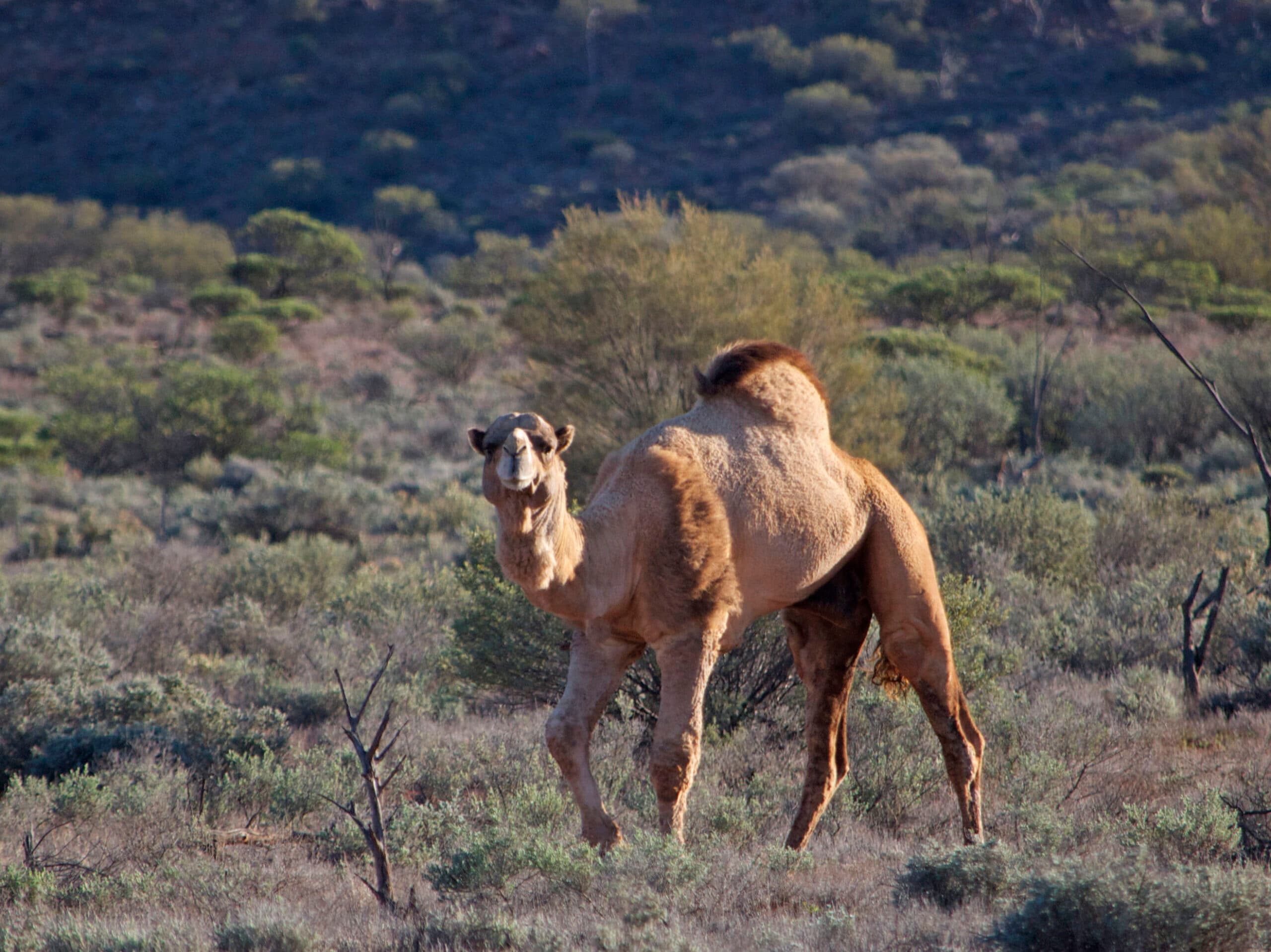
Dromedary Camel (Camelus dromedarius) is a large domesticated camel adapted to hot deserts and semi-arid plains. Its single hump stores fat, while specialized blood, kidneys, feet, nostrils and body-temperature control conserve water and protect it from sand and heat. Nearly all Dromedaries live under human management; Australia supports the world’s largest feral population. This guide separates well-supported biology from common assumptions and covers identification, range, habitat, diet, behavior, reproduction and conservation.
Identification
A Dromedary has one tall hump, a long S-curved neck, deep narrow chest, long legs and a small head with a split upper lip. Thick eyelashes, bushy eyebrows and closable slit-like nostrils protect against blowing sand. Broad two-toed feet spread under weight instead of sinking deeply into soft ground. Color ranges from pale cream and tan to reddish brown, dark brown and nearly black. Males are larger, with heavier heads and necks. During the rut a male inflates a pink soft-palate sac called the dulaa from the side of his mouth.
Identification should combine body shape, markings, size, voice or movement, and location. One feature by itself can overlap with a related animal, a juvenile, or an individual in unusual light.
Photographs are most useful when they preserve scale and show several diagnostic features. Handling or repositioning a wild dromedary camel for identification can cause stress and is unnecessary.
Size and physical adaptations
Dromedary Camel typically measures about 2.2–3.4 m head and body and weighs females commonly 300–540 kg; males about 400–690 kg. Breed and purpose strongly affect build: riding camels are lean, while dairy and pack types may be heavier.
Its useful adaptations include hump concentrates fat without insulating the whole body, oval red blood cells remain functional during dehydration, kidneys produce highly concentrated urine, dry feces and nasal heat exchange conserve water, body temperature can fluctuate to reduce sweating, broad padded feet spread on sand, thick lips browse thorny and salty plants. These traits work together in the animal’s normal setting rather than serving as isolated curiosities.
Published measurements may use different methods, life stages or sample locations. Comparing figures responsibly means checking what was measured rather than selecting the largest number available.
Range and distribution
Domestic herds are widespread through North and East Africa, the Arabian Peninsula, the Middle East and dry parts of South Asia. People have moved the species far beyond its likely ancestral range. Feral herds occupy arid and semi-arid Australia, descended from animals imported for exploration and transport during the nineteenth century. The native range includes Afghanistan, Algeria, Bahrain, Burkina Faso, Chad, Djibouti, Egypt, Eritrea, Ethiopia, India, Iran, Iraq, Jordan, Kenya, Kuwait, Libya, Mali, Mauritania, Morocco, Niger, Nigeria, Oman, Pakistan, Qatar, Saudi Arabia, Somalia, Sudan, Syria, Tunisia, United Arab Emirates, Yemen.
A country-level map indicates broad distribution, not continuous occupation. Climate, elevation, water, vegetation, prey, breeding sites, barriers and survey effort all affect where records occur.
Records near the edge of the range deserve careful documentation because they may reflect natural movement, improved survey coverage, accidental transport or a genuine distribution change.
Habitat
Hot desert, semi-desert, dry steppe, thorn scrub, pastoral rangeland, oasis margins and open sandy or stony plains.
Dromedaries travel between widely scattered forage and water, resting through the hottest periods and feeding when conditions are cooler. Herding systems follow seasonal pasture and rainfall. Their padded feet suit sand and firm dry ground but are vulnerable on sharp rock, mud and slippery surfaces. Australian feral herds move over huge areas and can damage remote waterholes during drought. Protecting a population therefore requires the feeding, shelter and breeding features that make a site usable, along with connections that allow movement.
Microhabitat matters. Shade, soil, current, moisture, shelter or host plants can determine whether a small area is usable even when the surrounding landscape appears suitable.
Diet and feeding
Dromedary Camel is a herbivore. Important foods include dry grasses, acacia leaves, thorny shrubs, saltbush, halophytic plants, pods and seeds, crop residues, supplementary hay and grain. A Dromedary browses with a mobile split lip that selects leaves among thorns and tolerates salty, bitter plants many livestock reject. As a foregut fermenter it regurgitates and rechews cud, allowing microbes to extract energy from coarse fiber. Camels should still receive balanced minerals and adequate clean water; their famous drought tolerance does not mean chronic dehydration is harmless.
Diet changes with age, season, location and food supply. A dramatic prey record does not establish what most individuals eat most of the time; repeated field observations provide a stronger picture.
Feeding opportunities also create risk. An animal focused on prey may be less alert to predators, traffic or people, while contaminated prey can transfer pollutants through the food web.
Behavior and communication
Mostly diurnal under traditional herding, with feeding concentrated in cool morning and evening periods. Domestic Dromedaries form herds organized around females and young, while mature males may be separated outside breeding. They kneel by folding calloused legs beneath the body and can carry loads or riders over long distances. A calm animal communicates clearly before resisting: it turns the head, lays ears back, raises the tail or vocalizes. During the rut, males become territorial and may bite, kick or wrestle.
Dromedaries use low moans, roars, grunts, bellows and a mother-calf contact call. Smell is critical during reproduction: males mark with urine and poll-gland secretions, and investigate females with a curled-lip flehmen response. Neck posture, ear position, tail movement, spitting and the male dulaa provide visual warnings. Close herd members maintain bonds through touch and grooming. Behavior should be interpreted in context: alarm, courtship, feeding and temperature regulation can produce very different actions from the same animal.
Daily schedules are flexible responses, not rigid rules. Weather, breeding condition, disturbance, tides or food can move activity into a different part of the day.
Reproduction and development
Breeding is seasonal and often begins during cooler months. A rutting male may stop eating, become restless, grind his teeth, extrude the dulaa and mark frequently. Dromedaries are induced ovulators, meaning mating stimulates ovulation. After a long gestation, a female usually leaves the herd briefly to deliver one calf and then rejoins with it. Usually one calf; twins are rare A calf stands and nurses within hours, receiving antibody-rich colostrum. It follows its mother while learning forage and herd routes. Nursing may continue for 12–18 months, although management systems vary. Young grow slowly and are not suited to heavy work; full body size and load capacity develop over several years.
Young animals face different risks and may use different microhabitats or food than adults. Breeding success depends on adult condition, suitable sites and the survival of offspring through vulnerable early stages.
Counts of eggs or young describe reproductive output, not the number expected to reach adulthood. Mortality is normally greatest during eggs, larval or juvenile stages.
Predators and ecological role
Domestic Dromedaries convert sparse dryland plants into milk, meat, fiber, transport and manure, supporting people where cattle struggle. Moderate browsing can distribute seeds and nutrients, but excessive stocking damages shrubs and soil. In Australia, dense feral herds compete at waterholes, browse native plants, erode banks and damage cultural and ecological sites, requiring coordinated management. Documented or likely predators include Human, Lion, Spotted Hyena, Wolf.
This animal is both a consumer and a food source. Its influence comes through many repeated interactions, so ecological claims should be based on measured populations rather than assumptions drawn from appearance.
Predator and prey relationships differ among places. A species can be ecologically influential without being abundant everywhere, and its role can change across its range.
Relationship with people
For millennia Dromedaries have carried people and goods, powered agriculture and supplied milk, meat, hair, leather and fuel. Camel milk remains a staple and income source for many pastoral communities because camels produce under heat and sparse forage that suppress cattle. Racing and tourism add modern roles. Welfare depends on humane loading, shade, foot care, veterinary medicine and realistic work limits.
Approach with the handler’s permission, remain clear of the head and hind legs and never surprise a resting animal. Rutting males require expert handling and secure separation. A Dromedary can bite, kick in several directions, crush with its body or spit stomach contents when distressed. Riders should use fitted equipment and follow weight and heat limits. Responsible observation means keeping an appropriate distance, avoiding capture or feeding, protecting habitat and following local wildlife or invasive-species guidance.
Wildlife guidance should come from the responsible local agency because collection rules, reporting requests and appropriate responses differ between native and introduced ranges.
Conservation
The domestic Dromedary is abundant and not assessed as a threatened wild species because no uncontested wild population survives. Conservation priorities include maintaining diverse traditional breeds and managing Australia’s feral population humanely. The reported global trend is Domestic numbers generally stable or increasing; feral Australian numbers fluctuate with drought and control.
Important pressures include loss of locally adapted breeds through genetic replacement, drought and pasture degradation, heat stress under poor husbandry, emerging disease and limited veterinary access, conflict and displacement of pastoral communities. Global status can hide local decline or recovery, so current regional monitoring and habitat management remain necessary.
The most useful conservation action follows the documented pressure. Protecting breeding sites, reducing road deaths or limiting pollutants can require different tools in different populations.