
Bornean Earless Monitor Overview
The Bornean Earless Monitor (Lanthanotus borneensis) is a living lizard found only on Borneo. It is the sole living species in the family Lanthanotidae, making every surviving population unusually important in evolutionary as well as ecological terms. Despite its common name, it is not a true monitor lizard in the family Varanidae. The two families are close relatives within the anguimorph lizards, but the Bornean Earless Monitor represents its own distinct lineage.
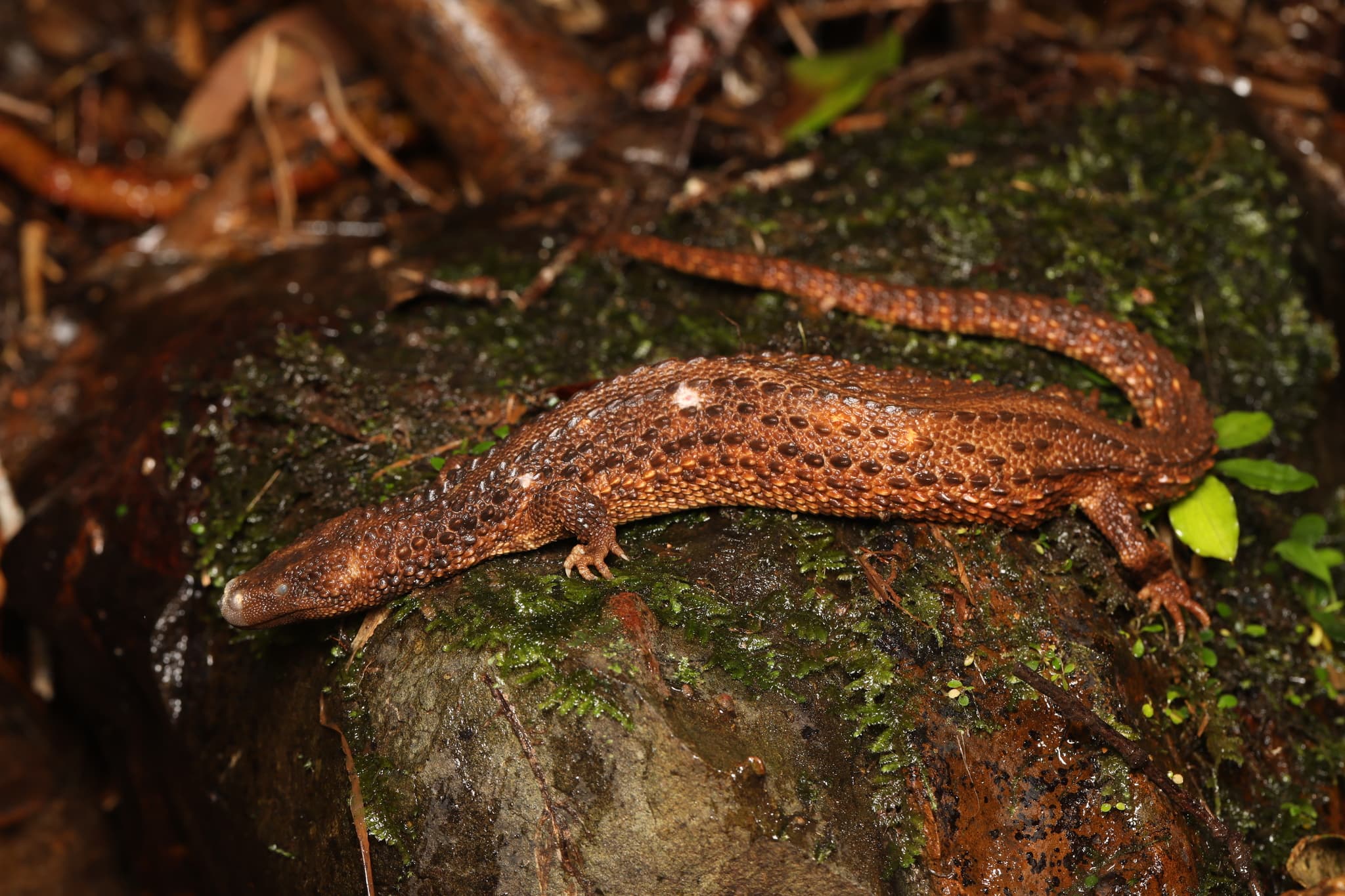
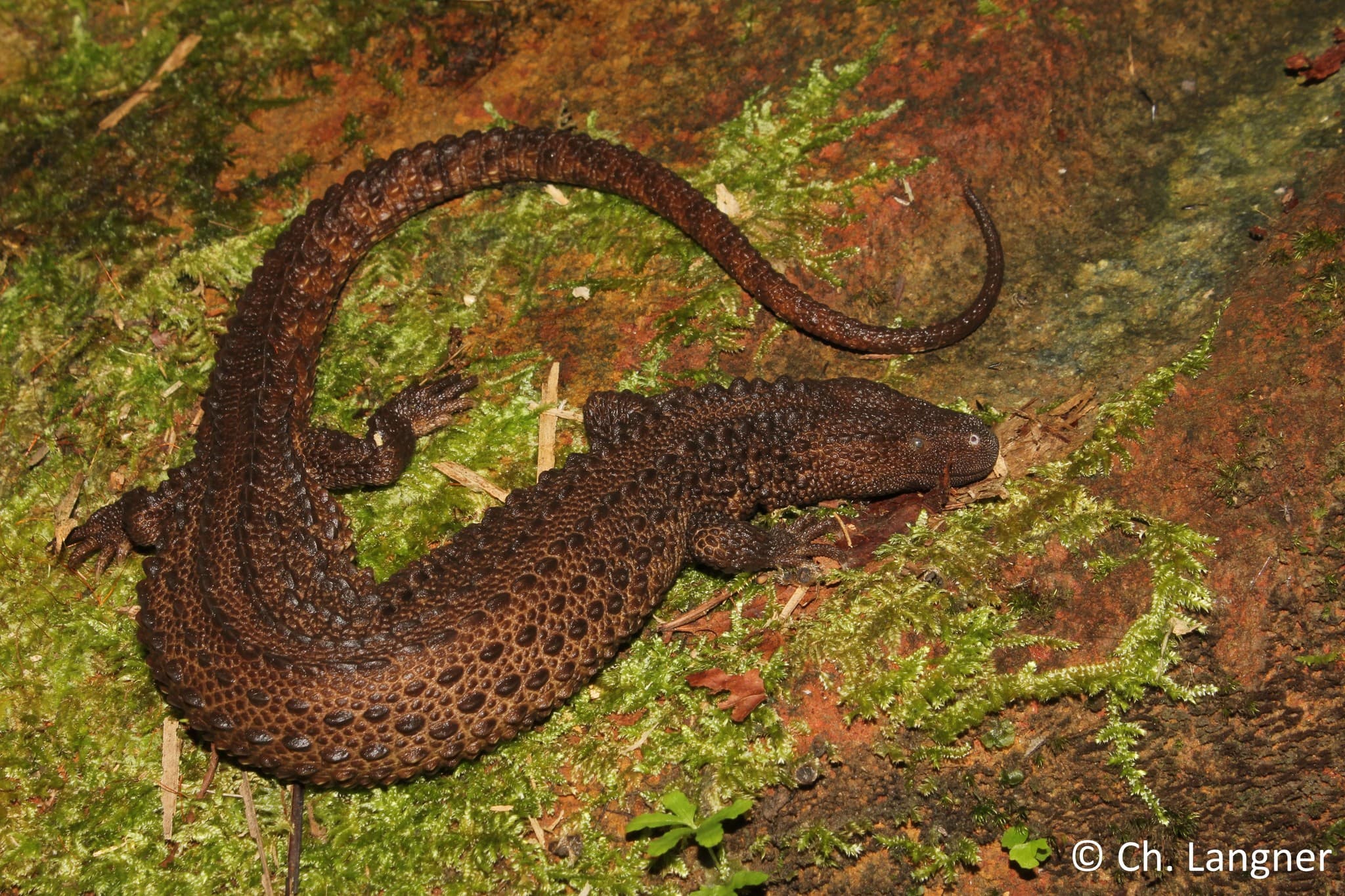
Its appearance matches a life spent in wet soil, stream margins and hidden retreats. The body is long and cylindrical, the limbs are short, and the tail is muscular and laterally compressed. Rows of enlarged, beadlike scales give the back an armored texture. The head is small, flat and blunt, with tiny eyes, small nostrils and no visible external ear opening. Adults are usually dark brown, although wet skin and flash photography can reveal warm reddish tones. Published accounts report total lengths around 40 to 55 centimetres, much of that length being tail.
Range and Rainforest Habitat
This species is endemic to Borneo. Confirmed records come from Sarawak in Malaysia and Kalimantan in Indonesia, while more recent records have also documented it in Brunei. The IUCN assessment emphasizes that confirmed localities are few and fragmented. Precise sites are often withheld because publication of locality details can help collectors target rare reptiles. A lack of sightings therefore does not necessarily mean absence: this secretive animal is difficult to survey and spends much of its time concealed.
Bornean Earless Monitors are associated with humid lowland forest, inland wetlands and the edges of small streams. Field studies have found animals beneath roots, rocks and woody debris, inside burrows, and in shallow water. Damp soil and stable retreats appear more important than one particular surface feature. Forest clearing, drainage, logging roads and conversion to plantations can remove shelter, change stream flow and isolate small populations. Protecting an intact corridor along a watercourse preserves both aquatic conditions and the shaded terrestrial refuges the lizard uses.
Hidden Anatomy and Adaptations
The name Lanthanotus refers to a hidden ear. Although there is no external ear opening, the animal is not literally earless: internal structures remain capable of detecting sound and vibration. The small eyes and translucent lower eyelids fit a lifestyle in which vision is less useful than close-range chemical and tactile information. Like other squamates, the lizard samples scents with a forked tongue and transfers chemical particles to sensory tissue in the roof of the mouth.
A flattened head can enter narrow crevices, while the elongated body flexes through wet substrate and between roots. The short, strong limbs carry long claws that can grip soil and resist extraction from a retreat. A laterally compressed tail helps propel the animal in water, and the textured skin provides protection. These features do not make it a fast, open-ground hunter. They make it effective in a dark, structurally complex world where concealment, traction and short movements matter more than sustained speed.
Activity, Diet and Hunting
The species is primarily nocturnal. Individuals emerge when humidity is high and temperatures are relatively moderate, then search on land or in shallow water. Field observations describe a secretive animal that may remain motionless when discovered or retreat beneath cover. Its true home-range size, seasonal movements and population density are still active research questions, and conclusions based on captive animals should not automatically be applied to wild populations.
Documented food includes earthworms and crustaceans, while published reviews also report fish, tadpoles and other small aquatic or soil-dwelling prey. The lizard uses chemical cues to find food and grips prey with recurved teeth. Research on its mandibular glands found anatomical evidence relevant to venom evolution in anguimorph lizards, but the practical effect of its oral secretions on natural prey remains incompletely resolved. It should not be portrayed as a dangerous animal: it is small, elusive and avoids people. A defensive bite is possible if it is captured or restrained, which is another reason to leave wild individuals untouched.
Reproduction and Life History
Bornean Earless Monitors lay eggs. Most detailed reproductive information comes from managed-care breeding because nests and courtship are extremely difficult to observe in the forest. Captive breeding has shown that females can produce small clutches and that incubation lasts for months, but exact figures vary among reports and husbandry conditions. Those observations confirm the basic reproductive mode without establishing one universal schedule for every wild population.
Hatchlings resemble miniature adults and receive no prolonged parental care. Their small size likely makes them vulnerable to snakes, larger lizards, birds and other rainforest predators, although the natural predator list is poorly documented. Longevity, age at maturity and generation length in the wild are not reliably established. These gaps matter for conservation because managers cannot accurately predict recovery from collecting or habitat loss without knowing how quickly adults are replaced.
Conservation Status and Wildlife Trade
The IUCN Red List classifies Lanthanotus borneensis as Endangered under criterion B2ab(iii,iv,v), with a decreasing population trend. The assessment cites a very small known area of occupancy, severe fragmentation, continuing habitat loss and collection for the pet trade. It does not provide a reliable global population total. The rarity of confirmed records should be described honestly rather than converted into a guessed number of animals.
The family Lanthanotidae is listed in CITES Appendix II, so international trade is regulated through permits and must not threaten wild survival. National laws also protect the species across its range. Trade concern is especially serious because wild animals appeared in overseas commerce despite longstanding range-country protections and no lawful export history for the founding stock described in conservation reviews. Claims of captive breeding do not erase the need for documented legal origin. Buyers, exhibitors and researchers should insist on traceable permits and avoid sharing sensitive locality information.
Research and Responsible Observation
A wild sighting should be documented without handling, moving or exposing the animal for a staged photograph. Observers can record time, broad habitat type and behavior from a respectful distance, then provide sensitive location data only to trusted conservation authorities or research programs. Turning rocks, digging burrows or removing cover can injure the lizard and damage the very refuge that allowed it to survive.
Current research priorities include population surveys, seasonal habitat use, genetics, diet, reproduction and the effectiveness of legal protection. The species illustrates why uncertainty is not a reason to delay conservation. Its restricted distribution, specialized wet-forest habitat and desirability in illegal trade create risks even while many details of its biology remain unknown. Protecting forested streams, enforcing wildlife laws and supporting carefully designed field studies offer the best path to keep this singular living lineage in Borneo’s ecosystems.