
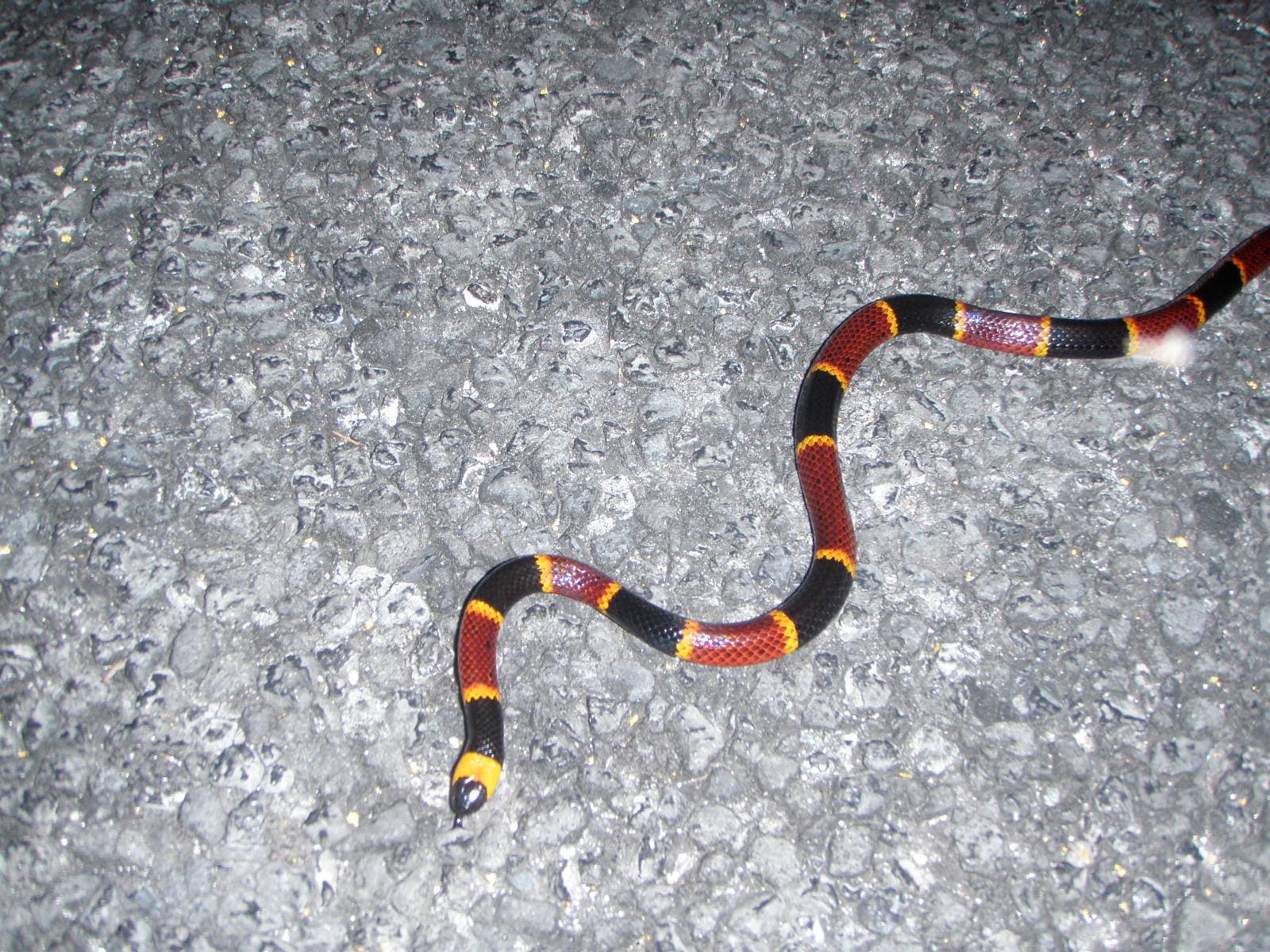
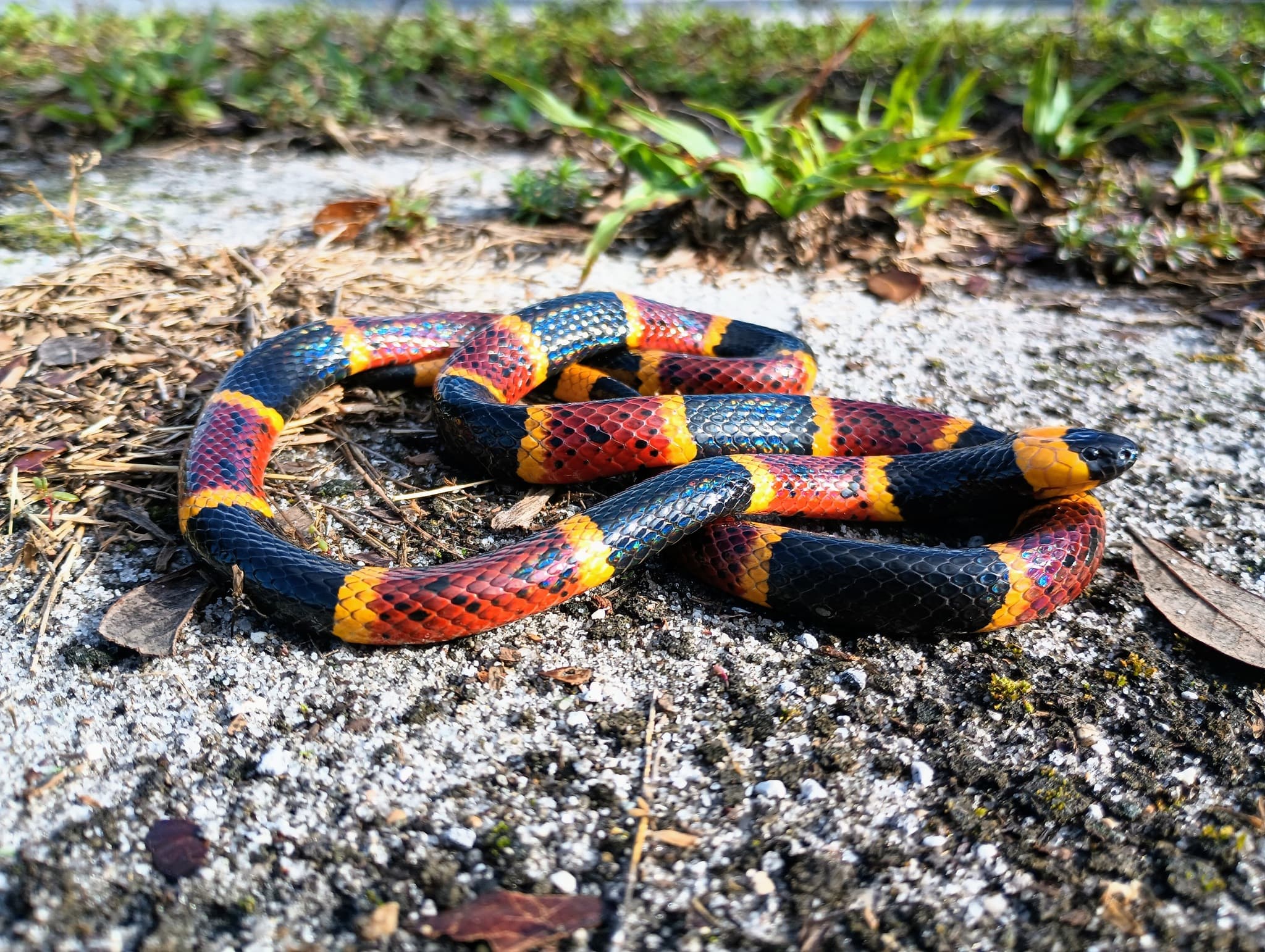
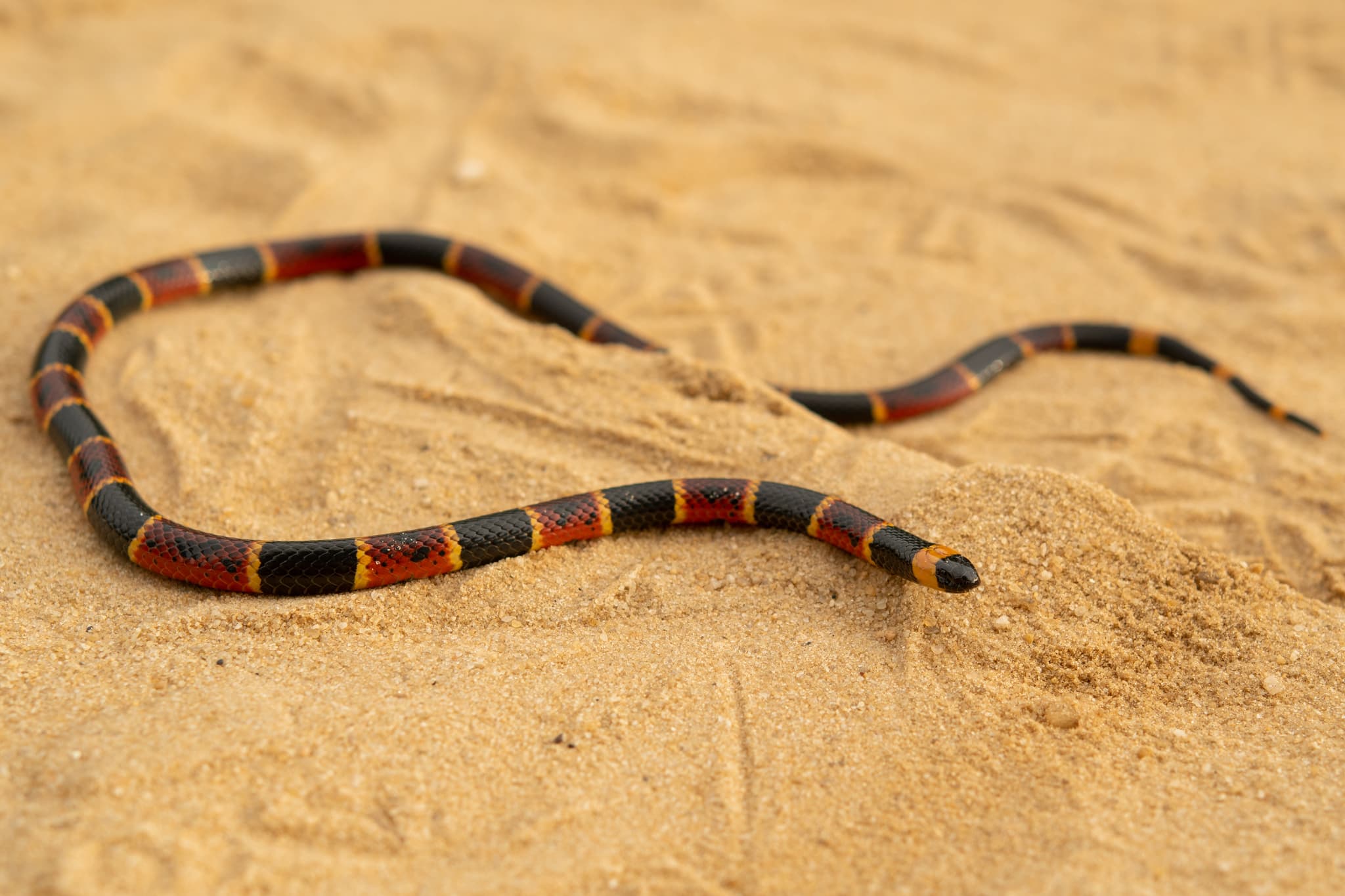
A living coral snake of the southeastern United States
The Eastern Coral Snake, Micrurus fulvius, is a living venomous elapid native to the southeastern United States. It is also called the harlequin coralsnake. This page covers that species specifically, rather than every American coral snake or every harmless snake with red, yellow and black bands. The Center for North American Herpetology recognizes records from Florida and several neighboring southeastern states.
Although its colors are conspicuous, the snake spends much of its life concealed beneath leaf litter, logs or loose soil. Encounters are uncommon compared with encounters with many pit vipers. Its venom is medically important, so an observer should keep well back, never handle the snake and use professional emergency care after any suspected bite.
Appearance and careful identification
Adults are slender and usually about 50–80 centimetres long, though exceptional individuals can be longer. The body carries complete rings of red, yellow and black. Broad red and black bands are separated by narrow yellow bands, and the snout is black. The head is small and not sharply wider than the neck. Smooth scales give the body a glossy appearance.
Several harmless snakes share parts of this pattern. The familiar color rhyme is not a safe identification method because patterns vary and the rhyme fails outside parts of the United States. Location, head pattern, complete body rings and expert confirmation all matter. The University of Florida wildlife guide compares the species with scarlet snakes and scarlet kingsnakes. People should photograph an unknown snake from a distance rather than approach it.
Range and habitat
The Eastern Coral Snake occurs in the southeastern United States, with its strongest distribution in Florida and the coastal plain. Verified records extend into Georgia, the Carolinas and portions of Alabama, Mississippi and Louisiana. It is a species of the United States; closely related coral snakes occupy Texas, Mexico and other parts of the Americas but are separate taxa.
Habitats include pine flatwoods, scrub, sandy ridges, hardwood hammocks, palmetto thickets and the edges of wetlands. Loose, well-drained soil and deep litter provide places to burrow and hide. The snake may also shelter beneath logs, boards or other cover. Development, roads and intensive ground disturbance can fragment the protected spaces it uses even where broad habitat remains.
Secretive behavior
Eastern Coral Snakes are primarily terrestrial and partly fossorial. They move through loose soil and litter, and many surface observations follow heavy rain or seasonal changes in temperature and moisture. Activity can occur by day or at night depending on conditions. When threatened, an animal generally tries to escape or conceal its head rather than pursue a person.
Defensive behavior can include tightly coiling the tail, elevating it or producing cloacal musk. These displays may redirect a predator’s attention from the head. A reluctant defensive response does not make the snake safe to touch. Coral snakes have fixed front fangs and can maintain a bite, allowing venom to enter tissue. Distance is the only reliable safety practice.
Diet and hunting
The species is a carnivore that specializes in small elongated vertebrates. Other snakes form an important part of the diet, along with small lizards and occasionally amphibians. A coral snake searches through litter and burrows where this prey also hides. Its narrow body allows it to enter confined spaces that larger predators cannot use easily.
Venom helps immobilize prey after a bite. The snake swallows prey whole, as other snakes do. Feeding is intermittent because a substantial meal can support a reptile for days or weeks. In the ecosystem, the Eastern Coral Snake is both predator and prey: kingsnakes and some birds or mammals may kill it, while its secretive habits and warning colors reduce exposure.
Venom and bite response
Eastern Coral Snake venom contains neurotoxic components that can interfere with communication between nerves and muscles. Early pain or swelling may be limited, so a mild-looking bite cannot be dismissed. Weakness, drooping eyelids, slurred speech and breathing difficulty may develop later. The correct response is immediate emergency medical evaluation.
Do not cut the wound, apply ice, use a tourniquet or attempt to capture the snake. Keep the person calm, remove restrictive jewelry and call emergency services or a poison center. A distant photograph can help identification if it is obtained without delaying care or approaching the animal. Treatment decisions belong to clinicians and poison-control specialists.
Reproduction and development
Eastern Coral Snakes reproduce by laying eggs. Courtship and mating occur seasonally, and females place a small clutch in protected, humid cover such as rotting vegetation or an underground chamber. Published accounts often report roughly three to twelve eggs, but clutch size varies with female size and condition.
The embryos develop without parental attendance. Hatchlings emerge with the same basic warning pattern as adults and possess functional venom. They begin life at a much smaller scale but hunt similar narrow-bodied prey. Growth is gradual, and reliable wild longevity estimates are limited because this secretive snake is difficult to follow through an entire lifetime.
Conservation
The Eastern Coral Snake has been assessed as Least Concern. Animal Diversity Web summarizes its biology and conservation status, while museum and observation records confirm that the species remains extant. A broad category does not mean every local population is secure. Habitat conversion, road mortality, persecution and collection can reduce numbers in developed areas.
Protecting connected pine woods, scrub, hammocks and litter-rich ground benefits this snake and its prey. Leaving fallen logs and natural cover where appropriate preserves shelter. It is especially important not to kill a snake simply because it is venomous. Giving it space protects people while allowing a native predator to continue its ecological role.
Living safely alongside the species
Residents can reduce accidental encounters by wearing shoes outdoors, using gloves when moving debris and checking before placing hands beneath logs or boards. Children and pets should be kept away from any brightly banded unknown snake. If one appears in a building or high-use area, a trained wildlife professional can remove it without unnecessary handling.
The Eastern Coral Snake is not suitable as a casual pet. Its medically significant venom, specialized care and legal restrictions demand professional facilities and protocols. Wild animals should remain in their habitat. Calm, distant observation and accurate reporting provide useful records without putting the observer or the snake at risk.