
Home/Animals/Reptilia/Eastern Glass Lizard
Species profileIUCN: LC

Eastern Glass Lizard

Ophisaurus ventralis

A long, legless coastal-plain lizard with movable eyelids, ear openings and a tail built to break away.

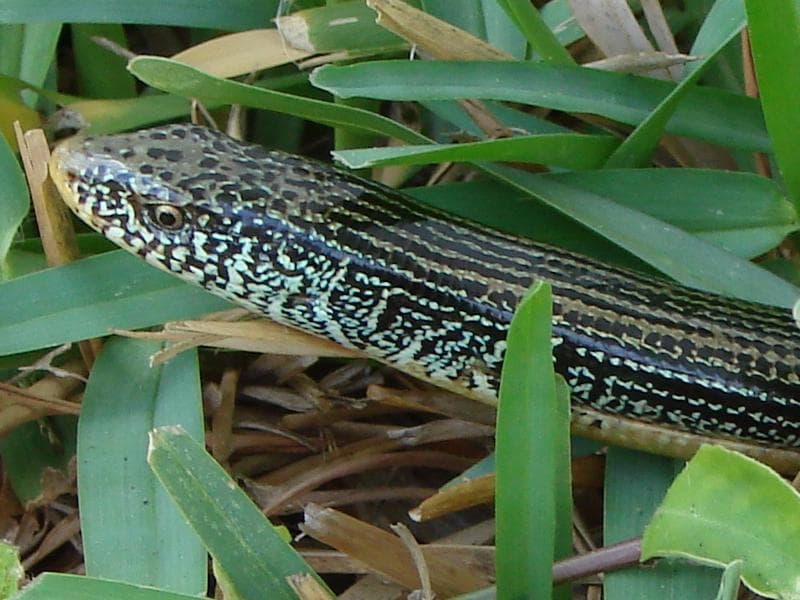
Eastern Glass Lizard showing its long legless body, pointed head and olive-striped scales
Fl295 / Wikimedia Commons / Public domain
๐ŸŒ Read in Language:

โšก At a Glance

Species profile
Also Known As
Glass Snake; Joint Snake
Diet Category
Carnivore of invertebrates and small vertebrates
Activity Rhythm
Crepuscular and active after rain, with daytime basking in mild weather; brumates underground during cold months.
Wild Lifespan
Wild longevity is poorly known; 4โ€“15 years recorded in managed care
Typical Weight
about 300โ€“600 g in large adults
Conservation Status
LC
๐Ÿ’ก Key Biological Insight: A broken glass-lizard tail may continue twisting and can fragment into several pieces, distracting a predator while the lizard escapes.

๐ŸŒณ Scientific Taxonomy Hierarchy

Ophisaurus ventralis belongs to Anguidae, the family that includes alligator lizards and glass lizards. It is a true lizard rather than a snake. The absence of a dark stripe down the middle of the back helps distinguish it from slender glass lizards, while location and head pattern separate it from mimic and island glass lizards.

KingdomAnimalia
PhylumChordata
ClassReptilia
OrderSquamata
FamilyAnguidae
GenusOphisaurus
SpeciesOphisaurus ventralis

Distinguishing Anatomical Features

  • โœ“Adults are olive, greenish or yellow-brown with numerous narrow black longitudinal lines along the sides but no dark mid-dorsal stripe. The underside is yellowish. White markings often appear near the head and neck. Lateral grooves run along each side, allowing expansion during breathing, feeding and egg development. Eyelids and external ear openings confirm it is a lizard.
  • โœ“Legless body moves through dense grass
  • โœ“Lateral grooves permit body expansion
  • โœ“Movable eyelids protect the eyes
  • โœ“External ears detect vibration and sound
  • โœ“Tail autotomy distracts predators
  • โœ“Forked tongue samples chemical trails
  • โœ“Pointed snout pushes through loose soil

๐Ÿ“ Physical Measurements

Total Length18โ€“42.5 in total length
Body Weightabout 10.6โ€“21.2 oz in large adults
Tail LengthExtremely long, often more than twice the body length; readily autotomized
WingspanNot applicable
Top SpeedNo dependable universal maximumMovement changes with context and conditions.

๐ŸŽจ Appearance & Distinctive Markings

OliveGreenYellowBrownBlackWhiteOliveYellowBlack

Skin / Covering: Smooth hard overlapping scales reinforced by small bony plates

Sexual Dimorphism: Males often become more yellowish or speckled with age, while females can appear greener. The sexes overlap strongly in size and pattern, so reliable identification may require examination of the tail base or cloacal region.

๐Ÿ—บ๏ธ Geographic Distribution & Habitat

The native range follows the Atlantic and Gulf Coastal Plains from southeastern Virginia through the Carolinas, Georgia and Florida west to southeastern Louisiana, with records in adjoining Alabama and Mississippi. Reports from the Cayman Islands may represent human introduction and are not treated as part of the secure native range.

Pine flatwoods, coastal dune, sandy scrub, wet meadow, marsh edge, grassland, open woodland and debris-rich field.

Country-level distribution map

Native range
FijiTanzaniaWestern SaharaCanadaUnited States โ€” Native rangeKazakhstanUzbekistanPapua New GuineaIndonesiaArgentinaChileCongo - KinshasaSomaliaKenyaSudanChadHaitiDominican RepublicRussiaBahamasFalkland IslandsNorwayGreenlandFrench Southern TerritoriesTimor-LesteSouth AfricaLesothoMexicoUruguayBrazilBoliviaPeruColombiaPanamaCosta RicaNicaraguaHondurasEl SalvadorGuatemalaBelizeVenezuelaGuyanaSurinameFranceEcuadorPuerto RicoJamaicaCubaZimbabweBotswanaNamibiaSenegalMaliMauritaniaBeninNigerNigeriaCameroonTogoGhanaCรดte dโ€™IvoireGuineaGuinea-BissauLiberiaSierra LeoneBurkina FasoCentral African RepublicCongo - BrazzavilleGabonEquatorial GuineaZambiaMalawiMozambiqueEswatiniAngolaBurundiIsraelLebanonMadagascarPalestinian TerritoriesGambiaTunisiaAlgeriaJordanUnited Arab EmiratesQatarKuwaitIraqOmanVanuatuCambodiaThailandLaosMyanmar (Burma)VietnamNorth KoreaSouth KoreaMongoliaIndiaBangladeshBhutanNepalPakistanAfghanistanTajikistanKyrgyzstanTurkmenistanIranSyriaArmeniaSwedenBelarusUkrainePolandAustriaHungaryMoldovaRomaniaLithuaniaLatviaEstoniaGermanyBulgariaGreeceTรผrkiyeAlbaniaCroatiaSwitzerlandLuxembourgBelgiumNetherlandsPortugalSpainIrelandNew CaledoniaSolomon IslandsNew ZealandAustraliaSri LankaChinaTaiwanItalyDenmarkUnited KingdomIcelandAzerbaijanGeorgiaPhilippinesMalaysiaBruneiSloveniaFinlandSlovakiaCzechiaEritreaJapanParaguayYemenSaudi ArabiaCyprusMoroccoEgyptLibyaEthiopiaDjiboutiUgandaRwandaBosnia & HerzegovinaNorth MacedoniaSerbiaMontenegroKosovoTrinidad & TobagoSouth Sudan
Highlighted countries are recorded profile locations, not precise biological range boundaries.Map boundaries: Natural Earth

Recorded Native Countries & Territories:

๐Ÿ’ก Did You Know?

  • ๐Ÿ’กLegless body moves through dense grass
  • ๐Ÿ’กLateral grooves permit body expansion
  • ๐Ÿ’กMovable eyelids protect the eyes
  • ๐Ÿ’กExternal ears detect vibration and sound
  • ๐Ÿ’กTail autotomy distracts predators
  • ๐Ÿ’กForked tongue samples chemical trails
  • ๐Ÿ’กPointed snout pushes through loose soil

๐ŸŒฟ Conservation Status & Threats

IUCN: LC โ€” Least Concern

โ€œThe Eastern Glass Lizard is widespread in the southeastern coastal plain and treated as Least Concern. Local losses can occur where grassy open habitat is developed, heavily mowed or converted to closed canopy.โ€

Population TrendGenerally stable with local declines
Wild Population EstimateNo reliable range-wide estimate
CITESNot listed

โš ๏ธ Major Threats to Eastern Glass Lizard

  • โ€ขCoastal development
  • โ€ขLoss of open grassland
  • โ€ขRoad mortality
  • โ€ขFrequent mowing
  • โ€ขDomestic cats
  • โ€ขPesticide reduction of prey
  • โ€ขWild collection
  • โ€ขRemoval of natural cover

๐Ÿ”„ Life Cycle & Reproduction

Wild vs. Captivity Lifespan Comparison

๐ŸŒฟ In the WildWild longevity is poorly known; 4โ€“15 years recorded in managed care
๐Ÿ  In Captivity (with veterinary care)Specialist care requires deep substrate, ground cover, correct heat and humidity, UVB, live prey and minimal handling.
Clutch / Litter SizeUsually 5โ€“17 eggs
Incubation / GestationAbout 50โ€“65 days
Fledging / WeaningIndependent hatchling 15โ€“20 cm long
Sexual MaturityAbout 2 years
Mating SystemInternal fertilization; egg-laying
Nesting / Den TypeShallow covered chamber under logs, boards or grass clumps

๐Ÿฆ… Behavior & Field Ecology

Carnivore of invertebrates and small vertebrates

๐ŸŒ Ecological Food Web & Relationships: Eastern Glass Lizards consume abundant insects, worms and mollusks and occasionally small vertebrates or eggs. They are prey for snakes, raptors and mammals, transferring energy from soil and grass-layer invertebrates to larger predators. Their need for open grassy cover links them to coastal-prairie, flatwoods and dune management.

Social Group SizeSolitary except during courtship and female egg attendance
Activity RhythmCrepuscular and active after rain, with daytime basking in mild weather; brumates underground during cold months.
Feeding StrategyCarnivore of invertebrates and small vertebrates

๐Ÿฅฉ Primary Prey & Preferred Diet

โœ“ Grasshoppersโœ“ Beetlesโœ“ Spidersโœ“ Earthwormsโœ“ Slugsโœ“ Snailsโœ“ Small lizards

๐Ÿ“ข Communication & Territorial Signals

  • Tongue-flick chemoreception
  • Visual prey detection
  • Ground vibration
  • Courtship contact
  • Rapid thrashing
  • Tail autotomy

๐Ÿพ Wild Temperament & Traits

โ€ข Secretiveโ€ข Fossorialโ€ข Crepuscularโ€ข Mostly solitaryโ€ข Fast when exposedโ€ข Harmless

๐Ÿค Human Interaction & Pet Advisory

โš ๏ธ Strictly Wild Species
๐Ÿšซ

Can You Keep a Eastern Glass Lizard as a Pet?

This secretive native species is best left wild. Captive care would require a broad enclosure with deep diggable substrate, secure hides, UVB, a carefully controlled thermal gradient and varied live invertebrates. Wild capture can be illegal and commonly causes tail loss, stress and feeding problems.

Domestication StatusWild species; not domesticated
Danger to HumansHarmless to people; minor bite or scratch possible if restrained
Economic & Ecotourism RoleControl of insects and mollusks, prey for coastal predators, and an educational example of convergent snake-like form and tail autotomy.

โš ๏ธ Behavioral Risk Factors & Wildlife Safety

  • Small teeth can pinch
  • Handling triggers stress
  • Tail loss harms the lizard
  • Misidentification leads to needless killing

๐ŸŒ Ecological Food Web & Relationships

๐Ÿฆ… Natural Predators (5)

KingsnakesLampropeltis spp.
Red-Shouldered HawkButeo lineatus
RaccoonProcyon lotor
Domestic CatFelis catus
Wild TurkeyMeleagris gallopavo

๐Ÿงฌ Related Species (4)

Slender Glass LizardOphisaurus attenuatusStriped widespread relative
Island Glass LizardOphisaurus compressusFlorida relative
Mimic Glass LizardOphisaurus mimicusSmall southeastern relative
European Glass LizardPseudopus apodusLarge Old World anguine

Eastern Glass Lizard (Ophisaurus ventralis) is the largest glass lizard in North America, a legless species of the southeastern coastal plain. Although it resembles a snake, it has movable eyelids, visible external ear openings and lateral body grooves. Most of its exceptional length is tail, which can break into pieces when seized and later regrow only partially. This guide separates well-supported biology from common assumptions and covers identification, range, habitat, diet, behavior, reproduction and conservation.

Identification

Adults are olive, greenish or yellow-brown with numerous narrow black longitudinal lines along the sides but no dark mid-dorsal stripe. The underside is yellowish. White markings often appear near the head and neck. Lateral grooves run along each side, allowing expansion during breathing, feeding and egg development. Eyelids and external ear openings confirm it is a lizard. Males often become more yellowish or speckled with age, while females can appear greener. The sexes overlap strongly in size and pattern, so reliable identification may require examination of the tail base or cloacal region.

Identification should combine body shape, markings, size, voice or movement, and location. One feature by itself can overlap with a related animal, a juvenile, or an individual in unusual light.

Photographs are most useful when they preserve scale and show several diagnostic features. Handling or repositioning a wild eastern glass lizard for identification can cause stress and is unnecessary.

Size and physical adaptations

Eastern Glass Lizard typically measures 45โ€“108 cm total length and weighs about 300โ€“600 g in large adults. More than half the total length is fragile tail; regenerated tails are shorter and differently patterned.

Its useful adaptations include legless body moves through dense grass, lateral grooves permit body expansion, movable eyelids protect the eyes, external ears detect vibration and sound, tail autotomy distracts predators, forked tongue samples chemical trails, pointed snout pushes through loose soil. These traits work together in the animal’s normal setting rather than serving as isolated curiosities.

Published measurements may use different methods, life stages or sample locations. Comparing figures responsibly means checking what was measured rather than selecting the largest number available.

Range and distribution

The native range follows the Atlantic and Gulf Coastal Plains from southeastern Virginia through the Carolinas, Georgia and Florida west to southeastern Louisiana, with records in adjoining Alabama and Mississippi. Reports from the Cayman Islands may represent human introduction and are not treated as part of the secure native range. The native range includes United States.

A country-level map indicates broad distribution, not continuous occupation. Climate, elevation, water, vegetation, prey, breeding sites, barriers and survey effort all affect where records occur.

Records near the edge of the range deserve careful documentation because they may reflect natural movement, improved survey coverage, accidental transport or a genuine distribution change.

Habitat

Pine flatwoods, coastal dune, sandy scrub, wet meadow, marsh edge, grassland, open woodland and debris-rich field.

Eastern Glass Lizards spend much time beneath grass thatch, boards, logs and natural debris or moving through loose sandy soil. They favor open-canopy habitat with dense ground cover and both moist and dry refuges. Burrows below the frost line provide winter shelter, while sunny roads and openings are used for basking. Protecting a population therefore requires the feeding, shelter and breeding features that make a site usable, along with connections that allow movement.

Microhabitat matters. Shade, soil, current, moisture, shelter or host plants can determine whether a small area is usable even when the surrounding landscape appears suitable.

Diet and feeding

Eastern Glass Lizard is a carnivore of invertebrates and small vertebrates. Important foods include grasshoppers, beetles, spiders, earthworms, slugs, snails, small lizards. The lizard actively searches at dawn, dusk and after rain, using sight and chemical cues to locate prey in soil and thatch. It grasps insects, spiders, worms, slugs and snails with the jaws. Small reptiles and bird eggs are taken opportunistically. Unlike snakes, its jaws cannot expand enough to swallow very large prey.

Diet changes with age, season, location and food supply. A dramatic prey record does not establish what most individuals eat most of the time; repeated field observations provide a stronger picture.

Feeding opportunities also create risk. An animal focused on prey may be less alert to predators, traffic or people, while contaminated prey can transfer pollutants through the food web.

Behavior and communication

Crepuscular and active after rain, with daytime basking in mild weather; brumates underground during cold months. Most movement occurs within thick grass or loose soil, so the species is seen less often than its size suggests. When exposed it may thrash rapidly and shed the tail if grabbed. It cannot move with the same lateral flexibility as a snake because the body is relatively stiff. Individuals are mostly solitary and occupy small areas.

The forked tongue and vomeronasal organ detect prey and reproductive chemicals. Vision helps locate moving prey, while external ears and body contact detect vibrations. Courtship likely combines scent, close following and touch. Defensive communication is mainly rapid escape, body thrashing and tail release. Behavior should be interpreted in context: alarm, courtship, feeding and temperature regulation can produce very different actions from the same animal.

Daily schedules are flexible responses, not rigid rules. Weather, breeding condition, disturbance, tides or food can move activity into a different part of the day.

Reproduction and development

Adults mate in spring. Fertilization is internal, and a female creates a shallow nest beneath a log, board, grass clump or other covered site. Unlike many lizards, she remains coiled around the clutch during incubation, repositioning eggs and returning after brief disturbances. Usually 5โ€“17 eggs Eggs absorb moisture as embryos grow. Hatchlings emerge in late summer or early autumn at about 15โ€“20 centimetres and are fully independent. Juveniles are tan with distinct dark lines. They grow for roughly two years before reaching reproductive maturity.

Young animals face different risks and may use different microhabitats or food than adults. Breeding success depends on adult condition, suitable sites and the survival of offspring through vulnerable early stages.

Counts of eggs or young describe reproductive output, not the number expected to reach adulthood. Mortality is normally greatest during eggs, larval or juvenile stages.

Predators and ecological role

Eastern Glass Lizards consume abundant insects, worms and mollusks and occasionally small vertebrates or eggs. They are prey for snakes, raptors and mammals, transferring energy from soil and grass-layer invertebrates to larger predators. Their need for open grassy cover links them to coastal-prairie, flatwoods and dune management. Documented or likely predators include Kingsnakes, Red-Shouldered Hawk, Raccoon, Domestic Cat, Wild Turkey.

This animal is both a consumer and a food source. Its influence comes through many repeated interactions, so ecological claims should be based on measured populations rather than assumptions drawn from appearance.

Predator and prey relationships differ among places. A species can be ecologically influential without being abundant everywhere, and its role can change across its range.

Relationship with people

People often mistake this harmless lizard for a snake. It should never be lifted by the tail, because tail loss removes stored energy and takes resources to repair. Retaining native grass, leaf litter and safe debris while limiting pesticides supports populations. Collection rules vary by state and protected area.

Eastern Glass Lizards are nonvenomous and not dangerous. A restrained animal may nip or scratch, but serious injury is unlikely. Observe without handling, keep pets away and allow the lizard to reach cover. Wash any minor wound with soap and water. Responsible observation means keeping an appropriate distance, avoiding capture or feeding, protecting habitat and following local wildlife or invasive-species guidance.

Wildlife guidance should come from the responsible local agency because collection rules, reporting requests and appropriate responses differ between native and introduced ranges.

Conservation

The Eastern Glass Lizard is widespread in the southeastern coastal plain and treated as Least Concern. Local losses can occur where grassy open habitat is developed, heavily mowed or converted to closed canopy. The reported global trend is Generally stable with local declines.

Important pressures include coastal development, loss of open grassland, road mortality, frequent mowing, domestic cats, pesticide reduction of prey, wild collection, removal of natural cover. Global status can hide local decline or recovery, so current regional monitoring and habitat management remain necessary.

The most useful conservation action follows the documented pressure. Protecting breeding sites, reducing road deaths or limiting pollutants can require different tools in different populations.

Sources and further reading

โ“ Frequently Asked Questions

Answers to frequently asked questions verified against peer-reviewed zoological research.

Its scientific name is Ophisaurus ventralis, a legless lizard in the family Anguidae.