
Home/Animals/Reptilia/Eastern Hognose Snake
Species profileIUCN: LC

Eastern Hognose Snake

Heterodon platirhinos

A North American snake with an upturned snout, a talent for digging and one of the most theatrical bluff displays in the reptile world.

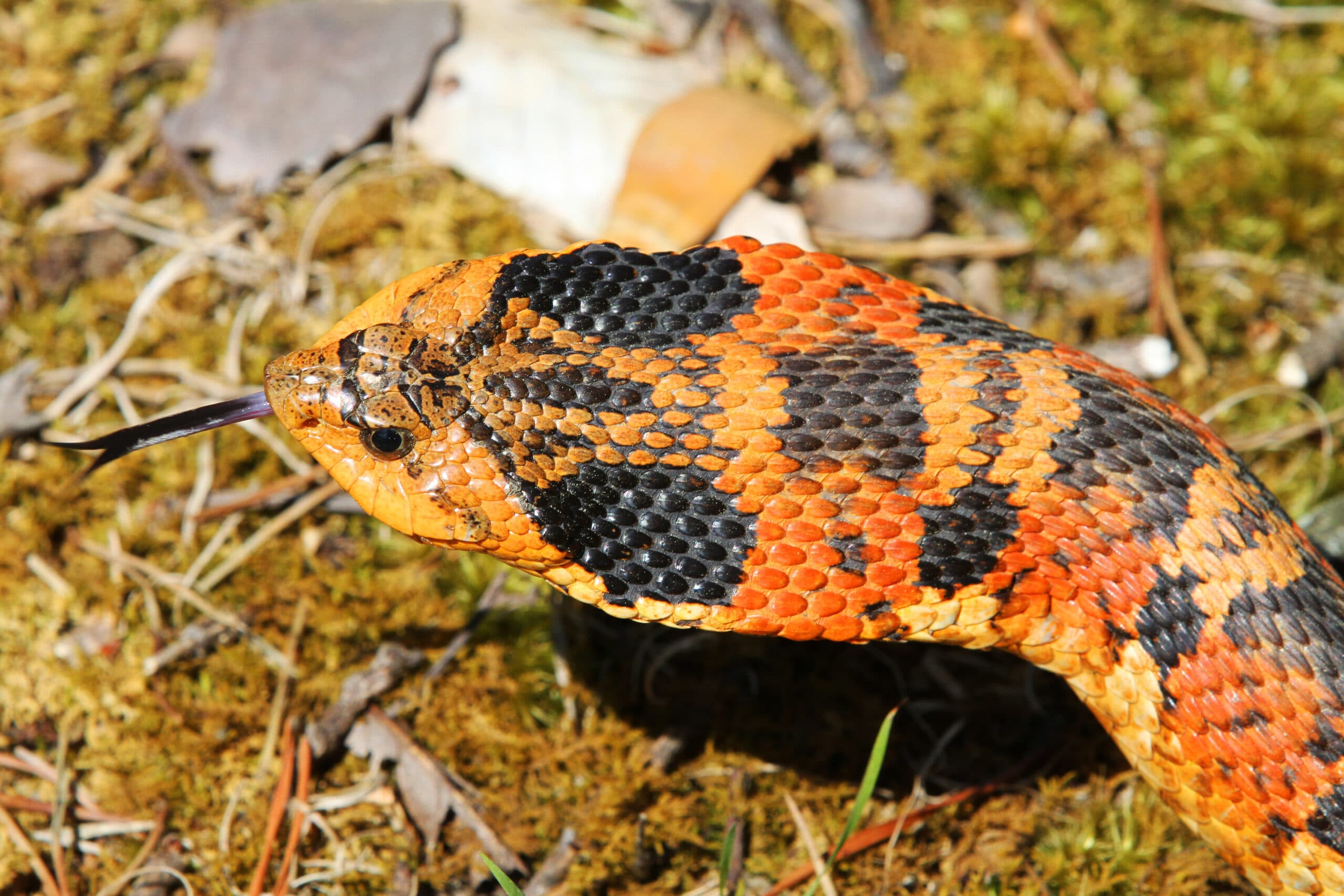
Eastern Hognose Snake with its upturned snout visible among dry leaves in Virginia
Judy Gallagher / Wikimedia Commons / CC BY 2.0
🌐 Read in Language:

⚡ At a Glance

Species profile
Also Known As
Eastern Hog-Nosed Snake; Spreading Adder; Puff Adder
Diet Category
Specialist predator of toads and other small vertebrates
Activity Rhythm
Primarily active by day from spring through autumn, with activity concentrated in mild morning hours during hot weather; overwinters underground.
Wild Lifespan
Often estimated at 8–12 years in the wild; longer lives occur in managed care
Typical Weight
commonly about 100–450 g, depending on length, sex and season
Conservation Status
LC
💡 Key Biological Insight: If its cobra-like bluff fails, an Eastern Hognose Snake may roll onto its back, open its mouth and remain limp as though dead—even rolling back over if turned upright.

🌳 Scientific Taxonomy Hierarchy

Heterodon platirhinos belongs to the family Colubridae, subfamily Dipsadinae, and order Squamata. It is one of several North American hognose snakes in the genus Heterodon. This profile covers the species Heterodon platirhinos and does not combine it with the western hognose snake, southern hognose snake or Malagasy hognose snakes.

KingdomAnimalia
PhylumChordata
ClassReptilia
OrderSquamata
FamilyColubridae
GenusHeterodon
SpeciesHeterodon platirhinos

Distinguishing Anatomical Features

  • ✓The short, broad head ends in a conspicuously upturned scale used like a small shovel. The body is thick for its length and usually patterned with dark blotches on a tan, yellow, gray, orange or reddish ground, although nearly black individuals occur. Two large dark blotches often mark the neck. The belly is generally dark, while the underside of the tail is lighter, a useful distinction from some similar snakes.
  • ✓Upturned rostral scale excavates sandy soil
  • ✓Rear enlarged teeth help subdue inflated toads
  • ✓Mild oral secretion assists prey handling
  • ✓Neck flattening exaggerates apparent size
  • ✓Death-feigning can deter persistent predators
  • ✓Variable color provides camouflage
  • ✓Resistance to toad skin toxins supports dietary specialization

📏 Physical Measurements

Total Lengthusually 20–35 in, with exceptional individuals near 46 in
Body Weightcommonly about 3.5–16 oz
Tail LengthShort tapering tail with a lighter underside than the belly
WingspanNot applicable
Top SpeedNo dependable universal maximumMovement changes with context and conditions.

🎨 Appearance & Distinctive Markings

TanYellowOrangeRedBrownGrayBlackBrownGrayBlack

Skin / Covering: Dry overlapping keeled scales

Sexual Dimorphism: Females average larger and heavier than males. Color and pattern vary too widely for reliable sexing, so external appearance alone should not be used to determine sex.

🗺️ Geographic Distribution & Habitat

The native range covers much of the eastern and central United States, from New England and the Great Lakes west into Minnesota, South Dakota, Nebraska and Kansas, then south through Texas, the Gulf Coast and Florida. In Canada it is restricted mainly to southern Ontario. Country-level mapping greatly overstates its patchy distribution within the two countries.

Dry sandy woodland, pine barrens, oak savanna, prairie, old field, coastal dune, scrub, woodland edge and well-drained sites near wetlands that support amphibian prey.

Country-level distribution map

Native range
FijiTanzaniaWestern SaharaCanada — Native rangeUnited States — Native rangeKazakhstanUzbekistanPapua New GuineaIndonesiaArgentinaChileCongo - KinshasaSomaliaKenyaSudanChadHaitiDominican RepublicRussiaBahamasFalkland IslandsNorwayGreenlandFrench Southern TerritoriesTimor-LesteSouth AfricaLesothoMexicoUruguayBrazilBoliviaPeruColombiaPanamaCosta RicaNicaraguaHondurasEl SalvadorGuatemalaBelizeVenezuelaGuyanaSurinameFranceEcuadorPuerto RicoJamaicaCubaZimbabweBotswanaNamibiaSenegalMaliMauritaniaBeninNigerNigeriaCameroonTogoGhanaCôte d’IvoireGuineaGuinea-BissauLiberiaSierra LeoneBurkina FasoCentral African RepublicCongo - BrazzavilleGabonEquatorial GuineaZambiaMalawiMozambiqueEswatiniAngolaBurundiIsraelLebanonMadagascarPalestinian TerritoriesGambiaTunisiaAlgeriaJordanUnited Arab EmiratesQatarKuwaitIraqOmanVanuatuCambodiaThailandLaosMyanmar (Burma)VietnamNorth KoreaSouth KoreaMongoliaIndiaBangladeshBhutanNepalPakistanAfghanistanTajikistanKyrgyzstanTurkmenistanIranSyriaArmeniaSwedenBelarusUkrainePolandAustriaHungaryMoldovaRomaniaLithuaniaLatviaEstoniaGermanyBulgariaGreeceTürkiyeAlbaniaCroatiaSwitzerlandLuxembourgBelgiumNetherlandsPortugalSpainIrelandNew CaledoniaSolomon IslandsNew ZealandAustraliaSri LankaChinaTaiwanItalyDenmarkUnited KingdomIcelandAzerbaijanGeorgiaPhilippinesMalaysiaBruneiSloveniaFinlandSlovakiaCzechiaEritreaJapanParaguayYemenSaudi ArabiaCyprusMoroccoEgyptLibyaEthiopiaDjiboutiUgandaRwandaBosnia & HerzegovinaNorth MacedoniaSerbiaMontenegroKosovoTrinidad & TobagoSouth Sudan
Highlighted countries are recorded profile locations, not precise biological range boundaries.Map boundaries: Natural Earth

Recorded Native Countries & Territories:

💡 Did You Know?

  • 💡Upturned rostral scale excavates sandy soil
  • 💡Rear enlarged teeth help subdue inflated toads
  • 💡Mild oral secretion assists prey handling
  • 💡Neck flattening exaggerates apparent size
  • 💡Death-feigning can deter persistent predators
  • 💡Variable color provides camouflage
  • 💡Resistance to toad skin toxins supports dietary specialization

🌿 Conservation Status & Threats

IUCN: LC — Least Concern

“The Eastern Hognose Snake is globally assessed as Least Concern because it remains widespread. That category masks regional losses and legal protection in several states and in Canada, where southern Ontario populations are fragmented and vulnerable.”

Population TrendGlobally uncertain; declining or fragmented in several northern and urbanized regions
Wild Population EstimateNo reliable global total; locally secure in large sandy landscapes but sparse or absent from many former sites
CITESNot listed in CITES appendices

⚠️ Major Threats to Eastern Hognose Snake

  • •Loss of sandy open habitat
  • •Wetland loss and prey decline
  • •Road mortality
  • •Deliberate killing
  • •Residential development
  • •Fire suppression and woody succession
  • •Illegal collection
  • •Predation by free-ranging cats

🔄 Life Cycle & Reproduction

Wild vs. Captivity Lifespan Comparison

🌿 In the WildOften estimated at 8–12 years in the wild; longer lives occur in managed care
🏠 In Captivity (with veterinary care)Licensed institutions and experienced legal keepers should use secure enclosures, minimal handling, careful feeding records and veterinary oversight; wild collection should never substitute for captive breeding.
Clutch / Litter SizeUsually 10–30 eggs, with reported clutches ranging roughly from 4 to 69
Incubation / GestationAbout 39–65 days, depending on temperature and moisture
Fledging / WeaningIndependent hatchling about 10–20 cm long
Sexual MaturityOften reached in about 2–3 years, varying with food and climate
Mating SystemInternal fertilization; egg-laying
Nesting / Den TypeShallow chamber in warm loose soil, sand or decaying vegetation

🦅 Behavior & Field Ecology

Specialist predator of toads and other small vertebrates

🌐 Ecological Food Web & Relationships: Eastern Hognose Snakes are important predators of toads and other amphibians, linking wetland breeding systems with dry upland food webs. They are eaten by raptors, larger snakes and mammals. Because they need both prey-rich wetlands and open sandy uplands, their presence reflects a connected landscape rather than a single habitat patch.

Social Group SizeSolitary except during courtship and occasional shared habitat features
Activity RhythmPrimarily active by day from spring through autumn, with activity concentrated in mild morning hours during hot weather; overwinters underground.
Feeding StrategySpecialist predator of toads and other small vertebrates

🥩 Primary Prey & Preferred Diet

✓ American toads✓ Fowler’s toads✓ Frogs✓ Salamanders✓ Lizards✓ Small mammals✓ Bird eggs

📢 Communication & Territorial Signals

  • Tongue-flick scent sampling
  • Pheromones
  • Loud hissing
  • Neck flattening
  • Bluff lunges
  • Death-feigning

🐾 Wild Temperament & Traits

• Secretive• Diurnal• Mostly solitary• Specialized feeder• Dramatic when threatened• Reluctant to bite

🤝 Human Interaction & Pet Advisory

⚠️ Strictly Wild Species
🚫

Can You Keep a Eastern Hognose Snake as a Pet?

Captive-bred hognose snakes are kept by experienced reptile keepers, but this species can be a difficult toad specialist and is not suitable for casual collection from the wild. Laws differ by state and province, and protected populations cannot be collected. Any legal captive animal needs secure escape-proof housing, an appropriate thermal gradient, clean water, veterinary access and a nutritionally sound diet accepted by that individual.

Domestication StatusWild snake; captive lines exist but the species is not domesticated
Danger to HumansLow medical risk; bites are uncommon and serious effects are not expected for most people
Economic & Ecotourism RoleAmphibian population balance, upland-wetland food webs, public education about harmless snakes, and research on toxin resistance and defensive behavior.

⚠️ Behavioral Risk Factors & Wildlife Safety

  • Rear enlarged teeth require prolonged contact to deliver secretion effectively
  • Localized swelling or itching can occur
  • Allergic reactions are possible
  • Misidentification of any wild snake creates avoidable risk

🌐 Ecological Food Web & Relationships

🦅 Natural Predators (5)

Red-Tailed HawkButeo jamaicensis
KingsnakeLampropeltis species
RaccoonProcyon lotor
Red FoxVulpes vulpes
Domestic CatFelis catus

🧬 Related Species (4)

Western Hognose SnakeHeterodon nasicusWestern grassland relative
Southern Hognose SnakeHeterodon simusSmaller southeastern relative
Mexican Hognose SnakeHeterodon kennerlyiSouthwestern relative
Plains Garter SnakeThamnophis radixCo-occurring non-hognose colubrid

Eastern Hognose Snake (Heterodon platirhinos) is a stout, harmless-to-people colubrid of eastern North America. It is best known for flattening its neck, hissing and making closed-mouth strikes before rolling over and feigning death if the bluff fails. Its upturned rostral scale is a digging tool, and its feeding anatomy is specialized for handling toads that inflate themselves in defense. This guide separates well-supported biology from common assumptions and covers identification, range, habitat, diet, behavior, reproduction and conservation.

Identification

The short, broad head ends in a conspicuously upturned scale used like a small shovel. The body is thick for its length and usually patterned with dark blotches on a tan, yellow, gray, orange or reddish ground, although nearly black individuals occur. Two large dark blotches often mark the neck. The belly is generally dark, while the underside of the tail is lighter, a useful distinction from some similar snakes. Females average larger and heavier than males. Color and pattern vary too widely for reliable sexing, so external appearance alone should not be used to determine sex.

Identification should combine body shape, markings, size, voice or movement, and location. One feature by itself can overlap with a related animal, a juvenile, or an individual in unusual light.

Photographs are most useful when they preserve scale and show several diagnostic features. Handling or repositioning a wild eastern hognose snake for identification can cause stress and is unnecessary.

Size and physical adaptations

Eastern Hognose Snake typically measures usually 50–90 cm, with exceptional individuals near 116 cm and weighs commonly about 100–450 g, depending on length, sex and season. Females are typically longer and more robust; recently fed or gravid snakes can be substantially heavier.

Its useful adaptations include upturned rostral scale excavates sandy soil, rear enlarged teeth help subdue inflated toads, mild oral secretion assists prey handling, neck flattening exaggerates apparent size, death-feigning can deter persistent predators, variable color provides camouflage, resistance to toad skin toxins supports dietary specialization. These traits work together in the animal’s normal setting rather than serving as isolated curiosities.

Published measurements may use different methods, life stages or sample locations. Comparing figures responsibly means checking what was measured rather than selecting the largest number available.

Range and distribution

The native range covers much of the eastern and central United States, from New England and the Great Lakes west into Minnesota, South Dakota, Nebraska and Kansas, then south through Texas, the Gulf Coast and Florida. In Canada it is restricted mainly to southern Ontario. Country-level mapping greatly overstates its patchy distribution within the two countries. The native range includes United States, Canada.

A country-level map indicates broad distribution, not continuous occupation. Climate, elevation, water, vegetation, prey, breeding sites, barriers and survey effort all affect where records occur.

Records near the edge of the range deserve careful documentation because they may reflect natural movement, improved survey coverage, accidental transport or a genuine distribution change.

Habitat

Dry sandy woodland, pine barrens, oak savanna, prairie, old field, coastal dune, scrub, woodland edge and well-drained sites near wetlands that support amphibian prey.

Loose soil is essential for burrowing, nesting and winter refuge. Individuals use a mosaic of sunny open ground, leaf litter, shrubs, woodland edges and nearby wetlands where toads breed. Fire suppression, development and dense vegetation can remove the open sandy structure the species needs even when a site still appears wooded. Protecting a population therefore requires the feeding, shelter and breeding features that make a site usable, along with connections that allow movement.

Microhabitat matters. Shade, soil, current, moisture, shelter or host plants can determine whether a small area is usable even when the surrounding landscape appears suitable.

Diet and feeding

Eastern Hognose Snake is a specialist predator of toads and other small vertebrates. Important foods include american toads, fowler’s toads, frogs, salamanders, lizards, small mammals, bird eggs. The snake searches by scent and digs for hidden amphibians. Toads form the core diet in many populations. When a toad inflates, the snake uses rear enlarged teeth to puncture or secure it and delivers a mild Duvernoy-gland secretion that helps immobilize prey. Physiological resistance allows it to eat toads whose skin chemicals deter many predators. Juveniles may take more frogs, salamanders and small reptiles.

Diet changes with age, season, location and food supply. A dramatic prey record does not establish what most individuals eat most of the time; repeated field observations provide a stronger picture.

Feeding opportunities also create risk. An animal focused on prey may be less alert to predators, traffic or people, while contaminated prey can transfer pollutants through the food web.

Behavior and communication

Primarily active by day from spring through autumn, with activity concentrated in mild morning hours during hot weather; overwinters underground. A startled snake usually tries to escape or remain hidden. If pressed, it may flatten its head and neck, hiss loudly and lunge with its mouth closed. Continued harassment can trigger a second display: the snake writhes, releases musk, rolls onto its back and lies limp with its mouth open. These displays are bluffs, not evidence of aggression. The upturned snout also lets the snake bury itself in minutes.

Tongue flicks carry chemical particles to the vomeronasal organ, allowing the snake to locate prey, mates and familiar shelter. Females produce reproductive scent cues. Hissing, body inflation, neck flattening, lunging and death-feigning are visual and acoustic signals directed at predators rather than social communication. Behavior should be interpreted in context: alarm, courtship, feeding and temperature regulation can produce very different actions from the same animal.

Daily schedules are flexible responses, not rigid rules. Weather, breeding condition, disturbance, tides or food can move activity into a different part of the day.

Reproduction and development

Mating occurs mainly in spring and early summer, with autumn mating and sperm storage reported in some populations. Males locate females through chemical trails. Fertilization is internal, and females select warm, loose sandy or loamy soil for egg deposition. Usually 10–30 eggs, with reported clutches ranging roughly from 4 to 69 Eggs are deposited about 10–15 cm below the surface in loose soil or beneath natural cover. Hatchlings emerge in late summer or early autumn, measure about 10–20 cm and must hunt independently. Parental care is not generally recognized, although occasional observations of females near nests should not be taken as routine guarding.

Young animals face different risks and may use different microhabitats or food than adults. Breeding success depends on adult condition, suitable sites and the survival of offspring through vulnerable early stages.

Counts of eggs or young describe reproductive output, not the number expected to reach adulthood. Mortality is normally greatest during eggs, larval or juvenile stages.

Predators and ecological role

Eastern Hognose Snakes are important predators of toads and other amphibians, linking wetland breeding systems with dry upland food webs. They are eaten by raptors, larger snakes and mammals. Because they need both prey-rich wetlands and open sandy uplands, their presence reflects a connected landscape rather than a single habitat patch. Documented or likely predators include Red-Tailed Hawk, Kingsnake, Raccoon, Red Fox, Domestic Cat.

This animal is both a consumer and a food source. Its influence comes through many repeated interactions, so ecological claims should be based on measured populations rather than assumptions drawn from appearance.

Predator and prey relationships differ among places. A species can be ecologically influential without being abundant everywhere, and its role can change across its range.

Relationship with people

This snake benefits people by contributing to balanced amphibian and small-vertebrate food webs. Its defensive theater often causes needless killing because the flattened neck is mistaken for dangerous aggression. Observe from several metres away, keep pets back and let it leave. Landowners can retain sandy openings, native ground cover and wetland connections while reducing road mortality and pesticide use.

Eastern Hognose Snakes are not dangerous in ordinary encounters. They rarely bite defensively and usually strike with the mouth closed. Prolonged chewing can introduce mild secretion and cause localized swelling in sensitive people. If bitten, release the snake without pulling, wash the wound, remove tight jewelry and seek medical advice for spreading swelling, breathing difficulty or allergy symptoms. Never handle a wild snake whose identity is uncertain. Responsible observation means keeping an appropriate distance, avoiding capture or feeding, protecting habitat and following local wildlife or invasive-species guidance.

Wildlife guidance should come from the responsible local agency because collection rules, reporting requests and appropriate responses differ between native and introduced ranges.

Conservation

The Eastern Hognose Snake is globally assessed as Least Concern because it remains widespread. That category masks regional losses and legal protection in several states and in Canada, where southern Ontario populations are fragmented and vulnerable. The reported global trend is Globally uncertain; declining or fragmented in several northern and urbanized regions.

Important pressures include loss of sandy open habitat, wetland loss and prey decline, road mortality, deliberate killing, residential development, fire suppression and woody succession, illegal collection, predation by free-ranging cats. Global status can hide local decline or recovery, so current regional monitoring and habitat management remain necessary.

The most useful conservation action follows the documented pressure. Protecting breeding sites, reducing road deaths or limiting pollutants can require different tools in different populations.

Sources and further reading

❓ Frequently Asked Questions

Answers to frequently asked questions verified against peer-reviewed zoological research.

They have rear enlarged teeth and a mild prey-subduing oral secretion, but they are not medically dangerous in ordinary encounters and rarely bite defensively.