
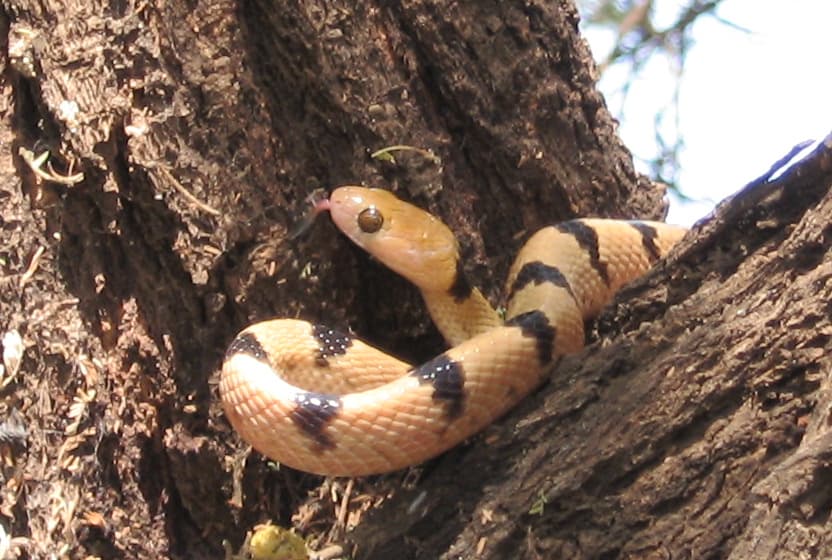
Eastern Tiger Snake (Telescopus semiannulatus) is a slender rear-fanged colubrid of central, eastern and southern Africa. It is unrelated to Australia’s highly venomous tiger snakes. Large eyes, vertical pupils and a bold orange-and-black pattern suit a nocturnal hunter that searches trees, rocks and buildings for lizards, geckos, frogs and small birds. This guide separates well-supported biology from common assumptions and covers identification, range, habitat, diet, behavior, reproduction and conservation.
Identification
The body is orange, reddish brown, yellow-brown or cream with 20–50 dark brown or black saddle-like blotches. The head is broad and distinct from the narrow neck, and the large eyes have vertical pupils. The belly is pale and usually unmarked. Smooth scales and a long tapering body help it move through branches and crevices. Males and females are similar in pattern and general size. Males usually have relatively longer tails, while females may become heavier when carrying eggs.
Identification should combine body shape, markings, size, voice or movement, and location. One feature by itself can overlap with a related animal, a juvenile, or an individual in unusual light.
Photographs are most useful when they preserve scale and show several diagnostic features. Handling or repositioning a wild eastern tiger snake for identification can cause stress and is unnecessary.
Size and physical adaptations
Eastern Tiger Snake typically measures commonly 50–80 cm; large adults near 1 m and weighs generally under 250 g, varying with length and condition. Regional populations vary in average size and number of dark body blotches.
Its useful adaptations include vertical pupils support night vision, large eyes detect prey in low light, slender body climbs shrubs and trees, rear grooved teeth deliver mild venom to prey, bold saddles break up the body outline, slow stalking reduces detection, flexible jaws swallow lizards whole. These traits work together in the animal’s normal setting rather than serving as isolated curiosities.
Published measurements may use different methods, life stages or sample locations. Comparing figures responsibly means checking what was measured rather than selecting the largest number available.
Range and distribution
The species is widespread from parts of central and eastern Africa south through Zambia, Malawi, Mozambique, Zimbabwe, Botswana and northeastern South Africa, with western populations in Angola and Namibia. Taxonomic treatment of the southwestern Damara form varies. The native range includes Angola, Namibia, Botswana, Zimbabwe, South Africa, Zambia, Democratic Republic of the Congo, Republic of the Congo, Malawi, Tanzania, Rwanda, Burundi, Kenya, Eswatini, Mozambique.
A country-level map indicates broad distribution, not continuous occupation. Climate, elevation, water, vegetation, prey, breeding sites, barriers and survey effort all affect where records occur.
Records near the edge of the range deserve careful documentation because they may reflect natural movement, improved survey coverage, accidental transport or a genuine distribution change.
Habitat
Savanna, open woodland, thorn scrub, rocky hills, dry forest, riverine vegetation, farms and buildings near natural cover.
Eastern Tiger Snakes rest by day in rock cracks, hollow wood, bark, roofs or rodent burrows. After dark they climb acacias, walls and shrubs in search of geckos and other resting prey. Their ability to use buildings can bring them near people, but they remain secretive and usually retreat into cover. Protecting a population therefore requires the feeding, shelter and breeding features that make a site usable, along with connections that allow movement.
Microhabitat matters. Shade, soil, current, moisture, shelter or host plants can determine whether a small area is usable even when the surrounding landscape appears suitable.
Diet and feeding
Eastern Tiger Snake is a small-vertebrate predator specializing in lizards. Important foods include geckos, skinks, other lizards, frogs, small birds, nestlings, small rodents. The snake approaches prey slowly at night, then seizes it with small front teeth and works the rear grooved teeth into position. Mild venom helps immobilize lizards and frogs before swallowing. Geckos are frequent prey around trees and buildings; larger adults may also take small birds, nestlings and mice.
Diet changes with age, season, location and food supply. A dramatic prey record does not establish what most individuals eat most of the time; repeated field observations provide a stronger picture.
Feeding opportunities also create risk. An animal focused on prey may be less alert to predators, traffic or people, while contaminated prey can transfer pollutants through the food web.
Behavior and communication
Strictly or strongly nocturnal, sheltering during daylight. Movement is generally slow and deliberate, especially while climbing. A threatened snake may flatten the head, coil, hiss and strike, but escape into a crack or branch is the usual response. It can bite repeatedly if restrained. Because venom delivery requires chewing with rear fangs, serious human envenomation is unlikely but handling is still inappropriate.
Tongue flicks collect prey scent and mate pheromones. Large eyes detect motion in dim light, while the body senses vibrations through branches and ground. Close contact guides courtship. Defensive signals include head flattening, coiling, hissing and short strikes. Behavior should be interpreted in context: alarm, courtship, feeding and temperature regulation can produce very different actions from the same animal.
Daily schedules are flexible responses, not rigid rules. Weather, breeding condition, disturbance, tides or food can move activity into a different part of the day.
Reproduction and development
Courtship follows seasonal warming or rain in many parts of the range. Males follow female scent and align their bodies during mating. A female lays a small clutch in a protected warm cavity and leaves it to develop without further care. Usually 3–8 eggs Embryos develop in leathery eggs hidden in loose soil, a hollow log, rock crack or building crevice. Hatchlings emerge fully independent and begin with tiny geckos, skinks and frogs. They grow through repeated shedding and gain access to larger prey as the head and body enlarge.
Young animals face different risks and may use different microhabitats or food than adults. Breeding success depends on adult condition, suitable sites and the survival of offspring through vulnerable early stages.
Counts of eggs or young describe reproductive output, not the number expected to reach adulthood. Mortality is normally greatest during eggs, larval or juvenile stages.
Predators and ecological role
As a nocturnal predator, this snake controls geckos, skinks, frogs and other small vertebrates that daytime hunters may miss. It transfers energy from arboreal and building-associated prey to raptors, mongooses and larger snakes. Its use of both natural woodland and farms links food webs across habitat edges. Documented or likely predators include Southern Yellow-Billed Hornbill, White-Tailed Mongoose, Secretarybird, Black-Headed Centipede Eater, Human.
This animal is both a consumer and a food source. Its influence comes through many repeated interactions, so ecological claims should be based on measured populations rather than assumptions drawn from appearance.
Predator and prey relationships differ among places. A species can be ecologically influential without being abundant everywhere, and its role can change across its range.
Relationship with people
The species often enters roofs and walls while hunting geckos. Its pattern can cause confusion with more dangerous snakes, so identification should come from a safe photograph and local expert. Keep distance, open an escape path and call a trained remover. Reducing clutter and sealing gaps helps prevent repeat entry.
The Eastern Tiger Snake has rear grooved teeth and mild venom adapted to small prey. Bites are uncommon and serious effects are not expected, but no bite should be dismissed. Wash the wound, remove tight jewelry and seek medical advice, especially for swelling or systemic symptoms. Do not handle, cut or suck the bite. Responsible observation means keeping an appropriate distance, avoiding capture or feeding, protecting habitat and following local wildlife or invasive-species guidance.
Wildlife guidance should come from the responsible local agency because collection rules, reporting requests and appropriate responses differ between native and introduced ranges.
Conservation
The IUCN assesses Telescopus semiannulatus as Least Concern because it is widespread and occupies varied habitats. Local populations can still be affected by persecution, road deaths and habitat clearing. The reported global trend is Generally stable at the broad scale, with local trends poorly documented.
Important pressures include deliberate killing, road mortality, habitat clearing, pesticide exposure, loss of mature trees, pet collection, building renovation without rescue. Global status can hide local decline or recovery, so current regional monitoring and habitat management remain necessary.
The most useful conservation action follows the documented pressure. Protecting breeding sites, reducing road deaths or limiting pollutants can require different tools in different populations.