
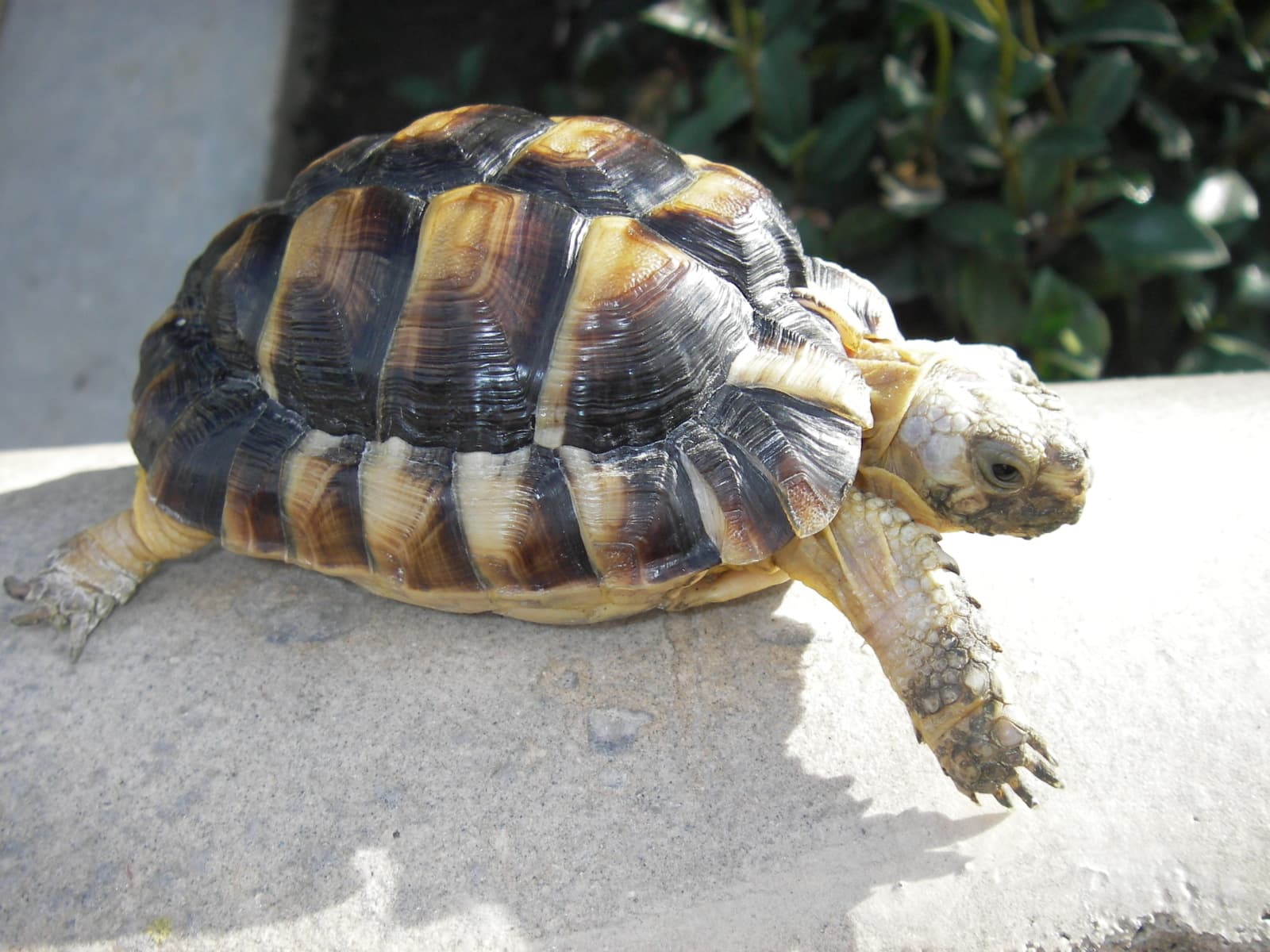
Egyptian Tortoise (Testudo kleinmanni) is a tiny, critically endangered land tortoise of Egypt, Libya and the western Negev. Its pale shell reflects desert heat, while its seasonal routine avoids the hottest and driest months. Habitat conversion and illegal pet collection have erased it from much of its former range. This guide separates well-supported biology from common assumptions and covers identification, range, habitat, diet, behavior, reproduction and conservation.
Identification
The high, oval shell is pale straw, cream or yellow-green, often with small dark marks near the center or edges of the scutes. The plastron is light with paired dark triangles or patches. Forelegs carry large protective scales, the head is small, and the tail lacks the enlarged terminal spur seen in some related tortoises. Females are usually larger and broader. Males have longer, thicker tails and a slightly concave plastron, while females have shorter tails and more space around the rear shell opening.
Identification should combine body shape, markings, size, voice or movement, and location. One feature by itself can overlap with a related animal, a juvenile, or an individual in unusual light.
Photographs are most useful when they preserve scale and show several diagnostic features. Handling or repositioning a wild egyptian tortoise for identification can cause stress and is unnecessary.
Size and physical adaptations
Egyptian Tortoise typically measures adult shell commonly 10–13 cm; large females near 14 cm and weighs roughly 150–400 g, with females usually heavier. Males are among the smallest living tortoises and females average noticeably larger.
Its useful adaptations include pale shell reflects solar heat, burrowing avoids temperature extremes, low profile reduces exposure, seasonal dormancy conserves water, scaly forelegs aid digging, herbivorous diet uses sparse plants, strong shell limits predation. These traits work together in the animal’s normal setting rather than serving as isolated curiosities.
Published measurements may use different methods, life stages or sample locations. Comparing figures responsibly means checking what was measured rather than selecting the largest number available.
Range and distribution
Historically the species occupied Mediterranean coastal deserts from northern Egypt through Libya and east into the western Negev and northern Sinai. It has disappeared from many Egyptian sites and survives in severely fragmented pockets, with its strongest remaining wild populations believed to be in Libya. The native range includes Egypt, Libya, Israel, Palestinian territories.
A country-level map indicates broad distribution, not continuous occupation. Climate, elevation, water, vegetation, prey, breeding sites, barriers and survey effort all affect where records occur.
Records near the edge of the range deserve careful documentation because they may reflect natural movement, improved survey coverage, accidental transport or a genuine distribution change.
Habitat
Coastal sand dunes, gravel plains, semi-desert scrub, dry steppe and low Mediterranean shrubland.
Tortoises forage among sparse shrubs and annual plants during mild weather. They shelter beneath bushes, in rodent burrows or in shallow scrapes when heat, cold or wind becomes severe. Activity peaks after cool-season rains bring fresh growth; prolonged summer heat can lead to months of inactivity underground. Protecting a population therefore requires the feeding, shelter and breeding features that make a site usable, along with connections that allow movement.
Microhabitat matters. Shade, soil, current, moisture, shelter or host plants can determine whether a small area is usable even when the surrounding landscape appears suitable.
Diet and feeding
Egyptian Tortoise is a herbivore feeding on desert annuals and perennial plants. Important foods include grasses, annual herbs, leaves, flowers, succulents, dry plant matter. Wild tortoises browse a varied mixture of grasses, leaves, flowers and soft annual plants. Food availability rises after winter rains and contracts during drought. Their digestive system handles fibrous vegetation, but they still depend on dietary diversity and natural calcium. Fruit and protein-rich foods are not part of the normal wild diet.
Diet changes with age, season, location and food supply. A dramatic prey record does not establish what most individuals eat most of the time; repeated field observations provide a stronger picture.
Feeding opportunities also create risk. An animal focused on prey may be less alert to predators, traffic or people, while contaminated prey can transfer pollutants through the food web.
Behavior and communication
Diurnal in mild seasons, with activity concentrated in cool mornings and late afternoons. Individuals move slowly between feeding patches and familiar refuges. They bask briefly to warm the body, then retreat before sand temperatures become dangerous. During cold, drought or intense summer heat they remain hidden and reduce activity. They are quiet, nonaggressive animals whose survival depends on remaining inconspicuous.
Scent helps adults locate mates and recognize occupied areas. Courtship involves following, circling, shell nudging and occasional biting. Males may produce short vocal sounds while mounting. Visual posture and contact carry most close-range signals; hatchlings receive no parental guidance. Behavior should be interpreted in context: alarm, courtship, feeding and temperature regulation can produce very different actions from the same animal.
Daily schedules are flexible responses, not rigid rules. Weather, breeding condition, disturbance, tides or food can move activity into a different part of the day.
Reproduction and development
Courtship occurs mainly during the mild active season. A male follows and nudges a female before mating. The female digs a flask-shaped nest in firm soil and may lay more than one small clutch in a favorable year. She covers the eggs and provides no further care. Usually 1–5 eggs Embryos develop in hard-shelled eggs buried in warm soil. Incubation temperature influences development and likely sex, as in related tortoises. Hatchlings emerge with a temporary egg tooth, absorb the remaining yolk and begin independent feeding. Growth is slow and maturity takes several years.
Young animals face different risks and may use different microhabitats or food than adults. Breeding success depends on adult condition, suitable sites and the survival of offspring through vulnerable early stages.
Counts of eggs or young describe reproductive output, not the number expected to reach adulthood. Mortality is normally greatest during eggs, larval or juvenile stages.
Predators and ecological role
This small herbivore converts short-lived desert plant growth into food for predators and moves seeds and nutrients through coastal scrub. Its burrowing and shelter use connect it to rodents and desert shrubs. Because it needs intact patches of vegetation and undisturbed sandy soil, its presence signals functioning coastal-desert habitat. Documented or likely predators include Red Fox, Golden Jackal, Egyptian Vulture, Monitor Lizard, Human.
This animal is both a consumer and a food source. Its influence comes through many repeated interactions, so ecological claims should be based on measured populations rather than assumptions drawn from appearance.
Predator and prey relationships differ among places. A species can be ecologically influential without being abundant everywhere, and its role can change across its range.
Relationship with people
Coastal development, agriculture, roads, overgrazing and military activity remove or fragment habitat. Illegal collectors can empty small colonies quickly because the animals are slow and easy to carry. People should never buy an undocumented tortoise, remove one from the wild or publish precise locations of vulnerable colonies. Sightings should be reported to local conservation authorities.
The species poses little direct danger, but handling stresses it and may spread reptile-associated Salmonella. Leave wild individuals where found. If a tortoise is in immediate road danger, contact local wildlife professionals rather than relocating it far from its home range. Wash hands after necessary authorized contact. Responsible observation means keeping an appropriate distance, avoiding capture or feeding, protecting habitat and following local wildlife or invasive-species guidance.
Wildlife guidance should come from the responsible local agency because collection rules, reporting requests and appropriate responses differ between native and introduced ranges.
Conservation
The Egyptian Tortoise is assessed as Critically Endangered. It has lost most of its habitat and much of its former population, and collection for the pet trade remains a serious threat. The reported global trend is Decreasing and severely fragmented.
Important pressures include illegal pet collection, coastal development, agricultural expansion, overgrazing, roads and infrastructure, habitat fragmentation, drought and climate change. Global status can hide local decline or recovery, so current regional monitoring and habitat management remain necessary.
The most useful conservation action follows the documented pressure. Protecting breeding sites, reducing road deaths or limiting pollutants can require different tools in different populations.