
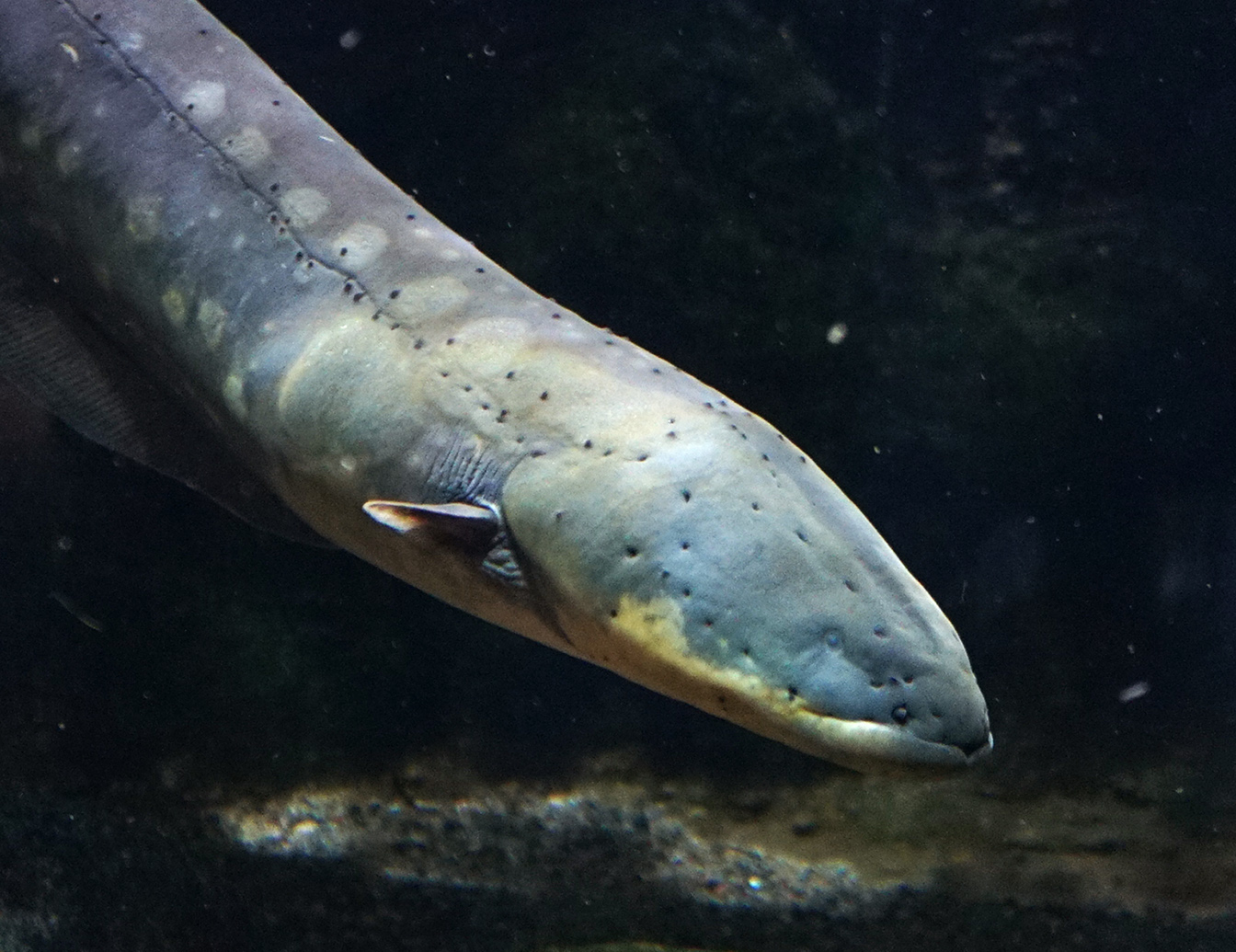
Electric Eel (Electrophorus electricus) is a long-bodied freshwater fish, not a true eel. Modern research recognizes three electric-eel species; this profile concerns Electrophorus electricus in the strict sense, the Guiana Shield species, rather than applying every report from the wider Amazon and Orinoco basins to one animal. This guide separates well-supported biology from common assumptions and covers identification, range, habitat, diet, behavior, reproduction and conservation.
Identification
The body is long, cylindrical and eel-like, with a broad flattened head, small eyes and a wide mouth. It has no dorsal or pelvic fins and only a reduced tail fin. Instead, an extremely long anal fin ripples along most of the underside, moving the fish forward, backward or in place without bending the entire body. Thick scaleless skin is dark gray, brown or blackish above, while the throat and front underside may be yellow or orange. External sex differences are subtle. Mature males are associated with saliva-foam nest building and parental defense, but size and color alone do not reliably determine sex. Many older accounts combined several Electrophorus species, so reported differences require taxonomic caution.
Identification should combine body shape, markings, size, voice or movement, and location. One feature by itself can overlap with a related animal, a juvenile, or an individual in unusual light.
Photographs are most useful when they preserve scale and show several diagnostic features. Handling or repositioning a wild electric eel for identification can cause stress and is unnecessary.
Size and physical adaptations
Electric Eel typically measures up to about 2.5 m in accepted species accounts and weighs up to about 20 kg in FishBase records. The 2.5 m maximum belongs to E. electricus records, but older measurements and much natural-history literature may include other electric-eel species identified before the 2019 revision.
Its useful adaptations include thousands of electrocytes act like biological battery cells, weak pulses support electrolocation and communication, high-voltage volleys stimulate prey muscles, a vascular mouth absorbs atmospheric oxygen, the long anal fin permits precise forward and reverse movement, vital organs are packed into the front fifth of the body, thick skin helps protect against abrasion and current. These traits work together in the animal’s normal setting rather than serving as isolated curiosities.
Published measurements may use different methods, life stages or sample locations. Comparing figures responsibly means checking what was measured rather than selecting the largest number available.
Range and distribution
Restricted in the 2019 revision to upland rivers and streams of the Guiana Shield, especially Guyana and Suriname. Older maps covering most of tropical South America combine three species and should not be used for this taxon. The native range includes Guyana, Suriname.
A country-level map indicates broad distribution, not continuous occupation. Climate, elevation, water, vegetation, prey, breeding sites, barriers and survey effort all affect where records occur.
Records near the edge of the range deserve careful documentation because they may reflect natural movement, improved survey coverage, accidental transport or a genuine distribution change.
Habitat
Freshwater Guiana Shield rivers, streams and connected pools with rocky substrates, rapids or waterfalls and generally oxygenated, low-conductivity water.
Unlike the lowland species E. varii, strict E. electricus is associated with upland shield systems. It uses deeper channels, margins, pools and cover where its flexible electric sense works despite darkness or turbidity. It must rise regularly to gulp air because most oxygen enters through the highly vascular lining of the mouth. Air breathing lets an individual remain in warm or locally oxygen-poor pockets, although its regional habitat is generally more oxygenated than Amazon floodplain systems. Protecting a population therefore requires the feeding, shelter and breeding features that make a site usable, along with connections that allow movement.
Microhabitat matters. Shade, soil, current, moisture, shelter or host plants can determine whether a small area is usable even when the surrounding landscape appears suitable.
Diet and feeding
Electric Eel is a carnivore. Important foods include fish, freshwater crustaceans, aquatic insects, amphibians, small reptiles, occasional small mammals. Low-voltage pulses probe the surroundings. When hidden prey is suspected, two rapid high-voltage pulses can trigger an involuntary twitch, revealing its position. The fish then fires a fast volley that produces sustained muscle contraction and immobilization. A wide mouth creates suction to draw in the stunned animal. Juveniles emphasize invertebrates, while larger individuals can capture fish and other vertebrates.
Diet changes with age, season, location and food supply. A dramatic prey record does not establish what most individuals eat most of the time; repeated field observations provide a stronger picture.
Feeding opportunities also create risk. An animal focused on prey may be less alert to predators, traffic or people, while contaminated prey can transfer pollutants through the food web.
Behavior and communication
Mostly nocturnal or crepuscular, surfacing frequently to breathe and using electricity continuously at low intensity. Electric eels are usually solitary. They move by sending waves along the anal fin, which permits reverse travel while the head remains aimed at a target. Weak electric organ discharges create a field around the body; distortions caused by objects are read through electroreceptors. During defense, an eel may leap partly from the water and press against a partly submerged threat, increasing current through the contact area.
Individuals emit species-typical low-voltage pulses whose frequency and timing vary with sex, condition and social context. Electroreceptors detect those signals as well as distortions caused by objects. This private sensory channel is effective in murky water where vision is limited. High-voltage discharge serves hunting and defense rather than ordinary close-range communication. Behavior should be interpreted in context: alarm, courtship, feeding and temperature regulation can produce very different actions from the same animal.
Daily schedules are flexible responses, not rigid rules. Weather, breeding condition, disturbance, tides or food can move activity into a different part of the day.
Reproduction and development
Available accounts describe dry-season spawning. A male builds a floating nest from saliva foam, attracts a female and guards eggs or larvae as water levels remain low. Details are still incomplete, and some classic observations may include electric-eel populations now assigned to other species. Claims should therefore be treated as a working account for the genus rather than assuming every number applies equally across its range. Historical accounts report roughly 1,200–1,700 eggs Larvae remain in or near the guarded nest and may consume unhatched eggs. Rising rainy-season water reconnects channels and pools, allowing growing juveniles to disperse. Their electrical organs and air-breathing behavior develop as they shift from tiny invertebrates to larger prey. Species-specific age at maturity and wild growth remain poorly documented after the taxonomic split.
Young animals face different risks and may use different microhabitats or food than adults. Breeding success depends on adult condition, suitable sites and the survival of offspring through vulnerable early stages.
Counts of eggs or young describe reproductive output, not the number expected to reach adulthood. Mortality is normally greatest during eggs, larval or juvenile stages.
Predators and ecological role
Electric eels are predators in tropical freshwater food webs, consuming fish and other aquatic or shoreline animals. Their air breathing gives access to habitats that exclude strictly water-breathing fishes, while electrical hunting works in darkness and turbidity. Eggs and young feed predators, but large adults deter many attackers. The species also provides a natural model for research on ion channels, neural control, sensing and bio-inspired power systems. Documented or likely predators include Black Caiman, Green Anaconda, Large Predatory Fish, Humans.
This animal is both a consumer and a food source. Its influence comes through many repeated interactions, so ecological claims should be based on measured populations rather than assumptions drawn from appearance.
Predator and prey relationships differ among places. A species can be ecologically influential without being abundant everywhere, and its role can change across its range.
Relationship with people
Electric eels influenced Alessandro Volta’s thinking about batteries and remain important in neuroscience and bioengineering. Local people know and avoid their shocks, while public aquariums demonstrate electric output safely through insulated equipment. Habitat alteration, mining pollution and water contamination can affect Guiana Shield streams even where global risk appears low. Accurate labeling matters because E. voltai, not E. electricus, holds the measured 860-volt record.
Never enter water to approach, touch, net or corner an electric eel. Repeated shocks can cause muscle loss of control, falls, drowning, cardiac complications or secondary injury. Keep hands and metal tools out of occupied water and leave capture to trained specialists using insulated equipment. Any significant shock, breathing difficulty, chest symptoms or loss of consciousness requires urgent medical evaluation. Responsible observation means keeping an appropriate distance, avoiding capture or feeding, protecting habitat and following local wildlife or invasive-species guidance.
Wildlife guidance should come from the responsible local agency because collection rules, reporting requests and appropriate responses differ between native and introduced ranges.
Conservation
The IUCN assessment lists Electrophorus electricus as Least Concern, but it predates recognition of three species and therefore covered a much wider combined range. The conservation status of the newly restricted Guiana Shield species needs modern reassessment. The reported global trend is Unknown for the newly restricted species.
Important pressures include mining pollution and sediment, water contamination, dam and channel alteration, riparian forest loss, collection and persecution, taxonomic uncertainty masking local trends. Global status can hide local decline or recovery, so current regional monitoring and habitat management remain necessary.
The most useful conservation action follows the documented pressure. Protecting breeding sites, reducing road deaths or limiting pollutants can require different tools in different populations.