
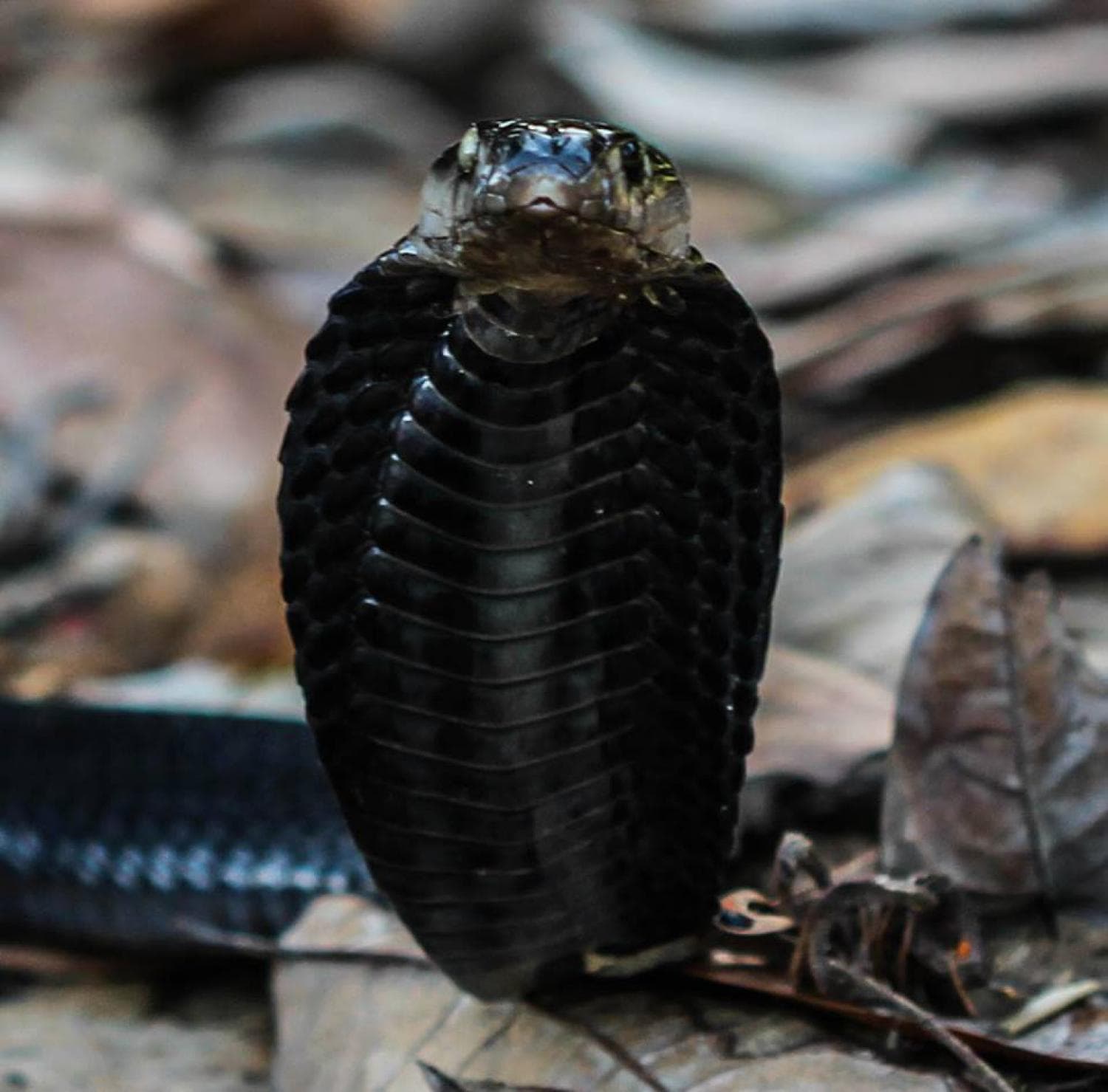
Equatorial Spitting Cobra (Naja sumatrana) is a highly venomous cobra of the Malay Peninsula, Sumatra, Borneo and nearby islands. It can bite, but its best-known defense is projecting venom from specialized fang openings toward the face of a threat. The snake lives in forests, wetlands, plantations and cities, where frogs and rodents provide food. This guide separates well-supported biology from common assumptions and covers identification, range, habitat, diet, behavior, reproduction and conservation.
Identification
This is a stout, medium-sized cobra with a short rounded snout and an expandable neck hood. Many adults are glossy black or dark brown, especially around Singapore, Sumatra and Borneo; some populations are yellowish, golden or pale brown. The underside may be lighter and the throat can show faint bands. Juveniles often carry more obvious patterning. Males and females overlap greatly in color and body size. Mature males may have relatively longer tails, while females become heavier when carrying eggs.
Identification should combine body shape, markings, size, voice or movement, and location. One feature by itself can overlap with a related animal, a juvenile, or an individual in unusual light.
Photographs are most useful when they preserve scale and show several diagnostic features. Handling or repositioning a wild equatorial spitting cobra for identification can cause stress and is unnecessary.
Size and physical adaptations
Equatorial Spitting Cobra typically measures commonly 0.9–1.2 m; large individuals approach 1.5 m and weighs often about 0.5–1.5 kg depending on length and condition. Regional color varies more conspicuously than average adult size.
Its useful adaptations include forward-facing fang openings spray venom, expandable hood warns predators, venom immobilizes vertebrate prey, large nostrils support active scenting, dark color camouflages shaded ground, nocturnal activity reduces heat exposure, strong body enters burrows and drains. These traits work together in the animal’s normal setting rather than serving as isolated curiosities.
Published measurements may use different methods, life stages or sample locations. Comparing figures responsibly means checking what was measured rather than selecting the largest number available.
Range and distribution
The species occurs in southern Thailand, Peninsular Malaysia, Singapore, Sumatra, Borneo, Bangka, Belitung and nearby islands, plus Palawan and associated western Philippine islands. Distribution limits overlap other Asian cobras, making location and expert identification important. The native range includes Thailand, Malaysia, Singapore, Brunei, Indonesia, Philippines.
A country-level map indicates broad distribution, not continuous occupation. Climate, elevation, water, vegetation, prey, breeding sites, barriers and survey effort all affect where records occur.
Records near the edge of the range deserve careful documentation because they may reflect natural movement, improved survey coverage, accidental transport or a genuine distribution change.
Habitat
Lowland rainforest, swamp forest, mangrove edge, plantations, farms, gardens, drains, parks and humid urban neighborhoods.
The cobra shelters in rodent burrows, root cavities, culverts, drains, rubbish piles and dense vegetation. It forages mostly at ground level but can climb. In cities and plantations, rodents and frogs draw it toward buildings and waterways. Daytime refuge use reduces exposure to heat and people. Protecting a population therefore requires the feeding, shelter and breeding features that make a site usable, along with connections that allow movement.
Microhabitat matters. Shade, soil, current, moisture, shelter or host plants can determine whether a small area is usable even when the surrounding landscape appears suitable.
Diet and feeding
Equatorial Spitting Cobra is a generalist predator of small vertebrates. Important foods include rodents, frogs, toads, lizards, other snakes, birds, eggs. The cobra searches actively after dusk, following chemical trails into burrows, drains and vegetation. It bites prey and uses venom to stop movement before swallowing head-first. Rodents and amphibians are major foods, while lizards, snakes, birds and eggs add variety. Young cobras begin with small frogs and reptiles.
Diet changes with age, season, location and food supply. A dramatic prey record does not establish what most individuals eat most of the time; repeated field observations provide a stronger picture.
Feeding opportunities also create risk. An animal focused on prey may be less alert to predators, traffic or people, while contaminated prey can transfer pollutants through the food web.
Behavior and communication
Primarily nocturnal and crepuscular, with occasional daytime movement after rain or disturbance. An undisturbed cobra usually escapes into cover. If cornered, it lifts the forebody, spreads its hood and tracks the threat. It may eject repeated streams of venom toward the eyes from more than a body length away, then bite if contact continues. Spitting creates distance and is not evidence that the snake is pursuing people.
Tongue flicks sample prey scent and mate pheromones through the vomeronasal organ. Vision detects movement and helps aim defensive venom toward the face. Ground vibrations warn of approaching animals. Hissing, an upright hood and repeated head tracking form a graded defensive display. Behavior should be interpreted in context: alarm, courtship, feeding and temperature regulation can produce very different actions from the same animal.
Daily schedules are flexible responses, not rigid rules. Weather, breeding condition, disturbance, tides or food can move activity into a different part of the day.
Reproduction and development
Mating timing varies with monsoon cycles and local climate. Males follow female scent and may compete for access. The female deposits eggs in a warm protected cavity where humidity remains high enough for development. She provides no food to the hatchlings. Usually about 10–20 eggs Embryos develop in leathery eggs within a burrow, hollow log or secluded structure. Hatchlings emerge independent with functional venom systems and can display, spit and bite. They begin with small frogs and lizards, growing rapidly when prey and warm humid conditions are available.
Young animals face different risks and may use different microhabitats or food than adults. Breeding success depends on adult condition, suitable sites and the survival of offspring through vulnerable early stages.
Counts of eggs or young describe reproductive output, not the number expected to reach adulthood. Mortality is normally greatest during eggs, larval or juvenile stages.
Predators and ecological role
Equatorial Spitting Cobras regulate rodents, amphibians and other small vertebrates across forest and urban-edge food webs. They in turn feed king cobras, raptors, monitor lizards and mammalian predators. Their ability to live in altered landscapes makes safe coexistence, rodent management and public education especially important. Documented or likely predators include King Cobra, Malayan Water Monitor, Crested Serpent Eagle, Yellow-Throated Marten, Human.
This animal is both a consumer and a food source. Its influence comes through many repeated interactions, so ecological claims should be based on measured populations rather than assumptions drawn from appearance.
Predator and prey relationships differ among places. A species can be ecologically influential without being abundant everywhere, and its role can change across its range.
Relationship with people
Encounters occur in gardens, drains, farms and buildings where prey and shelter are available. Keep people and pets indoors, stay several metres away and call trained wildlife responders. Never corner, spray, throw objects at or attempt to capture the snake. Eye protection matters for professionals because venom can be projected without a bite.
A bite requires immediate hospital treatment because venom can cause paralysis and respiratory failure. Spat venom in the eyes is also urgent: rinse continuously with large amounts of clean water or saline for at least 15–20 minutes, remove contact lenses and obtain medical care. Do not rub the eyes, cut or suck a bite, or apply a tight tourniquet. Responsible observation means keeping an appropriate distance, avoiding capture or feeding, protecting habitat and following local wildlife or invasive-species guidance.
Wildlife guidance should come from the responsible local agency because collection rules, reporting requests and appropriate responses differ between native and introduced ranges.
Conservation
The IUCN assesses Naja sumatrana as Least Concern across its broad range. Local populations still face road mortality, persecution, habitat loss and capture for trade. The reported global trend is Not well quantified; local declines may occur in heavily developed landscapes.
Important pressures include deliberate killing, road mortality, deforestation, illegal collection, drain entrapment, pesticide exposure, wetland loss. Global status can hide local decline or recovery, so current regional monitoring and habitat management remain necessary.
The most useful conservation action follows the documented pressure. Protecting breeding sites, reducing road deaths or limiting pollutants can require different tools in different populations.