
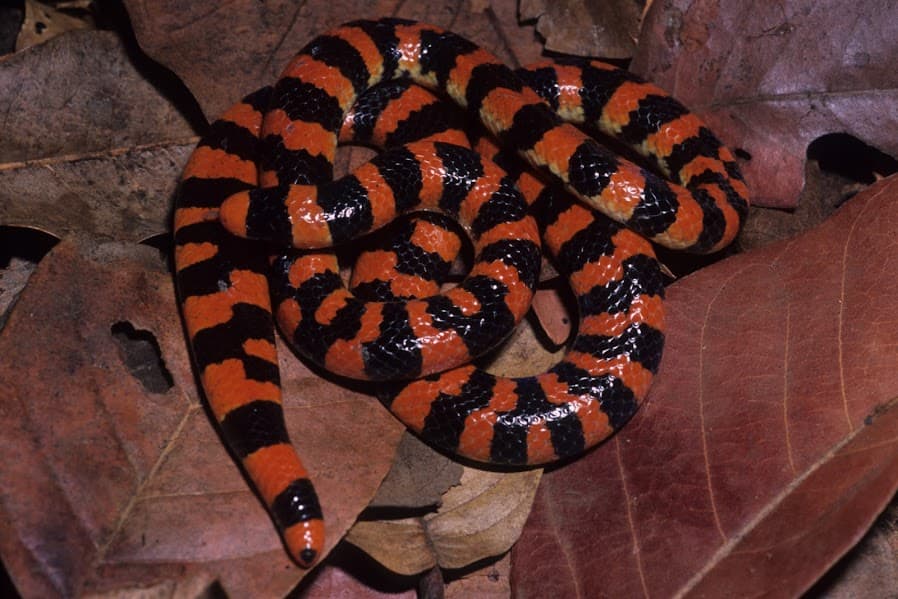
False Coral Snake (Anilius scytale) is the common-name scope used here for Anilius scytale, the red pipe snake. It is a nonvenomous, mostly underground species from the Amazon basin and Trinidad. Its bright rings resemble coral-snake warning colors, but it belongs to the ancient snake family Aniliidae and hunts elongated burrowing vertebrates. This guide separates well-supported biology from common assumptions and covers identification, range, habitat, diet, behavior, reproduction and conservation.
Identification
The body is cylindrical and nearly uniform in thickness, with glossy smooth scales arranged in alternating red or orange and black rings. Pale cream marks may edge some bands. The head is small, rounded and barely wider than the neck, with tiny eyes. The short blunt tail can resemble the head, inspiring the misleading two-headed-snake name. Females generally grow larger and more robust. Males have relatively longer tails and different scale counts around the vent, but color pattern is not a reliable sex indicator.
Identification should combine body shape, markings, size, voice or movement, and location. One feature by itself can overlap with a related animal, a juvenile, or an individual in unusual light.
Photographs are most useful when they preserve scale and show several diagnostic features. Handling or repositioning a wild false coral snake for identification can cause stress and is unnecessary.
Size and physical adaptations
False Coral Snake typically measures commonly 50–80 cm; large females may approach 1 m and weighs often roughly 200–600 g depending on length and condition. The cylindrical body can look heavier than that of a similarly long surface-active snake.
Its useful adaptations include cylindrical body pushes through soil, wedge-shaped skull supports burrowing, tiny eyes suit underground life, short blunt tail distracts predators, bright rings mimic dangerous coral snakes, strong body subdues elongated prey, smooth scales reduce friction. These traits work together in the animal’s normal setting rather than serving as isolated curiosities.
Published measurements may use different methods, life stages or sample locations. Comparing figures responsibly means checking what was measured rather than selecting the largest number available.
Range and distribution
The species occurs through much of lowland Amazonia and the Guianas, including Brazil, Colombia, Ecuador, Peru, Bolivia, Guyana, Suriname and French Guiana, with an isolated population on Trinidad. Venezuelan records may refer to the related Anilius phelpsorum under newer treatments. The native range includes Brazil, Colombia, Ecuador, Peru, Bolivia, Guyana, Suriname, French Guiana, Trinidad and Tobago.
A country-level map indicates broad distribution, not continuous occupation. Climate, elevation, water, vegetation, prey, breeding sites, barriers and survey effort all affect where records occur.
Records near the edge of the range deserve careful documentation because they may reflect natural movement, improved survey coverage, accidental transport or a genuine distribution change.
Habitat
Lowland rainforest, seasonally flooded forest, swamp edge, riverbank, wet soil, leaf litter and disturbed humid ground.
False Coral Snakes spend most time below leaf litter, inside loose soil, beneath logs or in burrows made by other animals. They surface mainly at night or after heavy rain and can enter shallow water. Moist ground is essential because their fossorial body is poorly suited to prolonged exposure in hot dry conditions. Protecting a population therefore requires the feeding, shelter and breeding features that make a site usable, along with connections that allow movement.
Microhabitat matters. Shade, soil, current, moisture, shelter or host plants can determine whether a small area is usable even when the surrounding landscape appears suitable.
Diet and feeding
False Coral Snake is a specialist predator of elongated fossorial and aquatic vertebrates. Important foods include caecilians, eels, swamp eels, amphisbaenians, small snakes, legless lizards, frogs. The snake searches underground and along wet margins using smell and touch. It seizes long-bodied prey such as caecilians, eels, amphisbaenians and small snakes, restraining them with muscular coils or the jaws before swallowing. Its small head can follow prey through narrow tunnels inaccessible to many predators.
Diet changes with age, season, location and food supply. A dramatic prey record does not establish what most individuals eat most of the time; repeated field observations provide a stronger picture.
Feeding opportunities also create risk. An animal focused on prey may be less alert to predators, traffic or people, while contaminated prey can transfer pollutants through the food web.
Behavior and communication
Mostly nocturnal and fossorial, with surface activity after rain or flooding. A disturbed individual rarely attacks. It may hide the head beneath a coil, raise and wave the short tail, release musk or roll the body. The tail-first display can confuse a predator about which end is vulnerable. Movement above ground is slow and awkward compared with its efficient pushing through damp soil.
Chemical sensing guides prey searches and mate location in dark tunnels. The body detects soil and water vibration, while small eyes register light and nearby movement at the surface. Close tactile contact coordinates courtship. Defensive communication relies on bold rings, musking and tail presentation. Behavior should be interpreted in context: alarm, courtship, feeding and temperature regulation can produce very different actions from the same animal.
Daily schedules are flexible responses, not rigid rules. Weather, breeding condition, disturbance, tides or food can move activity into a different part of the day.
Reproduction and development
Little is documented in the wild. Males likely follow chemical trails to females during wet seasonal conditions. Fertilization is internal, and the female retains developing embryos rather than laying a nest of eggs. Birth timing is expected to coincide with humid periods and abundant small prey. Usually about 6–15 live young; reports vary Young are born alive and receive no parental care. Neonates already have the cylindrical burrowing form and bright ringed pattern. They move into loose soil and litter, taking tiny caecilians, eels or other elongate vertebrates as available. Growth and maturity remain poorly studied.
Young animals face different risks and may use different microhabitats or food than adults. Breeding success depends on adult condition, suitable sites and the survival of offspring through vulnerable early stages.
Counts of eggs or young describe reproductive output, not the number expected to reach adulthood. Mortality is normally greatest during eggs, larval or juvenile stages.
Predators and ecological role
The species is a specialized predator within underground and wetland food webs. By eating caecilians, eels, amphisbaenians and small snakes, it reaches prey that many surface predators cannot. It feeds larger snakes, mammals and birds when exposed after rain, linking hidden soil communities with above-ground ecosystems. Documented or likely predators include White Hawk, Tayra, Black Caiman, Boa Constrictor, Human.
This animal is both a consumer and a food source. Its influence comes through many repeated interactions, so ecological claims should be based on measured populations rather than assumptions drawn from appearance.
Predator and prey relationships differ among places. A species can be ecologically influential without being abundant everywhere, and its role can change across its range.
Relationship with people
People usually encounter this snake after rain, during digging or beneath debris. Its red-and-black pattern often causes unnecessary killing. Do not rely on color rhymes to identify tropical snakes; many species vary. Observe from a distance, keep hands away and ask a local expert or wildlife responder for identification.
Anilius scytale is nonvenomous and generally reluctant to bite, but wild animals should not be handled. If an accidental bite breaks skin, wash it and monitor for infection. Return displaced individuals only with expert guidance because moving a soil-specialist snake into dry or unsuitable ground can be fatal. Responsible observation means keeping an appropriate distance, avoiding capture or feeding, protecting habitat and following local wildlife or invasive-species guidance.
Wildlife guidance should come from the responsible local agency because collection rules, reporting requests and appropriate responses differ between native and introduced ranges.
Conservation
The IUCN assesses Anilius scytale as Least Concern because it has a wide range and occurs in protected areas. Its hidden habits make local trends hard to measure, and forest loss, drainage and persecution can still remove populations. The reported global trend is Presumed broadly stable, with local trends poorly known.
Important pressures include deforestation, wetland drainage, soil compaction, road mortality after rain, deliberate killing, mining, water pollution. Global status can hide local decline or recovery, so current regional monitoring and habitat management remain necessary.
The most useful conservation action follows the documented pressure. Protecting breeding sites, reducing road deaths or limiting pollutants can require different tools in different populations.