
Home/Animals/Reptilia/Fer-de-Lance Snake
Species profileIUCN: NE

Fer-de-Lance Snake

Bothrops asper

A large tropical pit viper that waits among leaf litter and detects warm prey with heat-sensitive facial pits.

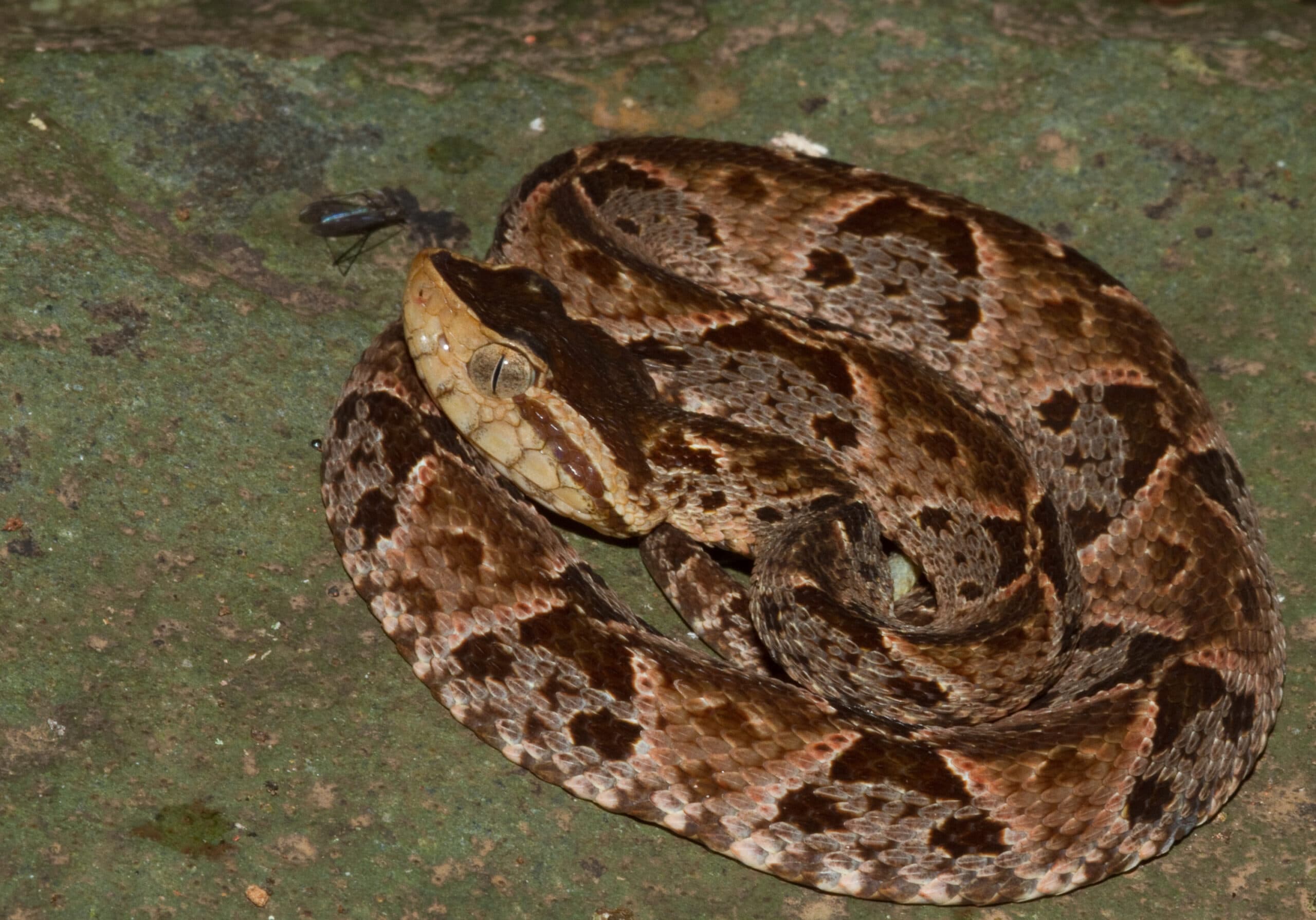
Bothrops asper coiled on leaf litter in Panama with dark triangular side markings
Brian Gratwicke / Wikimedia Commons / CC BY 2.0
๐ŸŒ Read in Language:

โšก At a Glance

Species profile
Also Known As
Terciopelo; Central American Lancehead; Barba Amarilla
Diet Category
Ambush predator whose diet shifts from ectotherms to mammals with age
Activity Rhythm
Mostly nocturnal and crepuscular, with activity increasing after rain and in warm humid conditions.
Wild Lifespan
Likely 15โ€“20 years in managed care; wild lifespan is poorly quantified
Typical Weight
often 1โ€“3 kg; exceptional females may exceed 5 kg
Conservation Status
NE
๐Ÿ’ก Key Biological Insight: Young Bothrops asper may wiggle a bright tail tip like a caterpillar to lure frogs and lizards within striking range.

๐ŸŒณ Scientific Taxonomy Hierarchy

Bothrops asper is a full species in Viperidae and the pit-viper subfamily Crotalinae. It is distinct from the common lancehead Bothrops atrox and the true Martinique lancehead Bothrops lanceolatus. Because the common name fer-de-lance is ambiguous, scientific names and location are essential for accurate identification.

KingdomAnimalia
PhylumChordata
ClassReptilia
OrderSquamata
FamilyViperidae
GenusBothrops
SpeciesBothrops asper

Distinguishing Anatomical Features

  • โœ“The heavy body has alternating dark triangular or X-shaped side blotches on a tan, olive, brown or gray ground color. A broad, spear-shaped head is sharply distinct from the neck, with a pale or yellowish lower jaw and a dark stripe behind the eye. The pupils are vertical and a deep heat-sensing pit lies between each eye and nostril.
  • โœ“Heat pits detect warm prey
  • โœ“Hinged fangs fold against the palate
  • โœ“Cryptic leaf-litter pattern
  • โœ“Wide gape takes bulky mammals
  • โœ“Juvenile tail lure attracts frogs and lizards
  • โœ“Large venom glands subdue prey
  • โœ“Strong swimming crosses streams

๐Ÿ“ Physical Measurements

Total Lengthcommonly 4โ€“6 ft; large females exceed 6.6 ft and may approach 8.2 ft
Body Weightoften 2.2โ€“6.6 lb; exceptional females may exceed 11 lb
Tail LengthModerately short; juveniles often have a contrasting yellow or greenish tip
WingspanNot applicable
Top SpeedNo dependable universal maximumMovement changes with context and conditions.

๐ŸŽจ Appearance & Distinctive Markings

BrownTanOliveGrayBlackYellowTanBlackYellow

Skin / Covering: Strongly keeled scales

Sexual Dimorphism: Females grow substantially longer and heavier than males and have proportionally shorter tails. Adult males remain slimmer and may show stronger tail contrast.

๐Ÿ—บ๏ธ Geographic Distribution & Habitat

Bothrops asper ranges from eastern and southern Mexico through Belize and Central America to western and northern Colombia and western Ecuador. It occurs mainly in humid lowlands and foothills, with local records to roughly 1,500 m. Similar South American lanceheads outside this range may be other species.

Tropical rainforest, wet forest edge, plantations, farms, river valleys, secondary growth, pasture margins and humid lowland settlements.

Country-level distribution map

Native range
FijiTanzaniaWestern SaharaCanadaUnited StatesKazakhstanUzbekistanPapua New GuineaIndonesiaArgentinaChileCongo - KinshasaSomaliaKenyaSudanChadHaitiDominican RepublicRussiaBahamasFalkland IslandsNorwayGreenlandFrench Southern TerritoriesTimor-LesteSouth AfricaLesothoMexico โ€” Native rangeUruguayBrazilBoliviaPeruColombia โ€” Native rangePanama โ€” Native rangeCosta Rica โ€” Native rangeNicaragua โ€” Native rangeHonduras โ€” Native rangeEl Salvador โ€” Native rangeGuatemala โ€” Native rangeBelize โ€” Native rangeVenezuelaGuyanaSurinameFranceEcuador โ€” Native rangePuerto RicoJamaicaCubaZimbabweBotswanaNamibiaSenegalMaliMauritaniaBeninNigerNigeriaCameroonTogoGhanaCรดte dโ€™IvoireGuineaGuinea-BissauLiberiaSierra LeoneBurkina FasoCentral African RepublicCongo - BrazzavilleGabonEquatorial GuineaZambiaMalawiMozambiqueEswatiniAngolaBurundiIsraelLebanonMadagascarPalestinian TerritoriesGambiaTunisiaAlgeriaJordanUnited Arab EmiratesQatarKuwaitIraqOmanVanuatuCambodiaThailandLaosMyanmar (Burma)VietnamNorth KoreaSouth KoreaMongoliaIndiaBangladeshBhutanNepalPakistanAfghanistanTajikistanKyrgyzstanTurkmenistanIranSyriaArmeniaSwedenBelarusUkrainePolandAustriaHungaryMoldovaRomaniaLithuaniaLatviaEstoniaGermanyBulgariaGreeceTรผrkiyeAlbaniaCroatiaSwitzerlandLuxembourgBelgiumNetherlandsPortugalSpainIrelandNew CaledoniaSolomon IslandsNew ZealandAustraliaSri LankaChinaTaiwanItalyDenmarkUnited KingdomIcelandAzerbaijanGeorgiaPhilippinesMalaysiaBruneiSloveniaFinlandSlovakiaCzechiaEritreaJapanParaguayYemenSaudi ArabiaCyprusMoroccoEgyptLibyaEthiopiaDjiboutiUgandaRwandaBosnia & HerzegovinaNorth MacedoniaSerbiaMontenegroKosovoTrinidad & TobagoSouth Sudan
Highlighted countries are recorded profile locations, not precise biological range boundaries.Map boundaries: Natural Earth

๐Ÿ’ก Did You Know?

  • ๐Ÿ’กHeat pits detect warm prey
  • ๐Ÿ’กHinged fangs fold against the palate
  • ๐Ÿ’กCryptic leaf-litter pattern
  • ๐Ÿ’กWide gape takes bulky mammals
  • ๐Ÿ’กJuvenile tail lure attracts frogs and lizards
  • ๐Ÿ’กLarge venom glands subdue prey
  • ๐Ÿ’กStrong swimming crosses streams

๐ŸŒฟ Conservation Status & Threats

IUCN: NE โ€” NE

โ€œBothrops asper lacks a current global IUCN category used here. It remains widespread and locally common, but habitat loss, road mortality and deliberate killing affect populations. Regional assessments may differ.โ€

Population TrendUnknown globally and variable by region
Wild Population EstimateNo reliable global estimate; common in many suitable lowland habitats
CITESNot listed

โš ๏ธ Major Threats to Fer-de-Lance Snake

  • โ€ขDeliberate killing
  • โ€ขRoad mortality
  • โ€ขDeforestation
  • โ€ขAgricultural chemicals
  • โ€ขIllegal collection
  • โ€ขWetland drainage
  • โ€ขClimate-driven habitat change

๐Ÿ”„ Life Cycle & Reproduction

Wild vs. Captivity Lifespan Comparison

๐ŸŒฟ In the WildLikely 15โ€“20 years in managed care; wild lifespan is poorly quantified
๐Ÿ  In Captivity (with veterinary care)Only licensed venom research, conservation or professional zoo facilities should maintain this species.
Clutch / Litter SizeCommonly 10โ€“40 live young; exceptional litters can approach 80โ€“90
Incubation / GestationNo external incubation; gestation lasts roughly 6โ€“8 months
Fledging / WeaningIndependent live-born neonate roughly 25โ€“35 cm long
Sexual MaturityOften 2โ€“4 years, with females maturing later and larger
Mating SystemInternal fertilization; live-bearing
Nesting / Den TypeNo nest; females give birth in sheltered ground-level sites

๐Ÿฆ… Behavior & Field Ecology

Ambush predator whose diet shifts from ectotherms to mammals with age

๐ŸŒ Ecological Food Web & Relationships: Bothrops asper is a major predator of tropical rodents and other small vertebrates. Juveniles connect amphibian and reptile prey to higher trophic levels, while adults affect mammal populations in forests and farms. The snake itself feeds raptors, mustelids, opossums and other predators, and its abundance makes it ecologically influential.

Social Group SizeSolitary except during mating and occasional aggregations in favorable refuge
Activity RhythmMostly nocturnal and crepuscular, with activity increasing after rain and in warm humid conditions.
Feeding StrategyAmbush predator whose diet shifts from ectotherms to mammals with age

๐Ÿฅฉ Primary Prey & Preferred Diet

โœ“ Rodentsโœ“ Small mammalsโœ“ Frogsโœ“ Lizardsโœ“ Birdsโœ“ Other snakesโœ“ Crayfish

๐Ÿ“ข Communication & Territorial Signals

  • Tongue-flick chemoreception
  • Pheromones
  • Infrared sensing
  • Vision
  • Ground vibration
  • Tail vibration

๐Ÿพ Wild Temperament & Traits

โ€ข Camouflagedโ€ข Nocturnalโ€ข Ambush-orientedโ€ข Defensive at close rangeโ€ข Mostly solitaryโ€ข Highly venomous

๐Ÿค Human Interaction & Pet Advisory

โš ๏ธ Strictly Wild Species
๐Ÿšซ

Can You Keep a Fer-de-Lance Snake as a Pet?

Bothrops asper is unsuitable for private pet keeping. Safe institutional care requires permits, secure double-containment, trained teams, bite protocols, regional antivenom access and specialist veterinary support. Wild collection risks both conservation harm and fatal exposure during capture and transport.

Domestication StatusWild venomous species; not domesticated
Danger to HumansVery high medical risk from destructive hemotoxic and proteolytic venom
Economic & Ecotourism RoleAn important controller of tropical rodents, a medically significant species that drives antivenom research and a powerful example of predator adaptation in humid forests.

โš ๏ธ Behavioral Risk Factors & Wildlife Safety

  • Venom disrupts clotting and damages tissue
  • Large females deliver substantial venom
  • Camouflage allows accidental close approach
  • Strikes are rapid and far-reaching
  • Delayed antivenom raises complication risk

๐ŸŒ Ecological Food Web & Relationships

๐Ÿฆ… Natural Predators (5)

Black Hawk-EagleSpizaetus tyrannus
TayraEira barbara
Central American OpossumDidelphis marsupialis
King SnakeLampropeltis triangulum
HumanHomo sapiens

๐Ÿงฌ Related Species (4)

Common LanceheadBothrops atroxFrequently confused Amazonian relative
Martinique LanceheadBothrops lanceolatusSpecies properly associated with the name fer-de-lance
Yellow-Blotched Palm Pit ViperBothriechis auriferArboreal pit-viper relative
BushmasterLachesis stenophrysLarge regional pit viper

Fer-de-Lance Snake (Bothrops asper) is the widely used English name here for Bothrops asper, more precisely called the terciopelo or Central American lancehead. โ€œFer-de-lanceโ€ is applied inconsistently to several American pit vipers, so this profile is species-specific. Bothrops asper is a medically important ambush predator from Mexico through Central America into northwestern South America. This guide separates well-supported biology from common assumptions and covers identification, range, habitat, diet, behavior, reproduction and conservation.

Identification

The heavy body has alternating dark triangular or X-shaped side blotches on a tan, olive, brown or gray ground color. A broad, spear-shaped head is sharply distinct from the neck, with a pale or yellowish lower jaw and a dark stripe behind the eye. The pupils are vertical and a deep heat-sensing pit lies between each eye and nostril. Females grow substantially longer and heavier than males and have proportionally shorter tails. Adult males remain slimmer and may show stronger tail contrast.

Identification should combine body shape, markings, size, voice or movement, and location. One feature by itself can overlap with a related animal, a juvenile, or an individual in unusual light.

Photographs are most useful when they preserve scale and show several diagnostic features. Handling or repositioning a wild fer-de-lance snake for identification can cause stress and is unnecessary.

Size and physical adaptations

Fer-de-Lance Snake typically measures commonly 1.2โ€“1.8 m; large females exceed 2 m and may approach 2.5 m and weighs often 1โ€“3 kg; exceptional females may exceed 5 kg. Females account for nearly all of the largest records and can be several times heavier than adult males.

Its useful adaptations include heat pits detect warm prey, hinged fangs fold against the palate, cryptic leaf-litter pattern, wide gape takes bulky mammals, juvenile tail lure attracts frogs and lizards, large venom glands subdue prey, strong swimming crosses streams. These traits work together in the animal’s normal setting rather than serving as isolated curiosities.

Published measurements may use different methods, life stages or sample locations. Comparing figures responsibly means checking what was measured rather than selecting the largest number available.

Range and distribution

Bothrops asper ranges from eastern and southern Mexico through Belize and Central America to western and northern Colombia and western Ecuador. It occurs mainly in humid lowlands and foothills, with local records to roughly 1,500 m. Similar South American lanceheads outside this range may be other species. The native range includes Mexico, Belize, Guatemala, Honduras, El Salvador, Nicaragua, Costa Rica, Panama, Colombia, Ecuador.

A country-level map indicates broad distribution, not continuous occupation. Climate, elevation, water, vegetation, prey, breeding sites, barriers and survey effort all affect where records occur.

Records near the edge of the range deserve careful documentation because they may reflect natural movement, improved survey coverage, accidental transport or a genuine distribution change.

Habitat

Tropical rainforest, wet forest edge, plantations, farms, river valleys, secondary growth, pasture margins and humid lowland settlements.

Adults spend much time on the ground among leaf litter, roots, fallen branches and vegetation beside trails or streams. Rodents can draw them to crops, barns and settlement edges. Young snakes climb low plants more often and feed on ectothermic prey. Heavy rain or flooding may shift snakes onto roads and higher ground. Protecting a population therefore requires the feeding, shelter and breeding features that make a site usable, along with connections that allow movement.

Microhabitat matters. Shade, soil, current, moisture, shelter or host plants can determine whether a small area is usable even when the surrounding landscape appears suitable.

Diet and feeding

Fer-de-Lance Snake is a ambush predator whose diet shifts from ectotherms to mammals with age. Important foods include rodents, small mammals, frogs, lizards, birds, other snakes, crayfish. The snake waits motionless beside animal paths and detects warm prey through facial pits. It strikes rapidly with long hinged fangs, releases dangerous mammals when useful, then follows their scent after venom takes effect. Juveniles use caudal luring for frogs and lizards; growing snakes increasingly take rodents, birds and other mammals.

Diet changes with age, season, location and food supply. A dramatic prey record does not establish what most individuals eat most of the time; repeated field observations provide a stronger picture.

Feeding opportunities also create risk. An animal focused on prey may be less alert to predators, traffic or people, while contaminated prey can transfer pollutants through the food web.

Behavior and communication

Mostly nocturnal and crepuscular, with activity increasing after rain and in warm humid conditions. During the day the snake often remains tightly coiled and nearly invisible in leaf litter. It usually relies on camouflage and may stay still as a person approaches. If touched, cornered or closely threatened, it can strike quickly and repeatedly over a substantial portion of its body length. It does not hunt people and often retreats when given space.

The tongue and vomeronasal organ track prey and reproductive scents. Heat pits detect infrared radiation from warm animals, even in darkness. Vision detects motion, and the body senses ground vibrations. Defensive warnings may include a tense coil, rapid head tracking and tail vibration in dry litter. Behavior should be interpreted in context: alarm, courtship, feeding and temperature regulation can produce very different actions from the same animal.

Daily schedules are flexible responses, not rigid rules. Weather, breeding condition, disturbance, tides or food can move activity into a different part of the day.

Reproduction and development

Mating timing varies geographically and often follows seasonal rain. Males locate females chemically and may wrestle competitors. Fertilization is internal, and females retain embryos rather than laying eggs. Large females invest heavily and can produce exceptionally large litters after a long gestation. Commonly 10โ€“40 live young; exceptional litters can approach 80โ€“90 Embryos develop inside the female and young are born alive in thin membranes. Neonates are independent immediately, possess venom and begin hunting small frogs and lizards. A contrasting tail tip supports caudal luring. As body size increases, prey shifts toward rodents and other warm-blooded animals.

Young animals face different risks and may use different microhabitats or food than adults. Breeding success depends on adult condition, suitable sites and the survival of offspring through vulnerable early stages.

Counts of eggs or young describe reproductive output, not the number expected to reach adulthood. Mortality is normally greatest during eggs, larval or juvenile stages.

Predators and ecological role

Bothrops asper is a major predator of tropical rodents and other small vertebrates. Juveniles connect amphibian and reptile prey to higher trophic levels, while adults affect mammal populations in forests and farms. The snake itself feeds raptors, mustelids, opossums and other predators, and its abundance makes it ecologically influential. Documented or likely predators include Black Hawk-Eagle, Tayra, Central American Opossum, King Snake, Human.

This animal is both a consumer and a food source. Its influence comes through many repeated interactions, so ecological claims should be based on measured populations rather than assumptions drawn from appearance.

Predator and prey relationships differ among places. A species can be ecologically influential without being abundant everywhere, and its role can change across its range.

Relationship with people

This species causes many serious snakebites because it is common in farms and forest edges, well camouflaged and active near ground-level work. Prevention includes boots, a light at night, clearing hands before reaching, controlling rodents and checking paths. Never step over logs without seeing the far side or attempt to kill a snake.

A bite is an immediate medical emergency. Venom can cause severe swelling, bleeding, shock, kidney injury and tissue death. Keep the patient still, remove rings and tight clothing, immobilize the limb and reach a hospital with appropriate antivenom urgently. Do not cut, suck, ice, shock or tightly tourniquet the wound. Responsible observation means keeping an appropriate distance, avoiding capture or feeding, protecting habitat and following local wildlife or invasive-species guidance.

Wildlife guidance should come from the responsible local agency because collection rules, reporting requests and appropriate responses differ between native and introduced ranges.

Conservation

Bothrops asper lacks a current global IUCN category used here. It remains widespread and locally common, but habitat loss, road mortality and deliberate killing affect populations. Regional assessments may differ. The reported global trend is Unknown globally and variable by region.

Important pressures include deliberate killing, road mortality, deforestation, agricultural chemicals, illegal collection, wetland drainage, climate-driven habitat change. Global status can hide local decline or recovery, so current regional monitoring and habitat management remain necessary.

The most useful conservation action follows the documented pressure. Protecting breeding sites, reducing road deaths or limiting pollutants can require different tools in different populations.

Sources and further reading

โ“ Frequently Asked Questions

Answers to frequently asked questions verified against peer-reviewed zoological research.

This profile covers Bothrops asper, more precisely called the terciopelo or Central American lancehead.