
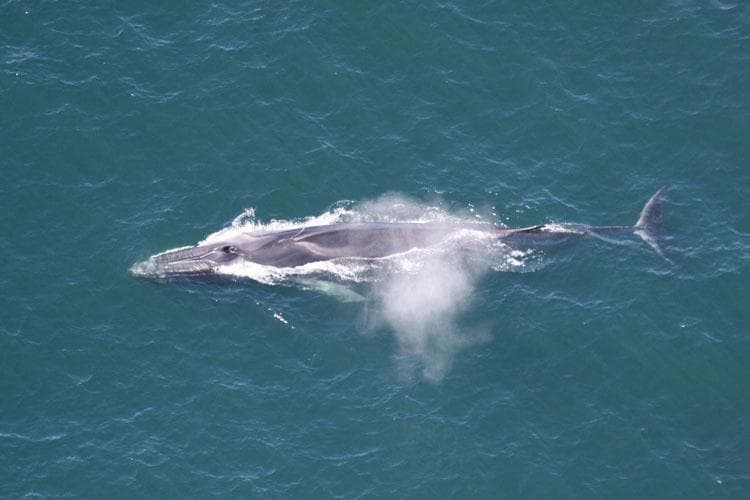
Fin Whale (Balaenoptera physalus) is a cosmopolitan baleen whale recognized by its exceptionally streamlined body and asymmetric jaw coloration. This guide separates well-supported biology from common assumptions and covers identification, range, habitat, diet, behavior, reproduction and conservation.
Identification
A long, narrow whale with a V-shaped head, a tall falcate dorsal fin set far back, pale chevrons behind the head and a dark back over a white underside. The right lower jaw is white while the left is dark. Females average slightly longer than males, but sex cannot usually be determined from a distant sighting.
Identification should combine body shape, markings, size, voice or movement, and location. One feature by itself can overlap with a related animal, a juvenile, or an individual in unusual light.
Photographs are most useful when they preserve scale and show several diagnostic features. Handling or repositioning a wild fin whale for identification can cause stress and is unnecessary.
Size and physical adaptations
Fin Whale typically measures usually 20–26 m and weighs roughly 36–72 metric tonnes. Size differs by ocean basin, sex and age; Southern Hemisphere animals tend to be larger.
Its useful adaptations include accordion-like throat pleats expand during lunge feeding, baleen plates strain prey from seawater, streamlined body supports efficient long-distance swimming, asymmetric jaw coloration may assist prey capture. These traits work together in the animal’s normal setting rather than serving as isolated curiosities.
Published measurements may use different methods, life stages or sample locations. Comparing figures responsibly means checking what was measured rather than selecting the largest number available.
Range and distribution
Present in all major oceans, with greatest densities in temperate and polar feeding regions and lower occurrence in the tropics. The native range includes Iceland, Norway, United States, Canada, Mexico, Argentina, Chile, South Africa, Australia, New Zealand, Japan, Antarctica.
A country-level map indicates broad distribution, not continuous occupation. Climate, elevation, water, vegetation, prey, breeding sites, barriers and survey effort all affect where records occur.
Records near the edge of the range deserve careful documentation because they may reflect natural movement, improved survey coverage, accidental transport or a genuine distribution change.
Habitat
Deep offshore water, continental slopes, productive shelf edges and some enclosed seas such as the Mediterranean and Gulf of California.
Seasonal movement often links high-latitude feeding grounds with lower-latitude winter areas, but routes and residency differ among populations. Protecting a population therefore requires the feeding, shelter and breeding features that make a site usable, along with connections that allow movement.
Microhabitat matters. Shade, soil, current, moisture, shelter or host plants can determine whether a small area is usable even when the surrounding landscape appears suitable.
Diet and feeding
Fin Whale is a carnivore and filter feeder. Important foods include krill, herring, capelin, sand lance, squid. It accelerates into dense prey patches with its mouth open, expands dozens of throat grooves, then forces water through baleen while retaining prey. Feeding groups may include other whale and dolphin species.
Diet changes with age, season, location and food supply. A dramatic prey record does not establish what most individuals eat most of the time; repeated field observations provide a stronger picture.
Feeding opportunities also create risk. An animal focused on prey may be less alert to predators, traffic or people, while contaminated prey can transfer pollutants through the food web.
Behavior and communication
Active day and night, with diving and travel shaped by prey depth. Fin whales are often seen alone or in groups of two to seven, although much larger temporary feeding gatherings form where prey is concentrated.
Very low-frequency pulses travel long distances through seawater and are especially prominent in male song sequences. Behavior should be interpreted in context: alarm, courtship, feeding and temperature regulation can produce very different actions from the same animal.
Daily schedules are flexible responses, not rigid rules. Weather, breeding condition, disturbance, tides or food can move activity into a different part of the day.
Reproduction and development
Mating and calving are thought to peak in lower-latitude waters during winter, although some breeding areas remain poorly known. One calf; twins are exceptionally rare. undefined
Young animals face different risks and may use different microhabitats or food than adults. Breeding success depends on adult condition, suitable sites and the survival of offspring through vulnerable early stages.
Counts of eggs or young describe reproductive output, not the number expected to reach adulthood. Mortality is normally greatest during eggs, larval or juvenile stages.
Predators and ecological role
A major consumer of krill and schooling fish that transfers nutrients through feeding, movement and defecation across ocean ecosystems. Documented or likely predators include Killer Whale, Humans.
This animal is both a consumer and a food source. Its influence comes through many repeated interactions, so ecological claims should be based on measured populations rather than assumptions drawn from appearance.
Predator and prey relationships differ among places. A species can be ecologically influential without being abundant everywhere, and its role can change across its range.
Relationship with people
Industrial whaling severely reduced the species. Present conservation focuses on ship-strike avoidance, safer fishing gear, noise reduction and population monitoring.
Observe under local whale-watching rules, maintain legal vessel distance and report entanglements or strandings to trained responders rather than intervening. Responsible observation means keeping an appropriate distance, avoiding capture or feeding, protecting habitat and following local wildlife or invasive-species guidance.
Wildlife guidance should come from the responsible local agency because collection rules, reporting requests and appropriate responses differ between native and introduced ranges.
Conservation
Vulnerable globally on the IUCN Red List; several populations are recovering from whaling while regional risks and data gaps remain. The reported global trend is Increasing globally, with regional variation.
Important pressures include vessel strikes, fishing-gear entanglement, underwater noise, climate-driven prey change, directed hunting in limited areas. Global status can hide local decline or recovery, so current regional monitoring and habitat management remain necessary.
The most useful conservation action follows the documented pressure. Protecting breeding sites, reducing road deaths or limiting pollutants can require different tools in different populations.