
Identification and daily life
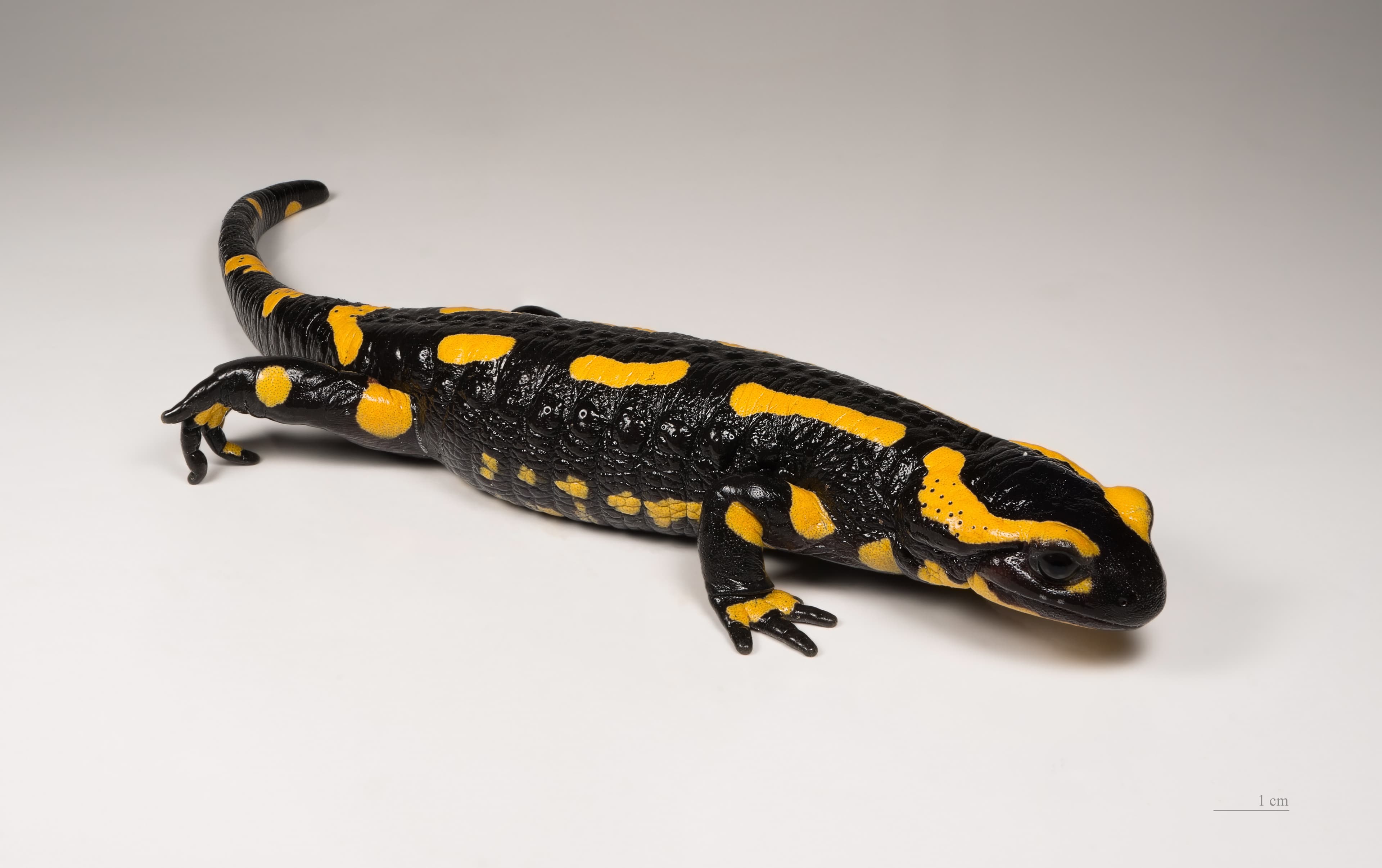
The fire salamander (Salamandra salamandra) has a sturdy body and contrasting black-and-yellow markings. Adults usually measure 15–25 cm. It spends much of its time sheltered under logs, rocks or in crevices, emerging mainly on mild nights. Its food includes worms, slugs and insects. Glands behind the eyes and along the body produce defensive toxins; its bright pattern is a warning to predators. See Animal Diversity Web.
Where does it live?
The American Museum of Natural History’s current taxonomy reference places this species in western, central and southern Europe, from Portugal east toward Greece and the Black Sea region. Older accounts sometimes include North Africa and the Middle East: several animals previously grouped here are now separate species, including Salamandra algira and S. infraimmaculata. A range description for the entire genus should therefore not be treated as the range of this species.
Young salamanders and water
Adults live chiefly on land, but many populations give birth to larvae that develop in water. Some populations instead produce young that have already metamorphosed. This variation means there is no single breeding description that fits every population. The species is an amphibian, despite its lizard-like outline.
Why conservation is a local question
The invasive fungus Batrachochytrium salamandrivorans, abbreviated Bsal, has caused devastating local declines. EAZA’s 2021 guidelines describe assurance colonies established after losses in northwestern Europe. Those guidelines focus on the subspecies S. s. terrestris; details about that subspecies should not automatically be applied to all fire salamanders. Protecting woodland alone does not remove an infectious-disease threat, and a broad geographic range does not guarantee that a local population is secure.
A name from folklore
Stories of salamanders surviving flames probably arose when hidden animals escaped burning logs. Fire salamanders are not fireproof. Their skin provides no protection from flames.
Photo credit
Didier Descouens, Wikimedia Commons, CC BY-SA 4.0. Displayed at a resized size; the layout may crop the image.
