
A living genus of gliding tree snakes
Flying snakes are five living species in the genus Chrysopelea, a branch of the colubrid family found across South and Southeast Asia. They do not fly with wings. Instead, they launch from branches, flatten the body and glide through the air. This page covers the genus, so measurements, colors and ranges vary among species. The Reptile Database documents living members of the group, including the ornate flying snake.
The name is shared by the paradise, ornate, banded, Moluccan and Sri Lankan flying snakes. These slender reptiles are specialized for moving through vegetation. A glide can carry a snake across a gap without descending to the ground, where travel may be slower and predators more numerous.
How a snake glides
Before launching, a flying snake may hang part of its body from a branch and form a tight curve. It then pushes away and spreads its ribs, changing its normally rounded body into a broad, concave shape. The body undulates from side to side during the glide. This movement stabilizes the animal and helps it steer rather than simply tumble.
Researchers studying Chrysopelea paradisi have shown that the flattened cross-section generates aerodynamic lift. The snake still loses height, so the movement is technically gliding rather than powered flight. Small individuals can be especially effective gliders because their mass is low relative to the surface presented to the air. A snake aims for another trunk or branch and curls or reorients its body as it lands.
Appearance and species differences
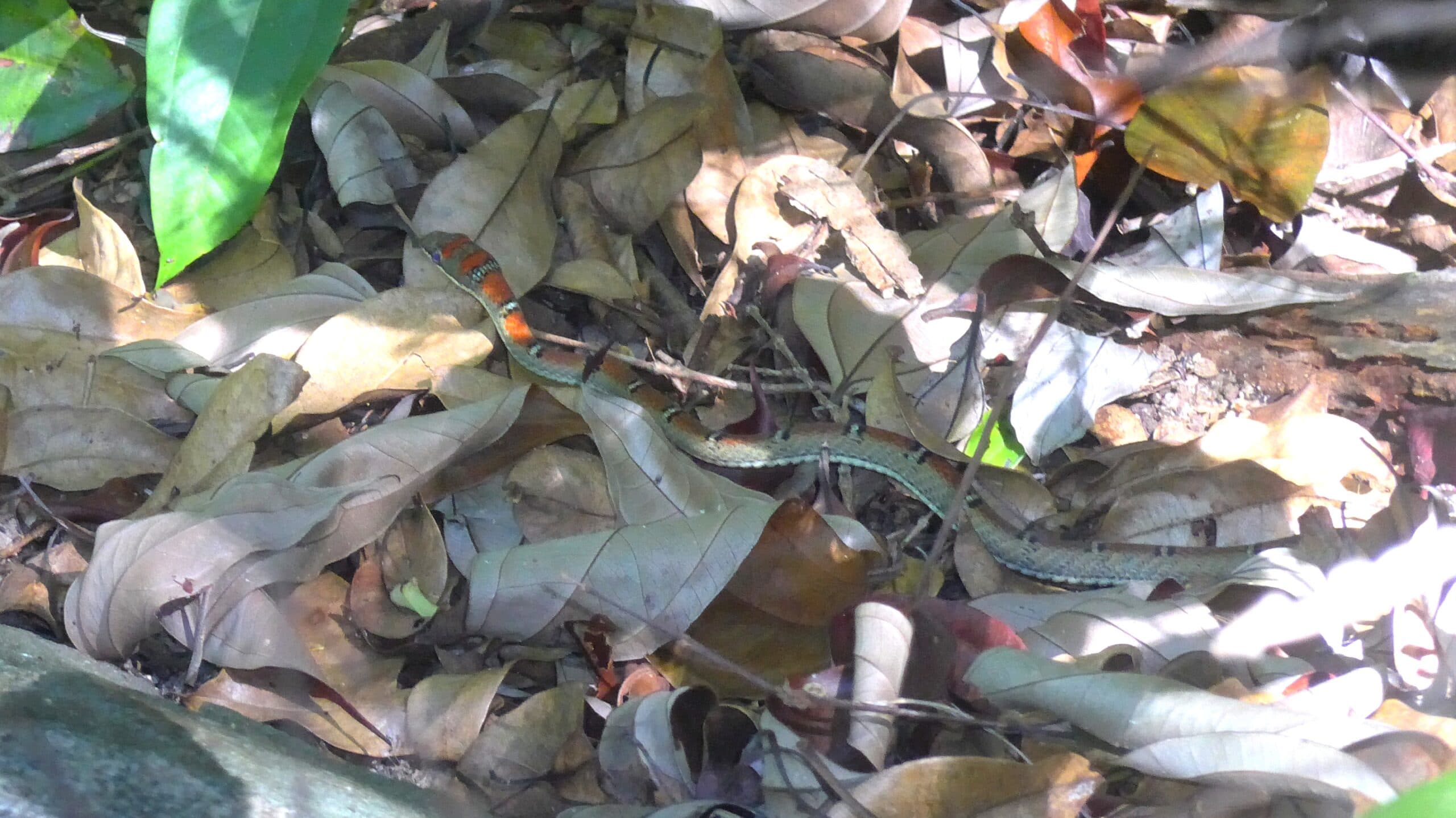
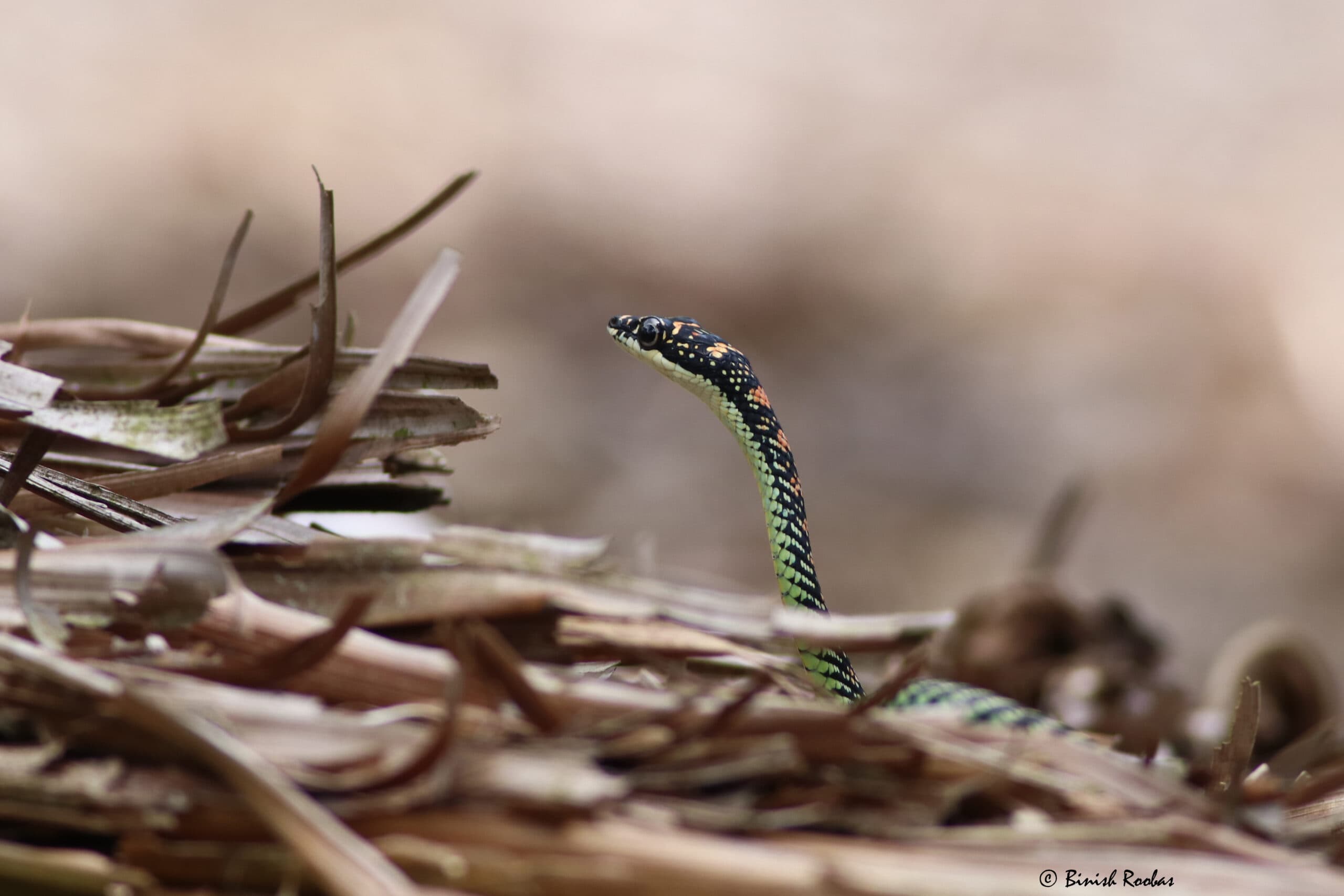
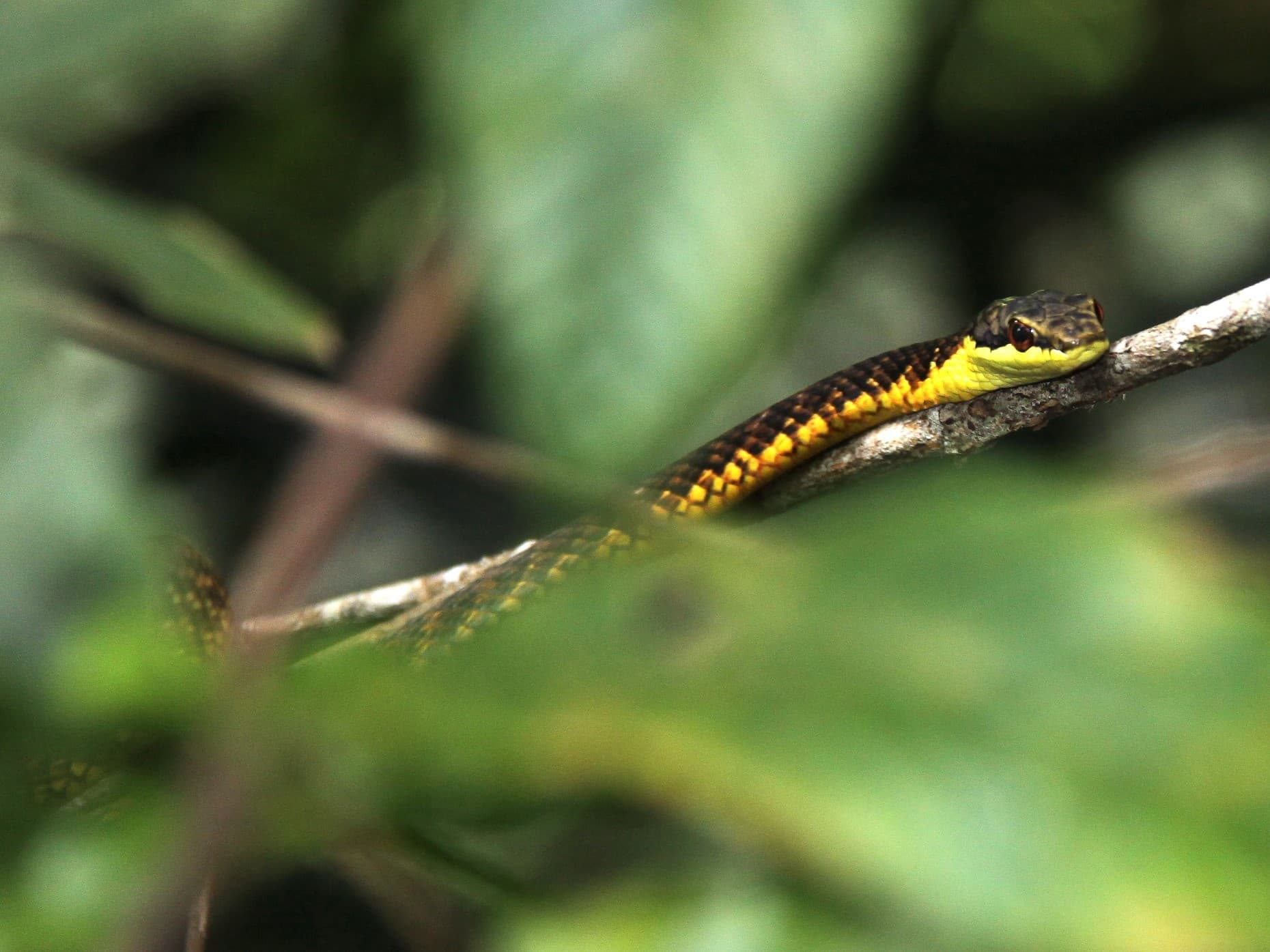
All flying snakes have long, slender bodies, relatively large eyes and keeled or ridged belly scales that help them grip bark. Color varies. Paradise flying snakes are often black with greenish or yellow markings and orange or red spots. Banded flying snakes have striking red or orange bars. Ornate flying snakes may be green, yellow and black, while the Moluccan species can show yellow along the neck and flanks.
Adults range broadly from roughly 60 centimetres to more than 1.2 metres depending on species and individual. Color alone is not enough for a confident identification because patterns overlap and can change across the range. Scale counts, head markings, locality and expert comparison are useful. The Integrated Taxonomic Information System places Chrysopelea in the family Colubridae.
Range and forest habitat
The genus occupies warm parts of South and Southeast Asia. Collectively, flying snakes occur from India and Sri Lanka through mainland Southeast Asia to southern China, the Malay Peninsula, Singapore, the Philippines and many Indonesian islands. Individual species have much narrower distributions. The Sri Lankan flying snake is restricted to Sri Lanka, while the Moluccan flying snake is associated with islands in eastern Indonesia.
Most records come from forests, wooded edges, plantations, gardens and other places with connected trees or tall vegetation. Some species tolerate altered habitat and may appear near buildings where geckos are abundant. Their dependence on climbing surfaces makes continuous canopy and mature trees useful, although they can cross open gaps by gliding.
Daily life and movement
Flying snakes are active during the day and spend much of their time above ground. They climb by pressing the body against bark and using the edges of their belly scales for purchase. On a branch they move with ordinary serpentine waves. Gliding is used to escape, travel between trees and possibly approach feeding areas, but most movement still involves climbing and crawling.
These snakes are alert and quick. When disturbed they usually flee into foliage or across a trunk. They are mildly venomous rear-fanged snakes, with enlarged teeth toward the back of the mouth. Their venom helps subdue small prey and is not generally considered medically important to people, but any wild snake should be left untouched. Bites can still cause pain or swelling and require sensible medical advice.
Diet and ecological role
Flying snakes are carnivores. Lizards, especially geckos, form a major part of the diet. Frogs, small birds, bats and other small vertebrates may also be taken, with prey differing by snake species, size and location. The snake searches visually through vegetation, approaches rapidly and holds prey with its jaws while venom and constriction-like body pressure help secure it.
As agile canopy predators, flying snakes connect several levels of the forest food web. They limit populations of small arboreal vertebrates and are themselves eaten by raptors, larger snakes and carnivorous mammals. Their ability to cross gaps lets them exploit feeding sites that a strictly ground-moving snake might reach less efficiently.
Reproduction and development
Members of the genus lay eggs. A female deposits a clutch in a protected, humid site such as a tree hollow, decaying wood or sheltered ground cover. Published clutch sizes vary among species and females, and genus-wide figures should be treated as approximate rather than universal. The eggs develop without parental care.
Hatchlings are independent and already possess the body form needed for climbing. As they grow, they take progressively larger prey and can cross wider gaps. Precise ages at maturity and maximum wild longevity are poorly documented for several species because following an individual canopy snake for many years is difficult.
Conservation
There is no single conservation category for the entire genus. Several species have been assessed as Least Concern, but the status and pressures must be checked species by species. Forest clearance, fragmentation, road building and persecution can reduce local populations. Restricted island species may be more vulnerable to habitat change than widespread mainland relatives.
Protecting connected native forest, retaining mature trees and reducing unnecessary killing all help. Observation records can improve knowledge of distributions when photographs are made from a safe distance and locations of sensitive animals are handled responsibly. The genus remains living and diverse, but a broad distribution should not be mistaken for equal security everywhere.
Relationship with people
Flying snakes attract attention because their locomotion seems improbable, yet they do not chase or swoop at people. A glide follows a deliberate launch toward a landing surface. Someone beneath the path may be startled, but the animal is traveling or escaping. Giving it room is the safest response.
Wild flying snakes should not be collected. They require secure, vertically complex housing, specialized food and careful management, and wildlife trade rules differ among countries. In homes near their range, sealing roof gaps and reducing gecko access can discourage entry. A local wildlife professional can move an animal when necessary without staged handling or injury.