
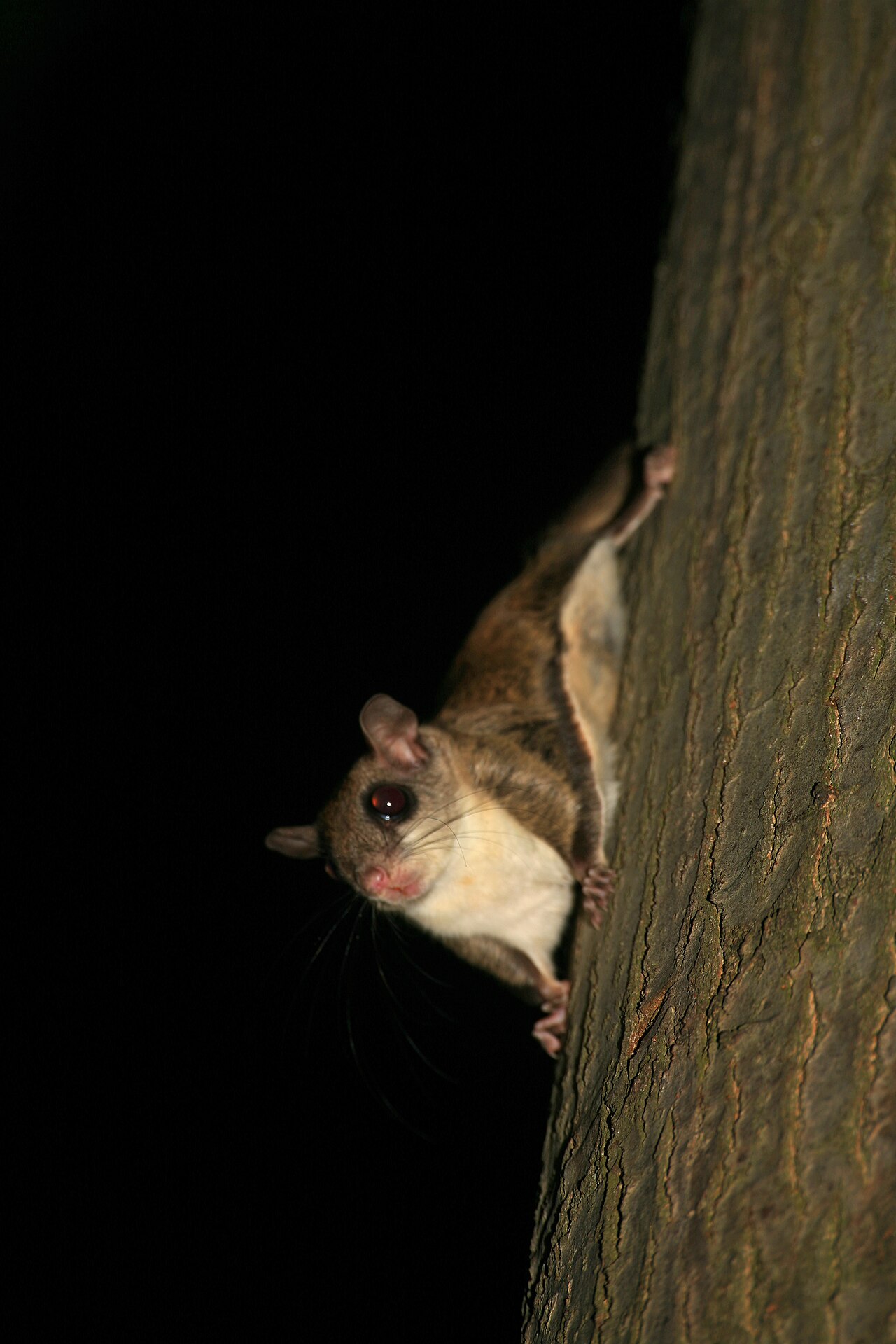
Flying Squirrel (Pteromyini) are more than 50 species of gliding rodents in forests across North America, Europe and Asia. This guide separates well-supported biology from common assumptions and covers identification, range, habitat, diet, behavior, reproduction and conservation.
Identification
Flying squirrels have large dark eyes, flattened tails and a furred patagium extending between wrist and ankle; size and markings differ by species. Sexes usually look similar, though females may be slightly larger in some species.
Identification should combine body shape, markings, size, voice or movement, and location. One feature by itself can overlap with a related animal, a juvenile, or an individual in unusual light.
Photographs are most useful when they preserve scale and show several diagnostic features. Handling or repositioning a wild flying squirrel for identification can cause stress and is unnecessary.
Size and physical adaptations
Flying Squirrel typically measures roughly 12–60 cm including tail and weighs about 30 g to more than 2 kg. Dwarf flying squirrels and giant flying squirrels differ greatly in size.
Its useful adaptations include patagium creates lift, flattened tail steers and brakes, large eyes support night vision, sharp claws grip bark. These traits work together in the animal’s normal setting rather than serving as isolated curiosities.
Published measurements may use different methods, life stages or sample locations. Comparing figures responsibly means checking what was measured rather than selecting the largest number available.
Range and distribution
Forests of North America and across northern, eastern and southern Asia, with one species extending into northeastern Europe. The native range includes United States, Canada, Finland, Russia, China, India, Japan, Indonesia.
A country-level map indicates broad distribution, not continuous occupation. Climate, elevation, water, vegetation, prey, breeding sites, barriers and survey effort all affect where records occur.
Records near the edge of the range deserve careful documentation because they may reflect natural movement, improved survey coverage, accidental transport or a genuine distribution change.
Habitat
Mature deciduous, coniferous and tropical forests with tree cavities, connected canopy and reliable food.
They den in cavities or nests and launch from high trunks, so broken canopy and removal of old trees reduce safe travel and shelter. Protecting a population therefore requires the feeding, shelter and breeding features that make a site usable, along with connections that allow movement.
Microhabitat matters. Shade, soil, current, moisture, shelter or host plants can determine whether a small area is usable even when the surrounding landscape appears suitable.
Diet and feeding
Flying Squirrel is an omnivore. Important foods include nuts, seeds, fruit, fungi, insects and bird eggs. Many forage in trees and cache food; diet differs among species, seasons and latitudes.
Diet changes with age, season, location and food supply. A dramatic prey record does not establish what most individuals eat most of the time; repeated field observations provide a stronger picture.
Feeding opportunities also create risk. An animal focused on prey may be less alert to predators, traffic or people, while contaminated prey can transfer pollutants through the food web.
Behavior and communication
Mostly nocturnal. Individuals climb to a launch point, leap, extend the limbs and glide in controlled arcs before turning upward to land.
High calls, scent and touch maintain contact; some North American species produce ultrasonic vocalizations. Behavior should be interpreted in context: alarm, courtship, feeding and temperature regulation can produce very different actions from the same animal.
Daily schedules are flexible responses, not rigid rules. Weather, breeding condition, disturbance, tides or food can move activity into a different part of the day.
Reproduction and development
Season and litter frequency differ with species and climate. Commonly two to four young, with a broader range among species. undefined
Young animals face different risks and may use different microhabitats or food than adults. Breeding success depends on adult condition, suitable sites and the survival of offspring through vulnerable early stages.
Counts of eggs or young describe reproductive output, not the number expected to reach adulthood. Mortality is normally greatest during eggs, larval or juvenile stages.
Predators and ecological role
Disperses fungal spores and seeds and serves as prey for nocturnal forest predators. Documented or likely predators include Owls, Martens, Snakes.
This animal is both a consumer and a food source. Its influence comes through many repeated interactions, so ecological claims should be based on measured populations rather than assumptions drawn from appearance.
Predator and prey relationships differ among places. A species can be ecologically influential without being abundant everywhere, and its role can change across its range.
Relationship with people
Forest retention and properly placed nest boxes can aid some local species, but boxes do not replace mature habitat.
Do not handle wildlife found indoors; contact a licensed rehabilitator or humane wildlife professional. Responsible observation means keeping an appropriate distance, avoiding capture or feeding, protecting habitat and following local wildlife or invasive-species guidance.
Wildlife guidance should come from the responsible local agency because collection rules, reporting requests and appropriate responses differ between native and introduced ranges.
Conservation
The group has no single IUCN status; individual species range from common to threatened. The reported global trend is Different among species.
Important pressures include deforestation, loss of cavity trees, canopy fragmentation, hunting and wildlife trade. Global status can hide local decline or recovery, so current regional monitoring and habitat management remain necessary.
The most useful conservation action follows the documented pressure. Protecting breeding sites, reducing road deaths or limiting pollutants can require different tools in different populations.