
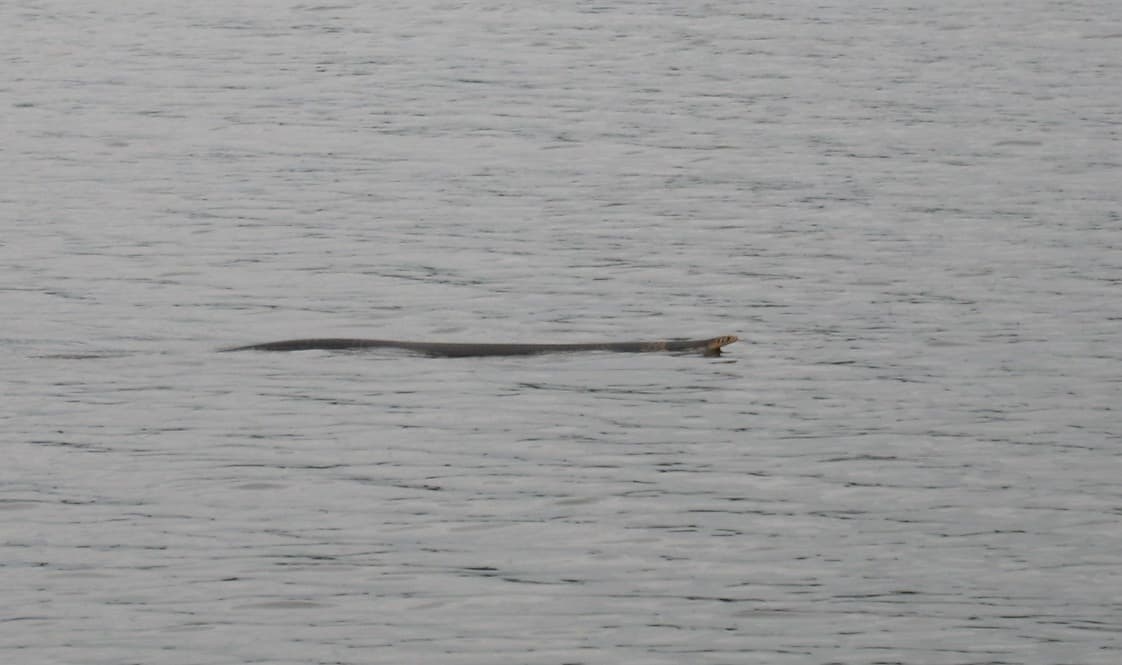
Forest Cobra (Naja melanoleuca) is a highly venomous cobra now understood in a narrower taxonomic sense than older field guides used. Modern research split the former forest-cobra complex into five species. Naja melanoleuca remains the black-and-white forest cobra of parts of Central Africa, where it hunts mammals, amphibians, fish, birds and reptiles. This guide separates well-supported biology from common assumptions and covers identification, range, habitat, diet, behavior, reproduction and conservation.
Identification
Adults are robust cobras with a broad head, smooth glossy scales and a wedge-shaped hood. The restricted species is typically dark brown or black above, with pale lips and contrasting cream or white bars along the lower jaw, throat and front belly. The exact width and number of ventral bands vary. The eyes are medium-sized with round pupils. Males and females look similar, although mature males may average longer and have proportionally longer tails. Color pattern does not reliably indicate sex.
Identification should combine body shape, markings, size, voice or movement, and location. One feature by itself can overlap with a related animal, a juvenile, or an individual in unusual light.
Photographs are most useful when they preserve scale and show several diagnostic features. Handling or repositioning a wild forest cobra for identification can cause stress and is unnecessary.
Size and physical adaptations
Forest Cobra typically measures commonly 1.4–2.2 m; exceptional individuals near 2.7 m and weighs often about 2–3.6 kg in large adults. Older maximum-size records may include species that have since been split from Naja melanoleuca.
Its useful adaptations include expandable hood warns threats, fixed front fangs inject venom, strong body climbs trees, capable swimmer crosses waterways, glossy dark color suits forest shade, chemical sensing tracks hidden prey, broad diet supports wet habitats. These traits work together in the animal’s normal setting rather than serving as isolated curiosities.
Published measurements may use different methods, life stages or sample locations. Comparing figures responsibly means checking what was measured rather than selecting the largest number available.
Range and distribution
Under the modern split, Naja melanoleuca occupies humid Central African forests from southern Cameroon and the Congo Basin through Gabon, Equatorial Guinea, the Congos and parts of northern Angola. Records far west, east or south often represent one of the four species separated in 2018. The native range includes Cameroon, Central African Republic, Equatorial Guinea, Gabon, Republic of the Congo, Democratic Republic of the Congo, Angola.
A country-level map indicates broad distribution, not continuous occupation. Climate, elevation, water, vegetation, prey, breeding sites, barriers and survey effort all affect where records occur.
Records near the edge of the range deserve careful documentation because they may reflect natural movement, improved survey coverage, accidental transport or a genuine distribution change.
Habitat
Lowland rainforest, swamp forest, forest edge, wooded riverbanks, plantations and humid settlements with dense cover.
Forest Cobras shelter in hollow logs, root tangles, burrows, rock spaces, brush piles and abandoned structures. They forage on the forest floor, climb well and readily enter water. Near people, rubbish, poultry and rodents can attract prey, but the snake generally uses cover and avoids open disturbance. Protecting a population therefore requires the feeding, shelter and breeding features that make a site usable, along with connections that allow movement.
Microhabitat matters. Shade, soil, current, moisture, shelter or host plants can determine whether a small area is usable even when the surrounding landscape appears suitable.
Diet and feeding
Forest Cobra is a generalist predator of vertebrates and eggs. Important foods include rodents, frogs, toads, fish, birds, eggs, lizards, other snakes. The cobra searches actively through leaf litter, burrows, shallow water and low vegetation. It follows chemical trails, seizes prey and uses venom to immobilize it. Frogs and rodents are important, while fish, tadpoles, birds, eggs, lizards and other snakes broaden the diet. Juveniles concentrate on smaller amphibians and reptiles.
Diet changes with age, season, location and food supply. A dramatic prey record does not establish what most individuals eat most of the time; repeated field observations provide a stronger picture.
Feeding opportunities also create risk. An animal focused on prey may be less alert to predators, traffic or people, while contaminated prey can transfer pollutants through the food web.
Behavior and communication
Active by day in quiet forest and often after dark near disturbed areas. This agile snake moves on the ground, climbs trees and swims across water. When surprised it usually seeks cover. If escape is blocked, it raises much of the front body, spreads its hood, hisses and tracks movement before striking. The display is defensive, but its reach and speed make close approach extremely dangerous.
Tongue flicks deliver scent particles to the vomeronasal organ, helping locate prey and mates. Ground vibration alerts the snake to approaching animals. Vision detects rapid motion. During breeding, pheromones guide males and close body contact coordinates courtship; hooding and hissing warn threats. Behavior should be interpreted in context: alarm, courtship, feeding and temperature regulation can produce very different actions from the same animal.
Daily schedules are flexible responses, not rigid rules. Weather, breeding condition, disturbance, tides or food can move activity into a different part of the day.
Reproduction and development
Breeding is seasonal, with timing influenced by rainfall and region. Males follow female scent trails and may wrestle rivals. After mating, the female selects a protected cavity and deposits a clutch of elongated eggs. Some observations indicate she may remain near and defend the clutch until hatching. Usually about 15–26 eggs Embryos grow inside leathery eggs in a warm humid refuge. Hatchlings emerge fully independent with functional venom glands. They shed within the first weeks, begin hunting small frogs, tadpoles and lizards, and grow rapidly before sexual maturity. There is no parental feeding after emergence.
Young animals face different risks and may use different microhabitats or food than adults. Breeding success depends on adult condition, suitable sites and the survival of offspring through vulnerable early stages.
Counts of eggs or young describe reproductive output, not the number expected to reach adulthood. Mortality is normally greatest during eggs, larval or juvenile stages.
Predators and ecological role
Forest Cobras function as secondary and tertiary predators, controlling rodents, amphibians and other small vertebrates. They also feed raptors, mongooses, monitor lizards, crocodiles and other snakes, especially when young. Swimming and climbing allow them to connect aquatic, ground and lower-canopy food webs. Documented or likely predators include Egyptian Mongoose, White-Tailed Mongoose, Monitor Lizard, Crocodile, Human.
This animal is both a consumer and a food source. Its influence comes through many repeated interactions, so ecological claims should be based on measured populations rather than assumptions drawn from appearance.
Predator and prey relationships differ among places. A species can be ecologically influential without being abundant everywhere, and its role can change across its range.
Relationship with people
Bites can occur when people surprise snakes in farms, paths, wood piles or buildings. Prevention centers on footwear, lighting, rodent control and avoiding hand searches in dark cover. If a cobra is present, keep everyone back, give it an escape route and call trained responders. Never attempt capture or killing.
A bite is a medical emergency because venom can cause paralysis, respiratory failure and local injury. Keep the patient still, remove tight items, immobilize the limb and arrange immediate hospital transport. Do not cut, suck, ice, shock or tightly tourniquet the wound, and never pursue the snake for identification. Responsible observation means keeping an appropriate distance, avoiding capture or feeding, protecting habitat and following local wildlife or invasive-species guidance.
Wildlife guidance should come from the responsible local agency because collection rules, reporting requests and appropriate responses differ between native and introduced ranges.
Conservation
The IUCN assesses Naja melanoleuca as Least Concern, but the modern restricted range and local pressures require care when interpreting older population information. Forest loss, roads, persecution and collection can cause regional declines. The reported global trend is Not well quantified after the recent species split.
Important pressures include deforestation, persecution, road mortality, illegal collection, agricultural expansion, mining, loss of wet forest. Global status can hide local decline or recovery, so current regional monitoring and habitat management remain necessary.
The most useful conservation action follows the documented pressure. Protecting breeding sites, reducing road deaths or limiting pollutants can require different tools in different populations.