
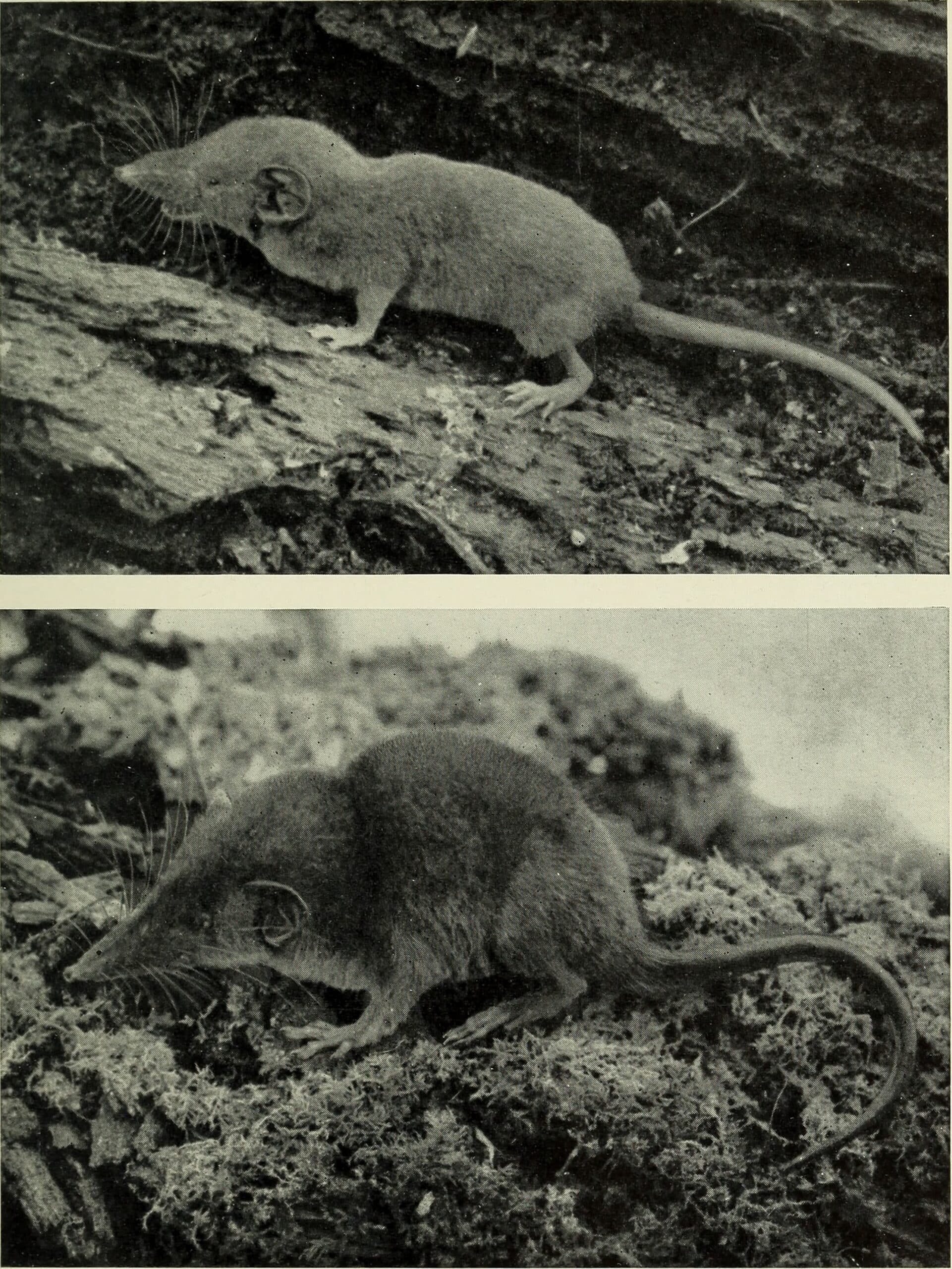
Forest Shrew (Sylvisorex) refers here to the African shrew genus Sylvisorex, a diverse group of very small mammals rather than to one species. The same English name is also used for Myosorex varius, which this genus profile does not cover. This guide separates well-supported biology from common assumptions and covers identification, range, habitat, diet, behavior, reproduction and conservation.
Identification
Forest shrews are minute, narrow-snouted mammals with small eyes, rounded ears, soft gray to brown fur and tails that range from relatively short to nearly the head-and-body length. Species can be difficult to distinguish without locality, measurements and specialist examination of teeth or genetics. Males and females generally overlap in outward appearance; reproductive condition and precise measurements are more informative than coat color for sexing individuals.
Identification should combine body shape, markings, size, voice or movement, and location. One feature by itself can overlap with a related animal, a juvenile, or an individual in unusual light.
Photographs are most useful when they preserve scale and show several diagnostic features. Handling or repositioning a wild forest shrew for identification can cause stress and is unnecessary.
Size and physical adaptations
Forest Shrew typically measures approximately 4.5–10 cm head and body across species and weighs approximately 3–12 g across documented species. These endpoints come from different Sylvisorex species and do not describe a typical individual of every species.
Its useful adaptations include elongated flexible snout probes litter and crevices, sharp teeth process small invertebrate prey, small body enters dense ground vegetation, sensitive whiskers aid close-range navigation, some species have proportionally long tails for movement through vegetation. These traits work together in the animal’s normal setting rather than serving as isolated curiosities.
Published measurements may use different methods, life stages or sample locations. Comparing figures responsibly means checking what was measured rather than selecting the largest number available.
Range and distribution
Collectively, Sylvisorex species occur in tropical Central Africa and parts of East Africa, from Nigeria and Cameroon through the Congo Basin to the Albertine Rift and some Eastern Arc forests. Individual species occupy only portions of this combined range. The native range includes Nigeria, Cameroon, Equatorial Guinea, Gabon, Central African Republic, Republic of the Congo, Democratic Republic of the Congo, Uganda, Rwanda, Burundi, Kenya, Tanzania.
A country-level map indicates broad distribution, not continuous occupation. Climate, elevation, water, vegetation, prey, breeding sites, barriers and survey effort all affect where records occur.
Records near the edge of the range deserve careful documentation because they may reflect natural movement, improved survey coverage, accidental transport or a genuine distribution change.
Habitat
Humid lowland rainforest, montane forest, forest edges and dense ground vegetation; exact elevation and microhabitat differ among species.
Forest shrews forage within leaf litter, herb layers, fallen wood and other moist cover where invertebrate prey and protection from drying are available. Some narrow-range species are tied to particular mountains or islands. Protecting a population therefore requires the feeding, shelter and breeding features that make a site usable, along with connections that allow movement.
Microhabitat matters. Shade, soil, current, moisture, shelter or host plants can determine whether a small area is usable even when the surrounding landscape appears suitable.
Diet and feeding
Forest Shrew is a small-invertebrate predator. Important foods include insects, spiders, earthworms, other small soil invertebrates. Individuals search rapidly through litter and low vegetation, using smell, touch and hearing to locate prey. Direct dietary data remain limited for several rare species, so a single prey list should not be applied rigidly to the whole genus.
Diet changes with age, season, location and food supply. A dramatic prey record does not establish what most individuals eat most of the time; repeated field observations provide a stronger picture.
Feeding opportunities also create risk. An animal focused on prey may be less alert to predators, traffic or people, while contaminated prey can transfer pollutants through the food web.
Behavior and communication
Activity can occur by day and night in short bouts, with schedules varying among species and conditions. These elusive shrews are usually encountered singly in traps or field surveys. Their high energy demands favor frequent foraging, while dense cover helps them avoid predators and dehydration.
Like other shrews, forest shrews rely strongly on scent, touch and high-frequency sounds at close range, but detailed species-level studies are scarce. Behavior should be interpreted in context: alarm, courtship, feeding and temperature regulation can produce very different actions from the same animal.
Daily schedules are flexible responses, not rigid rules. Weather, breeding condition, disturbance, tides or food can move activity into a different part of the day.
Reproduction and development
Reproductive biology is poorly documented across Sylvisorex. Species are expected to give birth to small litters after internal gestation, but reliable values must be reported species by species. Small litter; exact number differs by species and is poorly documented Young are born dependent and develop in a sheltered nest. Growth and dispersal schedules are insufficiently documented for many species.
Young animals face different risks and may use different microhabitats or food than adults. Breeding success depends on adult condition, suitable sites and the survival of offspring through vulnerable early stages.
Counts of eggs or young describe reproductive output, not the number expected to reach adulthood. Mortality is normally greatest during eggs, larval or juvenile stages.
Predators and ecological role
Forest shrews consume small invertebrates and transfer energy to snakes, owls and small carnivores. Because they respond to moisture, litter and forest structure, their presence also helps document otherwise overlooked small-mammal communities. Documented or likely predators include Owl, Snake, Small Carnivore.
This animal is both a consumer and a food source. Its influence comes through many repeated interactions, so ecological claims should be based on measured populations rather than assumptions drawn from appearance.
Predator and prey relationships differ among places. A species can be ecologically influential without being abundant everywhere, and its role can change across its range.
Relationship with people
Forest shrews rarely interact directly with people. Their main human connection comes through biodiversity surveys, forest conservation and research on African small-mammal evolution.
Do not handle wild shrews. Researchers use permits and protective procedures because small mammals can bite when restrained and may carry parasites or pathogens. Responsible observation means keeping an appropriate distance, avoiding capture or feeding, protecting habitat and following local wildlife or invasive-species guidance.
Wildlife guidance should come from the responsible local agency because collection rules, reporting requests and appropriate responses differ between native and introduced ranges.
Conservation
Sylvisorex is not assessed as one Red List unit. Each species has its own category, and several narrow-range forest shrews face greater concern than widespread members. The reported global trend is Different species have different trends; several remain poorly surveyed.
Important pressures include forest loss and fragmentation, agricultural expansion, logging, fire and habitat drying, mining and road development, small ranges in montane or island species, limited survey information. Global status can hide local decline or recovery, so current regional monitoring and habitat management remain necessary.
The most useful conservation action follows the documented pressure. Protecting breeding sites, reducing road deaths or limiting pollutants can require different tools in different populations.
