
Two living species share the foxsnake name
Fox snakes are large, nonvenomous rat snakes native to the Great Lakes region and the central United States. The common name now refers mainly to two living species: the Eastern Foxsnake, Pantherophis vulpinus, and the Western Foxsnake, Pantherophis ramspotti. Older books and databases may apply vulpinus, gloydi, or the former genus Elaphe differently because the boundary between the eastern and western forms was revised. This page treats fox snakes as a small species group and keeps measurements, conservation statements, and range details qualified by species.
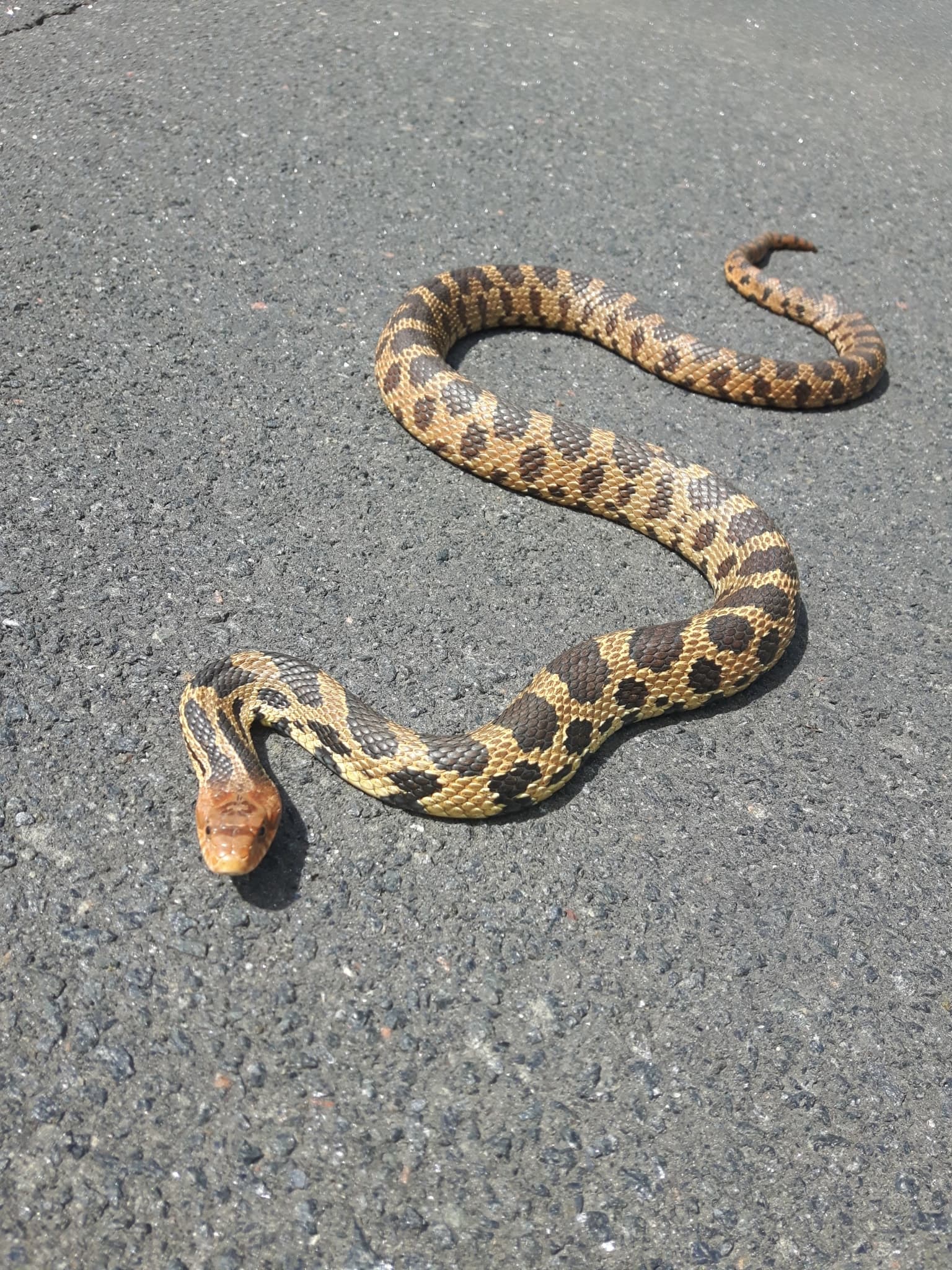
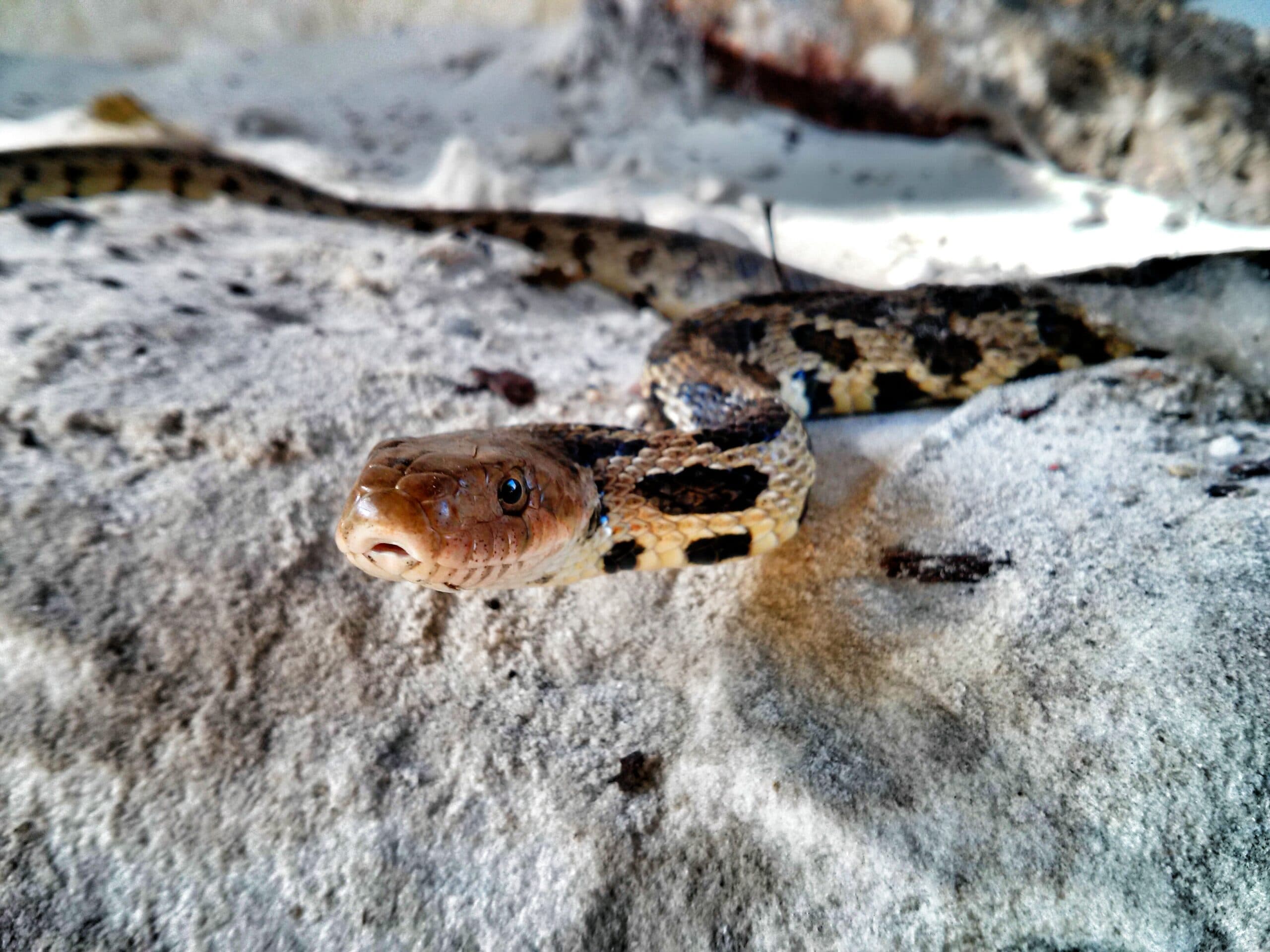
Both are muscular constrictors with brown or black dorsal blotches on a yellow, tan, or brown background. Their reddish or copper-colored heads can cause people to mistake them for venomous copperheads, but fox snakes lack the copperhead’s hourglass bands and vertical pupils. They are harmless to people and usually try to escape before defending themselves.
Identification and appearance
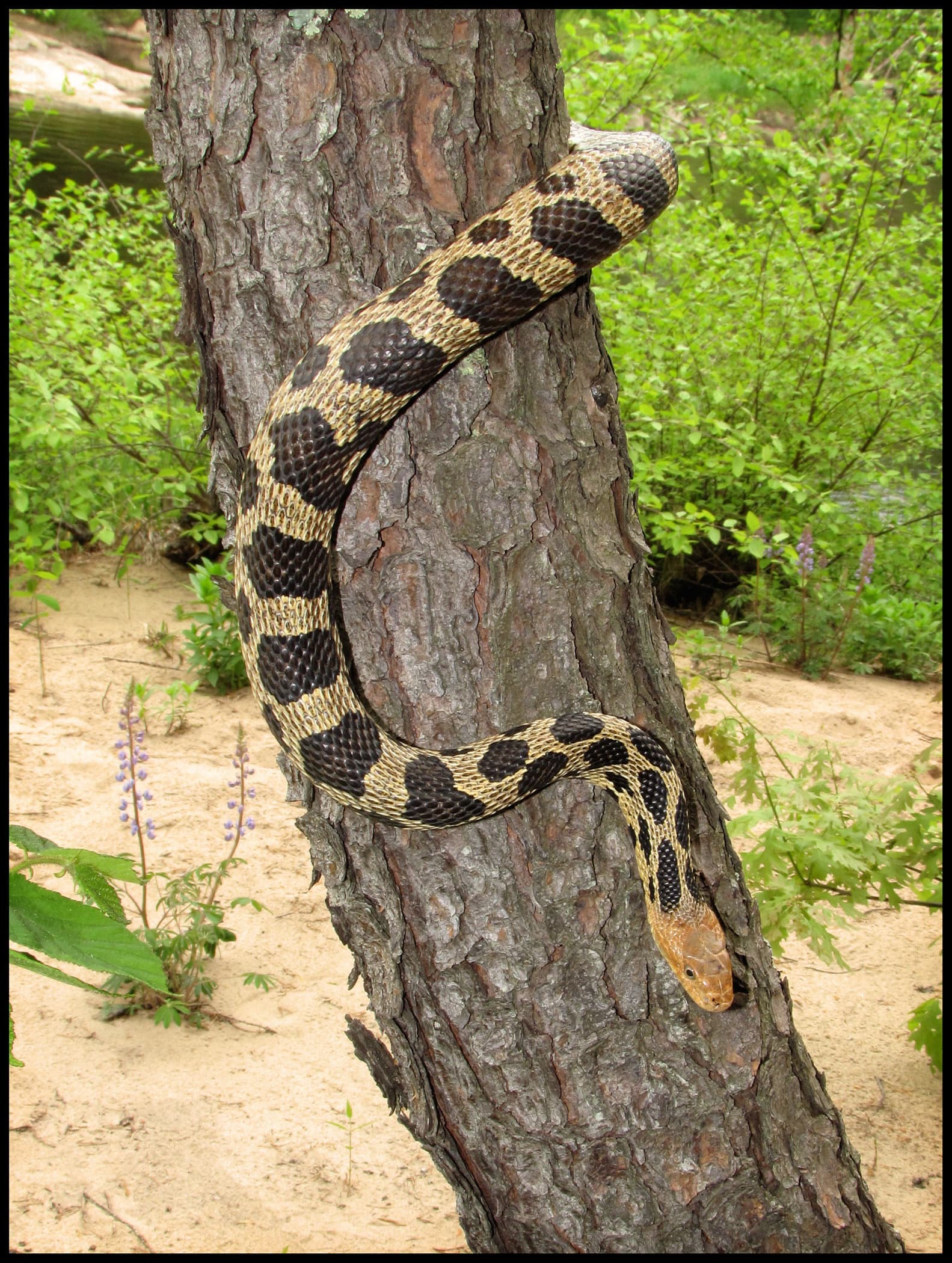
Adult fox snakes are heavy-bodied and commonly reach roughly 90–140 centimeters, although exceptional individuals can be longer. A row of large dark blotches runs down the back, with smaller marks along the sides. The belly is pale with dark checkerboard markings. Juveniles usually have stronger contrast than older snakes, whose ground color may darken. The scales are weakly keeled, the pupils are round, and the anal plate is divided.
The head is often orange, reddish brown, or coppery and may have fewer markings than the neck. That color alone is not evidence of a dangerous snake. Copperheads have broad hourglass-shaped crossbands that are narrow across the spine, while fox snakes have separate rounded or rectangular blotches. When identification is uncertain, observers should keep their distance and use photographs rather than handling the animal.
Range and habitat
Eastern Foxsnakes occupy a restricted Great Lakes range centered on southern Ontario, Michigan, and northern Ohio. They use coastal marshes, wetlands, fields, woodland edges, dunes, and rocky or shrubby uplands. The Canadian Species at Risk Public Registry documents their limited Canadian populations and habitat needs. Western Foxsnakes range farther west and south through parts of the upper Mississippi basin and nearby Great Lakes states, where they use prairie, farmland margins, marshes, open woodland, and river corridors.
Both species need a connected landscape. A snake may forage in grassland, retreat into a mammal burrow or rock crevice, lay eggs in decaying vegetation, and travel to a communal winter den. Roads, dense development, and the loss of wetland-to-upland connections can interrupt those seasonal movements. Fox snakes also enter barns and farm edges when rodents are abundant, which can bring them into conflict with people despite the useful pest control they provide.
Daily life and behavior
Fox snakes are mainly active by day in spring and autumn, with more activity around dusk or at night during hot summer weather. They move on the ground but can climb low trees, shrubs, fences, and farm structures. They also swim readily, especially in wetland landscapes. Much of the day may be spent beneath boards, logs, rocks, vegetation mats, or in abandoned burrows where temperature and moisture are more stable.
When alarmed, a fox snake may vibrate its tail in dry leaves, flatten its head, hiss, release musk, or strike. Tail vibration can sound like a rattle when it hits debris, but fox snakes have no rattle and no venom. The name “fox snake” is often linked to a musky defensive odor that early observers compared with a fox. These displays are attempts to avoid being grabbed, not signs that the snake is pursuing a person.
Diet and ecological role
Fox snakes are constrictors that feed mostly on small mammals. Mice, voles, young rats, and other rodents make up much of the diet, while birds, bird eggs, nestlings, frogs, and other small vertebrates may also be taken. The snake locates prey with chemical cues collected by its tongue and delivered to the vomeronasal organ in the roof of the mouth. It coils around active prey and then swallows it whole.
By removing rodents, fox snakes help regulate prey populations in wetlands, grasslands, and agricultural landscapes. They are themselves eaten by hawks, owls, mammals, and larger snakes, particularly when young. Eggs and hatchlings face additional predators. Their place in both predator and prey networks makes them part of the energy flow between wetland margins, fields, and woodland edges.
Reproduction and life cycle
Mating generally occurs in spring after snakes leave winter refuges. Females lay a clutch of eggs in early or midsummer, often in rotting vegetation, old stumps, sawdust piles, or other warm, humid sites. Incubation commonly lasts about two months, depending on temperature. Hatchlings emerge in late summer or early autumn and receive no parental care. They begin with small prey and spend much of their time concealed.
Fox snakes grow for several years before breeding. Reliable lifespan figures for free-ranging animals are limited, and values from captivity should not be presented as normal wild longevity. Individuals in northern populations must survive long winters in secure dens below the frost line. Several snakes may share a hibernation site, making the protection of those small locations disproportionately important to a local population.
Conservation and coexistence
The two species do not have identical conservation status. The Reptile Database recognizes the Eastern Foxsnake as Pantherophis vulpinus, while current taxonomic treatments recognize P. ramspotti for the western species. The NatureServe Explorer provides conservation context for the eastern taxon, and the IUCN Red List assessment covers P. vulpinus. Local legal protection can be stricter than a broad global category.
Major threats include wetland drainage, habitat fragmentation, road mortality, deliberate killing, illegal collection, and destruction of nesting or wintering sites. Drivers often kill fox snakes because they resemble venomous species or because defensive tail vibration is mistaken for a rattlesnake. People can help by leaving snakes alone, reducing vehicle speed near wetlands, retaining natural cover, and contacting a qualified wildlife professional when relocation is genuinely necessary. Never move a fox snake across long distances; populations are adapted to seasonal routes and specific den sites.