
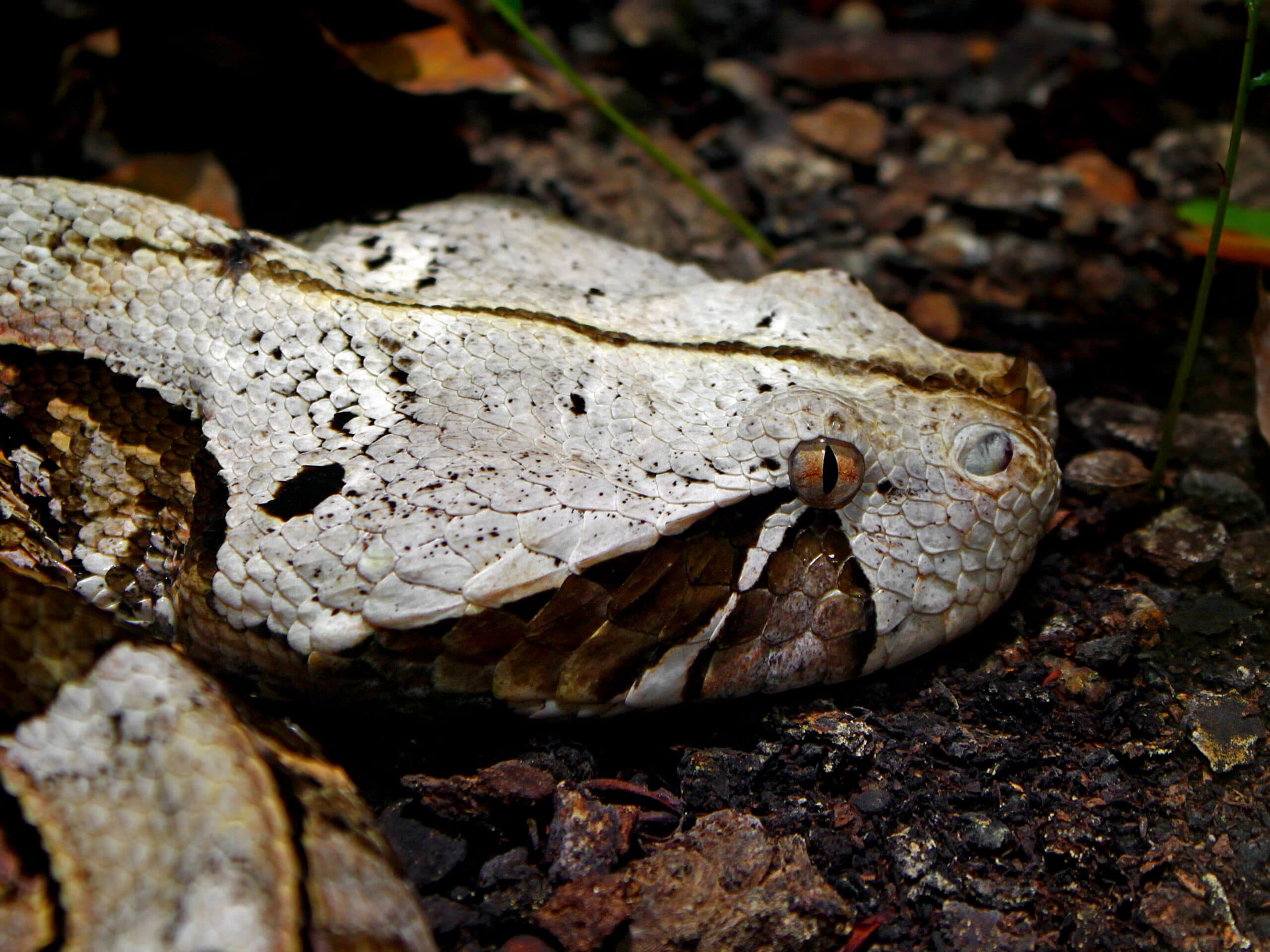
A living forest-floor viper
The Gaboon Viper, Bitis gabonica, is a living true viper of tropical Africa. It belongs to the family Viperidae and is built for stillness: a broad triangular head, exceptionally heavy body, and intricate pattern let it disappear among fallen leaves. This profile follows the modern species scope used by the Reptile Database. The West African Gaboon Viper, Bitis rhinoceros, was once treated as a subspecies but is now recognized separately, so facts and range records for the two should not be mixed.
Gaboon Vipers are dangerously venomous wild animals. Their quiet behavior does not make them safe to approach. A snake encountered outdoors should be given space and an unobstructed route away. Nobody should attempt capture, handling, or close identification. A suspected bite is an emergency requiring immediate professional medical care; waiting for symptoms or trying folk remedies can waste critical time.
Identification and camouflage
The snake’s back carries a repeating series of pale hourglass shapes, dark diamonds, bars, and patches edged in cream, tan, brown, pinkish, and black. Against leaf litter the geometric pattern breaks up the body outline. The head is very broad behind the eyes and narrows toward the snout, while dark facial marks cross the pale cheeks. Keeled scales make the surface appear textured rather than glossy.
Adults are commonly around 90–150 centimeters long, with exceptional individuals longer. Females generally become larger and heavier than males. The body is notably thick for its length. The Smithsonian describes the species as Africa’s largest viper and reports that very large individuals can exceed 1.8 meters. Size claims vary among sources and should not be used to identify a snake at close range. Pattern, locality, scale characters, and facial markings require expert assessment.
Range and habitat
The Reptile Database records Bitis gabonica across parts of central, eastern, and southern Africa, including Cameroon, the Central African Republic, the Republic of the Congo, the Democratic Republic of the Congo, Equatorial Guinea, Gabon, Uganda, Angola, Zambia, western Kenya, Rwanda, Tanzania, Mozambique, Malawi, eastern Zimbabwe, and northeastern South Africa, with additional records requiring careful regional interpretation. The species does not occupy every place inside those national borders.
Gaboon Vipers are associated mainly with rainforest, moist woodland, forest edges, plantations beside suitable forest, and other humid habitats with deep ground cover. They spend most of their time on the ground. Fallen leaves, roots, low plants, and broken light create the visual background that makes their pattern effective. Local populations can be isolated when forests are cleared or divided by roads, intensive agriculture, and development.
Ambush hunting and diet
A Gaboon Viper usually hunts from concealment. Rather than pursuing prey for long distances, it waits nearly motionless until a small animal passes within striking range. The Smithsonian reports a diet of small and medium-sized mammals and birds and describes the viper as a passive ambush hunter. Rodents form an important part of the diet; ground-feeding birds and other suitable vertebrates may also be taken.
The snake senses chemical trails with its forked tongue, feels ground vibrations, and uses vision at close range. Its long hinged front fangs fold against the roof of the mouth when not in use and swing forward during a strike. Venom immobilizes prey and begins tissue damage. Unlike many vipers that strike and release, a Gaboon Viper may hold prey after biting. Feeding behavior toward prey should never be confused with how a cornered snake responds to people.
Daily behavior and movement
Gaboon Vipers are mainly terrestrial, solitary, and often active from dusk into the night. During the day they may remain hidden beneath leaf litter or lie exposed but visually concealed. Animal Diversity Web describes a sedentary, nocturnal ambush hunter that relies on its camouflage. Slow rectilinear movement allows the body to advance with little side-to-side bending, although the snake can move and strike rapidly when necessary.
When threatened, the viper may remain still, hiss loudly, raise the front of its body, or strike if danger continues. Reports that the species is “placid” describe a tendency to avoid biting, not an absence of risk. Many bites occur after accidental contact or deliberate handling. Thick footwear cannot make close approach safe, and even a snake that appears motionless can defend itself within striking distance.
Reproduction and life cycle
Gaboon Vipers reproduce through internal fertilization and give birth to live young. The Reptile Database lists the species as ovoviviparous, a traditional term for eggs retained within the mother until the young emerge. Modern descriptions often use viviparous or live-bearing because embryos develop internally and the neonates are born fully formed. Litters can be large; the Smithsonian notes that females may have 50–60 young, although litter size varies with the female and conditions.
Newborn vipers receive no prolonged parental care and must hunt small prey themselves. They already possess functional venom apparatus. Growth, survival, and age at maturity vary with food, climate, and local ecology. Animal Diversity Web notes that dependable wild longevity information is limited, while managed individuals have lived much longer than many wild snakes probably survive. Captive records should not be presented as a normal lifespan for free-ranging animals.
Venom, safety, and medical response
Gaboon Viper venom can cause severe local tissue injury, swelling, pain, bleeding abnormalities, shock, and systemic illness. The large venom glands and long fangs can deliver a substantial dose, but bite severity is unpredictable. A “dry” bite cannot be assumed without medical evaluation. First aid should focus on getting the person away from the snake, keeping them still, removing rings or tight items before swelling increases, and contacting emergency medical services or a poison center immediately.
Do not cut or suck the wound, apply ice, use electric shock, or tighten a tourniquet. Do not attempt to catch or kill the snake for identification; a photograph from a safe distance is useful only if it can be obtained without delaying care. Regional medical professionals determine monitoring and antivenom use. Prevention is simpler: watch where hands and feet go, use a light at night, and let trained responders handle snakes around homes.
Ecology and conservation
As a predator of rodents and other vertebrates, the Gaboon Viper transfers energy through forest food webs and helps regulate prey populations. The Smithsonian lists it as Least Concern while noting that habitat loss may threaten local populations. A global category does not mean every population is secure. Forest clearing, road mortality, deliberate killing, and collection can remove animals from fragmented landscapes.
Coexistence depends on distance and habitat awareness. People can reduce conflict by clearing clutter immediately beside occupied buildings, controlling rodents without indiscriminate poisons, using lights and closed footwear at night, and contacting qualified local wildlife services. Snakes should never be relocated casually over long distances. Protecting intact forest floor habitat benefits the viper and the many amphibians, reptiles, birds, mammals, fungi, and invertebrates sharing the same leaf-litter system.